
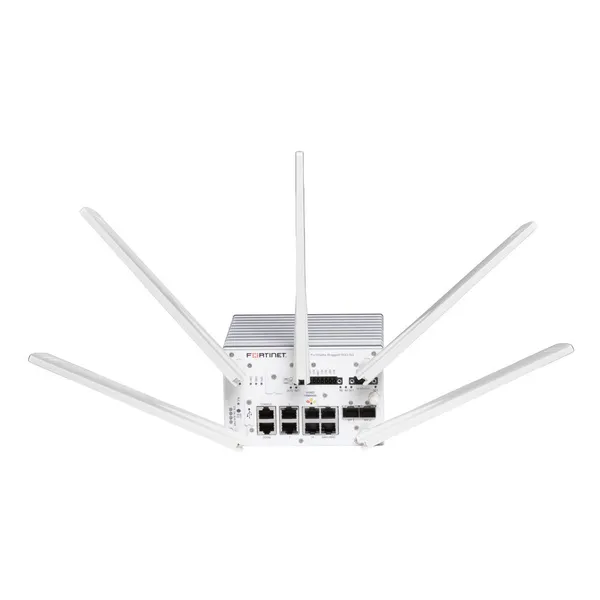
FortiGate Rugged 50G 5G (FGR-50G-5G) Tanzania
FortiGate Rugged 50G 5G is built for organizations that must extend next-generation firewall protection into industrial, utility, transport, energy, remote-site and operational technology networks where conventional office hardware may not be the right physical fit. The FGR-50G-5G combines Fortinet security and networking with integrated 5G cellular connectivity, GPS, dual SIM active/passive operation, six Gigabit Ethernet RJ45 ports, two SFP slots, digital I/O and redundant DC power inputs. For Tanzania projects, this creates a practical platform for protecting remote assets, connecting distributed facilities, building secure SD-WAN paths and adding cellular WAN resilience without treating the firewall and mobile gateway as unrelated systems.
What the FGR-50G-5G is designed to solve
Industrial networks increasingly need the same policy control, segmentation, encrypted connectivity and threat inspection expected at the enterprise edge, but their deployment conditions can be very different. Remote substations, production environments, transport systems, outdoor cabinets, utility sites and field installations may depend on DC power, cellular links and compact industrial enclosures. The FortiGate Rugged 50G-5G addresses that intersection by combining ruggedized networking with FortiGate security functions and an embedded cellular modem. Instead of adding a separate mobile router merely to obtain WAN access, a project can evaluate one security platform for wired and 5G paths, VPN, SD-WAN policy and threat controls.
Fortinet positions the Rugged Series for mission-critical industrial environments and operational technology. The FGR-50G-5G model is especially relevant where connectivity diversity matters: a wired service can remain the preferred path while cellular connectivity is designed as an alternate route, or the 5G interface can support locations where fixed connectivity is impractical. Dual SIM active/passive capability can also be considered in resilience planning, subject to compatible carrier services, signal conditions and the final network design. GPS provides location-related capability for deployments that benefit from integrated positioning data.
Verified FGR-50G-5G hardware and performance highlights
| IPS throughput | 2.25 Gbps |
| NGFW throughput | 1.25 Gbps |
| Threat protection | 1.1 Gbps |
| Copper interfaces | 6 × GE RJ45 |
| Fiber interfaces | 2 × SFP slots |
| Cellular | Single integrated 5G modem |
| SIM | Dual SIM, active/passive |
| Additional hardware | GPS and digital I/O module |
| Power input | Redundant 12V–54V DC inputs |
Performance figures are vendor-published values and should be treated as platform specifications rather than a promise of application throughput in every deployment. Real-world results depend on enabled security services, traffic mix, packet sizes, inspection settings, VPN use, cellular conditions and architecture.
Industrial security, segmentation and secure connectivity
The strongest reason to consider a rugged FortiGate is not simply that it can pass traffic in a harsh environment. The business value comes from extending a consistent security architecture closer to operational assets. A well-designed deployment can separate management traffic from industrial devices, control which systems may communicate across zones, encrypt approved site-to-site flows and create auditable policy boundaries between IT and OT networks. This is important for organizations modernizing industrial environments without assuming that every legacy controller, sensor or field device should communicate freely with enterprise or internet-facing networks.
Secure SD-WAN can be useful when a site has more than one WAN path. Network teams can define how applications use wired and cellular links and establish continuity policies around link health. The integrated 5G capability does not eliminate the need for proper RF planning: antenna placement, carrier availability, supported bands, signal strength, data plans and local service conditions should all be checked during design. Likewise, dual SIM support should be treated as an architecture option rather than a guarantee of uninterrupted service.
FortiGate Rugged 50G 5G Tanzania
Tanzania organizations considering the FGR-50G-5G are often solving a different problem from a standard office-firewall purchase. Industrial operators, utilities, logistics networks, transport projects, mining environments, energy facilities, remote depots and distributed infrastructure may need secure IP connectivity in places where conventional fixed broadband is unavailable, slow to provision or unsuitable as the only WAN path. The integrated 5G modem gives architects another connectivity option while the rugged FortiGate platform provides firewalling, segmentation, VPN and SD-WAN capabilities within the same operational design. Procurement teams should begin by defining the actual site: available DC power, expected temperatures, cabinet design, fiber or copper handoffs, cellular coverage, required security inspection and the systems that must cross the IT/OT boundary.
For Tanzanian projects, cellular compatibility should be validated before order placement. The vendor publishes broad 5G and LTE band support, but successful deployment still depends on the selected operator, local band availability, SIM provisioning, antenna system and signal quality at the specific installation point. A site survey can be more valuable than relying on a general coverage map when the firewall will sit inside a metal enclosure, industrial building or geographically isolated facility. Where fixed connectivity exists, teams can consider a design in which the wired path handles normal traffic and the 5G interface supports continuity. Where cellular is the practical primary WAN, data-plan capacity and application behavior deserve extra attention.
Security planning should also identify which industrial protocols and devices are present, whether remote vendors require controlled access, how logs will be retained, and whether centralized management is required. FortiGuard and FortiCare selections should be matched to the required protection and support scope rather than added mechanically to a quote. Buyers can also review broader Fortinet product options when a project needs switches, access points or a different FortiGate class. For Tanzania procurement, a useful quotation request should include site count, WAN types, expected bandwidth, required VPN topology, cellular role, interface needs, security-service expectations and project timescale.
FortiGate Rugged 50G 5G Dar es Salaam
Dar es Salaam deployments can range from port and logistics operations to manufacturing, warehousing, utilities, construction projects and distributed commercial infrastructure. In these environments, the FGR-50G-5G can be evaluated when a standard desktop firewall does not match the physical or connectivity requirements. The six GE RJ45 ports and two SFP slots provide useful wired interface flexibility, while integrated 5G creates an additional path for sites that need rapid connectivity, failover design or a mobile-network option. A port-side or industrial deployment should still be engineered around the actual enclosure, grounding, power design, fiber distances and upstream equipment rather than selecting a firewall from throughput alone.
For organizations linking Dar es Salaam facilities to headquarters, cloud resources or other branches, IPsec VPN and SD-WAN planning can help create consistent encrypted paths. Network teams should map which traffic is operationally critical, which flows can use cellular during a fixed-line outage, and which high-volume applications should be constrained to avoid consuming mobile data unexpectedly. Remote administration should use tightly controlled management access, named administrators and appropriate authentication. Where third-party contractors require access to industrial systems, segmentation and least-privilege policy are more important than simply opening a broad VPN route.
The purchase conversation should include FortiGuard services, FortiCare term, centralized logging or management requirements, SIM/operator strategy, antenna requirements and deployment responsibility. Buyers comparing a rugged 5G firewall with conventional branch models should focus on environment and use case. A standard FortiGate may be appropriate inside a climate-controlled office, while the rugged series is designed for industrial conditions. FourTeck’s wider FortiGate 50G-5G reference can also help teams understand the distinction between conventional compact 5G branch security and rugged industrial deployment requirements.
FortiGate Rugged 50G 5G Mwanza
Mwanza projects may include distributed industrial facilities, transport operations, warehouses, service depots, energy infrastructure and remote operational sites around the wider Lake Zone. The FGR-50G-5G is relevant when secure connectivity must extend beyond a normal office and the design benefits from integrated mobile broadband. A remote location can use 5G or LTE where compatible service is available, while wired Ethernet or SFP connectivity can connect local equipment and upstream infrastructure. The rugged platform is particularly useful when the firewall must become part of an operational cabinet or field network rather than sit on an office desk.
Planning should start with traffic flows. Identify controllers, engineering workstations, cameras, telemetry systems, local servers and management stations, then determine which flows truly need to cross security zones. Avoid treating the firewall as a simple internet router. The value of an NGFW at an industrial site comes from controlled segmentation, visibility, VPN, threat inspection and centrally defined policy. If a site relies heavily on cellular connectivity, test signal quality where antennas will actually be installed and consider how weather, building materials and terrain can affect the radio path.
Procurement teams should document the number of sites and whether every site needs the same hardware. Some projects may need rugged 5G at remote nodes but conventional enterprise FortiGate appliances at offices or data centers. Standardizing policy and management while selecting hardware by environment can produce a cleaner design than forcing one appliance type everywhere. Include expected throughput with security enabled, number of tunnels, interface media, power range, SIM strategy and support requirements in the request for quotation. This gives the supplier enough information to discuss the appliance, subscriptions and accessories as one deployable solution rather than separate line items.
FortiGate Rugged 50G 5G Arusha
Arusha organizations can use rugged secure networking for distributed operations where remote sites, tourism infrastructure, logistics, agriculture, utilities, construction or industrial facilities need controlled connectivity. The FGR-50G-5G can support a design that combines fixed and cellular WAN options while maintaining FortiGate policy enforcement. Integrated GPS and cellular functions may simplify the equipment stack at locations where space, power and maintenance access are constrained. The redundant 12V–54V DC inputs are also relevant to industrial power designs, although the complete power architecture should be validated by the project engineer.
For remote locations outside dense urban connectivity, buyers should not assume that “5G” automatically means 5G service will be present at every installation. The modem supports multiple generations and a broad range of bands, but operator service and site conditions determine the actual connection. Testing with the intended SIM and antenna arrangement is advisable. If the site carries telemetry or business-critical control traffic, define what happens when cellular bandwidth falls, latency changes or the preferred WAN becomes unavailable. SD-WAN rules can then reflect business priority rather than treating every packet equally.
Security teams should also decide how the device will be monitored. Central management and logging can reduce operational effort across many sites, but connectivity and retention requirements should be designed in advance. Industrial deployments benefit from configuration backups, documented change control, clear naming and restricted administrative access. When requesting pricing in Arusha, provide the desired FortiGuard bundle or ask for bundle guidance, state the required support term, and identify whether installation, VPN configuration, policy migration or centralized management is part of the scope. A precise requirement produces a more useful quote than asking for hardware price alone.
FortiGate Rugged 50G 5G Dodoma
Dodoma deployments can include government-related infrastructure, utilities, construction sites, transport networks, service facilities and organizations with branches spread across central Tanzania. For remote or industrial networks, the FGR-50G-5G offers a combination of rugged hardware and integrated cellular connectivity that can reduce dependence on separate security and mobile-gateway devices. The design can use Ethernet, SFP and cellular interfaces according to the site architecture, with VPN and SD-WAN supporting secure connectivity back to central systems.
A good Dodoma deployment plan separates procurement from engineering decisions without disconnecting them. Procurement needs the exact appliance, subscriptions, support period and accessories; engineering needs to verify interface count, fiber transceivers, power, cellular service, antenna placement, routing, segmentation and security policy. Both teams should agree on the role of the 5G modem. It may be a backup link, a primary WAN for a temporary site, or part of a multi-link SD-WAN design. Each use case changes data-plan requirements and failover behavior.
Industrial security should also account for maintenance. Remote assets are often difficult to visit, so configuration standards, monitoring, software lifecycle planning and controlled remote access matter. Before deployment, document recovery procedures and identify who can authorize changes. When external vendors maintain equipment, use narrowly scoped access rather than permanent broad network reach. For quotation preparation, include site location, carrier preference if known, required number of units, expected traffic, VPN topology, fiber requirements and support expectations. This helps align the FGR-50G-5G with the operational environment rather than purchasing it solely because integrated 5G appears attractive.
FortiGate Rugged 50G 5G UAE
UAE industrial projects frequently combine high-speed fixed connectivity with construction sites, logistics facilities, energy environments, utilities, transport systems and temporary operational locations that can benefit from cellular resilience. The FGR-50G-5G is suited to discussions where the firewall must operate closer to industrial assets and where 5G can be part of the WAN design. The platform’s integrated modem, dual SIM active/passive capability, GPS, copper and SFP interfaces and redundant DC inputs distinguish it from a conventional office appliance.
For UAE procurement, verify the exact environmental and compliance requirements of the project. Fortinet publishes industrial certifications for the FGR-50G-5G, including IEC 61850-3 and IEEE 1613 for electric-power-industry environments, along with rolling-stock-related standards in its current Rugged Series documentation. Project teams should map those published certifications against tender requirements instead of assuming that a rugged label alone satisfies a specification. Cellular service should likewise be tested with the intended operator and site antenna design.
FourTeck provides a dedicated Fortinet UAE resource for broader firewall and security planning. Organizations comparing this rugged model with a conventional 5G branch appliance can review the FortiGate 50G-5G UAE page. The key selection question is environment: if the firewall belongs in an industrial or OT deployment, the Rugged family should be assessed on its physical, power and compliance characteristics as well as security performance. Quote requests should include project location, quantity, support term, security subscriptions, antenna needs and implementation scope.
FortiGate Rugged 50G 5G Uganda
Uganda projects can benefit from rugged secure connectivity when sites are distributed across industrial, utility, logistics, energy, infrastructure or field environments. The FGR-50G-5G provides an integrated cellular option that can support primary or secondary WAN designs depending on local network availability. For multi-site operators, the attraction is not only mobile connectivity but the ability to apply FortiGate security and SD-WAN policies consistently across locations that may use different access technologies.
Before ordering, verify cellular coverage at each site and determine whether the project needs one or two operator SIMs. Dual SIM active/passive capability provides flexibility, but resilience still depends on carrier networks, signal conditions, data plans and antenna placement. If the same upstream failure affects both mobile services, dual SIM alone cannot remove that dependency. Where fixed fiber or microwave connectivity exists, architects can use the cellular modem as part of a broader continuity strategy.
Industrial networks should be segmented according to function and risk. Engineering workstations, controllers, cameras, guest devices and corporate systems should not automatically share unrestricted reachability. VPN connections to central offices should expose only required services. Buyers can explore related FourTeck Uganda technology resources when coordinating regional procurement. For an FGR-50G-5G quote, provide site count, required security subscriptions, expected bandwidth, WAN architecture, VPN needs, power arrangement and whether deployment support is needed. This makes it easier to determine whether the rugged model is the correct choice for every location or only the industrial edge sites.
FortiGate Rugged 50G 5G Kampala
Kampala-based organizations may manage remote branches, warehouses, utility assets, construction sites or industrial facilities across Uganda. The FGR-50G-5G can act as a secure edge for locations that need FortiGate protection and cellular connectivity in one rugged platform. At headquarters or a conventional office, a different FortiGate model may be more appropriate; at field sites, the rugged construction and DC input design can become more important than desktop convenience.
A Kampala IT team planning centralized operations should consider how configurations, logs and alerts from remote rugged firewalls will be managed. Centralized management can improve consistency, especially when dozens of sites use common segmentation and VPN templates. However, remote sites also need a recovery strategy if their primary WAN fails. Administrators should document which management paths remain available over cellular and ensure that failover does not accidentally expose administrative services to untrusted networks.
When evaluating cellular connectivity, measure signal at the intended installation and validate supported operator service. Industrial cabinets, concrete structures and remote terrain can materially change RF performance. Antenna selection and placement should therefore be part of implementation rather than an afterthought. Procurement should request the exact firewall, required FortiGuard services, FortiCare support, compatible accessories and any professional configuration work as a single scope. This helps avoid receiving hardware without the subscriptions or deployment components needed to put it into production.
FortiGate Rugged 50G 5G Arua
Arua and north-western Uganda can present connectivity requirements where remote-site design matters as much as raw firewall throughput. Organizations operating depots, field offices, infrastructure assets, utilities or distributed service locations can evaluate the FGR-50G-5G where cellular WAN and rugged hardware simplify the edge architecture. The embedded 5G modem supports a wide set of cellular bands, while dual SIM active/passive operation can support operator-diversity planning when suitable services are available.
For remote sites, bandwidth should be budgeted around actual applications. Telemetry and management traffic may be light, while video, cloud backups or software updates can consume substantial mobile data. SD-WAN and firewall policies can prioritize operational traffic and control nonessential use during failover. VPN design should similarly consider latency and bandwidth so that remote systems remain usable when traffic moves from a fixed path to cellular.
Physical deployment requires attention to power, grounding, cabling and antenna routing. Redundant DC inputs can support resilient power designs, but the upstream power sources and protection remain part of the overall project. Security teams should maintain a clear asset inventory and avoid broad rules that make industrial devices reachable from unrelated networks. A quote request for Arua should state whether 5G is primary or backup, expected data usage, required SIM arrangement, local interface requirements, VPN destinations and support term. These details help turn the product selection into a deployable architecture rather than a hardware-only purchase.
FortiGate Rugged 50G 5G Mbarara
Mbarara projects serving agriculture, logistics, utilities, manufacturing, transport or distributed commercial operations may require secure connectivity outside conventional office environments. The FGR-50G-5G can be considered where a rugged FortiGate needs to connect local Ethernet or fiber devices while using cellular connectivity as a WAN option. Its integrated approach can reduce the number of separate network appliances at a field site, but the final design should still account for antenna hardware, power protection, cabling and environmental installation.
Network segmentation is particularly valuable when operational equipment shares a site with business IT. Separate zones can limit lateral movement and make access policies easier to audit. If remote technicians need access, use authenticated VPN and narrow policies tied to the systems they maintain. Avoid exposing industrial management interfaces directly to the public internet. Where multiple WAN links are present, define SD-WAN health checks and traffic priorities around business impact rather than simply distributing traffic evenly.
For purchasing, compare the FGR-50G-5G with alternatives based on environment, performance and connectivity. A standard branch FortiGate may cost differently and fit climate-controlled spaces, while the rugged model is aimed at harsher industrial use. Request a quotation that identifies the desired service bundle, support term, quantity, accessories, implementation and any centralized management requirement. If cellular is critical, include the operator and expected site coverage information so the deployment discussion can address real connectivity conditions before installation.
FortiGate Rugged 50G 5G Gulu
Gulu organizations and projects across northern Uganda may need secure connectivity for infrastructure, utilities, logistics, remote offices and field operations. The FortiGate Rugged 50G-5G provides a compact industrial security platform with integrated 5G, giving designers an option when fixed WAN connectivity is limited or when a secondary mobile path is desirable. Six GE RJ45 ports and two SFP slots support local wired connections, while the embedded modem and dual SIM capability provide cellular flexibility.
Remote deployment should prioritize maintainability. Establish configuration templates, naming standards, backup procedures and centralized monitoring before rolling out multiple units. If a remote site loses its preferred link, administrators should know which services remain available over cellular and how the device can be reached securely. Cellular data plans should be sized for failover behavior; a site that suddenly sends backups, video or large updates over mobile can consume data far faster than expected.
Industrial firewall rules should be based on required communications between zones. Start with known assets and protocols, then permit only necessary paths. This reduces the risk of using the rugged firewall merely as an expensive router. For Gulu procurement, include environmental conditions, DC power design, fiber/copper needs, cellular role, number of SIMs, VPN topology and subscription requirements. A technically complete request makes model selection and quotation more accurate and helps identify any accessories or services needed before equipment reaches the remote site.
FortiGate Rugged 50G 5G Kenya
Kenya has diverse industrial and infrastructure environments, from urban manufacturing and logistics to remote energy, transport and field deployments. The FGR-50G-5G can support projects that need rugged security plus integrated cellular WAN. Organizations with regional operations can use a consistent FortiGate policy framework while selecting rugged appliances for harsh sites and conventional models for office environments. This approach can simplify security governance without ignoring physical deployment requirements.
Cellular planning should account for the exact operator and installation location. The modem’s broad band support is useful, but real performance depends on coverage, antenna placement, network congestion and service configuration. For remote installations, consider whether the 5G link is intended for full-time production traffic, emergency failover, out-of-band-style operational access or rapid site activation. Each role leads to different SD-WAN, routing and data-plan decisions.
Regional buyers can consult FourTeck Kenya for Kenya-focused technology procurement context. For an industrial firewall quotation, provide project city or site type, quantity, required FortiGuard and FortiCare term, cellular design, interface requirements, expected inspected throughput and deployment services. If the project includes FortiSwitch, FortiAP or centralized management, include those elements early so compatibility and licensing can be reviewed as a system. A complete bill of requirements reduces the risk of treating the rugged firewall as an isolated appliance.
FortiGate Rugged 50G 5G Kuwait
Kuwait industrial, energy, utility, logistics and infrastructure environments can require network security at sites where temperature, power architecture and connectivity differ from a standard corporate office. The FGR-50G-5G is designed for rugged industrial use and combines FortiGate security with embedded 5G connectivity. For energy or utility projects, buyers should review the vendor-published certifications and compare them directly with project specifications, especially when tenders reference standards such as IEC 61850-3 or IEEE 1613.
Cellular connectivity can be valuable for temporary facilities, backup WAN, remote operational assets or sites where fixed service takes time to provision. The integrated modem and dual SIM design provide flexibility, but the implementation should include compatible antennas, carrier validation and a tested failover policy. Where a project handles sensitive operational traffic, VPN encryption and segmentation should be designed together with the WAN architecture rather than added after connectivity is established.
Kuwait buyers can use FourTeck Kuwait for regional procurement context. A useful request for quote should identify project standards, number of units, environmental conditions, security-service term, support requirements, SIM/operator assumptions, SFP needs and whether professional deployment is required. If the project is part of a larger Fortinet environment, include central management, logging, switching and wireless requirements so the proposed architecture can be reviewed end to end.
FortiGate Rugged 50G 5G Ghana
Ghana deployments in mining, energy, logistics, utilities, manufacturing and remote infrastructure can benefit from security platforms designed for industrial conditions. The FGR-50G-5G brings next-generation firewall capability and cellular connectivity together, making it relevant for sites that need secure WAN access without relying entirely on fixed broadband. It can also form part of a regional architecture in which headquarters and data centers use larger FortiGate platforms while remote industrial edges use rugged models.
For mining or remote infrastructure, the network design should consider site-to-site VPN, segmentation between operational systems and business IT, controlled vendor access and resilient WAN. The integrated 5G modem can support cellular connectivity where compatible service exists, but signal surveys and antenna planning are essential. If cellular is used for failover, teams should determine which applications may continue over the backup link and which should pause to preserve capacity.
Regional buyers can visit FourTeck Ghana for Ghana-focused enquiries. When requesting the FGR-50G-5G, include the operational environment, site count, interface media, security subscriptions, support period, WAN strategy and implementation requirements. Buyers should also distinguish between hardware availability and a complete deployable package: FortiGuard services, FortiCare, SFP modules, antennas, power accessories and configuration work may all affect the final scope. Accurate requirements help prevent delays during commissioning.
FortiGate Rugged 50G 5G Nigeria
Nigeria has substantial demand for secure connectivity across energy, oil and gas, manufacturing, logistics, utilities, transport and distributed enterprise operations. The FGR-50G-5G can be evaluated for industrial edge sites that need FortiGate security with integrated 5G. Cellular connectivity may be used as a primary WAN in selected locations or as part of a resilience design alongside fiber, microwave or other services. The rugged platform is intended for environments where standard office appliances may not be physically appropriate.
Power and WAN resilience should be designed as separate but coordinated layers. Redundant DC inputs provide device-level power options, while the wider site still needs properly engineered power sources and protection. Dual SIM capability provides cellular flexibility, while genuine carrier diversity depends on the selected operators and infrastructure. SD-WAN policy can steer traffic according to link health, but organizations should define which business and OT applications receive priority during degraded conditions.
Nigeria-focused buyers can consult FourTeck Nigeria. For quotation accuracy, specify project location, industry, number of sites, expected bandwidth, cellular role, VPN topology, FortiGuard services, FortiCare term and any central management requirements. If the firewall will protect industrial control systems, include the required segmentation zones and remote-access workflow in the design discussion. This allows the security architecture to be aligned with operations rather than applying a generic branch-office template.
FortiGate Rugged 50G 5G Seychelles
Seychelles projects may involve hospitality infrastructure, utilities, ports, transport, remote facilities and distributed island operations where WAN diversity and compact secure networking are valuable. The FGR-50G-5G can support locations that require rugged security with cellular connectivity, especially where a second WAN path improves continuity or where fixed connectivity is difficult to provision at a remote operational point. The integrated modem reduces the need to treat mobile connectivity as a completely separate appliance layer.
Island and coastal deployments should still be engineered around the actual environment. Enclosures, power quality, cabling, antenna placement and exposure conditions need project-specific assessment. Cellular service must be verified at each intended site. If the 5G interface is used for failover, define traffic priorities so essential management and operational flows remain usable without allowing noncritical transfers to consume limited backup capacity.
Security design should separate operational equipment from guest, staff and general business networks. Hospitality or infrastructure sites can have many device classes, and broad flat networks increase operational risk. FortiGate policies, VLAN segmentation, VPN and controlled administration can help establish clearer boundaries. For a Seychelles quote, provide site type, quantity, WAN services, SIM strategy, required subscriptions, support term, SFP requirements and deployment scope. Where equipment will be shipped for a project, confirm all required accessories and licensing before dispatch to reduce commissioning delays.
Selection and deployment checklist
Confirm industrial conditions, enclosure, mounting, power, grounding and cable entry requirements.
Decide whether 5G is primary, backup or one path in an SD-WAN design.
Check operator, bands, SIM provisioning, signal and antenna placement at the actual site.
Document IT, OT, management, vendor and internet flows before writing firewall policies.
Match FortiGuard and FortiCare options to the protection, support and lifecycle needs.
Define logging, management, backups, software updates, monitoring and recovery procedures.
FortiGuard, FortiCare and lifecycle planning
A FortiGate purchase should be planned as an operational security platform, not only a hardware acquisition. FortiGuard security services provide threat-intelligence-backed capabilities according to the selected bundle, while FortiCare covers vendor support entitlements according to the purchased level and term. The right combination depends on what the organization intends to inspect and how it will support the firewall over its lifecycle. Buyers should request a quote that clearly separates appliance, subscription bundle, support term, accessories and implementation so renewal dates and responsibilities are visible from the start.
Software compatibility should also be checked during deployment and upgrade planning. Fortinet’s current documentation lists FGR-50G-5G among supported FortiGate Rugged models. Production upgrades should follow the applicable FortiOS release guidance and change-control process rather than assuming every new release should be installed immediately. For industrial sites, planned maintenance windows and tested rollback procedures are especially important because connectivity may support operational processes.
Related Fortinet planning resources
Organizations building a wider Fortinet architecture can use the Fortinet products overview to compare firewall families and related security options. Teams evaluating conventional compact cellular firewalls can review FortiGate 50G-5G, while projects needing regional coordination can use FourTeck Uganda, FourTeck Kenya, FourTeck Ghana, FourTeck Nigeria and FourTeck Kuwait. These links are useful when a deployment spans countries and procurement needs regional context.
Frequently asked questions
Does the FGR-50G-5G include a 5G modem?
Yes. Fortinet lists the FGR-50G-5G with a single integrated 5G modem and GPS. It also provides dual SIM slots operating in an active/passive arrangement.
Can 5G be used as backup WAN?
The integrated cellular interface can be incorporated into a resilient WAN or SD-WAN design. The exact failover behavior should be configured and tested for the deployment, and cellular coverage, data plans and antenna placement must be validated.
How many wired network interfaces does it have?
Fortinet lists six GE RJ45 ports and two SFP slots on the FGR-50G-5G, giving projects both copper and fiber connectivity options.
What published security performance does Fortinet specify?
The current FortiGate Rugged Series data sheet lists 2.25 Gbps IPS throughput, 1.25 Gbps NGFW throughput and 1.1 Gbps threat protection for the FGR-50G-5G. Actual deployment performance depends on configuration and traffic conditions.
Is the FGR-50G-5G intended for industrial environments?
Yes. Fortinet positions the Rugged Series for industrial and operational technology environments. The FGR-50G-5G also carries vendor-published industrial compliance information that should be checked against the exact requirements of each project.
What information should I provide for a quotation?
Provide quantity, deployment country and site, required support term, preferred FortiGuard services, WAN design, 5G role, SIM/operator assumptions, SFP needs, expected inspected bandwidth, VPN requirements and whether configuration or installation services are required.
Decision recap
Choose the FortiGate Rugged 50G 5G when the requirement combines industrial-grade deployment needs with FortiGate security and integrated cellular connectivity. Its strongest fit is a field, OT, utility, transport, energy or other rugged site where wired interfaces, 5G, dual SIM, GPS and DC power flexibility matter together. If the installation is a normal climate-controlled office, compare conventional FortiGate models before deciding. If the project needs higher throughput, more interfaces or different redundancy characteristics, size the FortiGate family against the actual traffic and architecture rather than selecting solely by model name.
Prepare your FGR-50G-5G quotation
For a useful quotation, send the number of appliances, destination, required FortiCare term, FortiGuard bundle preference, cellular use case, expected bandwidth, VPN topology, interface and SFP requirements, power environment and any installation or migration scope. FourTeck can then align the product discussion with the actual project instead of providing a hardware-only number that omits essential deployment items.




Reviews
There are no reviews yet.