
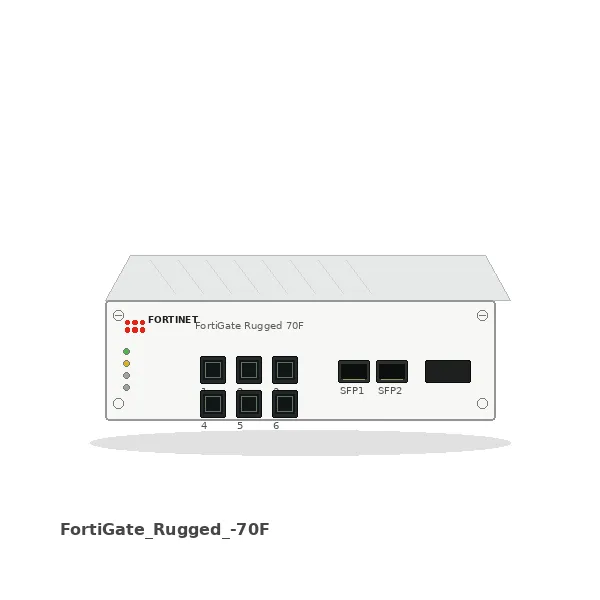
FortiGate Rugged 70F (FGR-70F) Tanzania
FortiGate Rugged 70F is an industrial next-generation firewall designed for operational technology networks and locations where ordinary office appliances may not suit the physical environment. Fortinet positions the Rugged Series for mission-critical industrial environments, combining FortiOS networking and security with a compact DIN-rail form factor, extended DC power options, industrial interfaces and security inspection. For Tanzania projects involving utilities, manufacturing, transportation, mining, energy, water, remote infrastructure, industrial control networks or exposed field cabinets, the buying decision should consider both cybersecurity requirements and the electrical, environmental and connectivity conditions at the installation point.
The FGR-70F publishes 975 Mbps IPS throughput, 950 Mbps NGFW throughput and 580 Mbps threat-protection throughput under Fortinet test conditions. It provides six GE RJ45 interfaces, two dedicated GE SFP slots, a bypass pair on ports 3 and 4, a MicroSD slot, digital I/O, console and USB connectivity, FortiSoC4 processing, an IP40 enclosure and redundant 12–125 V DC inputs. Those characteristics make it useful where security must sit closer to industrial assets, but model selection should still be based on inspected traffic, VPN load, network zones, fiber requirements, protocol flows, logging, subscriptions and future expansion rather than headline throughput alone.
What the FGR-70F is designed to solve
Industrial networks increasingly connect control systems, engineering workstations, remote sites, sensors, gateways and business applications. That connectivity improves operations but also creates paths that must be segmented and monitored. The FGR-70F can act as a security boundary between industrial zones, upstream enterprise networks, WAN links and remote connections. FortiOS provides firewall policy, routing, VPN, SD-WAN and security inspection in a common operating environment, while FortiGate Rugged hardware is designed for locations where DIN-rail mounting and wide-range redundant DC power are operationally useful.
A practical deployment begins with an OT network map. Identify controllers, HMIs, historians, engineering stations, management systems, vendor-access paths, cameras, wireless bridges and upstream enterprise services. Document which systems genuinely need to communicate. The objective is not to insert a firewall and then allow every flow; it is to establish zones and controlled conduits so required traffic remains available while unnecessary lateral movement is reduced. Where uptime is critical, the bypass pair, redundant power inputs, WAN design and change process should be evaluated as part of the availability plan.
The appliance is not a substitute for a complete OT-security program. Asset inventory, secure remote access, identity controls, configuration backups, patch governance, monitoring, physical protection and incident procedures remain important. Buyers should also confirm the exact FortiGuard and FortiCare services required for their security objectives and procurement term.
Verified FGR-70F hardware and performance highlights
| IPS throughput | 975 Mbps | NGFW throughput | 950 Mbps |
| Threat protection | 580 Mbps | Processor | FortiSoC4 |
| Copper | 6 × GE RJ45 | Fiber | 2 × dedicated GE SFP |
| Bypass | GE RJ45 ports 3 and 4 | Power | Redundant 12–125 V DC inputs |
| Form factor | DIN-rail | Ingress rating | IP40 |
Published performance values are laboratory references and should not be treated as guaranteed application throughput. Production results depend on traffic mix, packet size, encryption, enabled security profiles, policy design, firmware and other conditions. The related FGR-70F-3G4G variant adds a 3G/4G LTE modem and GPS; do not assume those cellular features are present on the base FGR-70F.
Industrial deployment and integration guidance
The FGR-70F can be positioned between industrial cells and a site network, at a remote facility edge, between OT and IT zones, or at a protected WAN boundary. The correct position depends on traffic flows and failure consequences. In brownfield environments, discovery is especially important because legacy systems may use fixed addressing, undocumented dependencies or protocols that cannot tolerate abrupt changes. Capture existing flows before enforcing restrictive policies, then introduce segmentation in controlled stages with rollback plans.
Fiber interfaces can be valuable where industrial distances, electrical isolation or existing fiber infrastructure make copper unsuitable. Confirm the correct SFP optics, fiber type, connector format and link budget before ordering. For copper, confirm cabling condition and grounding practices. The wide 12–125 V DC input range gives design flexibility, but power engineering should still confirm available supply, protection, redundancy and cabinet wiring. DIN-rail mounting simplifies integration into appropriate industrial enclosures; cabinet temperature, ventilation, clearance and ingress protection must be considered at system level rather than assuming the appliance rating protects the entire installation.
For remote access, define who needs access, from where, to which assets and for how long. Avoid broad vendor VPN access to complete control networks. Use identity, authentication, narrow policy scopes, logging and change approval appropriate to the environment. For site-to-site connectivity, document addressing and routing carefully, especially when independently built sites contain overlapping private subnets. SD-WAN can help manage multiple WAN paths, but industrial continuity planning should define how critical applications behave during path changes.
FortiGate Rugged 70F Tanzania
Organizations evaluating FortiGate Rugged 70F Tanzania are usually solving a different problem from a conventional office-firewall purchase. Industrial sites can combine control networks, remote telemetry, engineering access, fiber uplinks, utility power systems and business connectivity in locations where space, heat, dust exposure and maintenance access require deliberate planning. The FGR-70F is designed for rugged industrial use, but the complete installation still needs an enclosure, power design, cabling and operating procedure appropriate to the site. For Tanzania deployments, start by documenting the process environment, network zones, available DC power, uplink media, internet or private WAN paths, remote-support requirements and the consequence of a communications interruption.
Cybersecurity policy should follow the operational architecture. Separate industrial control assets from general office users where practical, restrict management interfaces, and define only the traffic required between zones. If a plant historian or supervisory platform must communicate with enterprise systems, specify those flows instead of permitting unrestricted OT-to-IT access. Where third-party technicians require remote access, decide whether access is permanent or approved per maintenance window and how sessions will be authenticated and logged. These questions often matter more than the number of firewall ports.
Procurement should include the exact FGR-70F model, FortiGuard service requirements, FortiCare term, SFP optics, mounting and power accessories where applicable, logging approach and implementation scope. FourTeck Tanzania’s integrated IT and security overview explains how firewall, switching, wireless, servers and infrastructure fit together, while the Tanzania technology shop provides related product options. Buyers can compare larger enterprise models such as the FortiGate 100F when the environment is conventional rather than rugged or requires a different capacity and interface profile. A complete quote should state site conditions and intended security services so hardware and subscriptions are evaluated together.
FortiGate Rugged 70F Dar es Salaam
Dar es Salaam projects can include industrial facilities, logistics operations, ports-related infrastructure, warehouses, utilities, building systems and distributed commercial sites where OT equipment must exchange data with central applications. An FGR-70F deployment should begin with a physical and logical survey: where the firewall will be mounted, what power is available, whether uplinks are copper or fiber, which VLANs or routed networks exist, and which systems must remain reachable during maintenance. If the unit is installed inside a cabinet, the cabinet environment and power protection should be assessed independently of the appliance specification.
Connectivity design is equally important. A Dar es Salaam industrial site may use a primary fiber service with another connection for resilience, private WAN connectivity, or site-to-site VPN to a head office or data center. Secure SD-WAN can help steer traffic across available paths, but failover should be tested with the actual industrial and business applications. Some sessions may not survive a public-IP change, and some control systems have strict timing expectations. Define which applications must continue, which can tolerate interruption and how operators are alerted when a path degrades.
Security zoning should separate office users, guest connectivity, surveillance, industrial controllers, engineering workstations and management interfaces according to operational need. Where existing networks are flat, introduce segmentation gradually after traffic discovery. The FGR-70F’s bypass pair can be relevant to selected architectures, but its use should be engineered around the desired failure behavior rather than enabled by default. For broader network work, FourTeck Tanzania’s technology services page describes planning and integration support, and the verified Tanzania contact page can be used to provide site, bandwidth, network and subscription requirements. A useful quotation request includes quantity, installation environment, WAN type, fiber requirements, number of zones, VPN needs, FortiGuard term and whether migration from an existing firewall is required.
FortiGate Rugged 70F Mwanza
Mwanza organizations considering the FGR-70F may be protecting remote operational facilities, manufacturing processes, utility systems, logistics locations or infrastructure that must connect securely to centralized applications. Distance from a central IT team can make supportability especially important. The firewall configuration should therefore be understandable, documented and recoverable. Use clear interface and object names, maintain encrypted configuration backups, document firmware and subscription status, and define who is authorized to change policies. Remote administration should be restricted to approved management paths rather than exposed broadly to the internet.
Network discovery is critical before a brownfield installation. Industrial devices can depend on fixed addresses, broadcast behavior or undocumented peer relationships. Capture traffic and interview operators before creating restrictive rules. Group assets into logical zones based on function and risk, then permit required flows between those zones. If cameras, access control or building systems share infrastructure with industrial devices, decide whether they belong in separate VLANs and what management systems require cross-zone access. The objective is a network that supports operations while making trust boundaries explicit.
For Mwanza procurement, fiber can be an important design element when buildings, yards or industrial areas exceed normal copper distances. The FGR-70F provides two dedicated GE SFP slots, but optics are a separate selection issue: confirm single-mode or multimode fiber, connector type, distance and compatible transceiver before ordering. Redundant 12–125 V DC inputs also need an engineered source; document the available voltage and whether independent feeds are required. When comparing the FGR-70F with conventional enterprise firewalls, use the FortiGate 101F Tanzania page to understand a rack-oriented model with local storage, while keeping in mind that it serves a different physical deployment profile. Quote requests should separate hardware, subscriptions, optics, installation and support so stakeholders understand the full lifecycle scope.
FortiGate Rugged 70F Arusha
Arusha deployments can include hospitality infrastructure, utilities, industrial facilities, transport operations, estates and remote technical sites where business and operational networks intersect. The FGR-70F is relevant when the security boundary must be installed in an industrial-style location rather than a climate-controlled rack. Begin with the environment: cabinet type, available DIN rail, DC voltage, grounding, cable entry, fiber handoff, ventilation and maintenance access. The IP40 appliance rating is one component of the design and should not be interpreted as weatherproofing for an exposed outdoor installation.
Operational segmentation can reduce the impact of compromised endpoints and accidental misconfiguration. For example, a building-management network, surveillance system, staff network and industrial-control segment do not automatically need unrestricted access to one another. Create policy around documented services and management requirements. Where a hotel, facility or industrial site depends on cloud applications and remote support, WAN resilience may be valuable, but backup connectivity should preserve the same security controls as the primary path. SD-WAN policies should reflect application priority and measured link quality rather than simple round-robin balancing.
Arusha buyers should also plan licensing and lifecycle ownership. FortiGuard security services and FortiCare support are commercial components whose exact bundle and term should be confirmed in the quotation. Decide who tracks renewals, firmware advisories, configuration backups and rule reviews. If centralized logging is required, specify retention and analysis needs before deployment. For environments needing substantially higher enterprise throughput rather than rugged mounting, the FortiGate 120G Tanzania page is a useful related reference, while the FGR-70F remains focused on rugged industrial placement. Provide FourTeck with a network diagram, expected traffic, site conditions, fiber requirements, VPN destinations and preferred subscription term to prepare a meaningful technical and commercial discussion.
FortiGate Rugged 70F Dodoma
Dodoma organizations may evaluate the FGR-70F for utilities, public infrastructure, facilities, transport systems, industrial control networks or remote technical locations that need a compact security gateway with industrial power and mounting characteristics. A successful project starts with asset and dependency mapping. Identify which systems are safety- or operations-critical, which require internet access, which communicate with central services, and which third parties require maintenance connectivity. This creates the basis for firewall zones and policies instead of beginning with an open rule set and attempting to tighten it later.
Where the site connects to a headquarters or data center, IPsec VPN can provide encrypted transport, but the VPN should not create unrestricted trust. Define the exact networks and services permitted across the tunnel. For remote users or vendors, establish identity and access procedures appropriate to the organization. Logging should capture administrative actions and relevant security events, and configuration changes should follow a documented approval and rollback process. In operational environments, availability and security must be planned together because an untested policy change can be as disruptive as a cyber incident.
Procurement in Dodoma should include electrical and optical details that are sometimes omitted from standard firewall quotations. Confirm the 12–125 V DC source, redundancy expectations, SFP modules, fiber type, cabinet and mounting conditions, and whether a MicroSD card or external logging platform is part of the design. If a conventional rack firewall is more suitable, related models such as the FortiGate 121G Tanzania can be reviewed for a different deployment class. FourTeck’s Tanzania contact workflow recommends sharing users or assets, bandwidth, VPN requirements and existing infrastructure. For an OT project, add protocol dependencies, maintenance windows, critical processes and the expected consequence of a link or firewall interruption.
FortiGate Rugged 70F UAE
UAE buyers considering the FortiGate Rugged 70F often need security at industrial sites, utilities, energy facilities, transport infrastructure, manufacturing locations or remote cabinets where a standard rack appliance is not the preferred physical format. For regional organizations operating sites in both the Gulf and Africa, a common FortiOS policy framework can simplify administration while each location retains its own electrical, environmental and WAN design. Standardize naming, logging, administrator controls and change procedures; do not assume that identical hardware automatically means identical configuration.
The FGR-70F’s six GE RJ45 ports, two dedicated GE SFP slots, bypass pair and wide-range redundant DC inputs support flexible industrial architectures. Procurement teams should still confirm exact optics, power accessories, subscription bundles and support terms. If the project requires cellular connectivity, note that the base FGR-70F is different from the FGR-70F-3G4G variant. Model names should not be treated as interchangeable, particularly when preparing multi-country bills of material.
For UAE-led projects, the FourTeck Fortinet UAE specialist site can be used for Fortinet-focused regional enquiries, while FourTeck UAE provides a broader technology procurement route. When equipment is intended for Tanzania or another destination, state the final deployment country, site type, quantity, subscription term and installation responsibility. Cross-border project governance should also identify who owns FortiGuard renewals, firmware standards, configuration backups and incident escalation. A complete design package should contain network diagrams, addressing, allowed OT-to-IT flows, VPN parameters, WAN failover expectations and acceptance tests so the field team is not forced to make security decisions during installation.
FortiGate Rugged 70F Uganda
Uganda deployments can use the FGR-70F where industrial, utility, transport, manufacturing or remote operational networks require a firewall with DIN-rail mounting and industrial power characteristics. For organizations operating across Uganda and Tanzania, the security architecture can benefit from consistent FortiOS standards, but connectivity and site conditions should be surveyed independently. A remote facility with limited bandwidth and DC power has different requirements from a city office with dual fiber links and a conventional equipment room.
Start with an asset inventory and network-flow review. Separate control systems, engineering stations, general users, cameras and management networks where practical. Determine which flows cross site boundaries and whether they are business-critical. If VPN links connect operational sites, restrict tunnel policies to required networks and services. If a backup WAN path is available, test application recovery and routing rather than assuming that link failover alone provides continuity. For remote sites, centralized monitoring and secure administration are especially useful because physical visits may take time.
FourTeck’s Uganda technology site provides a regional path for Uganda enquiries. A useful FGR-70F request should state installation city, site type, quantity, DC supply, copper and fiber interfaces, WAN links, VPN destinations, security zones, FortiGuard term and whether deployment support is required. Do not omit logging and renewal planning. If security events must be retained centrally, identify the logging platform and retention objective. If third-party vendors require access to OT assets, define the authentication, approval and session scope. These operational controls help ensure that the rugged firewall becomes part of a maintainable security architecture rather than a standalone appliance with undocumented rules.
FortiGate Rugged 70F Kampala
Kampala-based organizations may procure the FGR-70F for industrial sites located inside or outside the city, centralized monitoring projects, utilities, manufacturing operations or infrastructure networks. The purchasing team should distinguish the location of procurement from the final installation environment. A unit delivered to a city office but installed later in a remote control cabinet must be specified for the field conditions, not the office receiving location. Capture DC voltage, mounting, enclosure, temperature expectations, fiber requirements and maintenance access before finalizing the bill of material.
From a security perspective, identify the trust boundaries first. Engineering workstations may need controlled access to PLC or controller networks; historians may need data flows toward enterprise applications; vendor support may need time-limited remote connectivity. Build policies around these explicit needs. Avoid using a site-to-site VPN as a reason to allow every remote subnet into every local segment. Encryption protects traffic in transit, while firewall policy determines which communication is authorized.
Kampala operations teams should define monitoring and change ownership. Who receives security alerts? Who can approve a new firewall rule? Where are configuration backups stored? How are FortiGuard and FortiCare renewals tracked? What is the rollback plan for a firmware upgrade? These questions are particularly important when the protected environment supports production or essential services. For procurement, include SFP transceivers and fiber specifications explicitly; the FGR-70F has dedicated SFP slots but the correct optics depend on the physical link. Include test criteria for WAN failure, VPN recovery, permitted OT flows and administrative access. This turns the deployment from a hardware installation into a controlled operational-security project.
FortiGate Rugged 70F Arua
Arua projects may emphasize remote-site resilience, secure management and efficient use of limited connectivity. The FGR-70F can be considered for field infrastructure and industrial networks where DIN-rail mounting, DC power and compact rugged construction fit the physical installation. Before purchase, document how technicians reach the site, how quickly failed upstream services can be restored, and which systems must continue operating locally when WAN connectivity is unavailable. A firewall should not create an unnecessary dependency on constant cloud or headquarters connectivity for local industrial processes.
Remote administration needs careful controls. Restrict management interfaces to trusted paths, use strong administrator authentication, maintain configuration backups and log changes. If external vendors require access, define the exact destination assets and maintenance windows. For site-to-site VPN, monitor both tunnel state and the applications behind it. A tunnel can remain established while DNS, routing or the remote service has failed, so operational monitoring should reflect the service users actually depend on.
Arua procurement teams should provide the expected WAN bandwidth and media, number of security zones, fiber distances, DC power arrangement and FortiGuard requirements. Where a secondary WAN exists, define whether it is always active or reserved for failure and which traffic is allowed over a constrained backup link. SD-WAN policies can implement those choices when designed correctly. For installations with limited local IT staff, documentation is a deliverable: interface maps, IP addressing, firewall rules, VPN parameters, renewal dates and recovery steps should be recorded. This reduces reliance on individual memory and makes future troubleshooting safer. The quotation should clearly separate appliance, subscriptions, optics, implementation and any ongoing support scope.
FortiGate Rugged 70F Mbarara
Mbarara organizations can evaluate the FGR-70F for industrial processing, utilities, logistics, distributed infrastructure and remote facilities that need network segmentation and secure connectivity. A useful design starts with zones rather than individual IP addresses. Group assets by operational function and trust level, then document the services that must cross each boundary. This approach produces policies that are easier to understand and audit than a long list of exceptions created over time.
For sites that rely on cloud or centralized applications, WAN quality can directly affect operations. Secure SD-WAN can select paths according to configured health criteria, but those criteria should correspond to real application needs. Measure latency, loss or reachability to meaningful targets, and decide what happens when only a low-capacity backup link remains. Industrial traffic, voice, business transactions and software updates may need different priorities. If VPN connects Mbarara to another site, coordinate IP addressing early to avoid overlapping subnets and document the permitted routes.
Lifecycle management should be included from the first quotation. Record the FortiGate serial, site, configuration owner, FortiGuard services, FortiCare term and renewal date. Plan firmware maintenance around operational windows and test critical traffic after changes. Where a firewall is inserted into an existing industrial path, establish a rollback procedure before cutover. The FGR-70F bypass pair may be relevant to some continuity designs, but the desired behavior must be understood and tested. Procurement details should include power voltage, redundant-feed expectations, SFP optics, fiber type, MicroSD requirements, logging destination and any remote-access solution. These specifics make commercial comparisons more meaningful than hardware price alone.
FortiGate Rugged 70F Gulu
Gulu deployments may involve remote operational networks, utilities, infrastructure sites, warehouses or industrial facilities where dependable connectivity and manageable security are equally important. The FGR-70F offers a rugged platform, but configuration simplicity remains a design goal. Use descriptive objects and interfaces, minimize broad rules, remove temporary access after maintenance and document why each cross-zone flow exists. Complex policy sets can become an operational risk when local staff must troubleshoot them under time pressure.
If the site has primary and backup WAN connectivity, test failure and recovery with real applications. Some industrial or business sessions may need to reconnect after a path change. If public services or inbound remote access depend on a particular public address, failover design needs additional DNS or upstream planning. For VPN-connected sites, define tunnel monitoring, route preference and what traffic is permitted when the primary path fails. Security controls should remain consistent across backup links.
Gulu buyers should also assess physical deployment. Confirm DIN-rail space, enclosure condition, DC supply, grounding, copper cable quality and fiber optics. The appliance’s IP40 rating does not make an exposed installation suitable for rain or uncontrolled outdoor conditions; the complete enclosure must match the environment. For centralized operations, decide how logs and alerts reach the monitoring team when bandwidth is constrained. A quotation request should state whether the FGR-70F is a new installation, a replacement or part of a multi-site standard. Include current firewall details, existing subnets, required VPNs, expected inspected traffic, FortiGuard term and implementation scope so migration risk can be evaluated before the change window.
FortiGate Rugged 70F Kenya
Kenyan organizations may consider the FGR-70F for manufacturing, energy, utilities, transport, agriculture, mining-related operations or distributed infrastructure where industrial mounting and DC power flexibility are important. For groups operating in both Kenya and Tanzania, common security templates can simplify administration, but templates should not hide site-specific requirements. Each location needs its own asset inventory, network flows, WAN characteristics, fiber design and operational constraints.
The published 975 Mbps IPS, 950 Mbps NGFW and 580 Mbps threat-protection figures are useful sizing references, but production design should allow headroom and account for encrypted traffic, VPN, enabled security services and growth. Industrial networks may have modest bandwidth yet very high availability requirements, so throughput is not the only criterion. Port count, bypass requirements, fiber connectivity, DC power, physical environment and recovery procedures can be equally important. Where logging or centralized management is required, include the network path and retention strategy in the architecture.
The FourTeck Kenya site provides a regional route for Kenya technology enquiries. For cross-border projects, maintain a device register with site, serial, subscription, configuration owner and renewal dates. Coordinate addressing so VPN-connected sites do not overlap. Define a minimum policy baseline for administrative access, segmentation and backups while allowing each location to use the WAN services available locally. Procurement should specify exact FGR-70F model, quantity, destination, FortiGuard term, FortiCare support, SFP modules and implementation responsibility. Current price and availability should be confirmed at quotation time rather than inferred from unrelated online listings.
FortiGate Rugged 70F Kuwait
Kuwait industrial and infrastructure projects can use the FGR-70F where a compact DIN-rail firewall must operate within an OT or field-network architecture. Energy, utilities, facilities, transport and industrial systems often require segmentation between control networks, engineering access and enterprise services. The firewall policy should reflect documented process flows and maintenance requirements. Where systems are sensitive to latency or interruption, introduce security controls with staged testing rather than making large rule changes during a single cutover.
Wide-range redundant DC inputs can fit industrial power architectures, but electrical design remains the responsibility of the complete installation. Confirm available voltage, independent feeds, protection and grounding. Similarly, SFP slots provide fiber flexibility but require correct transceivers for the actual fiber plant. Where equipment is installed in harsh areas, use an enclosure appropriate to environmental exposure; IP40 should not be confused with an outdoor weather rating.
For organizations connecting Kuwait with UAE or African sites, VPN and centralized policy standards can create consistent security operations. Avoid overlapping private address ranges, define route ownership and restrict inter-site traffic to business requirements. FourTeck’s Kuwait technology site can be used for Kuwait-focused enquiries. A complete FGR-70F request should state final installation environment, quantity, network zones, WAN links, fiber requirements, remote-access model, FortiGuard term and logging needs. If the project is part of a larger Fortinet estate, include management and renewal standards so the new rugged firewall can be incorporated into the existing operational process without becoming an isolated configuration.
FortiGate Rugged 70F Ghana
Ghana deployments can use the FGR-70F to protect industrial networks, utilities, remote facilities, transport systems and operational infrastructure where conventional office-firewall form factors are not ideal. The design process should connect cybersecurity to process availability. Identify critical assets and communication paths, then decide where segmentation creates meaningful risk reduction without interrupting required operations. A network diagram that includes switches, controllers, HMIs, engineering stations, WAN devices and management systems is a useful starting point.
For multi-ISP or private-WAN sites, secure SD-WAN can support path selection, while IPsec VPN can protect approved site-to-site traffic. Neither feature replaces application testing. Define how control and monitoring systems respond when a link changes, how routes reconverge and whether remote sessions need to reconnect. Where bandwidth is limited, prioritize essential operational traffic and schedule large updates or backups appropriately. Security inspection should be aligned with the risk and behavior of each traffic class.
FourTeck’s Ghana regional site can support Ghana-focused project discussions. Buyers should request the exact FGR-70F rather than the cellular FGR-70F-3G4G unless cellular connectivity is specifically required. Confirm FortiGuard services, FortiCare, optics, power and deployment scope. For remote industrial sites, documentation and spares strategy deserve attention because travel time can affect recovery. Maintain configuration backups, record cable and interface assignments, and document a safe replacement procedure. A current quotation should distinguish hardware from time-based subscriptions and implementation so procurement can compare equivalent solutions.
FortiGate Rugged 70F Nigeria
Nigeria has a wide range of industrial, energy, manufacturing, transport and distributed infrastructure environments where rugged network security may be relevant. The FGR-70F can provide segmentation, VPN, routing, SD-WAN and threat inspection in a DIN-rail platform with redundant wide-range DC inputs. Model suitability should be assessed against both cyber requirements and site engineering. A high-bandwidth office edge may be better served by a different FortiGate class, while an industrial cabinet with fiber links and OT zones may benefit from the rugged form factor even when traffic volume is lower.
Power and connectivity resilience should be designed as systems. Redundant firewall inputs do not create resilience if both feeds originate from the same unprotected source, and dual WAN does not guarantee application continuity if routing, DNS or public addressing is not prepared for failure. Document dependencies from field devices through switches, firewall, WAN equipment and upstream services. Test realistic failure scenarios and record expected operator actions.
For Nigeria-focused enquiries, FourTeck Nigeria provides a regional entry point. Procurement should include exact model, quantity, destination, power conditions, fiber optics, security zones, expected throughput, VPN requirements and subscription term. Where a centralized security team manages several sites, establish standard naming, admin roles, logging and change control. Where local teams manage operations, keep policies understandable and document recovery procedures. If the deployment replaces an existing firewall, inventory NAT, VPN, routes, address objects and allowed industrial flows before migration. This discovery work reduces the chance that an undocumented dependency appears only after cutover.
FortiGate Rugged 70F Seychelles
Seychelles organizations may consider the FGR-70F for utilities, facilities, transport infrastructure, remote technical sites or operational networks where secure remote administration and dependable connectivity are important. Island and distributed environments can make site visits comparatively expensive, so configuration quality, monitoring and documentation deserve emphasis. A remote firewall should have controlled administrative access, reliable configuration backups, clear interface labeling and a known recovery process.
If multiple WAN services are available, SD-WAN can help apply path policies, but application behavior during failover must be tested. Guest or general business traffic can be treated differently from operational monitoring and control traffic. VPN can protect connections to centralized systems, while firewall policies should limit which networks can communicate. For vendor maintenance, use narrowly scoped access and record who is responsible for enabling and disabling it.
Physical planning should confirm the DIN-rail enclosure, DC power, ventilation, fiber and copper cabling, grounding and maintenance clearance. For sites exposed to salt, humidity or outdoor conditions, the system enclosure and installation method must provide the environmental protection required; the appliance’s IP40 rating alone should not be treated as sufficient protection for exposed placement. Procurement should include the FortiGuard and FortiCare term, SFP optics, logging strategy and any spare or replacement planning appropriate to the site. When requesting a quotation, state the final installation island or location, expected network zones, WAN connectivity, remote-access needs and whether configuration or migration assistance is required. A well-defined scope helps ensure the FGR-70F is selected for the actual operational environment rather than only for its rugged product label.
Related Tanzania FortiGate and infrastructure options
The rugged model should be compared with other FortiGate classes only after the physical environment and security role are clear. The FortiGate 100F and FortiGate 101F are useful references for conventional enterprise-edge designs. Newer higher-capacity choices include FortiGate 120G, FortiGate 121G, FortiGate 200F, FortiGate 200G and FortiGate 201F. These internal references help buyers compare deployment classes and capacities without assuming that a rack firewall is a direct substitute for an industrial rugged model.
The surrounding network matters as much as the firewall. FourTeck Tanzania’s main site covers managed switching, Wi-Fi, servers, racks, UPS and structured cabling that may form part of the protected architecture. For an OT project, request a combined review when the firewall depends on new fiber, managed switches, VLAN design or power protection. This reduces the risk of ordering a security appliance before discovering that the supporting network cannot implement the intended zones.
FortiGuard licensing, support and lifecycle planning
Hardware selection and security-service selection are connected but distinct decisions. FortiGate capabilities can be extended with FortiGuard security services and FortiCare support according to the purchased bundle or service. Ask for the exact subscription SKU, term and support level in every quotation. Do not compare one hardware-only quote with another quote that includes multi-year security services as though the scope were identical.
Industrial environments benefit from disciplined lifecycle records. Maintain a register containing serial number, site, firmware, configuration owner, FortiGuard services, FortiCare term, renewal date, optics and power details. Plan firmware updates around operational maintenance windows, review release guidance, back up configuration before change and test critical traffic afterward. Where continuous production is important, document rollback criteria before starting maintenance.
FGR-70F quotation checklist
✓ Site type and environmental conditions
✓ Available DC voltage and redundancy
✓ Copper and fiber interface requirements
✓ SFP type and fiber distance
✓ OT/IT zones and critical traffic flows
✓ Site-to-site and remote-access VPN
✓ WAN failover or SD-WAN requirements
✓ FortiGuard and FortiCare term
✓ Existing firewall and migration scope
✓ Maintenance/change window
✓ Configuration and testing scope
✓ Documentation and support requirements
FortiGate Rugged 70F FAQ
What is the FortiGate Rugged 70F?
The FGR-70F is a Fortinet FortiGate Rugged next-generation firewall designed for industrial and operational-technology environments. It uses a DIN-rail form factor, provides redundant wide-range DC power inputs, copper and SFP interfaces, a bypass pair and FortiOS networking and security capabilities.
What are the published FGR-70F security performance figures?
Fortinet publishes 975 Mbps IPS throughput, 950 Mbps NGFW throughput and 580 Mbps threat-protection throughput for the FGR-70F under its stated test methodology. Real deployment performance varies with traffic and enabled functions.
Does the base FGR-70F include cellular connectivity?
No. Fortinet lists a separate FGR-70F-3G4G variant with 3G/4G LTE and GPS. Confirm the exact model when cellular connectivity is required.
Can the FGR-70F connect industrial sites by VPN?
FortiOS supports IPsec VPN use cases. The project should define addressing, routes, authentication, permitted networks, failover behavior and monitoring. Encryption should be combined with access-control policies rather than creating unrestricted trust between sites.
What should I provide for a Tanzania quotation?
Provide quantity, site location, installation environment, DC power, copper and fiber needs, WAN links, bandwidth, OT/IT zones, VPN requirements, FortiGuard term, logging needs and whether configuration, migration or testing is required.
Decision recap and consultation
FortiGate Rugged 70F is most compelling when the firewall must combine FortiOS security with industrial mounting, wide-range redundant DC power and rugged deployment characteristics. The correct decision depends on the physical site, traffic under inspection, fiber and copper interfaces, segmentation, VPN, WAN resilience, subscriptions, logging and operational maintenance model. For conventional climate-controlled enterprise racks, compare other FortiGate families rather than choosing rugged hardware automatically.
For a FourTeck Tanzania consultation, share a network diagram or a simple description of the site, current firewall, WAN links, industrial assets, required zones, fiber distances, power source, remote-access requirements and preferred subscription term. This information allows the discussion to focus on fit, dependencies and implementation scope instead of only the appliance name.



Reviews
There are no reviews yet.