
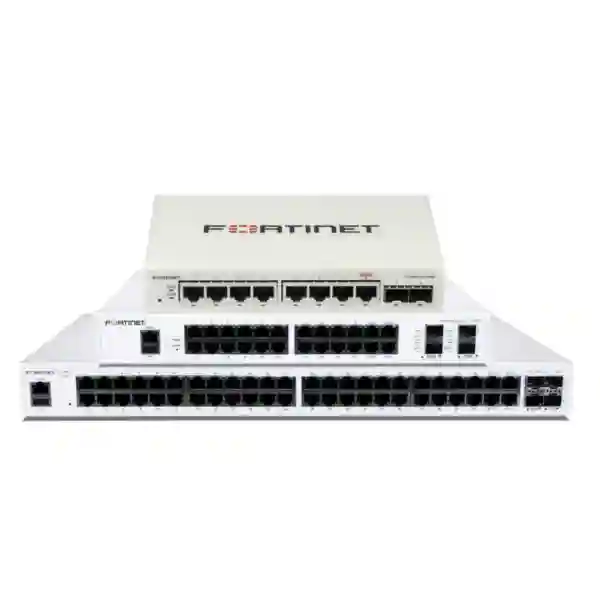
FORTINET SECURE ETHERNET SWITCHING
FortiSwitch 1000 Series Tanzania
FortiSwitch 1000 Series addresses high-capacity enterprise switching requirements where 10 Gigabit Ethernet connectivity, fast aggregation, resilient power and centralized network operations matter. Fortinet positions its 1000, 2000 and 3000 families for campus core and data-center use. Current 1000 Series choices include FS-1024E, FS-T1024E, FS-1048E and FS-1048G, but port media and uplink arrangements differ by model, so selection should begin with the actual topology rather than a generic series label.
What is FortiSwitch 1000 Series?
FortiSwitch 1000 Series is a family of high-speed Fortinet Ethernet switches intended for demanding enterprise environments. Fortinet’s current product matrix identifies the 1000 Series with 10 Gbps main-port speed, 24- or 48-port options at the family level, and 40 or 100 Gbps uplink capability depending on model. Redundant power supplies are part of the family positioning. Fortinet’s current Ethernet-switch portfolio lists FS-1024E with 24 10GE SFP/SFP+ slots and two 100GE QSFP28 interfaces; FS-T1024E with 24 copper ports capable of GE, multigigabit and 10GE plus two 100GE QSFP28 interfaces; FS-1048E with 48 GE/10GE SFP/SFP+ slots and high-speed QSFP uplinks; and FS-1048G with 48 10GE SFP/SFP+ slots and six 100GE QSFP28 uplink slots. These differences make model-level validation essential before ordering optics, cabling or rack infrastructure.
FortiSwitch can operate in standalone mode and Fortinet also documents management through a FortiGate, FortiEdge Cloud or FortiSwitch Manager. For organizations already standardizing on Fortinet security, FortiLink-managed switching can bring switch configuration into the FortiGate operational model. A procurement decision should still account for FortiOS and FortiSwitchOS compatibility, desired topology, required advanced features, transceivers, support coverage and the exact number and type of interfaces needed.
Verified 1000 Series model choices
FS-1024E
A fiber-oriented option with 24 10GE SFP/SFP+ slots and two 100GE QSFP28 interfaces. It can suit aggregation or core designs where SFP-based connectivity and high-speed upstream links are central requirements.
FS-T1024E
Provides 24 fixed copper interfaces capable of GE, multigigabit and 10GE connectivity, plus two 100GE QSFP28 interfaces. It is relevant when high-speed copper connectivity is preferred for selected servers or endpoints.
FS-1048E
Offers 48 GE/10GE SFP/SFP+ slots with QSFP-based uplink options. This port density can be useful for larger aggregation designs that require many fiber-facing connections.
FS-1048G
Fortinet lists 48 10GE SFP/SFP+ slots and six 100GE QSFP28 uplink slots, making it a current high-density 10GbE option for demanding core and aggregation architectures.
Planning the architecture before requesting a quote
Start with a port map. Separate server, access-switch, firewall, storage and inter-building links, then record media type, speed and redundancy expectations. A 10GbE switch is not automatically the right answer merely because the network is large. Traffic flows matter: east-west server traffic, north-south internet traffic, backup windows, CCTV streams, wireless aggregation and inter-VLAN routing can create very different loads. Documenting these flows makes it easier to decide whether 24 or 48 main ports are required and whether 40GbE or 100GbE uplinks are justified.
Transceivers and fiber deserve equal attention. SFP+, QSFP+ and QSFP28 interfaces require compatible optics or direct-attach solutions appropriate to distance and fiber type. Existing multimode or single-mode cabling, connector presentation, patch-panel design and cross-connect distance should be checked before the bill of materials is finalized. Power redundancy, rack depth, airflow, cooling and UPS capacity should also be reviewed. For FortiGate-managed designs, validate FortiOS and FortiSwitchOS compatibility for the chosen models and software release before deployment.
Related FourTeck resources
For the wider LAN design, review FourTeck Tanzania networking and infrastructure guidance, which connects switching with firewalls, Wi-Fi, servers, racks and cabling. Regional teams can also reference FourTeck Kenya enterprise networking and FourTeck Uganda IT and networking solutions for multi-country projects. For UAE-based requirements, FourTeck UAE provides the broader regional technology context. These resources are useful when a common switching and security standard needs to be coordinated across offices in several markets.
FortiSwitch 1000 Series Tanzania
For organizations evaluating FortiSwitch 1000 Series in Tanzania, the strongest use case is typically a network that has moved beyond ordinary 1GbE access switching and now needs a faster aggregation or core layer. That may include a headquarters consolidating multiple floor switches, a data room carrying server and storage traffic, a campus joining buildings over fiber, or a business standardizing secure networking around FortiGate. The planning process should begin with a physical and logical topology rather than with a quantity of switches. Identify existing access switches, firewall interfaces, server NIC speeds, fiber routes, internet capacity, VLANs and expected growth. This exposes where 10GbE main ports and 100GbE uplinks can solve a real bottleneck and where a lower-speed switch may remain adequate.
Tanzania projects can also involve varied site conditions. A central office may have a clean rack and structured fiber, while a secondary building may need new backbone cabling before a high-speed core can deliver value. Power protection and cooling should be included in the design because core switches are infrastructure devices whose failure can affect many users at once. If redundant power is being used, the upstream electrical design should avoid placing both supplies on the same unprotected source. The network team should also decide how configurations will be managed, backed up and monitored.
For procurement, specify the exact FortiSwitch model, interface count, required optics, cable types, management approach and support requirement. If FortiLink is planned, include the FortiGate model and software release in the compatibility review. If standalone or FortiEdge Cloud management is preferred, document that at quotation stage. A complete request should also state rack location, fiber distances and whether migration must occur without extended downtime. This gives FourTeck Tanzania enough context to discuss a bill of materials instead of treating the request as an isolated switch purchase.
FortiSwitch 1000 Series Dar es Salaam
A Dar es Salaam deployment may serve a corporate headquarters, hospitality property, financial office, logistics operation, data room or multi-floor commercial site where many network segments converge. In such environments, the core switch has to be considered alongside internet edge security, server connectivity, wireless aggregation, surveillance traffic and branch links. The FortiSwitch 1000 Series can be evaluated where 10GbE density and high-speed uplinks align with those traffic requirements. A useful first step is to map each floor or department back to the core and record current uplink utilization. This avoids upgrading merely because a faster model is available.
Fiber planning is especially important when the switch aggregates remote racks or separate buildings. Confirm whether existing runs are multimode or single-mode, their approximate distance, connector type and available strands. The selected transceiver must match both the FortiSwitch interface and the installed fiber. If servers use copper 10GbE rather than optical interfaces, the FS-T1024E may be relevant, while fiber-heavy aggregation may point toward other 1000 Series models. That is an architectural choice, not a universal recommendation.
Dar es Salaam buyers should prepare a quotation request with switch quantity, current core design, target link speeds, redundancy objectives, FortiGate model if present, and a list of optics. Include any planned growth such as additional access switches, Wi-Fi expansion, virtualization hosts or camera networks. Maintenance windows also matter: replacing a core switch can interrupt multiple services simultaneously, so configuration staging, cable labeling, rollback planning and post-change testing should be part of the project scope. The FourTeck Tanzania contact page can be used to start this discussion with a complete requirement.
FortiSwitch 1000 Series Mwanza
Organizations in Mwanza considering FortiSwitch 1000 Series may be planning a larger office network, an education campus, healthcare environment, hospitality site, distribution operation or an expanding multi-building LAN. The decision should focus on concentration points where many access links converge. If a site has dozens of ordinary endpoints but only a few 1GbE access switches, a 1000 Series core may offer more capacity than necessary. If multiple high-speed access switches, servers, wireless systems and fiber links converge in one rack, the family becomes more relevant.
Network resilience should be designed around the business impact of a core outage. Redundant power capability is valuable only when power feeds and UPS design are arranged sensibly. Link redundancy can use appropriate switching architecture and aggregation methods, but loops and spanning-tree behavior must be planned deliberately. Where two core switches are used, the topology should define how gateways, uplinks and downstream switches behave during maintenance or failure. The exact design depends on the chosen models and software features.
For Mwanza procurement, include environmental details such as rack condition, cooling, available UPS capacity and fiber paths. High-speed optics can represent a meaningful portion of project cost, so a quote that lists only the switch chassis is incomplete. Document each intended connection, speed and distance, then match the optic accordingly. If FortiGate integration is part of the plan, provide the firewall model and current FortiOS version so compatibility can be checked. This preparation supports a cleaner deployment and reduces the chance of discovering missing transceivers or unsuitable cabling during installation.
FortiSwitch 1000 Series Arusha
Arusha businesses evaluating FortiSwitch 1000 Series may include hotels, tour operators, corporate offices, institutions and organizations with multiple operational areas. A high-speed core can be useful where guest or staff Wi-Fi, CCTV, business systems, voice, servers and internet services all traverse shared network infrastructure. Those workloads should remain logically separated even when they use the same physical switching platform. VLAN design, firewall policy and routing placement therefore matter as much as raw port speed.
A practical Arusha design exercise starts by separating access and core functions. User devices and many PoE endpoints normally connect at the access layer, while the core concentrates uplinks and routes or transports traffic toward security and server resources. FortiSwitch 1000 Series is generally a high-capacity part of that hierarchy rather than a simple desktop-access replacement. Where Wi-Fi access points are being upgraded, check whether access switches and their uplinks can carry the resulting traffic before assuming the core alone needs replacement.
Quotation preparation should include a port schedule, required link speeds, fiber distances, transceiver types, FortiGate details and desired management model. If the network supports hospitality or other operations that cannot tolerate long outages, include a migration sequence and test plan. Label existing fiber before cutover and retain configuration backups. Where old and new infrastructure will coexist temporarily, define spanning tree, VLAN trunking and gateway behavior carefully. FourTeck Tanzania can use these inputs to discuss product selection and integration without making unsupported assumptions about the site.
FortiSwitch 1000 Series Dodoma
In Dodoma, FortiSwitch 1000 Series can be considered for larger administrative, institutional and enterprise networks that require a high-speed aggregation or core layer. A core switch purchase should be tied to measured or expected demand: number of downstream switches, server traffic, wireless density, inter-building links, backup flows and the firewall or WAN edge capacity. If the existing design has bottlenecks on 1GbE uplinks, moving key aggregation paths to 10GbE can materially change network headroom, while 100GbE uplinks may support higher-capacity inter-switch or upstream designs where justified.
The project should also establish operational ownership. Decide who will maintain VLANs, switch firmware, configuration backups, monitoring and change records. Fortinet supports several management approaches for FortiSwitch, including standalone administration, FortiGate management, FortiEdge Cloud and FortiSwitch Manager. The chosen method should fit the organization’s skills and security architecture. FortiLink can be attractive when FortiGate is already central to network policy, but software compatibility must be checked before deployment.
For a Dodoma quotation, list exact port and media requirements rather than requesting a generic “48-port core switch.” The FS-1048E and FS-1048G, for example, have different published uplink arrangements even though both are 48-port members of the family. Specify whether links are SFP+, QSFP+ or QSFP28, required distances and fiber types. Include rack and power information and whether dual power supplies will connect to independent protected circuits. A detailed scope produces a more useful procurement discussion and makes implementation planning more predictable.
FortiSwitch 1000 Series UAE
For UAE projects, FortiSwitch 1000 Series may be evaluated for enterprise headquarters, campuses, hospitality environments and data-center-adjacent networks where 10GbE aggregation and high-speed uplinks are required. Organizations with operations in both the UAE and Tanzania can benefit from using a common design vocabulary: consistent VLAN naming, uplink standards, management practices, configuration templates and documentation. Standardization does not require every office to use the same model; it means each site follows the same architecture principles while hardware is sized to local demand.
Procurement teams should separate chassis requirements from optics and support. Confirm whether links are copper or fiber, distances between racks, required transceiver form factors, redundancy and the target FortiSwitchOS release. If a FortiGate manages the switch fabric, record firewall models and FortiOS versions at every site. This is particularly useful in multi-country environments where one central IT team may be responsible for changes and troubleshooting.
The UAE design may also be a reference architecture for regional offices, but it should not be copied without checking scale. A large UAE headquarters may justify 48 10GbE ports and multiple 100GbE uplinks while a smaller branch may need a different FortiSwitch family. Use traffic demand, endpoint counts and resilience requirements to select hardware. For UAE-specific technology discussions, FourTeck UAE can complement the Tanzania project conversation while maintaining a common regional standard.
FortiSwitch 1000 Series Uganda
Uganda organizations planning enterprise network upgrades can assess FortiSwitch 1000 Series when their access layer, server environment or inter-building fiber has outgrown lower-speed aggregation. The series should be viewed as part of a complete switching hierarchy. Downstream access switches may continue to provide 1GbE or multigigabit endpoint connectivity, while the 1000 Series concentrates faster uplinks toward servers, security appliances and other core infrastructure.
A multi-site organization spanning Uganda and Tanzania should document common standards before buying hardware. Define VLAN ranges, naming conventions, switch management, logging, firmware governance and how FortiGate policies interact with campus switching. A common template makes remote support easier, but each site still needs its own port and capacity plan. Fiber distance, rack conditions and power resilience can vary significantly from one location to another.
For procurement, request the exact FortiSwitch model and list every required optic. State whether management will be standalone, FortiGate-based, cloud-based or through FortiSwitch Manager. Include the current firewall and software versions when FortiLink is planned. For regional project coordination, FourTeck Uganda provides an additional point of reference for networking requirements while the Tanzania team can address the Tanzania-side architecture. This is useful for businesses seeking repeatable network standards across East African branches.
FortiSwitch 1000 Series Kampala
Kampala enterprises may require a high-speed core when several floors, departments, server racks or branch connections converge at headquarters. FortiSwitch 1000 Series provides models with 10GbE-oriented interfaces and high-speed uplinks, but the correct model depends on media. Fiber aggregation commonly favors SFP-based designs, while selected copper 10GbE server connections can make a copper-capable model relevant. Count actual ports and include spare capacity for growth instead of choosing solely by the largest available port count.
Core upgrades are also an opportunity to clean up network design. Review old VLANs, undocumented trunks, unused ports, inconsistent link aggregation and single points of failure. Map dependencies before migration so critical services such as internet access, identity systems, VoIP, CCTV and application servers are tested after cutover. If the network uses FortiGate, decide whether FortiLink management will simplify operations and verify supported software combinations.
A Kampala quote should include switch model, quantity, optics, cables, rack accessories if needed, power design and support requirements. For a two-switch resilient core, document inter-switch connectivity and downstream redundancy rather than simply doubling the hardware list. Organizations coordinating Kampala and Tanzania sites can also align configuration standards and documentation so operational teams do not have to learn a completely different topology in each country.
FortiSwitch 1000 Series Arua
Arua deployments should begin with a realistic assessment of scale and operational criticality. FortiSwitch 1000 Series is intended for higher-capacity switching roles, so it is most appropriate where multiple fast links converge or where the organization expects significant growth. A smaller site with ordinary desktop traffic may be better served by another FortiSwitch family, while a regional hub, campus or infrastructure concentration point may justify a 1000 Series core.
Site readiness is especially important for core equipment. Check rack space, ventilation, UPS runtime, grounding practices and fiber termination quality. If redundant power supplies are part of the chosen model, connect them according to a resilient electrical plan rather than to one shared extension. For fiber, document the exact path and distance so transceivers are selected correctly. These infrastructure details often determine whether a technically capable switch performs reliably in daily operation.
Remote manageability should also influence the design. Centralized monitoring and consistent configuration can reduce the need for emergency travel when a site is distant from the main IT team. Fortinet documents FortiGate, FortiEdge Cloud and FortiSwitch Manager options in addition to standalone operation. The organization should choose the management model that fits its architecture and licensing plan. A quotation request should therefore include not only hardware but also management, support, optics and implementation expectations.
FortiSwitch 1000 Series Mbarara
For Mbarara organizations, a FortiSwitch 1000 Series project may be driven by campus expansion, server consolidation, faster wireless networks or the need to aggregate several access switches. Before selecting a model, measure current uplink utilization and identify peak traffic periods. Backup jobs, software distribution, surveillance recording and large file transfers can create short high-load windows that average statistics hide. Capacity planning should account for those peaks and for expected growth.
The physical network deserves equal attention. High-speed switch interfaces depend on the right optics, fiber and patching. Existing cabling should be inspected and documented rather than assumed compatible. If the project connects separate buildings, consider route distance and available fiber strands. Inside the rack, use clear labeling and cable management so high-density SFP connections remain serviceable. Core infrastructure should be easy to troubleshoot without tracing unmarked fibers during an outage.
Management and security policies should be decided before migration. Define administrator access, configuration backup, firmware procedure, monitoring and change control. If FortiGate integration is selected, confirm compatibility and design FortiLink connectivity as part of the topology. A complete Mbarara procurement request can then specify model, optics, software approach and implementation scope, giving stakeholders a clearer picture of the total solution rather than only the switch price.
FortiSwitch 1000 Series Gulu
Gulu businesses and institutions evaluating FortiSwitch 1000 Series should first determine whether the site functions as an access location or as a regional aggregation point. The 1000 Series is most compelling when multiple high-speed links must converge. That can include server networks, building backbones, large wireless deployments or a hub that carries traffic for several departments. Where endpoint demand is modest, a smaller switching platform may be more economical and operationally simpler.
If the 1000 Series fits the requirement, design for maintainability. Keep an accurate port map, label both ends of every fiber, record transceiver part numbers and maintain configuration backups. Core changes should follow a maintenance procedure because one error can affect many downstream users. Redundancy should be tested rather than assumed: verify how links reconverge, how gateways remain reachable and how management access behaves after a component failure.
For Gulu projects managed from another city or country, remote visibility becomes particularly valuable. Fortinet’s management options can support centralized operations, but licensing and platform choice should be reviewed during design. Procurement should include support expectations, spare strategy where appropriate and the operational owner responsible for updates. These considerations make the network easier to sustain after the initial installation and help a regional IT team apply consistent practices across Uganda and Tanzania.
FortiSwitch 1000 Series Kenya
Kenya enterprises with high-capacity campus or data-center-oriented requirements can evaluate FortiSwitch 1000 Series as an aggregation or core component. The family’s 10GbE main-port positioning and 40/100GbE uplink options can support architectures where many downstream networks converge. Model selection should reflect whether the environment uses copper 10GbE, SFP-based fiber links, 24 or 48 main ports, and how many high-speed uplinks are required.
For organizations operating in both Kenya and Tanzania, network standardization can reduce operational friction. Use common naming, VLAN design principles, monitoring and firmware processes while allowing hardware capacity to differ by site. A Nairobi headquarters, for example, may have more servers and access switches than a Tanzania branch, so copying the same chassis everywhere can waste budget. Standardize architecture and management rather than forcing identical port counts.
The bill of materials should include transceivers, fiber patch cords, rack considerations and any required licenses or support. If FortiEdge Cloud or FortiSwitch Manager is part of the design, confirm the applicable licensing. If FortiGate management is used, document FortiOS and FortiSwitchOS versions. FourTeck Kenya can support regional coordination alongside FourTeck Tanzania, helping procurement and IT teams discuss a consistent approach across East African operations.
FortiSwitch 1000 Series Kuwait
Kuwait organizations considering FortiSwitch 1000 Series may be modernizing a corporate core, server aggregation layer or campus backbone. The key design question is where high-speed traffic concentrates. Count downstream switch uplinks, server connections and security-appliance interfaces, then model expected traffic and redundancy. This establishes whether a 24-port or 48-port member of the family is appropriate and how many 100GbE uplinks are genuinely needed.
Data-room conditions and operational practices should be reviewed with the hardware. Ensure adequate rack depth, airflow and protected power. Redundant power is valuable when it connects to appropriately independent sources. For fiber-heavy designs, verify optic compatibility and cable type before ordering. A mismatch between transceiver, wavelength, fiber type or distance can delay an otherwise straightforward deployment.
Multi-region organizations can align Kuwait and Tanzania sites through common configuration templates and documentation. The local hardware can still differ based on demand. Procurement teams should request an itemized quotation showing switch model, optics, management requirements and support rather than comparing chassis price alone. This makes competing proposals easier to evaluate and helps expose missing components before the purchase order is issued.
FortiSwitch 1000 Series Ghana
Ghana enterprise networks can consider FortiSwitch 1000 Series when high-speed aggregation is required between access switching, servers, firewalls or building backbones. A proper design should identify traffic classes and critical services. Voice and business applications may need predictable latency, backups can consume large bursts of bandwidth, CCTV can create continuous streams and wireless networks can aggregate traffic from many clients. Understanding these patterns helps determine where faster links produce practical value.
The migration plan should include existing VLANs, routing, spanning-tree behavior, link aggregation and management addressing. If replacing an older core, document every current connection before disconnecting it. High-density fiber switches can look simple on a diagram but become difficult to troubleshoot when patching is poorly labeled. Clear documentation is part of resilience because it shortens fault isolation and future expansion work.
For Ghana procurement tied to a broader African standard, define a reference architecture that can also be used in Tanzania and other branches. The reference can specify Fortinet management, security integration, VLAN conventions and monitoring while leaving capacity choices site-specific. Include software compatibility and licensing review in the procurement process, particularly where FortiGate, FortiEdge Cloud or FortiSwitch Manager will be used to operate the switches.
FortiSwitch 1000 Series Nigeria
Nigeria deployments may range from a single high-capacity headquarters to distributed enterprise networks with regional sites. FortiSwitch 1000 Series is relevant to the core or aggregation layer when multiple 10GbE connections and high-speed uplinks are required. The correct model should be selected from a documented interface schedule. FS-1024E, FS-T1024E, FS-1048E and FS-1048G have materially different media and uplink configurations, so a generic 1000 Series request can leave important details unresolved.
Resilience planning should cover both network and facilities. Dual power supplies need protected power design, and switch redundancy requires a topology that can actually reconverge during failure. UPS runtime, generator transition behavior, cooling and rack organization all affect availability. On the network side, test link failure, device restart and management access during commissioning so operational teams know how the environment behaves under fault conditions.
Organizations linking Nigeria and Tanzania operations can simplify support by documenting common standards for switch administration, firmware, logging and security integration. Procurement should include optics and management licensing where required, and the quote should clearly identify what is included. A technically complete bill of materials is more useful than a low chassis-only price that later requires unplanned optics, cables or subscriptions.
FortiSwitch 1000 Series Seychelles
Seychelles organizations evaluating FortiSwitch 1000 Series may include hospitality groups, institutions and enterprises where a central site aggregates servers, wireless networks, surveillance and multiple building links. Because the 1000 Series is a high-capacity platform, sizing should be based on actual aggregation demand. In a hospitality environment, for example, guest Wi-Fi, back-office systems, IPTV or media, CCTV and voice can share the physical network while remaining logically separated. The core must have enough headroom for combined traffic and future expansion.
Operational resilience can be particularly important where replacement logistics or specialist access take time. That makes documentation, remote management, power protection and sensible spare planning valuable. The network team should know which transceivers are installed, how fibers are routed and how configuration backups can be restored. Redundancy should be implemented only with a clear understanding of failover behavior and tested during commissioning.
For procurement, provide a complete topology and indicate whether the site is being built new or migrated from existing switching. New builds allow fiber, racks and power to be designed around the target architecture. Existing sites require closer inspection of cable compatibility and migration constraints. If the organization also operates in Tanzania, use common operational standards so central IT teams can support both environments consistently while selecting hardware appropriate to each location.
Compatibility, licensing and management guidance
Fortinet documents FortiSwitch operation in standalone mode as well as management by FortiGate, FortiEdge Cloud or FortiSwitch Manager. Management choice should be established before purchase because it affects operational workflow and may affect licensing. Fortinet’s current data-center switching material lists a FortiEdge Cloud management license for FortiSwitch 1000 Series and above and also lists FortiSwitch Manager subscriptions. An advanced-features license is listed for FS-1000 Series switches. Requirements can change by feature and software generation, so licensing should be validated against the exact model, desired capability and current Fortinet ordering information at quotation time.
FortiLink integration can centralize switching within a FortiGate-managed environment, but compatibility between FortiOS, FortiSwitchOS and specific hardware should always be checked before an upgrade or new deployment. Do not assume that the newest software release is automatically suitable for every installed device. Establish a tested software baseline, back up configurations and schedule upgrades with rollback planning.
FortiSwitch 1000 Series quotation checklist
Number of downstream switches, servers, firewalls, buildings and uplinks.
Required 10GbE ports, copper versus fiber, and 40/100GbE uplink needs.
Fiber type, distance, connector, SFP+/QSFP+/QSFP28 transceiver requirements.
Standalone, FortiGate/FortiLink, FortiEdge Cloud or FortiSwitch Manager preference.
Power feeds, UPS, redundant switching and maintenance expectations.
Existing FortiGate models, FortiOS versions and target FortiSwitchOS baseline.
Frequently asked questions
Is FortiSwitch 1000 Series an access switch or a core switch?
Fortinet groups the 1000 Series with its campus core and data-center switching portfolio. Actual placement depends on architecture, but its 10GbE main-port positioning and high-speed uplinks make it particularly relevant to aggregation and core roles.
Which FortiSwitch 1000 Series models are currently listed by Fortinet?
Fortinet’s current Ethernet switch page lists FS-1024E, FS-T1024E, FS-1048E and FS-1048G in the 1000/2000/3000 campus core and data-center group. Their interface arrangements differ, so verify the exact model specification before ordering.
Can FortiSwitch be managed by FortiGate?
Yes. Fortinet documents FortiGate management through FortiLink. FortiSwitch can also operate standalone or use supported centralized management options such as FortiEdge Cloud and FortiSwitch Manager. Compatibility should be checked for the selected software versions and hardware.
What information is needed for a FortiSwitch 1000 Series price request?
Provide the exact model or required port count, media type, number and speed of uplinks, optics and distances, management method, FortiGate details if applicable, redundancy expectations, quantity and support requirement. This allows a quotation to include the components needed for deployment rather than only a chassis.
Does every 1000 Series model have the same ports?
No. The family includes different copper and fiber configurations and different uplink arrangements. Always use the model-specific Fortinet documentation for the final bill of materials.
Decision recap
Choose FortiSwitch 1000 Series when the requirement genuinely calls for high-density 10GbE switching and fast aggregation in a campus core, enterprise aggregation or data-center-oriented design. Choose the model by port media and uplink needs, not simply by series name. Validate optics, software compatibility, management licensing, power, rack and fiber infrastructure before purchase. For a Tanzania project, a useful next step is to send the topology, port schedule and FortiGate details to FourTeck so the discussion can focus on fit, compatibility and a complete bill of materials.
Consultation panel
When contacting FourTeck Tanzania, include the number of switches, required 10GbE connections, planned 40/100GbE uplinks, fiber distances, existing FortiGate model, software versions, rack location, redundancy requirements and project timeline. If you are replacing an existing core, attach a simple network diagram or port schedule. This information helps distinguish a chassis request from a complete switching project and supports more accurate model and accessory selection.




Reviews
There are no reviews yet.