
FortiSwitch FS-124F Tanzania
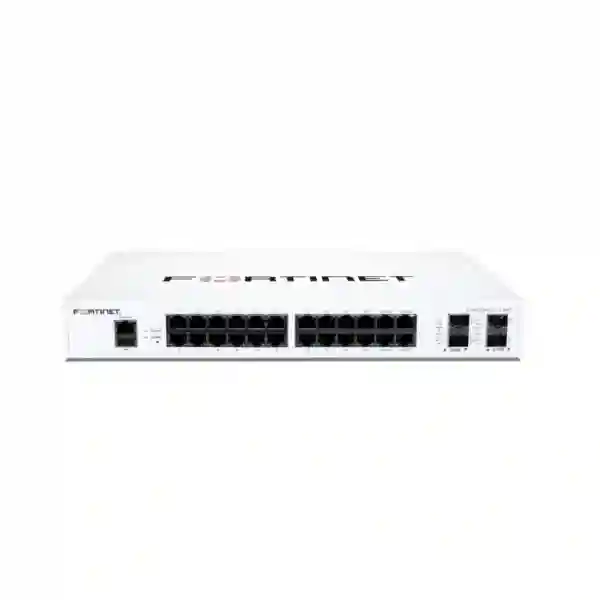
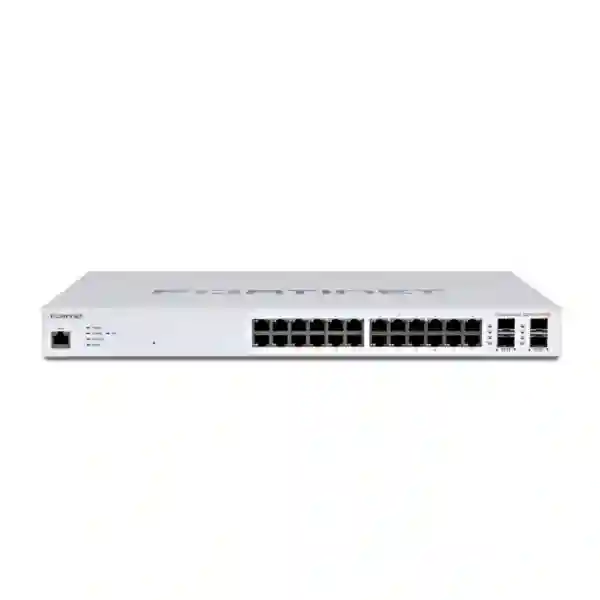
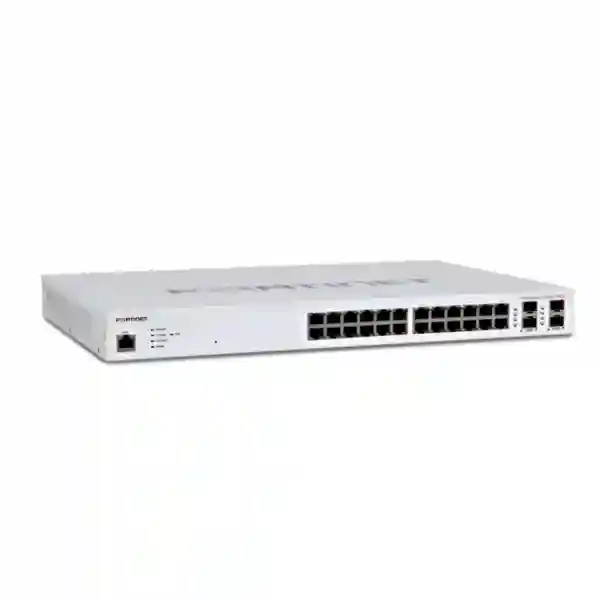
FortiSwitch FS-124F gives organizations a practical 24-port Gigabit access layer with four 10GE SFP+ uplinks for faster aggregation and backbone connectivity. Fortinet specifies 24 GE RJ45 interfaces, four 10GE SFP+ interfaces, 128 Gbps switching capacity, 190 Mpps packet forwarding, support for 4K VLANs, 32K MAC addresses and a fanless 1RU rack-mount chassis. For Tanzanian businesses planning a secure wired network, the model can serve office users, servers, printers, IP endpoints and other Ethernet devices while fitting naturally into a Fortinet security architecture.
RJ45 access interfaces for business endpoints and wired LAN connectivity.
SFP+ uplinks for aggregation, fiber links and higher-speed network paths.
Duplex switching capacity with 190 Mpps packet forwarding performance.
Rack-mount design for quiet operation in suitable office and communications spaces.
FortiSwitch FS-124F Overview and Verified Specifications
The FS-124F is the non-PoE member of the FortiSwitch 124F family. This distinction matters during procurement because the FS-124F, FS-124F-POE and FS-124F-FPOE share the same basic port count and 10GE uplink arrangement but differ in Power over Ethernet capability, chassis dimensions, power consumption and deployment profile. The standard FS-124F provides no PoE ports. Buyers planning to power wireless access points, IP phones or cameras directly from the switch should therefore evaluate the PoE family variants instead of assuming that the base FS-124F supplies endpoint power.
| Network interfaces | 24 × GE RJ45 + 4 × 10GE SFP+ |
| Switching capacity | 128 Gbps duplex |
| Packet forwarding | 190 Mpps duplex |
| MAC address storage | 32K |
| VLANs supported | 4K |
| Network latency | Less than 1 microsecond |
| Form factor | 1RU rack mount, fanless |
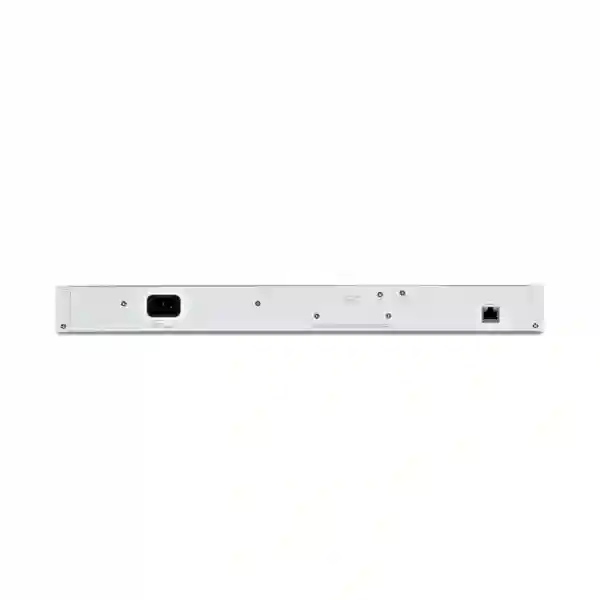
| Power | 100–240V AC, 50–60 Hz; built-in AC supply |
Why Businesses Consider the FS-124F
A 24-port access switch is a common building block for offices that need enough copper ports for a department, floor, server-room edge or branch without moving immediately to a 48-port chassis. The four 10GE SFP+ uplinks give the FS-124F useful headroom for fiber uplinks, switch aggregation and higher-bandwidth connections. This can be valuable where access ports remain Gigabit Ethernet but the network designer wants faster upstream paths to reduce bottlenecks between the access layer and the rest of the LAN.
The fanless chassis can also be attractive for environments where acoustic noise matters. It does not remove the need for proper rack ventilation, temperature control and power planning, but it avoids switch-fan noise at the device itself. Procurement teams should verify the required transceivers, fiber type, rack accessories, FortiGate integration design and support entitlement as part of the complete bill of materials rather than purchasing only the switch chassis.
Fortinet Integration, VLANs and Network Design
FortiSwitch is designed to fit into Fortinet’s secure networking ecosystem. In an integrated deployment, organizations can plan the switching layer alongside FortiGate security, segmentation and policy requirements. The practical design work still starts with fundamentals: endpoint count, VLAN plan, IP addressing, uplink topology, trunk requirements, link aggregation, spanning-tree design, management access and failure scenarios. The FS-124F supports 4K VLANs, link aggregation groups and multiple spanning-tree instances, giving network teams the building blocks required for structured business LAN designs.
Before ordering, identify whether each connected endpoint requires ordinary Ethernet or PoE. The standard FS-124F is appropriate when powered endpoints use separate power sources or when PoE is provided elsewhere. Where access points, phones or surveillance devices must receive power through Ethernet, request guidance on the FS-124F-POE, FS-124F-FPOE or another current FortiSwitch model that matches the required PoE budget.
FortiSwitch FS-124F Tanzania
Tanzanian organizations evaluating the FortiSwitch FS-124F typically need more than a model number. A useful quotation should reflect the actual access-layer design: how many wired endpoints are required today, expected growth, whether uplinks are copper or fiber, the distance between racks, the existing FortiGate model, VLAN requirements and whether any endpoints need PoE. For an office with conventional PCs, printers, servers and separately powered equipment, the 24 GE access ports can provide a clean departmental or branch switching footprint. Four 10GE SFP+ uplinks make it possible to plan faster connections toward aggregation switches, server infrastructure or other suitable network devices.
For Tanzania deployments, procurement teams should also document power protection, rack depth, cooling, fiber termination and compatible optics before installation. The switch accepts 100–240V AC and uses a built-in AC supply, while the fanless chassis is compact for a 1RU device. The absence of redundant power means designers who require device-level power redundancy should account for that limitation in the architecture rather than assuming dual power supplies are present.
Fourteck can use the requirement discussion to separate chassis selection from the wider project. Buyers may need the switch, compatible SFP/SFP+ transceivers, patching, fiber, FortiGate connectivity, configuration, VLAN implementation and documentation. For related security planning, review Fourteck Tanzania business IT solutions. A complete request should state endpoint count, desired uplink speed, fiber medium, existing firewall and whether centralized Fortinet management is part of the target design.
FortiSwitch FS-124F Dar es Salaam
Dar es Salaam buyers often plan switching for headquarters, professional offices, retail operations, hospitality environments, logistics sites and growing multi-floor workplaces. The FS-124F can be considered when the access layer requires 24 Gigabit copper ports while the uplink side benefits from 10 Gigabit SFP+ capability. Rather than selecting a switch only by port count, the design should map every physical connection and reserve capacity for expansion. A site using 18 or 20 ports today, for example, should consider whether future workstations, printers, servers or network appliances will consume the remaining interfaces.
Fiber planning is particularly important when a Dar es Salaam site links floors, buildings or communications rooms. The presence of four SFP+ interfaces does not mean that every optical module or fiber type should be assumed compatible. Specify link distance, fiber type and required speed so the correct supported transceiver can be identified. Where the network includes a FortiGate, the switching plan should also document FortiLink topology, VLAN segmentation and administrative responsibilities before change windows are scheduled.
A quotation request is stronger when it includes rack environment, UPS availability, uplink design, current firewall, number of users and whether PoE is needed. Since the standard FS-124F has no PoE budget, Dar es Salaam projects involving IP phones, cameras or access points should explicitly identify how those endpoints will be powered. This prevents a common procurement mismatch and allows the project team to compare the base model with an appropriate PoE variant where necessary.
FortiSwitch FS-124F Mwanza
Mwanza organizations can use the FS-124F as part of a structured wired network where reliable Gigabit access and faster uplinks are required. A branch, clinic, school administration block, warehouse office or commercial organization may have a mix of PCs, printers, servers and network appliances that do not need switch-supplied power. In such cases, the non-PoE FS-124F can keep the access layer straightforward while providing four 10GE SFP+ interfaces for backbone or aggregation connectivity.
Site preparation should be treated as part of the purchase. Confirm rack space, ambient operating conditions, stable protected power, patch-panel capacity and cable labeling. Fortinet lists the operating range as 0°C to 45°C and humidity as 10% to 90% non-condensing, so equipment-room conditions need to remain within the published limits. The fanless design reduces device noise, but environmental planning remains necessary because passive cooling still depends on appropriate installation conditions.
For a Mwanza quotation, provide a simple network map if possible. Indicate which ports are user access, which are trunks, where the firewall sits, whether there is another switch upstream and what optical distances are involved. This lets the bill of materials address more than the chassis. It also helps determine whether the 24-port model offers enough growth margin or whether a larger access switch would be more practical for the planned lifecycle.
FortiSwitch FS-124F Arusha
Arusha businesses in hospitality, tourism support, education, professional services and general commerce may need a switch that supports segmented wired access without unnecessary acoustic noise. The FS-124F combines 24 Gigabit RJ45 ports with four 10GE SFP+ uplinks in a fanless 1RU format. This can suit a communications rack near occupied workspace, provided the rack environment remains within Fortinet’s published operating conditions and the wider network design does not require PoE from this particular switch.
Segmentation is a useful planning topic for Arusha deployments. Staff devices, guest-facing systems, servers, voice equipment and operational technology should not automatically share one flat LAN. The FS-124F supports VLANs, while the security policy and routing design can be coordinated with the organization’s firewall architecture. The exact configuration depends on the network, so buyers should supply existing VLAN information and the FortiGate model when requesting deployment assistance.
When fiber uplinks are part of the project, specify whether the link is within one building or extends between buildings, plus the expected distance and fiber medium. Compatible optics should be selected against Fortinet documentation. If wireless access points or phones need PoE, note their quantity and power class in the request so a PoE-capable switch can be evaluated instead of the base FS-124F. This requirement-led approach helps prevent purchasing hardware that is electrically or operationally mismatched to the endpoint estate.
FortiSwitch FS-124F Dodoma
Dodoma organizations planning office networks, institutional facilities, professional environments and distributed branches can evaluate the FS-124F when they need 24 Gigabit access interfaces and higher-speed SFP+ uplinks. The model’s 128 Gbps switching capacity and 190 Mpps forwarding figure provide a clear technical baseline, but a sound buying decision also depends on topology. Network teams should estimate concurrent traffic, server access patterns, uplink utilization and future device growth instead of treating headline capacity as the only sizing criterion.
For formal procurement, document the exact model as FS-124F to distinguish it from FS-124F-POE and FS-124F-FPOE. This is important because the base model has no PoE ports. A specification that merely says “FortiSwitch 124F” without clarifying endpoint power requirements can lead to ambiguity. The request should also list required optical modules, rack accessories, patching and support expectations so suppliers can quote comparable scopes.
Deployment planning should include administrator access, configuration backup, VLAN naming, trunk definitions, spanning-tree roles and a rollback plan. If the switch will be integrated into an existing Fortinet environment, provide current FortiGate and FortiOS information for compatibility review. A well-documented handover is especially useful for institutional networks because future administrators need to understand port purpose, uplink paths and segmentation decisions without reverse-engineering the installation.
FortiSwitch FS-124F UAE
UAE procurement teams evaluating the FS-124F may be supporting a branch standard, regional network rollout or a Fortinet-based office design that also extends into East Africa. The model is useful where 24 one-gigabit copper access ports are sufficient but the upstream architecture benefits from four 10GE SFP+ interfaces. Standardizing on a documented access-switch configuration can simplify VLAN naming, uplink templates, monitoring and spare planning across multiple sites.
The technical scope should clearly state that FS-124F is non-PoE. If a UAE office needs to power Wi-Fi access points, phones or cameras from the access switch, a PoE-capable FortiSwitch should be evaluated. Where endpoints have separate power or PoE is delivered by another layer, the fanless base model can offer a quieter option. For regional Fortinet requirements, buyers can also review Fourteck UAE technology solutions and Fortinet-focused UAE resources.
For cross-border projects, keep the technical bill of materials consistent while handling commercial terms, logistics and support scope separately for each destination. Record exact switch model, optics, fiber specification, software requirements, rack environment and configuration responsibilities. This reduces ambiguity when the same architecture is deployed across different offices and helps technical reviewers compare equivalent designs.
FortiSwitch FS-124F Uganda
Uganda businesses considering FortiSwitch FS-124F can use it for secure access-layer designs that need 24 Gigabit Ethernet ports and 10 Gigabit uplinks. The model can fit branch offices, headquarters departments, schools, clinics, hospitality networks and commercial sites where connected devices are independently powered. For broader Fortinet planning in the country, Fourteck Uganda provides a regional path for firewall and network solution discussions.
A Uganda project should start with endpoint and topology discovery. Count wired users, printers, servers, network appliances and any devices expected during the next expansion phase. Then separate PoE and non-PoE endpoints. Because FS-124F itself provides no PoE, access points, IP phones and cameras require another power strategy or a different switch variant. Uplink planning should identify whether SFP+ ports will connect to another switch, a server, a firewall-supported topology or fiber between communications spaces.
For organizations already operating FortiGate, include the firewall model and software environment in the requirement. This supports a compatibility-led discussion around FortiLink and centralized operations. Procurement teams should also specify required support, configuration and handover documentation. Hardware supply alone does not define a successful LAN project; the VLAN structure, port assignments, uplink resilience and operational ownership determine how maintainable the installation becomes.
FortiSwitch FS-124F Kampala
Kampala networks often combine user access, cloud applications, local servers, voice systems and wireless infrastructure. The FS-124F can provide the non-PoE wired portion of that access layer with 24 GE RJ45 ports, while four 10GE SFP+ interfaces can connect the switch toward higher-speed aggregation. The best fit depends on port demand and endpoint power. If the same access switch must energize phones, cameras or access points, the project should compare a PoE-capable FortiSwitch rather than adding external injectors by default.
In multi-floor Kampala offices, fiber uplinks may be preferred between communications rooms. The optical bill of materials should be based on distance, fiber type, connector arrangement and supported Fortinet transceivers. Designers should also consider link aggregation and spanning-tree behavior where redundant physical paths exist. The FS-124F supports link aggregation groups and multiple spanning-tree instances, but the final topology needs deliberate configuration to avoid loops and unexpected failover behavior.
When requesting pricing, identify whether the requirement is hardware-only or a deployment project. A deployment scope can include configuration, VLANs, trunks, FortiGate integration, testing, port labeling, configuration backup and handover. Clear scope makes quotations easier to compare and reduces the chance that critical accessories or services are omitted from the purchase request.
FortiSwitch FS-124F Arua
Arua organizations can evaluate the FS-124F for branch and institutional LANs that need a manageable 24-port Gigabit access footprint. The four 10GE SFP+ uplinks give the design flexibility to connect toward faster network layers without requiring every endpoint to operate above one gigabit. This access-versus-uplink balance is often practical for normal office traffic, but the actual topology should be reviewed where servers, backups or high-volume applications generate concentrated traffic.
Infrastructure readiness matters. The rack should provide suitable mounting space, protected AC power and an environment within the vendor’s temperature and humidity limits. Although the FS-124F is fanless, installers should not block ventilation or assume that a closed unventilated cabinet is acceptable. UPS sizing should consider the switch plus other rack equipment rather than the switch in isolation.
For an Arua request, provide the number of current and planned devices, VLAN requirements, uplink destinations, fiber distances and firewall details. If the network includes powered Ethernet endpoints, list them separately because the standard FS-124F has zero PoE ports. A precise requirement helps determine whether the non-PoE model is appropriate or whether a different member of the FortiSwitch range better matches the project.
FortiSwitch FS-124F Mbarara
Mbarara businesses planning a new office LAN or replacing an older access switch can consider FS-124F where 24 Gigabit copper interfaces meet the endpoint requirement and 10GE uplinks are desirable for the backbone. Migration planning should inventory existing patching and VLANs before the old switch is removed. Port descriptions, trunk settings and any special endpoint requirements should be documented so the new configuration does not rely on assumptions made during a short maintenance window.
The FS-124F’s fanless design is useful where low acoustic output is valued, while the rack-mount chassis still supports structured communications-room deployment. Power protection and environmental conditions should be reviewed before installation. Because there is no redundant power supply on this model, sites with strict availability requirements may need to address resilience at the UPS, topology or equipment-selection level.
Where FortiGate is already deployed, the access-switch project can be considered as part of a broader Fortinet network architecture. Share the firewall model, intended management approach and segmentation goals during quotation. Also state whether optics and configuration are required. This ensures the commercial response reflects a usable network solution instead of a chassis that still requires unplanned components after arrival.
FortiSwitch FS-124F Gulu
Gulu buyers may need switching for offices, education environments, healthcare administration, NGOs and commercial branches. FS-124F provides a straightforward combination of 24 GE access ports and four 10GE SFP+ uplinks. This allows many everyday endpoints to remain on familiar copper Gigabit Ethernet while the switch has faster interfaces available for suitable upstream connections. The switch is non-PoE, so it should not be specified as the power source for access points, phones or cameras.
A clean Gulu deployment begins with cable and rack readiness. Verify patch-panel labeling, copper cable quality, fiber termination, grounding practices where applicable, protected power and administrator access. Prepare the target configuration before the change window, including VLANs, trunks, management addressing and uplink settings. After installation, save a configuration backup and update network diagrams so future maintenance has an accurate reference.
Procurement teams should request the exact model and accessories rather than a generic “24-port Fortinet switch.” Specify FS-124F, required transceiver types, quantities and any service scope. If future growth could exceed the available access ports, compare the cost and operational impact of a larger switch or additional access layer now instead of waiting until every port is consumed.
FortiSwitch FS-124F Kenya
Kenyan organizations evaluating FS-124F may be building a Fortinet-based branch, office or campus network where secure switching and 10GE uplinks are important. The device’s 24 GE RJ45 access interfaces can serve normal wired endpoints, while four 10GE SFP+ interfaces provide higher-speed uplink choices. Buyers can review Fourteck Kenya for regional Fortinet and business network planning alongside Tanzania projects.
For Nairobi and other Kenyan sites, the key buying questions remain technical rather than geographical: how many ports, which VLANs, what uplink medium, what redundancy, which FortiGate, and whether PoE is required. The standard FS-124F has no PoE interfaces. A project with a dense wireless or IP-phone estate should therefore calculate PoE requirements and compare an appropriate PoE model. Projects with independently powered endpoints can benefit from the simpler non-PoE chassis.
Regional organizations operating both Kenya and Tanzania can improve maintainability by documenting a common switching template where site requirements are similar. Standard VLAN names, management conventions, uplink patterns, backups and labeling can reduce operational variation. However, each site should still be validated for endpoint count, fiber distances, power conditions and local topology rather than cloning a configuration without review.
FortiSwitch FS-124F Kuwait
Kuwait buyers considering the FS-124F for a branch or regional standard should evaluate its access and uplink profile against the planned LAN. Twenty-four Gigabit RJ45 ports suit a moderate access footprint, while four 10GE SFP+ interfaces support faster upstream connectivity. The fanless 1RU design may suit office-adjacent communications areas where noise is a concern, provided temperature and ventilation remain within the manufacturer’s operating requirements.
The base FS-124F should be specified for non-PoE requirements. If the access layer must power phones, cameras or wireless access points, calculate device quantities and power needs before choosing a PoE variant. This avoids designing around external power injectors after purchase. Optical modules should likewise be selected according to supported compatibility and actual link requirements, not simply because an SFP or SFP+ module has the correct physical shape.
For a multi-country procurement project, list Kuwait requirements separately from Tanzania even when the hardware standard is shared. Commercial availability, logistics and deployment scope can differ, while the technical baseline should remain controlled. Record exact order model, optics, rack accessories, management design and support expectations so every stakeholder reviews the same specification.
FortiSwitch FS-124F Ghana
Ghana organizations can consider the FS-124F for business LAN access where 24 one-gigabit copper ports and multiple 10-gigabit uplinks fit the topology. Offices with cloud-heavy workflows still need a well-designed local network because user traffic, printing, internal applications, voice and internet access all depend on stable switching. The FS-124F provides the Layer 2 access foundation, while routing and security architecture should be planned with the wider network.
A Ghana deployment should define segmentation before installation. User, server, guest, management and operational networks may require separate VLANs depending on business policy. The switch supports large VLAN scale, but good design uses only the segmentation that is operationally justified and documented. Where FortiGate is part of the environment, the switch and firewall configuration can be planned together to keep access policies and network boundaries understandable.
Quotation requests should identify non-PoE versus PoE requirements explicitly. FS-124F is the non-PoE model. Include fiber distances and desired uplink speeds so compatible optics can be selected, and state whether configuration, testing and handover are required. These details help turn a hardware inquiry into a complete deployment scope and reduce last-minute accessory purchases.
FortiSwitch FS-124F Nigeria
Nigeria businesses evaluating FortiSwitch FS-124F may be standardizing branch connectivity, upgrading an older Gigabit switch or extending a Fortinet security architecture into the access layer. The 24 GE RJ45 ports suit ordinary business endpoints, and the four 10GE SFP+ interfaces can provide faster uplinks to suitable aggregation equipment. For distributed enterprises, a consistent access-switch standard can simplify templates and spare planning, but each site still requires a port and power assessment.
Power quality and equipment-room planning should form part of deployment. Use appropriate UPS and surge-protection practices for the site, keep the rack within the specified operating environment and document shutdown or recovery procedures. Since FS-124F has a single built-in AC supply and no redundant power option, organizations with strict continuity requirements should account for that fact when designing resilience.
Nigeria procurement teams should also distinguish the standard model from the PoE variants. If access points, cameras or IP phones must draw power from the switch, specify their quantities and expected PoE load so the correct FortiSwitch can be selected. For the non-PoE FS-124F, the request should focus on port count, 10GE uplinks, compatible optics, VLAN design, FortiGate integration and deployment services.
FortiSwitch FS-124F Seychelles
Seychelles businesses in hospitality, professional services, administration and other sectors can evaluate FS-124F for compact wired access networks where 24 Gigabit ports are appropriate and higher-speed fiber uplinks are useful. Hotels and distributed properties often require careful separation of operational, staff and guest systems, so the switch should be considered within a complete segmentation design rather than as an isolated connectivity device.
Where buildings or communications rooms are linked by fiber, document link distance, fiber type and connector requirements before choosing SFP+ modules. The four 10GE interfaces provide useful flexibility, but optical compatibility must be verified. In coastal or challenging environments, equipment-room conditions, power quality and physical protection deserve particular attention; the switch should be installed within Fortinet’s published temperature and humidity limits rather than exposed to unsuitable conditions.
The standard FS-124F is non-PoE. Seychelles projects with extensive wireless access points, IP telephony or surveillance should therefore determine whether a PoE model better matches the access layer. When requesting a quotation, include endpoint count, PoE count, fiber links, firewall model, VLAN requirements and desired configuration support. A complete requirement helps align hardware selection with the operational network that will actually be deployed.
Selection and Procurement Checklist
Before requesting a FortiSwitch FS-124F quote, confirm the number of active wired endpoints and expected growth; whether PoE is required; the number, speed and distance of fiber uplinks; the required transceiver type; existing FortiGate model and management approach; VLAN and segmentation plan; rack and power conditions; configuration and installation scope; support expectations; and documentation requirements. These inputs allow a supplier to build a comparable quotation and help technical teams verify that the switch is suitable before procurement approval.
Do not select the FS-124F solely because it has 24 ports. A project that already needs 23 or 24 access interfaces has little spare capacity. Likewise, a project requiring many powered endpoints may be better served by a PoE model even if the base chassis price initially appears attractive. The correct decision balances present port demand, future expansion, endpoint power, uplink capacity and operational consistency.
Related Fortinet Network Planning
FortiSwitch is commonly evaluated alongside FortiGate firewalls and secure wireless infrastructure. For Tanzania projects, the network design should consider how switching, firewalling, internet access, VLAN segmentation and wireless connectivity work together. Organizations operating across East Africa can also use the regional Fourteck resources for Kenya network requirements and Uganda network requirements. These links are useful when a common Fortinet architecture must be adapted for multiple country deployments.
FortiSwitch FS-124F FAQs
How many ports does the FortiSwitch FS-124F have?
Fortinet specifies 24 Gigabit Ethernet RJ45 access interfaces and four 10 Gigabit Ethernet SFP+ interfaces.
Does FS-124F provide PoE?
No. The standard FS-124F has no PoE ports. Fortinet also offers 124F family variants with PoE capability, so endpoint power requirements should be confirmed before ordering.
What is the switching capacity?
The published duplex switching capacity is 128 Gbps, with packet forwarding performance of 190 Mpps.
Is the FS-124F fanless?
Yes. Fortinet lists the base FS-124F as fanless. It remains important to follow the published environmental and installation requirements.
Can FS-124F be used with FortiGate?
FortiSwitch is designed for Fortinet secure networking environments and the 124F family supports FortiGate/FortiLink-oriented deployment. Compatibility, software version and topology should be checked for the specific project.
What should I provide for a Tanzania quotation?
Provide the exact FS-124F model requirement, quantity, endpoint count, PoE needs, uplink speeds, fiber distances, transceiver requirements, FortiGate model, VLAN needs and whether configuration or installation support is required.
Decision Recap
Choose the FortiSwitch FS-124F for evaluation when your design calls for 24 non-PoE Gigabit access ports, four 10GE SFP+ uplinks, a fanless 1RU chassis and integration into a structured Fortinet network. Reassess the model if you need switch-supplied PoE, more than 24 access ports, device-level redundant power or another uplink profile. The most useful quotation starts with the network requirement, not only the product name.
Talk to Fourteck About FS-124F Tanzania
Share your switch quantity, connected-device count, fiber uplink requirement, FortiGate model and whether PoE is needed. Fourteck can use those details to prepare a more accurate product and deployment discussion for your business network.


Reviews
There are no reviews yet.