
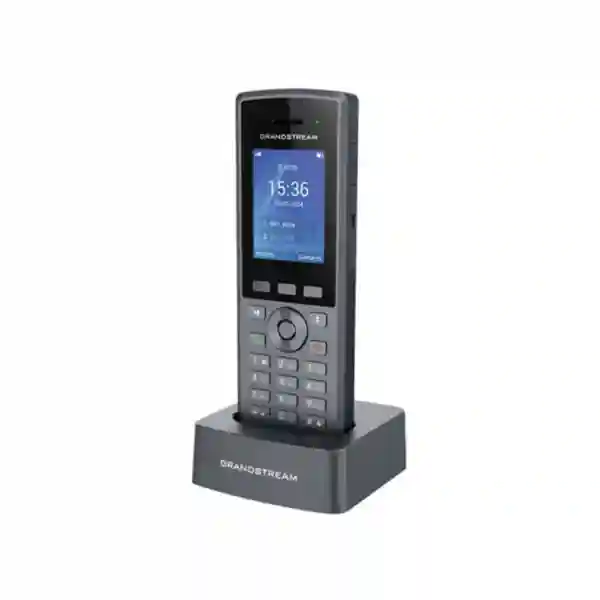
Grandstream DP735 Ruggedized DECT Cordless HD Handset
The Grandstream DP735 is designed for organisations that need cordless voice mobility without treating the handset as a fragile office accessory. Warehouses, retail floors, hotels, workshops, logistics facilities, healthcare-adjacent environments, maintenance teams, security operations and mobile supervisors often need a phone that can move with the user while remaining part of the business SIP system. The DP735 answers that need with a ruggedized IP67-rated enclosure, antimicrobial casing, resistance to cleaning chemicals, protection against dust and water, and tested drop safety from up to 2.5 metres. It also provides full HD audio, a 2.4-inch 240 × 320 color display, push-to-talk, vibration alert, speakerphone, a 3.5 mm headset jack and a removable belt clip. For organisations planning a resilient cordless voice deployment in Tanzania, the DP735 can become a practical extension of an existing or new Grandstream DECT architecture.
Rugged for demanding use
IP67-rated water and dust protection, cleaning-chemical resistance, antimicrobial casing and 2.5 m drop safety make the DP735 suitable for environments where a standard desk handset would be exposed to more wear.
Long-shift battery design
Grandstream specifies a rechargeable 2000 mAh Li-ion battery with up to 65 hours talk time and up to 650 hours standby time under laboratory conditions, supporting long operating periods between charges.
Business DECT mobility
With compatible DP750, DP752 or DP755 base stations, the handset supports secure DECT mobility, multiple lines, SIP accounts, HD audio and practical cordless range for distributed work areas.
What the Grandstream DP735 solves
A fixed desk phone works well when the employee remains at the desk. It becomes limiting when the role involves moving through shelving aisles, stock rooms, loading areas, service corridors, guest floors, maintenance zones, shop floors or multiple rooms. Using personal mobile phones can create inconsistent call handling and can separate business extensions from the organisation’s PBX policies. The DP735 keeps the user mobile while maintaining a purpose-built business telephony endpoint. Calls can remain part of the SIP and PBX environment, and the handset can be assigned according to extension, department or operational role.
This makes the DP735 particularly relevant where mobility and physical durability are both requirements. A cordless phone designed only for light indoor use may not be ideal around dust, occasional splashes, repeated handling or accidental drops. Grandstream positions the DP735 for business, warehouse, retail and residential environments where a more durable form factor is useful. The result is not simply a cordless replacement for a desk phone; it is a rugged voice endpoint intended for people whose work takes place away from a fixed workstation.
Verified Grandstream DP735 features
2.4-inch 240 × 320 color TFT LCD with three programmable soft keys.
IP67-rated waterproof and dustproof protection, cleaning-chemical resistance, antimicrobial casing and 2.5 m drop safety.
HD audio on handset and speakerphone, including G.722 wideband codec support.
Up to 20 SIP accounts and 20 lines per handset when used with the DP755 platform.
2000 mAh rechargeable Li-ion battery, up to 65 hours talk and 650 hours standby under laboratory conditions.
Up to 400 m outdoors with DP752/DP755, up to 300 m with DP750, and up to 50 m indoors, subject to environment and installation conditions.
Dedicated speakerphone, mute, send and power/end keys, side volume keys and push-to-talk key.
3.5 mm headset jack, vibration mode, removable belt clip, proximity sensor and accelerometer.
DP735 compatibility and deployment planning
The DP735 does not operate as a standalone SIP device without a compatible DECT base. Grandstream lists support for the DP750, DP752 and DP755 DECT VoIP base stations. Base selection therefore matters as much as handset selection. A small deployment with a handful of users may need a different base strategy from a larger site with more extensions, calls or coverage zones. Before ordering, buyers should confirm the number of simultaneous calls, number of handsets, required SIP accounts, physical area, wall construction and likely expansion. DECT radio range figures are maximum specifications rather than a guarantee for every building. Concrete walls, metal shelving, machinery and building layout can affect real-world coverage.
For a complete voice environment, the DP735 should also be considered alongside the PBX, SIP trunk, switching and network design. FourTeck’s Tanzania business technology overview explains how IP phones, PBX, networks and security fit together. Buyers comparing endpoint options can use the FourTeck Tanzania technology shop to frame procurement requirements, while FourTeck Tanzania services provides context for design, configuration and deployment support. Organisations with regional requirements can also review FourTeck Uganda and FourTeck Kenya for neighbouring-market coordination.
Grandstream DP735 Tanzania
For organisations in Tanzania, the Grandstream DP735 is most relevant where staff members need to stay reachable while moving between work zones. A warehouse supervisor may spend the day moving between receiving, storage, dispatch and loading areas. A retail manager may move from the front counter to stock rooms and administrative areas. A hotel operations team may work across reception, service corridors and support spaces. In these situations, a fixed phone can force users to return to a desk or rely on personal mobile phones. The DP735 allows the voice endpoint to travel with the user while remaining part of the organisation’s SIP telephony system through a compatible Grandstream DECT base station.
Tanzania deployments should begin with site conditions rather than handset quantity alone. The published indoor range is up to 50 metres, but walls, structural materials, metal shelving, racking, equipment and interference can change usable coverage. For larger premises, a basic walk-through and coverage plan can help determine where the base station should be located and whether the chosen architecture can support the required movement paths. If the site includes offices plus warehouse or outdoor work areas, the design should consider both radio coverage and how calls flow through the PBX. Extension numbering, hunt groups, reception transfer behaviour, after-hours routing and emergency communication procedures should be defined before users are handed the devices.
The rugged construction is a meaningful advantage for Tanzanian buyers operating in industrial, logistics, retail and service environments. IP67 protection, chemical resistance and drop safety reduce the mismatch between a delicate office endpoint and a physically demanding workplace. At the same time, procurement teams should still confirm the exact operating environment, charger locations, spare battery policy, headset requirement and cleaning practices. The handset includes a dedicated charging cradle, and its long specified battery life can reduce charging frequency, but organisations with continuous shifts should still plan practical charging discipline. For a quotation, provide handset quantity, existing PBX platform, current Grandstream base model if any, site type, approximate coverage area and required call features.
Grandstream DP735 Dar es Salaam
Businesses in Dar es Salaam often operate across offices, warehouses, logistics centres, retail spaces, hospitality properties and mixed-use commercial facilities where staff communication must follow employees away from their desks. The Grandstream DP735 is well suited to this type of mobility requirement because it combines business SIP telephony with a rugged DECT handset format. A user can carry the extension while moving through operational areas, receive internal or external calls according to PBX configuration, use speakerphone or a wired headset, and rely on the handset’s vibration mode when audible ringing may be less practical.
A Dar es Salaam deployment should be planned around the physical building. In a compact office, one compatible base station may be enough for the intended coverage and handset count. In a warehouse or multi-zone commercial property, metal shelving, reinforced walls, mezzanine levels, cold rooms, machinery and long corridors can influence radio propagation. The published outdoor and indoor ranges are useful planning references but should not be treated as guaranteed coverage. During procurement, it is helpful to mark the areas where users must remain reachable: loading bays, inventory aisles, reception, cash office, maintenance areas, staff rooms or external yard zones. This information can guide base selection and positioning.
The DP735’s rugged characteristics are especially relevant where the handset is handled repeatedly during busy shifts. IP67 protection, antimicrobial casing, resistance to cleaning chemicals and protection against drops from up to 2.5 m reduce the risk associated with routine operational use. For hotels and customer-facing businesses, HD audio and a 2.4-inch display can improve daily usability while maintaining cordless convenience. For logistics or warehouse teams, push-to-talk may provide a useful supplementary communication method depending on configuration and working procedures. Before requesting a quote in Dar es Salaam, buyers should identify how many staff need individual handsets, how many simultaneous conversations are expected, which PBX or SIP system is in use and whether compatible DP750, DP752 or DP755 bases are already installed.
Grandstream DP735 Mwanza
For Mwanza organisations considering rugged cordless business telephony, the DP735 offers a practical combination of SIP integration and mobility. The handset can be useful in distribution businesses, hospitality operations, workshops, healthcare-support environments, warehouses and retail facilities where employees need to remain reachable while moving through work areas. Rather than giving every mobile employee a separate cellular line, a DECT system can keep communication attached to the company’s internal extension plan and PBX call routing. This can simplify transfers, internal calling and departmental contact when the telephony environment is configured properly.
The first design question should be coverage. Grandstream specifies up to 50 metres indoors and up to 400 metres outdoors with the DP752 or DP755, while DP750 outdoor range is specified up to 300 metres. Real coverage can be lower depending on obstacles and building design. Mwanza businesses with workshops, storage buildings or compounds should consider where the DECT base will sit relative to the users’ normal routes. A centrally located base can improve coverage efficiency, but access to Ethernet, power or PoE requirements for the base, PBX connectivity and secure network placement must also be considered. A coverage test is sensible for sites with thick walls, dense metal shelving or separate structures.
Operational management is another part of the purchase decision. The DP735 supports over-the-air handset provisioning and software update mechanisms through the Grandstream environment, which can be valuable when several handsets are deployed. Administrators should define naming conventions, extension assignments, user permissions and a consistent charging routine. The handset’s specified 65-hour talk time and 650-hour standby time are laboratory figures and should be treated as maximums rather than a promise for every usage pattern. For procurement in Mwanza, include expected handset quantity, current telephony platform, base-station model, required range, preferred headset use and whether the devices will serve general staff, supervisors, security, maintenance or customer service teams. This creates a clearer basis for sizing and quotation.
Grandstream DP735 Arusha
Arusha businesses in hospitality, tourism support, logistics, offices, retail and light industrial operations may benefit from a cordless voice system when employees move continuously between customer-facing and operational areas. The Grandstream DP735 is designed for this style of mobility. It gives a user a DECT handset connected through a compatible Grandstream base station, allowing the extension to remain accessible while the employee is away from a desk. This can be useful for a hotel supervisor walking between reception and service areas, a stock controller working between store and office, or a maintenance coordinator moving across a property.
For hospitality and service environments in Arusha, usability matters as much as ruggedness. The DP735 provides full HD audio, a color display, speakerphone, headset connectivity and vibration alert. Users who spend much of the day on their feet can carry the handset using the removable belt clip, while push-to-talk can support quick team communication where that feature is appropriate to the workflow. The rugged enclosure is IP67 rated and is designed to resist dust, water, cleaning chemicals and falls from up to 2.5 metres. These characteristics can be valuable where equipment is used around housekeeping, maintenance, stock handling or outdoor-adjacent operational areas.
A good Arusha deployment still needs telephony planning. The DP735 is an endpoint, not the complete phone system. Buyers should confirm whether they already have a SIP PBX, whether it is compatible with the intended Grandstream base, how external numbers enter the system, and how calls should be transferred between reception, reservations, maintenance, stores or other departments. Base capacity should be matched to handset count and concurrent call demand. Building layout should also be reviewed because indoor range varies with walls and other obstacles. A useful quotation request should therefore include the number of intended users, current PBX information, the areas that require coverage, whether users need headsets, and whether devices will be shared by shifts or assigned to named employees.
Grandstream DP735 Dodoma
In Dodoma, the DP735 can suit organisations that need a robust cordless extension for administrative buildings, stores, facilities teams, warehouses, education-support operations, institutional campuses and commercial environments. Its value is strongest when users have defined business extensions but do not spend the day beside a desk phone. By pairing the handset with a supported Grandstream DECT base, organisations can extend SIP calling into mobile work areas while keeping users connected to PBX functions and call routing.
Institutional and multi-department environments should pay particular attention to call-flow design. A handset might be assigned to facilities, security, stores, IT support or an on-duty supervisor. Each of those roles may require different ring groups, transfer permissions, voicemail behaviour or after-hours routing. The DP735 supports multiple lines and accounts depending on the base system, but simply enabling many lines does not automatically create a better workflow. The PBX configuration should reflect real responsibilities. It is also important to document handset names and extensions so staff can identify which unit belongs to which role or shift.
Physical planning matters in Dodoma sites with multiple buildings or separated work areas. The specified maximum range helps estimate feasibility, but buildings with reinforced walls, metal structures or long distances may require testing before finalising the design. Charger placement should be convenient and protected from unnecessary dust or moisture even though the handset itself is ruggedized. Organisations operating multiple shifts should decide whether handsets stay with roles, rotate between users or remain in designated departments. The long battery specification can support extended operation, but charging and battery health should still be managed. When requesting a DP735 quotation for Dodoma, provide the handset count, base-station requirement, intended coverage areas, PBX platform, number of simultaneous calls, work pattern and any need for configuration, installation or user orientation.
Grandstream DP735 UAE
For UAE businesses, the Grandstream DP735 fits operational environments where staff need a rugged cordless voice endpoint rather than a conventional desk handset. Warehousing, logistics, retail, hospitality, facilities management and service operations are natural use cases because employees frequently move across work zones while still needing reliable internal and external calling. Through compatible DP750, DP752 or DP755 base stations, the DP735 becomes part of a SIP-based phone system and can support extension mobility without moving the organisation’s call management to personal cellular devices.
Large warehouses and logistics facilities in the UAE should pay close attention to radio coverage. High metal racks, concrete structures, machinery and large floor plates can produce coverage patterns that differ significantly from open-space specifications. Grandstream’s outdoor specification reaches up to 400 metres with DP752/DP755 and up to 300 metres with DP750, with up to 50 metres indoors. These are maximum values, so the practical design should consider actual layout and obstacles. A site survey or staged deployment can help confirm whether the selected base and handset architecture covers receiving, picking, packing, dispatch, maintenance and management areas as intended.
The rugged design supports operational reliability: IP67 water and dust protection, cleaning-chemical resistance, antimicrobial casing and 2.5 m drop safety. The 2000 mAh battery is specified for up to 65 hours talk time and 650 hours standby in laboratory conditions, supporting long-shift use when charging discipline is maintained. Procurement teams should also verify frequency-region suitability, exact base compatibility, PBX configuration, number of handsets, simultaneous call requirements and whether wired headsets are needed. For wider regional technology requirements, FourTeck UAE can provide relevant regional context for business telephony and infrastructure planning without assuming that stock or service terms are identical across every project.
Grandstream DP735 Uganda
The Grandstream DP735 can serve Ugandan businesses that want employees to carry a company-managed cordless extension across operational areas. Warehouses, hotels, supermarkets, clinics, schools, offices and service facilities can all have roles where staff move continuously but still need to answer calls or reach colleagues quickly. Because the DP735 works through a Grandstream DECT base, it can keep those users inside the organisation’s SIP telephony framework rather than relying on ad-hoc mobile communication.
For procurement in Uganda, the practical questions are handset count, site coverage and telephony integration. A base station has finite capacity, and the chosen model determines how many handsets and calls can be supported. Organisations with only a few mobile users may need a simpler configuration, while larger sites should consider concurrent calling, future expansion and whether additional coverage planning is required. Thick walls, metal roofing, shelving and compound layouts can influence the radio path. The DP735’s maximum range specification provides a planning reference but not a substitute for understanding the actual site.
The handset’s rugged profile is useful where phones are likely to be handled in busy or dusty environments. Its IP67 rating, antimicrobial casing, chemical resistance and drop protection make it more appropriate for operational work than a standard light-duty cordless phone. HD audio, speakerphone, push-to-talk and headset support can improve flexibility for different roles. Buyers should also consider charging locations, shift handover procedures and how devices are labelled and assigned. If Uganda forms part of a multi-country rollout, using the same endpoint family across locations can simplify user familiarity, but frequency and local regulatory requirements must still be checked for each market. A well-prepared quotation request should include the PBX type, intended base station, coverage zones, user roles, quantity and any configuration or deployment assistance required.
Grandstream DP735 Kampala
Kampala organisations often combine offices with stores, workshops, customer areas, stock rooms and support spaces. The Grandstream DP735 is attractive where employees move between those spaces and cannot remain beside a desk phone. By linking the handset to a supported Grandstream DECT base, a company can provide a cordless SIP extension that follows the user through much of the site while still participating in the business call flow. This can support supervisors, stock teams, maintenance, security, front-of-house support and other mobile roles.
Coverage design should be approached carefully in multilevel or dense urban buildings. Concrete partitions, lift cores, basement areas and metal structures may reduce usable indoor range. Rather than assuming a published maximum will cover every floor, it is better to identify critical communication zones and validate the base position against them. The DP735’s value is strongest when the DECT layer is combined with good PBX configuration. Calls can then be routed to the correct extension or group, transferred to colleagues and managed according to working hours or departmental policies.
Kampala buyers should also think about device management over the full lifecycle. Several handsets should be named consistently, assigned to documented extensions and updated through a controlled process. Spare chargers or batteries may be worth planning for environments where equipment is used across long shifts, even though the handset’s specified battery life is extensive. Cleaning procedures should follow manufacturer guidance despite the ruggedized chemical-resistant construction. For businesses comparing a DP735 purchase with Wi-Fi or mobile alternatives, the decision should focus on the required voice workflow, coverage environment, PBX integration and durability rather than on wireless technology alone. The quotation should state the number of handsets, current or proposed base model, PBX platform, expected simultaneous calls and whether installation, programming or testing is part of the requirement.
Grandstream DP735 Arua
For businesses and institutions in Arua, the DP735 can provide a robust cordless extension for sites where mobility is more important than having a phone fixed at a desk. A warehouse supervisor may need to coordinate receiving and dispatch. A hospitality employee may move between guest and service areas. A facilities or security team member may need to answer internal calls while performing rounds. In each case, a DECT handset linked to the organisation’s SIP phone system can make business communication more structured than relying on personal mobile phones.
The rugged design is relevant for sites where equipment sees more physical wear. IP67 protection, resistance to dust and water, chemical-resistant construction and 2.5 m drop safety can reduce concern about routine handling in demanding areas. The handset also offers HD audio, speakerphone, vibration, push-to-talk and a wired-headset interface. For staff who move between quiet offices and busier operational spaces, those different alert and audio options can be useful. Buyers should still establish a practical policy for storage, charging and issue/return if devices are shared between shifts.
Arua installations should be sized according to the real site rather than buying handsets first and planning later. The DP735 requires a compatible Grandstream base station, and the chosen base determines capacity. Coverage can vary with wall type, distance, compound layout and obstructions. Sites with separate buildings should not assume a single indoor base will automatically cover every area. PBX connectivity and SIP configuration must also be addressed, including extension numbers, inbound call routing, ring groups and voicemail. For an accurate quotation, state whether the deployment is new or an expansion, identify any existing Grandstream base, provide approximate distances between the base location and work areas, and note how many people are likely to make calls at the same time.
Grandstream DP735 Mbarara
In Mbarara, the Grandstream DP735 can be a strong fit for businesses with warehouses, stores, hospitality operations, agricultural-support facilities, workshops and other locations where users move around the premises while remaining responsible for calls. The handset brings together cordless DECT mobility and a physically hardened design, allowing it to serve operational users who would not benefit from a normal desk phone. Through a Grandstream base station, the handset can function as part of a SIP extension plan and receive calls according to the organisation’s PBX configuration.
The rugged properties can be particularly useful in dusty, active or frequently cleaned environments. The DP735 is IP67 rated, resistant to cleaning chemicals, built with an antimicrobial casing and specified as drop-safe from up to 2.5 metres. These attributes should not be treated as permission for careless handling, but they do provide additional resilience compared with light-duty devices. The 2.4-inch display, speakerphone, push-to-talk button and headset jack support day-to-day usability, and the long specified battery endurance can suit extended shifts when users return the device to its charger consistently.
The most important planning issue remains coverage. Buyers should identify the paths employees actually follow during work and ensure the DECT base position supports those routes. Warehouses with metal racks or sites with multiple structures may need more careful validation. When a PBX already exists, compatibility and registration procedures should be confirmed before purchase. When a new system is being planned, the DP735 should be included as part of the overall voice design along with base station capacity, SIP trunks, call groups, switching and power. Procurement requests for Mbarara should include the handset quantity, current phone system, number of concurrent calls, approximate site dimensions, indoor/outdoor usage and whether users require dedicated or shared extensions.
Grandstream DP735 Gulu
Gulu organisations that need cordless business communication across offices, stores, service areas or operational compounds can consider the Grandstream DP735 where durability and SIP integration are both priorities. The device is not simply a consumer cordless phone. It is a DECT SIP handset intended for connection through compatible Grandstream base stations, allowing organisations to keep mobile users inside the same business telephony framework as desk-based employees. This can simplify extension dialing, transfers and departmental call routing.
Roles that can benefit include facility supervisors, maintenance staff, stores personnel, security coordinators, hospitality teams and mobile managers. The DP735’s HD audio and speakerphone support normal voice use, while vibration mode can assist in noisy environments. Push-to-talk can provide additional operational flexibility where a quick team-oriented communication style is appropriate. The rugged enclosure helps protect the handset against water, dust, cleaning chemicals and accidental drops, which is valuable when devices are frequently carried through active work areas.
A Gulu deployment should include a simple coverage and capacity plan. Count how many handsets will be registered, how many calls are likely to be active simultaneously and which areas must have reliable DECT signal. The correct base station depends on those requirements. A business that already operates Grandstream DECT may only need additional handsets if capacity remains available; a new installation may need both handsets and base infrastructure. Indoor walls and site layout can reduce effective range, so buyers should avoid relying solely on theoretical distance. Charging locations, PBX configuration, extension assignment and user training should also be included in the rollout plan. For quotation purposes, sharing a floor plan or basic site description can improve the accuracy of the recommendation and reduce the risk of missing supporting equipment.
Grandstream DP735 Kenya
Kenyan businesses with mobile operational teams can use the DP735 as a rugged cordless extension connected to a Grandstream DECT system. Warehousing, logistics, retail, hospitality, manufacturing support, facilities management and service operations are common contexts where staff need voice access without remaining at a fixed workstation. The handset’s integration with SIP through compatible base stations means users can participate in the same extension plan and business call flows as other endpoints, rather than relying on separate consumer devices.
Large facilities in Kenya should evaluate coverage before committing to quantities. The published outdoor range is up to 400 metres with DP752/DP755 and up to 300 metres with DP750, while indoor range is specified up to 50 metres. These figures depend on environment. Warehouses with racking, industrial buildings with dense structures and multi-floor offices may require more deliberate base positioning. If mobility across several areas is a requirement, identify the critical routes and test them where possible. The number of registered handsets and simultaneous calls also needs to fit the selected base platform.
From a procurement perspective, the DP735 is best evaluated as part of the overall voice system. Confirm the PBX platform, SIP accounts, call routing, required extension features and network readiness. The handset’s IP67 construction, antimicrobial casing, cleaning-chemical resistance and drop safety can reduce risk in demanding environments, but operational policies still matter. Devices should be labelled, chargers placed in secure accessible locations and batteries monitored as they age. Buyers should also confirm the correct regional DECT frequency variant and exact package contents for the units being quoted. For a Kenya rollout linked to Tanzania or Uganda operations, standardising on the same Grandstream handset family can simplify support and user training when technically appropriate, while still allowing each site to be engineered according to its own layout and capacity needs.
Grandstream DP735 Kuwait
The Grandstream DP735 can meet the needs of Kuwait organisations that operate warehouses, logistics facilities, retail sites, hotels, maintenance teams and other environments where users need rugged cordless telephony. The handset works with Grandstream DP750, DP752 and DP755 DECT bases, giving businesses a way to deliver SIP extension mobility without asking employees to remain near a desk. The combination of mobility, robust construction and enterprise-style telephony features makes it particularly suitable for operational roles.
In large indoor spaces, coverage should be tested rather than assumed. Concrete construction, metal shelving, storage density and equipment can change radio propagation. The DP735 supports substantial maximum outdoor range and up to 50 metres indoors according to Grandstream, but the real design depends on the specific building. Procurement teams should identify which work areas need continuous coverage and whether a single base can meet both handset capacity and radio requirements. If users move between isolated zones or buildings, that information should be part of the design discussion before equipment is ordered.
The handset itself is engineered for demanding use, with IP67 protection, antimicrobial casing, cleaning-chemical resistance and drop safety from up to 2.5 metres. It includes a 2.4-inch color screen, HD audio, speakerphone, push-to-talk, vibration alert and a 3.5 mm headset connection. Battery performance is specified up to 65 hours of talk and 650 hours standby under laboratory conditions. For Kuwait buyers, the quotation should confirm the correct DECT frequency version, compatible base, handset quantity, charger requirement, PBX environment and any provisioning or configuration scope. Organisations with broader regional IT requirements can coordinate product standards across sites, but local regulatory and frequency requirements should always be respected.
Grandstream DP735 Ghana
For Ghanaian organisations, the DP735 can provide a robust DECT extension for users who are frequently away from desks. The handset can serve mobile employees in distribution, retail, hospitality, facility operations, workshops, education-support environments and other commercial settings. When paired with a supported Grandstream base station, it allows the user to remain part of the business SIP system while moving through the site, helping preserve internal extension calling and PBX-controlled inbound and outbound communication.
A strong Ghana deployment starts with a clear user and coverage profile. Businesses should count the mobile users, estimate simultaneous calls, identify whether devices are individually assigned or shared, and map the areas where DECT signal is required. The maximum published range is useful for planning, but walls, racking, building materials and site geometry affect actual coverage. The base station should therefore be positioned according to both radio needs and network connectivity. PBX integration should also be checked before purchase, especially when introducing the DP735 into an existing multi-vendor phone system.
The rugged enclosure is a key reason to choose the DP735 over lighter cordless devices. It is IP67 rated and designed to resist dust, water, cleaning chemicals and falls from up to 2.5 metres. The antimicrobial casing can also be relevant in shared-device environments. Users have HD audio, a color display, speakerphone, push-to-talk, vibration mode and headset connectivity. For procurement teams, the quote should clearly state whether only handsets are needed or whether compatible bases, PBX configuration, SIP licensing, switches or other supporting items are also part of the project. Battery life should be evaluated alongside shift structure and charging discipline. A documented rollout plan helps avoid buying durable handsets without the base capacity, coverage and PBX configuration needed to make them useful.
Grandstream DP735 Nigeria
Nigeria has many commercial environments where employees need reliable internal communication while moving through large facilities. Warehouses, logistics hubs, retail sites, hotels, production-support areas and service organisations can all benefit from cordless SIP extensions when the deployment is planned correctly. The Grandstream DP735 is built for this type of work, combining DECT mobility with IP67-rated ruggedization, HD voice and business telephony features through compatible Grandstream base stations.
For larger Nigerian facilities, the main design challenge is usually not handset functionality but coverage and capacity. A DP735 can support strong maximum range figures, yet metal racks, dense stock, machinery and walls can reduce usable signal. A successful design should identify the specific zones where users need to make and receive calls, then choose and place the base system accordingly. The number of handsets and expected concurrent calls should also be included in the calculation. Purchasing extra handsets without available base capacity can create an avoidable deployment problem.
Operational durability is another purchasing consideration. The DP735 resists dust, water and cleaning chemicals, has an antimicrobial casing and is designed to survive drops from up to 2.5 metres. These features can reduce downtime risks in active facilities, though device-care procedures remain important. Long laboratory-rated battery life supports extended operation, while push-to-talk, vibration and headset connectivity can help users adapt communication to different work areas. A Nigeria quotation should specify the correct regional radio version, PBX platform, required base station, extension count, call volume, coverage area and whether installation or provisioning is expected. Multi-site organisations should also define whether extension numbering and user settings will be standardised between branches to simplify support.
Grandstream DP735 Seychelles
In Seychelles, hospitality properties, resorts, retail sites, service businesses and operational facilities may require staff to move over a property while remaining reachable through the business phone system. The Grandstream DP735 is a practical handset for this requirement because it combines cordless DECT operation with ruggedized construction and SIP telephony integration through a compatible base station. Users can carry an extension through work areas instead of returning to a fixed desk or depending on a personal mobile device for every internal call.
Hospitality deployments should consider both guest-service workflows and physical site design. A handset may be assigned to housekeeping, engineering, maintenance, security, food and beverage operations or an on-duty manager. Each role can have a specific extension or ring-group arrangement. Coverage should be mapped according to where those users actually work, including back-of-house corridors, service rooms, reception areas and outdoor-adjacent zones. The published DECT range gives a useful starting point, but reinforced walls, separate structures and site terrain can alter practical coverage.
The DP735’s IP67 protection, antimicrobial casing, resistance to cleaning chemicals and 2.5 m drop safety are relevant in environments where handsets are shared and frequently handled. The device also provides HD audio, speakerphone, a color display, vibration alert, push-to-talk and headset support. Long specified battery endurance is useful for shift work, although a reliable charging routine and spare-device strategy should be considered for 24-hour operations. Before procurement, Seychelles buyers should confirm base compatibility, PBX requirements, handset count, call concurrency, correct regional DECT variant and any provisioning requirements. A quotation should also distinguish between hardware-only supply and a complete deployment that includes base station, programming, testing and user handover.
Grandstream DP735 buying checklist
Before ordering, confirm the number of mobile users, required simultaneous calls, whether users share handsets, the compatible base-station model, existing PBX or SIP platform, site size, critical coverage zones, indoor obstacles, headset needs, charger locations and future expansion. Also verify the correct regional DECT frequency version. If an existing DP750, DP752 or DP755 is already installed, check remaining registration and call capacity before adding handsets. If the project is new, include the base station and PBX integration requirements in the quotation rather than treating the DP735 as a standalone phone.
Frequently asked questions
Is the Grandstream DP735 waterproof?
Grandstream rates the DP735 to IP67 and describes it as waterproof and dustproof, as well as resistant to cleaning chemicals. The rating should still be used within the manufacturer’s operating guidance.
Which base stations work with the DP735?
Grandstream lists compatibility with the DP750, DP752 and DP755 DECT VoIP base stations. Capacity and maximum range differ by base model, so base selection should match the number of handsets and deployment size.
How far can the DP735 work from the base?
Grandstream specifies up to 400 metres outdoors with DP752/DP755, up to 300 metres outdoors with DP750 and up to 50 metres indoors. Real coverage depends on walls, shelving, equipment and other site conditions.
How long does the DP735 battery last?
The 2000 mAh Li-ion battery is rated by Grandstream for up to 65 hours talk time and 650 hours standby time in laboratory conditions. Actual results vary with usage, signal conditions, battery age and configuration.
Can the DP735 be used in a warehouse?
Yes, warehousing is one of the environments Grandstream explicitly positions the handset for. A warehouse deployment should still validate DECT coverage because metal racks, stock density and building structure can affect radio performance.
Does the DP735 support a headset?
Yes. The handset includes a 3.5 mm headset jack for compatible wired headsets.
Can I use the DP735 without a Grandstream DECT base?
The DP735 is designed to operate with compatible Grandstream DP750, DP752 or DP755 base stations. It should be planned as part of that DECT/SIP architecture rather than as a standalone Wi-Fi or Ethernet phone.
Decision recap
Choose the Grandstream DP735 when the user needs a cordless SIP extension and the work environment justifies a more rugged handset. Its strongest use cases are warehouses, retail operations, hospitality, service environments, maintenance teams and other mobile roles where drops, dust, cleaning or outdoor-adjacent activity make a standard cordless phone less suitable. The best deployment pairs the handset with the correct Grandstream base, validates coverage in the real building, integrates extensions with the PBX and includes a clear plan for charging, naming, provisioning and support.
Requesting a DP735 quotation
For a useful quotation, provide the number of DP735 handsets required, the existing or proposed Grandstream DECT base station, PBX model or hosted SIP platform, approximate site layout, required indoor and outdoor coverage, number of simultaneous calls, user roles, headset requirements and whether configuration or deployment assistance is required. If you are replacing an existing DECT system, include the current handset and base models so compatibility and migration can be considered. If you are expanding an existing Grandstream installation, confirm the remaining base capacity before adding new handsets.
FourTeck can help frame the DP735 within a broader business voice requirement, including PBX, extensions, call routing, switching and network readiness. The objective is to avoid buying a rugged handset without the radio coverage, base capacity or telephony configuration needed for day-to-day operation.



Reviews
There are no reviews yet.