
Grandstream GXP2160 Tanzania
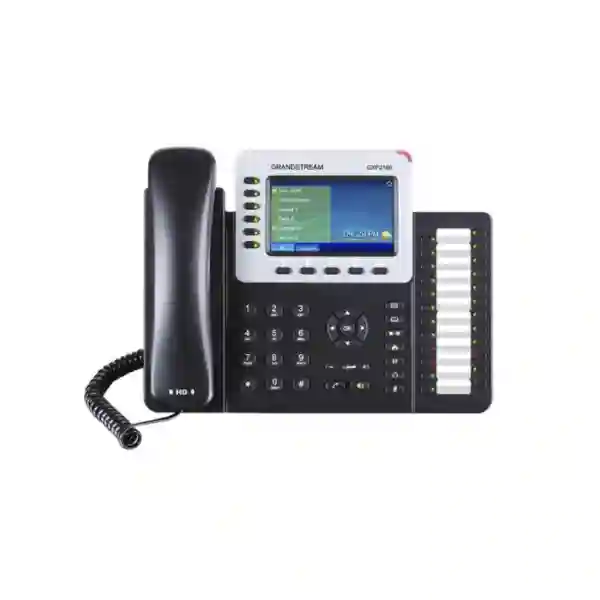
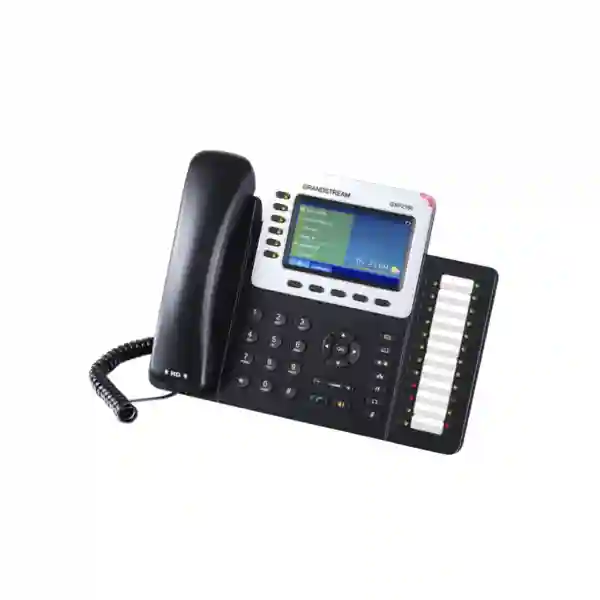
The Grandstream GXP2160 is an enterprise-class SIP desk phone built for users who need fast access to multiple lines, colleagues and call-handling functions from a single desktop endpoint. Grandstream specifies support for 6 lines and 6 SIP accounts, a 4.3-inch 480×272 color LCD, 24 dual-color BLF/speed-dial keys, dual Gigabit Ethernet with integrated Power over Ethernet, HD audio, Bluetooth, EHS headset support and 5-way voice conferencing. These capabilities make the GXP2160 especially relevant to reception desks, office administrators, customer-facing teams, supervisors and managers who handle frequent transfers, multiple extensions or higher call volumes. For Tanzania deployments, the phone should be considered as part of the complete voice environment: SIP service or IP PBX, network switching, PoE capacity, VLAN design, QoS, cabling, provisioning and user configuration all influence the final experience.
Useful for users who need multiple identities, line appearances or call-handling roles on one business endpoint.
Dedicated dual-color keys help users monitor extension presence and reach frequently used contacts or functions quickly.
Dual Gigabit Ethernet ports and integrated PoE simplify desk connectivity when the supporting switch and cabling are correctly planned.
HD audio on handset and speakerphone supports clearer conversation, while Bluetooth offers additional headset and mobile-device flexibility.
What the Grandstream GXP2160 is designed to solve
Many business users do not need only a dial pad and a single extension. A receptionist may need to see whether a colleague is available before transferring a caller. An office administrator may manage several departmental lines. A sales coordinator may need one-touch access to frequently called extensions. A supervisor may want a desk phone that can handle multiple calls while retaining familiar dedicated keys. The GXP2160 addresses these needs through a combination of six line keys, six SIP accounts, 24 programmable BLF/speed-dial keys, five programmable context-sensitive soft keys and a large color display. It is therefore best evaluated against the actual call workflow rather than purchased simply because it has a high feature count.
The network also matters. Because the GXP2160 uses SIP and Ethernet, call quality depends on stable switching, adequate LAN performance and correct voice configuration. A managed switch can provide VLAN separation and Quality of Service, while PoE can power the handset through the Ethernet cable when the switch provides sufficient budget. Organizations planning a larger rollout should also think about automated provisioning, extension naming, phonebook requirements, firmware management and configuration backups. FourTeck Tanzania’s business technology shop is a useful starting point for understanding how endpoint choice connects to broader infrastructure requirements.
Verified Grandstream GXP2160 capabilities
| Lines / SIP accounts | 6 lines, up to 6 SIP accounts |
| Display | 4.3-inch 480×272 TFT color LCD |
| Programmable keys | 24 dual-color BLF/speed-dial keys and 5 programmable context-sensitive soft keys |
| Network | Dual switched auto-sensing 10/100/1000 Mbps Gigabit Ethernet ports with integrated PoE |
| Audio | HD audio on handset and speakerphone; wideband codec support includes G.722 |
| Conferencing | Up to 5-way voice conferencing |
| Wireless / headset | Integrated Bluetooth plus RJ9 headset interface and EHS support |
| Provisioning / security | Grandstream documents TR-069 and encrypted XML provisioning, with TLS and SRTP among supported security technologies |
Deployment, compatibility and buying guidance
Before ordering a GXP2160, confirm the target PBX or SIP platform, extension count, intended line assignments, BLF requirements, PoE availability, VLAN design and headset preference. Grandstream documents broad SIP interoperability, but individual PBX features such as BLF, directory integration, provisioning templates and call recording are implemented differently by each platform. A proof-of-concept handset can be useful where a business uses a third-party PBX, hosted SIP platform or nonstandard call-control environment. The purpose is not to test basic dialing alone; it is to validate the complete workflow, including transfer, hold, BLF state, voicemail, caller ID, directory and any automated configuration process.
For new office builds, voice should be planned together with switching and structured cabling. The FourTeck Tanzania services page describes installation and integrated technology work that can be coordinated around network and telephony requirements. Businesses operating across East Africa can also reference FourTeck Uganda and FourTeck Kenya when procurement standards must be aligned across neighboring markets. For organizations with UAE operations, FourTeck’s Grandstream UAE resource provides a specialist regional reference for the same vendor ecosystem.
Grandstream GXP2160 Tanzania
For businesses in Tanzania, the Grandstream GXP2160 is most relevant where desk-phone users need more than basic calling. Reception points, administrative desks, sales coordination teams, service desks and supervisors often need to monitor several colleagues, move calls quickly and access frequently used extensions without searching through menus. The GXP2160’s six lines and six SIP accounts provide flexibility for multiple identities or call appearances, while the 24 dual-color BLF/speed-dial keys can be programmed around the organization’s actual extension map. Its 4.3-inch color display presents call information and menu navigation more clearly than basic monochrome endpoints, and the five programmable soft keys adapt to call context. For procurement teams, the key question is whether these capabilities match a real user role. If most employees need only one extension and basic calling, a simpler endpoint may be more economical; if a receptionist is handling constant transfers, the GXP2160 can justify its higher key density through workflow efficiency.
A Tanzania deployment should also account for the supporting network. The phone includes dual Gigabit Ethernet ports and integrated PoE, allowing a desk computer to share the phone’s network path and allowing compatible PoE switching to power the handset. Before rollout, verify that access switches have enough PoE budget, that cabling is correctly terminated, and that voice VLAN and QoS settings are planned where required. If power interruptions are a concern, keeping the PoE switches, router, firewall and PBX on correctly sized UPS protection can help maintain service during short disruptions. For multi-site organizations, consistent extension numbering, device naming, provisioning templates and firmware policy make ongoing support easier.
Compatibility must be confirmed with the chosen IP PBX or hosted SIP platform. Grandstream lists SIP RFC3261 and a broad set of common network and security protocols, and the GXP2160 supports automated provisioning methods including TR-069 and encrypted XML configuration. That makes the model practical for organizations that want standardized configuration across many desks, but the exact provisioning workflow depends on the PBX or management environment. Buyers should provide FourTeck with the PBX brand and model, expected quantity, user roles, number of SIP accounts per phone, headset requirements and whether PoE is already available. This information helps prepare a quotation around the complete requirement rather than only the handset quantity.
Grandstream GXP2160 Dar es Salaam
In Dar es Salaam, the GXP2160 fits business environments where inbound and internal call traffic is concentrated around reception, customer service, administration and management desks. Corporate offices, logistics companies, professional services firms, hospitality operations, healthcare administration, education offices and multi-branch businesses can all have users who need fast visual access to extension status. The 24 BLF/speed-dial keys are useful when a receptionist needs to see whether a person is busy before transferring a caller, while six lines and six SIP accounts can support more complex call assignments. The color screen, dedicated function keys and five-way conferencing also reduce dependence on software controls for common desk-phone tasks.
Dar es Salaam offices often combine phones, computers, wireless access points and security devices on the same Ethernet infrastructure. The GXP2160’s dual Gigabit ports allow the phone and a connected workstation to share a single desk drop where the network has been designed appropriately. Integrated PoE can reduce local power adapters, but only if the access switch supports 802.3af PoE and has adequate total power budget. Larger installations should consider a dedicated voice VLAN, prioritization for RTP traffic, DHCP options where used, and a documented switch-port strategy. These design choices become important when dozens of phones share the network with large file transfers, cloud applications, cameras or guest Wi-Fi.
For a quotation in Dar es Salaam, it is useful to specify whether the GXP2160 will replace an existing SIP phone, be added to a current IP PBX, or form part of a new phone-system deployment. Existing installations may require confirmation of SIP credentials, firmware compatibility, BLF behavior and directory integration. New systems require broader planning around trunks, numbering, IVR, call groups, voicemail, recording policy and remote extensions. A high-feature handset performs best when those call flows are designed first. Organizations should also identify which users genuinely need 24 BLF keys and which users can use simpler models, because mixed endpoint profiles often provide a more efficient overall budget while still giving high-volume call handlers the tools they need.
Grandstream GXP2160 Mwanza
Businesses in Mwanza evaluating the Grandstream GXP2160 should start with the communication pattern at each desk. A branch reception, administrative office, dispatch coordinator, customer-care position or manager who frequently handles several simultaneous calls can benefit from the model’s six lines, six SIP accounts and 24 programmable BLF/speed-dial keys. The physical BLF layout is particularly practical when staff need to transfer calls rapidly because it keeps commonly used extensions visible and reachable without navigating through multiple menus. The 4.3-inch color display gives additional context for call information and menus, while HD audio and Bluetooth support provide flexibility for users who spend substantial time on voice calls.
For Mwanza sites, network readiness should be checked before phones are ordered in quantity. The GXP2160 has dual Gigabit Ethernet ports with integrated PoE, so a PoE-capable managed switch can both connect and power the phone. If a workstation is connected through the phone, administrators should confirm VLAN behavior and switch configuration so voice and data traffic are handled as intended. Where a branch depends on WAN connectivity to reach a centralized PBX or hosted SIP platform, internet stability, latency, firewall policy and failover design can affect call quality more than the handset itself. A backup link may be worth considering for sites where telephone availability is operationally important.
Procurement should include the surrounding accessories and configuration requirements. Confirm whether users need wired EHS headsets, Bluetooth headsets, wall mounting or standard desktop placement. Define the extension list and BLF key assignments before deployment where possible, because consistent templates reduce configuration time. If the organization has several branches, standardizing the GXP2160 for receptionist or supervisor roles while using simpler phones for general users can simplify training and spare management. When requesting a quotation, include the number of endpoints, PBX platform, PoE availability, branch connectivity, desired headsets and any requirement for installation or remote configuration. That information gives the supplier a clearer basis for matching the phone with the complete voice environment.
Grandstream GXP2160 Arusha
The Grandstream GXP2160 can suit Arusha organizations that need professional desk telephony for reception, reservations, administration, operations and executive users. Hospitality companies, tour operators, education providers, NGOs, professional offices and other service-driven organizations may rely on quick transfers and clear communication between departments. The GXP2160 provides 24 dual-color BLF/speed-dial keys that can represent rooms, departments, managers or frequently used external numbers, making it easier for a high-traffic desk to route callers efficiently. Six SIP accounts also allow the phone to participate in more than one call identity where the PBX configuration requires it.
The handset’s dual Gigabit network interfaces are useful in modern offices where a computer and phone share a desk connection. Integrated PoE can simplify cabling by removing the need for a separate power adapter at each desk, but the upstream switch must provide the required PoE and should be sized for the whole endpoint count. Voice performance should be protected with a stable LAN, appropriate QoS and a well-configured firewall. If calls traverse the public internet to a hosted SIP provider or centralized PBX, bandwidth alone is not the only consideration; packet loss, jitter and latency also influence audio quality. Organizations with critical reservations or customer-service functions should therefore evaluate the entire communications path.
For deployments across hotels, offices or multiple Arusha properties, centralized provisioning can make maintenance easier. Grandstream supports automated provisioning approaches including TR-069 and encrypted XML configuration, helping administrators apply standard settings at scale. A rollout plan can define firmware, extension labels, time settings, phonebook sources, security credentials and BLF assignments before handover. Procurement teams should ask whether the intended SIP platform supports the desired functions exactly as expected, particularly BLF, transfer, voicemail and directory behavior. A small validation deployment can confirm the workflow before larger quantities are commissioned. This reduces surprises and provides users with a consistent configuration from the first day of production use.
Grandstream GXP2160 Dodoma
In Dodoma, the Grandstream GXP2160 is a strong candidate for offices that need structured, multi-line SIP calling at key desks. Administrative departments, reception points, institutions, professional organizations and service teams can use its six lines, six SIP accounts and 24 BLF/speed-dial keys to organize frequently used call paths. Rather than treating every phone identically, organizations can assign the GXP2160 to staff who manage transfers, multiple departments or heavy call volume. The high-density key layout is most valuable when the extension map is deliberately programmed around real workflows, such as finance, procurement, HR, management, security or branch locations.
A successful Dodoma deployment should include a review of the network closet as well as the desktop. PoE switching can power the handset over the LAN cable, and the second Gigabit port can connect a workstation. Managed switches make it easier to separate voice traffic, prioritize it and monitor port status. Network documentation should identify voice VLANs, switch ports, patch-panel positions, extension numbers and handset MAC addresses where those details are used operationally. If the phone system depends on a central PBX at another site, WAN resilience should be evaluated. A voice endpoint cannot compensate for unstable routing or an unavailable SIP server.
Security and administration are equally important. Grandstream documents TLS and SRTP support, along with administrator controls and encrypted provisioning options. The exact security configuration still depends on the PBX and network design. Default credentials should be changed, remote management should be limited appropriately, and firmware updates should follow a controlled process. When requesting GXP2160 pricing or a formal quotation, provide the exact number of phones, deployment locations, PBX platform, line requirements and any accessories. If the project also includes switching, structured cabling, UPS protection or firewall changes, including them in the same scope can reduce integration gaps and produce a more complete bill of materials for procurement approval.
Grandstream GXP2160 UAE
For UAE operations, the Grandstream GXP2160 remains relevant to receptionists, office administrators, executive assistants and other users who manage frequent calls. Its six lines, six SIP accounts and 24 physical BLF/speed-dial keys provide a familiar desk-phone interface for organizations that want visible extension status and fast one-touch access. The 4.3-inch color LCD, HD audio, Bluetooth and five-way conferencing support a broader professional communications workflow, while dual Gigabit Ethernet helps the handset fit into modern switched office networks. Businesses with sites in both Tanzania and the UAE can use the same user-role logic when standardizing endpoints across regions.
Cross-region standardization is useful when IT teams support several offices. A common phone model for reception or supervisory roles can simplify configuration templates, training, spare planning and troubleshooting. However, the SIP provider, PBX location and network policies may differ between countries, so each site still requires validation. UAE deployments may use on-premises PBX infrastructure, hosted voice platforms or regional SIP services; compatibility with BLF, directory, transfer and provisioning should be confirmed for the exact platform. If extensions traverse a VPN or WAN connection between offices, latency and failover strategy should be examined before the phone profile is finalized.
The GXP2160’s integrated PoE and dual Gigabit ports can simplify desks where one structured-cabling outlet serves both the phone and a computer. Managed switching, voice VLANs and QoS are recommended considerations in higher-density environments. Procurement teams should identify whether phones will be shipped as hardware only or require configuration, deployment and documentation. They should also specify headset preferences and whether centralized provisioning is desired. For multinational organizations, keeping a controlled list of approved phone models and standard configuration parameters can reduce support variation while still allowing local SIP settings and regulatory requirements to be handled site by site.
Grandstream GXP2160 Uganda
In Uganda, organizations considering the Grandstream GXP2160 can evaluate it as a high-feature endpoint for staff who need visible line control and rapid extension access. The model supports six lines and six SIP accounts, giving flexibility for shared departmental identities, executive lines or multi-role users. Twenty-four programmable BLF/speed-dial keys help reception and administration teams monitor extension status and execute transfers more efficiently. This can be valuable in multi-department offices, hospitality, education, healthcare administration, professional services and other environments where callers frequently move between teams.
The phone’s network design aligns well with managed office LANs because it provides dual Gigabit Ethernet and integrated PoE. A business can connect the phone to the access switch and pass network connectivity to a workstation, reducing the need for a second desk outlet in suitable designs. Nevertheless, the switch configuration should separate or prioritize voice traffic when required, and the total PoE budget must cover the complete phone count. For branch deployments that connect to a central PBX, reliable WAN service and clear firewall rules are essential. SIP and RTP traffic can be sensitive to packet loss and jitter, so internet quality should be assessed rather than judged only by headline bandwidth.
Before requesting a quotation, Uganda customers should provide details about their PBX platform, number of phones, line requirements, desired BLF assignments and whether headsets are needed. Organizations replacing older analog or digital systems may need a broader migration plan covering SIP trunks, numbering, IVR, voicemail and user training. Existing VoIP users may simply need endpoint replacement and provisioning. Grandstream’s documented provisioning methods can help when multiple GXP2160 phones must be configured consistently. A well-defined deployment template should include firmware level, extension naming, security credentials, phonebook sources and key assignments so future support staff can understand the installation without rebuilding the configuration from scratch.
Grandstream GXP2160 Kampala
Kampala businesses with busy reception and customer-facing teams can use the Grandstream GXP2160 to centralize high-volume call handling at the desktop. Six lines and six SIP accounts provide flexibility for several call identities, while 24 dual-color BLF/speed-dial keys give operators direct access to extensions without relying entirely on screen menus. This is particularly useful for receptionists, administrative coordinators, call-handling supervisors and executive assistants who frequently transfer callers or monitor colleague availability. The color display and dedicated call-control keys make the phone easier to operate during fast-paced interactions.
Office network planning in Kampala should include the phone as a managed IP endpoint. The GXP2160 supports dual Gigabit Ethernet and PoE, which can simplify deployment where a compatible managed switch powers endpoints centrally. A voice VLAN can separate phones from general data traffic, and QoS can help protect voice packets when the same network carries large downloads, cloud backups or video. If the phone reaches a cloud PBX over the internet, edge-firewall configuration and ISP stability become part of the voice design. For critical business functions, redundant connectivity may be appropriate, but it should be engineered around the whole PBX and network rather than the handset alone.
A Kampala deployment can also benefit from role-based endpoint selection. Not every employee needs 24 BLF keys. Use the GXP2160 where high call visibility has operational value and choose simpler SIP endpoints for users who mainly place and receive individual calls. This approach controls cost while maintaining a common SIP platform. When requesting pricing, specify the quantity of GXP2160 units, other phone profiles, PBX model, SIP provider, PoE switching status and any requirement for configuration. If the organization has branches outside Kampala, document naming, extension ranges and provisioning conventions centrally so the telephony system can scale without producing a different configuration standard at every location.
Grandstream GXP2160 Arua
For organizations in Arua, the Grandstream GXP2160 can serve as a capable central desk phone where one user coordinates communication for several people or departments. Its six lines, six SIP accounts and 24 programmable BLF/speed-dial keys support reception, branch administration, dispatch, front-office and supervisory roles that need immediate access to frequently contacted extensions. The phone’s HD audio and color screen improve the everyday user experience, while Bluetooth and headset support can help users who need hands-free operation during longer calling periods.
Branch connectivity deserves special attention when a GXP2160 is installed away from the main PBX. If the PBX is located in Kampala, Tanzania, a data center or the cloud, voice traffic depends on the WAN or public internet path. Before rollout, test latency, packet loss and stability at the site, confirm firewall and NAT behavior, and determine what happens if the primary connection fails. Voice quality problems are often network symptoms rather than handset defects. Where service continuity is important, organizations can consider appropriately designed secondary connectivity and ensure that switching, routers and PBX infrastructure receive UPS protection according to operational priorities.
The handset itself supports centralized provisioning methods that are useful when IT staff manage devices remotely. A standard configuration can define SIP accounts, BLF keys, time zone, directories, security credentials and firmware policy. Remote administration should be protected rather than left exposed, and changes should be documented. For quotation preparation, Arua buyers should state whether the project is hardware supply only, a replacement within an existing SIP system or part of a new IP PBX deployment. Include the number of extensions, call-flow requirements, PoE switch availability, headset needs and any remote-support expectations. Clear input lets the solution be sized around operational requirements instead of guessing from handset specifications alone.
Grandstream GXP2160 Mbarara
Mbarara organizations can consider the Grandstream GXP2160 for desks that act as communication hubs. A receptionist transferring calls across departments, an administrator coordinating several teams or a manager using multiple SIP identities can benefit from six lines and six SIP accounts. The 24 BLF/speed-dial keys make extension monitoring visible, which can reduce the time spent opening directories or asking whether a colleague is available. For environments with recurring call patterns, programming these keys around actual departments and staff can make the phone considerably more useful than a generic out-of-box setup.
The network should be prepared for business voice. The GXP2160’s integrated PoE allows centralized power from a suitable Ethernet switch, and the dual Gigabit ports can accommodate a workstation behind the handset. Administrators should verify switch PoE capacity, patching quality and VLAN configuration before quantity deployment. If other high-bandwidth services such as CCTV or large cloud synchronization share the same links, QoS and network segmentation can help protect voice performance. A UPS-backed access switch can also improve resilience during short power interruptions because the handset can remain powered as long as the upstream voice infrastructure is also available.
Mbarara procurement teams should distinguish endpoint features from PBX features. The phone can provide the physical keys, display and SIP capabilities, but voicemail, queues, IVR, call recording and advanced reporting are normally controlled by the PBX or service platform. Therefore, confirm the complete system requirement rather than assuming the handset alone provides every function. A quote request should include the PBX brand, expected number of users, desired GXP2160 quantity, whether other endpoint models are needed, and whether installation or configuration is in scope. For multi-branch organizations, a consistent extension plan and provisioning template can simplify later moves, additions and changes.
Grandstream GXP2160 Gulu
The Grandstream GXP2160 can be a practical choice in Gulu for organizations that need a feature-rich desk phone at reception, administration or coordination points. Its 24 BLF/speed-dial keys give users a direct visual map of frequently used extensions, while six lines and six SIP accounts provide flexibility for handling multiple calls and identities. This is useful in offices where a small number of staff handle a large proportion of incoming communication. The 4.3-inch color display, dedicated transfer and conference controls, HD audio and Bluetooth support help the handset function as a full business communication endpoint rather than a basic telephone.
For sites that connect to a remote PBX, the WAN should be considered part of the telephone system. Voice traffic can become unstable when packet loss or jitter rises even when ordinary web browsing still appears acceptable. Network monitoring, QoS and a stable firewall configuration are therefore important. The phone includes dual Gigabit Ethernet and PoE, so it can integrate with managed switching and share desk connectivity with a PC. Organizations should calculate the PoE budget for all endpoints and make sure switch and UPS sizing reflect actual requirements instead of only port count.
Gulu buyers planning a new voice deployment should define user groups before selecting quantities. Receptionists and supervisors may justify the GXP2160, while standard staff may need fewer keys. This role-based approach helps keep the solution efficient and easier to support. Automated provisioning can be valuable when devices are deployed across more than one site, because standardized settings reduce manual configuration. Before procurement, verify SIP platform compatibility, headset choice, any wall-mounting requirement, and the availability of structured cabling at each desk. A detailed bill of materials should include the dependencies that allow the phone to work correctly, not only the phone itself.
Grandstream GXP2160 Kenya
Kenya businesses considering the Grandstream GXP2160 can position it as a premium call-handling endpoint for receptionist, administrative and supervisory roles. The phone’s six lines, six SIP accounts and 24 BLF/speed-dial keys provide a dense physical interface for organizations that value quick transfers and extension monitoring. The 4.3-inch color display, five programmable soft keys, HD audio and Bluetooth add usability for employees who spend a large part of the day handling calls. For companies that operate in both Kenya and Tanzania, standardizing the same phone model for similar user roles can simplify support and user training.
Standardization should still allow for local PBX and carrier differences. One branch may connect to an on-premises IP PBX while another uses a hosted SIP platform. Before a cross-border rollout, test the features that matter most: BLF status, transfer behavior, voicemail notification, caller ID, directory access and provisioning. Grandstream supports common SIP standards and multiple provisioning methods, but implementation details can vary between PBX platforms. A documented test plan prevents procurement from assuming that every advanced feature behaves identically on every service.
From the network side, dual Gigabit ports and integrated PoE make the GXP2160 suitable for structured office deployments. Managed PoE switches can power the phones centrally, and voice VLANs can separate telephony from general data traffic. For branches that rely on inter-site connectivity to reach call control, WAN resilience should be planned alongside the phone deployment. Kenyan procurement teams should request a quote with quantities, user profiles, PBX details, PoE status and accessories clearly listed. If the project spans multiple East African offices, use consistent naming, extension ranges and configuration templates so administrators can support the environment as one system rather than a collection of unrelated branch installations.
Grandstream GXP2160 Kuwait
For Kuwait offices, the Grandstream GXP2160 can support demanding business users who need several line appearances and immediate access to a larger extension list. The combination of six SIP accounts and 24 BLF/speed-dial keys is well suited to front desks, executive assistants, administrative teams and service coordinators. A user can assign frequently contacted colleagues or functions to dedicated keys and see presence states where supported by the PBX. The color display, HD audio and headset options support day-to-day professional use without shifting common call controls to a computer application.
Multinational organizations that operate in Kuwait and East Africa can benefit from using the same endpoint standard where workflows are similar. This does not mean every site must use identical network settings. SIP trunks, hosted services, dial plans and firewall policies may differ by country, so local telephony requirements must be validated. The GXP2160 supports common SIP and security protocols, which helps it integrate into many environments, but the target PBX should be tested for the precise feature set the organization expects.
Network design remains important. Dual Gigabit Ethernet and PoE allow a clean desk deployment where a managed PoE switch supplies both connectivity and power. VLANs and QoS can help maintain voice quality on converged networks. If the phone system is centralized in another geography, latency and WAN reliability should be assessed before deciding where call control should reside. Kuwait buyers requesting a quotation should state whether the phones are for a new branch, replacement project or common corporate standard. Include required quantities, SIP platform, headset needs and configuration scope so that pricing reflects the operational deployment rather than an incomplete hardware-only list.
Grandstream GXP2160 Ghana
In Ghana, the Grandstream GXP2160 can serve organizations that need a dependable high-feature SIP phone for intensive call handling. Reception desks, customer-service coordinators, branch administrators and managers can use six lines, six SIP accounts and 24 BLF/speed-dial keys to manage multiple extensions more efficiently. The physical key layout is especially useful when the user repeatedly calls or transfers to the same group of colleagues. The 4.3-inch screen, HD audio, Bluetooth and five-way conferencing give the device additional flexibility for daily office communication.
A Ghana deployment should be planned around the selected voice architecture. If the business uses a hosted PBX, internet quality and firewall configuration become critical to call reliability. If the PBX is local, switch design, UPS protection and trunk connectivity need attention. The phone’s dual Gigabit Ethernet ports and integrated PoE support modern structured networks, but the PoE switch must have enough budget for all connected endpoints. Managed switching also enables VLAN and QoS policies that can help separate and prioritize real-time voice traffic.
For organizations with several offices, centralized provisioning can reduce repetitive configuration. Grandstream documents TR-069 and encrypted XML provisioning options, allowing administrators to apply standard settings where the management platform supports them. A Ghana quote request should identify the number of phones, PBX or SIP service, required line profiles, BLF assignments and desired accessories. Buyers should also ask which services are included: hardware supply, preconfiguration, onsite installation, remote deployment or ongoing support. This distinction helps procurement compare quotations fairly and ensures that any dependencies such as switches, cabling or UPS equipment are included before installation begins rather than discovered at the desk.
Grandstream GXP2160 Nigeria
Nigeria businesses with larger offices or high call volumes can deploy the Grandstream GXP2160 for staff who need fast access to multiple lines and colleagues. Its six lines, six SIP accounts and 24 dual-color BLF/speed-dial keys provide a dense call-control interface suitable for reception, executive support, customer service and operations. When BLF is correctly integrated with the PBX, the user can view extension state and transfer calls more confidently. HD audio, a 4.3-inch color display and Bluetooth support add comfort for users who handle calls throughout the day.
Voice resilience should be designed beyond the phone. Where hosted SIP or centralized PBX services are used, internet links, firewall rules and failover strategy can determine availability. A second internet connection only helps if routing and SIP behavior are designed to use it correctly. At the LAN layer, managed PoE switches can power the GXP2160 and support voice VLANs and QoS. The phone’s second Gigabit port can pass connectivity to a desk computer, which can reduce cabling requirements in suitable office designs while maintaining full Gigabit capability.
Nigeria procurement teams should define which users need the GXP2160 and which can use lower-feature endpoints. A role-based handset plan usually gives better value than assigning an identical premium phone to every employee. For multi-site organizations, create a standard template for extension naming, BLF keys, firmware and security settings. The exact PBX platform should be validated with the required features before bulk deployment. When asking for pricing, include the deployment city or cities, quantities, PBX details, PoE availability, headset requirements and support scope. This creates a clearer technical and commercial comparison and reduces the risk that a low hardware-only quote omits important implementation work.
Grandstream GXP2160 Seychelles
For Seychelles organizations, particularly hospitality, professional services, administration and multi-site operations, the Grandstream GXP2160 can be useful at desks that coordinate frequent inbound calls. Its six SIP accounts and 24 BLF/speed-dial keys are valuable where a receptionist or administrator must reach rooms, departments, managers or service teams quickly. The large color display and dedicated controls support fast call handling, while HD audio and Bluetooth provide options for users who need comfortable long-duration calling. The phone should be matched to the user role rather than selected solely on specification.
Island and multi-property environments can make centralized telephony attractive, but connectivity planning becomes important. If phones at separate locations register to one central PBX, the WAN path must provide stable latency and low packet loss. A failure in the internet link can affect voice even when the phone hardware remains powered. Businesses should decide which services must continue during link outages and whether local survivability, secondary connectivity or alternative routing is needed. On each LAN, PoE switching can simplify power and structured cabling, while QoS and VLANs can help preserve voice performance alongside guest Wi-Fi, office data and other services.
When purchasing the GXP2160 for Seychelles, identify the PBX, desired extension quantity, handset roles and required accessories. Hospitality organizations may have a mix of front-desk, back-office and guest-room requirements; the GXP2160 is better suited to feature-rich operational desks than to every endpoint. Grandstream’s provisioning capabilities can help standardize settings across multiple properties, but the deployment should include documented credentials, firmware, directory sources and BLF assignments. A quotation should clearly state whether configuration, remote support, installation or network changes are included so the buyer can assess the complete project cost and avoid assuming that endpoint hardware alone delivers a finished phone system.
Grandstream GXP2160 FAQs
How many lines and SIP accounts does the GXP2160 support?
Grandstream specifies 6 lines and up to 6 SIP accounts for the GXP2160. The way those accounts are used depends on the PBX and the organization’s call-flow design.
Does the GXP2160 support PoE?
Yes. The phone has dual Gigabit Ethernet ports with integrated PoE. The upstream switch must support the required PoE standard and have enough available power budget for the complete phone deployment.
What are the 24 BLF keys used for?
They can be programmed for Busy Lamp Field monitoring, speed dial and other supported functions. Receptionists commonly use BLF to see extension status and reach or transfer to colleagues quickly, subject to PBX support.
Can the GXP2160 work with a third-party SIP PBX?
Grandstream documents broad SIP interoperability. However, buyers should verify advanced functions such as BLF, provisioning, directory integration, transfer behavior and voicemail notification with the specific PBX platform before a large rollout.
Does the GXP2160 support Bluetooth headsets?
The GXP2160 includes integrated Bluetooth. It also has an RJ9 headset interface and supports EHS with compatible headsets, giving organizations several headset deployment options.
Quotation checklist
For a more accurate quotation, provide the required phone quantity, PBX or hosted SIP platform, number of SIP accounts per user, preferred BLF assignments, PoE-switch availability, headset requirements, installation locations, cabling status and whether configuration or onsite deployment is required. For replacement projects, include the existing phone model and any features users rely on today.
Decision recap
Choose the GXP2160 when the user genuinely benefits from six lines, six SIP accounts and a large bank of 24 BLF/speed-dial keys. Confirm PBX compatibility, PoE, VLAN and provisioning before rollout. For organizations with mixed user roles, reserve the GXP2160 for higher-volume call handlers and combine it with simpler SIP phones where fewer controls are sufficient.
Plan the GXP2160 as part of the complete voice system
A business phone delivers the best result when the PBX, SIP service, switching, PoE, cabling, VLANs and call flow are designed together. Share your user count, locations, current phone system and required call features so FourTeck can help frame the correct endpoint mix and supporting infrastructure for your Tanzania deployment.




Reviews
There are no reviews yet.