
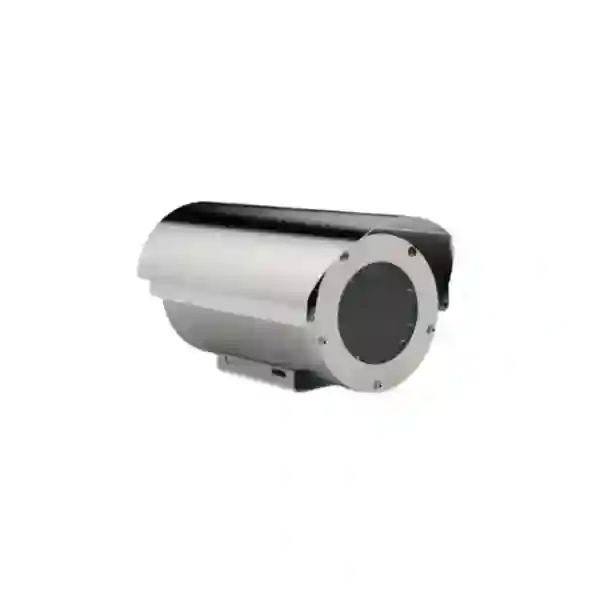
Hanwha Vision • Industrial IP Surveillance
Hanwha TNO-X6320EPT0-C Explosion-Proof Zoom Camera
Full-HD industrial video, 32x optical zoom and a stainless-steel explosion-proof housing for carefully engineered fixed-view surveillance.
Planning a Tanzania industrial security installation? Request an exact-model review that includes hazardous-area markings, viewing distance, network design and commercial availability before purchase.
At a glance
The table below summarizes the most relevant published manufacturer specifications for initial technical screening. Values are not a substitute for the current exact-model datasheet, certificate package or project acceptance test.
| Item | Manufacturer-listed specification |
|---|---|
| Imaging sensor | 1/2.8-inch CMOS; 1920 × 1080 maximum |
| Frame rate | H.265/H.264 up to 60 fps (60 Hz) / 50 fps (50 Hz) |
| Lens / autofocus | 4.44–142.6 mm; 32x optical; auto, manual or one-shot AF |
| Horizontal view | Approximately 61.8°–2.19° |
| Minimum illumination | Colour 0.05 lux; B/W 0.005 lux (1/30 sec, 30 IRE) |
| Image enhancement | 150 dB WDR, defog, digital stabilization, day/night |
| Compression / interfaces | H.265, H.264, MJPEG; RJ-45 10/100BASE-T; ONVIF S/G/T |
| Analytics | Motion, tamper, virtual area/line and other listed event types |
| Edge storage | Dual microSD/SDHC/SDXC; up to 256 GB per slot |
| Power | IEEE 802.3af Class 3 PoE; 12.0 W listed |
| Housing / protection | STS316L stainless steel; IP66 / IP67 |
| Temperature / humidity | −10°C to +55°C; 0–90% RH non-condensing |
| Dimensions / mass | 176 × 334 mm; approximately 8.54 kg |
| Variant | TNO-X6320EPT0-C; confirm current certificate markings before use |
What this industrial network camera is designed to solve
Conventional security cameras are useful in offices, retail buildings and normal perimeter settings, but some industrial monitoring points pose a different problem. Operators may need to see valves, processing equipment, access routes and distant assets from positions where the environment itself demands a carefully selected enclosure and installation method. The Hanwha TNO-X6320EPT0-C combines a full-HD network camera, a 32x optical zoom lens and a stainless-steel explosion-proof housing in a single specified product. It is intended for projects where optical detail and a documented hazardous-area equipment selection process are both important.
The immediate benefit to a security integrator or plant engineer is being able to evaluate camera performance and enclosure characteristics together. Rather than choosing an ordinary camera and assuming a generic protective box makes it suitable, the buyer can start with an identifiable manufacturer model and examine its certifications, power requirements, dimensions, optical performance and network interfaces. This makes project documentation clearer and reduces the chance of incompatible assumptions between security, electrical and safety teams.
The model is a zoom camera, not a motorized pan-tilt-zoom unit. Its 32x optical zoom adjusts the field of view, but the product information does not establish remote horizontal or vertical movement of the complete camera housing. Where the task requires following a moving target around a large site, confirm whether a separately selected PTZ configuration is necessary. Where a stable viewing direction and adjustable image magnification are sufficient, this fixed-position zoom design may be a sensible specification candidate.
For projects in Tanzania, describe the installation site, the hazardous-area classification if applicable, the distance to the objects being monitored and the intended network architecture before requesting a quotation. Those details influence whether this exact model is appropriate; the model name alone cannot establish approval for every industrial location.
A specification snapshot that helps procurement teams compare
The imaging hardware is a 1/2.8-inch CMOS sensor with a maximum stated resolution of 1920 by 1080 pixels. Hanwha lists up to 60 frames per second using H.265 or H.264 under 60 Hz conditions, with a corresponding 50 fps figure under 50 Hz conditions. The lens spans 4.44 to 142.6 mm and supports 32x optical zoom, autofocus, manual focus and one-shot autofocus. These are useful figures for engineers assessing both broad situational views and targeted inspection views.
The manufacturer specifies 150 dB Wide Dynamic Range, built-in gyro-assisted digital image stabilization, defog support and automatic day/night operation. Local edge recording can use two microSD/SDHC/SDXC slots, each accommodating a card up to 256 GB, for a stated combined maximum of 512 GB. Cards are not assumed to be supplied. Network video compression options include H.265, H.264 and MJPEG, supporting a range of recorder and client requirements.
For infrastructure planning, note the RJ-45 10/100BASE-T interface, IEEE 802.3af Class 3 Power over Ethernet and listed power consumption of 12.0 W. The enclosure material is STS316L stainless steel; listed dimensions are 176 by 334 mm and stated weight is approximately 8.54 kg. The manufacturer lists IP66 and IP67 ingress protection and an operating ambient temperature range of minus 10 to plus 55 degrees Celsius.
These headline numbers are product specifications, not a substitute for a complete installation design. Verify current revision documentation, lens positioning, required accessories, local operating conditions and the exact certification markings of the supplied variant before accepting the product for a project.
The practical value of 32x optical zoom
Optical zoom is especially useful where a monitoring point needs to capture a broad scene during normal operation but occasionally examine an object farther away. The TNO-X6320EPT0-C changes its optical focal length between 4.44 mm and 142.6 mm, providing a narrower field of view as magnification increases. This differs from digital zoom, which enlarges recorded pixels without capturing new optical detail. For industrial monitoring, the choice can affect whether a fixed camera position can serve both general observation and closer examination of selected plant components.
Hanwha quotes a horizontal angle of view from approximately 61.8 degrees at the wide end down to 2.19 degrees at the telephoto end. The vertical angle ranges from about 36.2 degrees to 1.24 degrees. These figures provide a starting point for mapping the view across a known distance. A narrow telephoto view covers a much smaller area, so it is unsuitable as the only view of a wide yard when the operator also needs comprehensive coverage. It is often better to use a dedicated overview camera as part of the overall system.
Autofocus is useful when operators adjust zoom during a live inspection. Manual and one-shot focus modes provide additional control where the scene contains foreground objects that may distract automatic focusing. The stated minimum object distance is 1.5 metres; do not assume the lens will focus on a component closer than its specified near limit.
Before ordering, identify the smallest feature the operator must recognize, the approximate viewing distance, the expected camera mounting height and whether the viewing direction will remain fixed. A demonstration image at a comparable distance is more informative than assuming a 32x zoom number proves every inspection objective is achievable.
Full-HD video and frame rate in real operations
The camera can produce Full-HD 1920 by 1080 video and supports several lower output resolutions for different viewing profiles. Full-HD is valuable when the installation requires identifiable scene detail, but image usefulness also depends on target size in the frame, lens focus, viewing angle, movement, available light and compression settings. A specification sheet cannot guarantee that a camera will identify a label, gauge reading or person at an unspecified distance.
The listed maximum H.265 and H.264 frame rate is 60 fps under 60 Hz settings, or 50 fps under 50 Hz settings. Higher frame rates can improve the continuity of moving machinery or vehicle observation; however, they also influence network load, recorder processing and storage consumption. For equipment that changes slowly, a lower frame rate may be adequate. For a fast conveyor, moving vehicle or activity near a gate, assess the operational value of additional frames against bandwidth and retention requirements.
The available alternative resolutions can support lightweight operator views or recordings dedicated to particular analysis tasks. The right profile is chosen for the real decision being made. A control-room display might prioritize smooth, clear viewing, while a long-retention recording profile might emphasize sustainable storage and meaningful evidence quality.
Do not base storage calculations on frame rate alone. Record sample footage from the intended scene with the planned codec, resolution, frame rate and quality settings. Inspect difficult periods such as changing shadows, dawn, dusty weather and active machinery. Calculate network and storage needs from measured or conservatively estimated bitrate rather than from the maximum video resolution in isolation.
150 dB WDR, day/night switching and difficult lighting
Industrial scenes commonly mix dark sheltered equipment with bright sky, open yards or vehicle headlights. Hanwha specifies a Wide Dynamic Range value of 150 dB for this model. WDR is intended to preserve usable detail when bright and dark image regions appear together. That makes it relevant to entrances, outdoor machinery bays, loading areas and other sites with strong contrast. Its effectiveness should still be evaluated with images from the intended mounting position.
The camera supports automatic day/night switching with an infrared-cut filter mechanism. Its listed minimum illumination values are 0.05 lux in colour and 0.005 lux in black-and-white, each stated at 1/30-second exposure and 30 IRE. Those test conditions matter: minimum-illumination numbers are not a guarantee of sharp moving-object images at night. Long exposure, movement, lens position and site lighting can all affect the result.
Hanwha also lists high-light compensation, backlight compensation, noise reduction and electronic shutter controls. The 32x zoom lens has a variable maximum aperture from F1.6 at wide angle to F4.4 at telephoto, so available light at the sensor changes as the lens zooms in. A scene that looks clear when wide may require more illumination or different settings at full magnification.
This model should not be described as a thermal camera or as having a built-in infrared illuminator without exact-model evidence. For dark process areas, verify actual light levels and the hazardous-area suitability of any separate lighting equipment. A night test at the expected zoom setting will show more than a generic claim that the camera performs well in low light.
Weather, vibration and image clarity
Cameras on industrial structures may experience vibration from rotating machinery, changing atmospheric visibility and variable weather. Hanwha lists digital image stabilization supported by a built-in gyro sensor, along with a defog feature and digital noise reduction. These functions can make video more usable in some challenging situations, but they cannot compensate for every mechanical or environmental condition. An unstable bracket, excessively long mounting arm or severely obscured lens will still undermine the picture.
A particularly important point for optical zoom installations is that magnification also makes apparent movement in the image more noticeable. Small mounting vibrations may become more distracting at the telephoto end of the lens than at wide angle. Engineers should therefore specify a rigid support, review vibration sources and test the camera at its intended maximum zoom. The approximately 8.54 kg camera assembly also makes mount and structure selection a substantive engineering task.
Defog processing may improve visibility under some low-contrast conditions, but it does not physically clean the front glass or eliminate severe fog, rain, dust deposits or steam. This PoE-only variant is described in Hanwha product-family material as a version without a wiper. Do not assume the equipment includes a powered wiper, heater or other cleaning system because another similarly named explosion-proof model offers different accessories.
For exposed sites, arrange safe access for inspection and cleaning in the maintenance plan. Where heavy grime or continuous spray is expected, discuss lens visibility, maintenance intervals and whether a different approved model is required. A realistic visibility plan often matters more to surveillance success than an impressive optical specification alone.
Understanding the explosion-proof housing
The defining industrial characteristic of the TNO-X6320EPT0-C is its explosion-proof housing. In engineering terms, a hazardous-location camera must be selected and installed as part of a site-specific electrical safety design. An enclosure described as explosion-proof is not an unconditional declaration that it can be installed in any combustible gas, vapour or dust environment. Relevant details include the applicable location classification system, protection method, gas or dust group, temperature class, installation arrangement and markings on the exact supplied unit.
The manufacturer describes this model within its explosion-proof zoom camera range and identifies the enclosure as stainless steel. Its published specification includes cLCus C1/D1 and cLC CSA in the standards listing, while historical manufacturer product-family references distinguish the -C regional certification variant from other suffixes. The exact marking and certificate scope should be checked against the device nameplate and current certificate before a project engineer treats it as suitable for a particular classified area.
Classification methods used by an end-user project may differ from those stated on manufacturer marketing pages. Do not convert Class/Division language into a Zone approval or claim ATEX, IECEx or Tanzania-specific acceptance without supporting documentation. A project using a different regulatory framework may require a different model, approval or design decision. The manufacturer’s current specification is important, but it does not replace a facility’s hazardous-area dossier.
For procurement, request the complete and current certification package, product label information, relevant installation manual, the required cable entry and gland details, and any restrictions that apply to the operating temperature or mounting arrangement. Installation must follow the exact certified configuration and applicable electrical rules. This is a product for properly designed industrial systems, not a device to retrofit casually into an unspecified hazardous space.
Ingress protection and corrosion planning
Hanwha lists IP66 and IP67 according to IEC 60529 for this model. These are enclosure ingress-protection ratings, providing useful information about resistance to dust and water under defined test conditions. They do not mean the installed camera can be placed in any environment without considering cable entries, seals, mounting, maintenance and mechanical damage. Any installation that changes the certified enclosure or introduces an unsuitable fitting may compromise its suitability.
The enclosure is specified as STS316L stainless steel. That is relevant when evaluating locations with moisture or corrosive exposure, but material grade alone does not guarantee immunity to every chemical, salt deposit or industrial cleaning agent. A plant’s corrosion review should account for surrounding substances, exposure duration, maintenance access and any specified surface treatments or compatible mounting hardware.
The stated operating temperature is minus 10 to plus 55 degrees Celsius with 0 to 90 percent non-condensing relative humidity. Storage limits are different: minus 40 to plus 60 degrees Celsius. These figures should not be mixed up. Indoor roof spaces, sunlit enclosures and areas near hot process equipment can be substantially warmer than ambient weather reports imply. The specified operating range remains important even when an enclosure is described as rugged.
When designing a Tanzanian installation, ask whether the mounting point experiences direct sun, radiant heat, condensation, salty air, cleaning chemicals or airborne dust. Record those conditions and evaluate them against the manufacturer documentation and the site’s safety requirements. Avoid assuming that a stainless-steel, ingress-protected enclosure is automatically appropriate for every coastal, industrial or hazardous application.
PoE design and the network connection
The TNO-X6320EPT0-C uses IEEE 802.3af Class 3 Power over Ethernet, with a manufacturer-listed power consumption of 12.0 watts. This can simplify a design because the camera does not require a separately specified camera power supply at the mounting point. It does not eliminate the requirement for a compliant network and power distribution design, especially in a classified area where permissible cable routes, terminations and protective measures must be evaluated.
The Ethernet port is specified as RJ-45 10/100BASE-T. Check the cable path, transmission distance, outdoor exposure, voltage drop and the total PoE budget across the selected network switch. A switch’s overall power rating is not always the amount available on each individual port. Power allocation should leave a sensible engineering margin and consider other devices connected to the same switch or power source.
A long industrial route may need fibre infrastructure, a suitable media conversion architecture or an intermediate network cabinet. The appropriate solution depends on the approved hazardous-area boundary, equipment location and site topology. Do not assume an ordinary extender or switch can be installed inside a classified space. Any additional equipment must be chosen and installed under the applicable site requirements.
For continuity, consider which parts of the chain need backup power: the PoE switch, network uplinks, recording platform, local controls and monitoring displays. A camera with an efficient power input still becomes unavailable if an upstream network or electrical device loses power. Commissioning should include a deliberate power-restoration and network-reconnection test rather than only checking that live video appears after initial installation.
Network video compression and profile selection
Hanwha lists H.265, H.264 and MJPEG compression, along with WiseStream II, and supports up to ten streaming profiles. These capabilities give system designers options for balancing image quality, bandwidth and client compatibility. H.265 may reduce data requirements in suitable systems, but the actual improvement varies with scene complexity, motion, configuration and recorder support. Verify the selected video management system can decode the chosen format correctly.
A useful design might define one high-quality recording profile, another for a control-room monitor and a lower-bandwidth view for occasional remote checks. This does not mean all ten profiles need to be used. More video consumers can increase demand on the network, and simultaneous recording or viewing choices should be tested against the camera’s documented limits. The manufacturer lists unicast streaming to up to twenty users and multicast capability, but system-wide performance still depends on configuration.
Consider the way the camera is used during unusual operations. A plant may have many people checking a live feed during an incident, whereas normal operation involves just one recorder and a handful of authorized operators. The network should be assessed for both patterns. Where reliable multicast is part of the design, confirm switch configuration, routing and application support before deploying it.
A codec name or nominal bitrate target should never be the sole basis for performance claims. Set the resolution and frame rate according to the monitoring objective, evaluate representative footage, then check bandwidth under difficult conditions such as movement, low light and changing weather. This method produces a defensible recorder and network specification.
Intelligent video analytics without overstating automation
The camera offers a range of manufacturer-listed analytics including motion detection, tampering, fog detection, face detection, audio detection, sound classification and shock detection. Hanwha also describes virtual-area functions such as loitering, intrusion, enter/exit and appear/disappear, alongside virtual-line crossing and direction events. These capabilities can support operators who need to prioritize certain changes in an industrial scene.
A virtual line can be useful when the objective is to highlight movement across a defined access route, while an intrusion region may be appropriate for a restricted equipment compound. Tamper detection can help alert staff to unexpected changes in the view, and shock detection can provide another diagnostic signal. None of these features should be described as a certified safety instrument, a replacement for gas detection or a guarantee of reliable event identification in every environment.
Analytics require careful placement and tuning. Small distant targets at wide angle, moving vegetation, reflections, steam, changing shadows and machinery movement can affect results. Zooming also changes the composition of the scene and therefore the practical meaning of fixed zones. The integrator should confirm how analytic configurations behave when the lens position is changed, and test the resulting alarms under actual operating conditions.
An effective commissioning plan begins with a limited number of high-value alerts. Define the detection objective, where the response goes, who reviews it and what happens when a false or missed alert occurs. Use routine testing and operator feedback to refine thresholds and regions. This is more useful than turning on every analytic feature and assuming more alerts always improve security.
Edge storage, recording and retention decisions
Two built-in microSD/SDHC/SDXC memory slots support cards up to 256 GB each, for a stated maximum combined capacity of 512 GB. This feature can be valuable for local event clips, additional recording options or resilience in a planned architecture. A memory-slot specification does not mean the camera is shipped with cards, that two cards always record simultaneously in a particular configuration, or that edge storage alone will meet an organization’s retention obligations.
The product information lists events that may trigger storage recording or related actions, and also refers to NAS recording options. The actual workflow depends on firmware, configuration and the external platform. Test which events are recorded, what video is available before and after the event, how retained material is exported and how the device behaves when storage is full. Storage cards are finite media and must be selected for the intended recording workload and environment.
Retention depends on average and peak video bitrate, hours recorded each day, event frequency, the number of profiles retained and whether audio is included. For example, an installation that records continuously needs a different capacity plan from one that captures only verified events. Rather than promising a number of days for a 512 GB maximum, calculate retention from the project’s selected profiles and observed footage.
For critical security monitoring, evaluate central recording, backup and evidence-handling policies alongside local storage. Define time synchronization, user permissions, audit logs and export controls. A removable card is not an automatic substitute for a monitored recorder or a documented incident process. Treat edge storage as a specified system component with limits, not an unlimited archive.
Integration with VMS, recording and control systems
The manufacturer lists ONVIF Profiles S, G and T for this camera, along with SUNAPI and Hanwha Vision Open Platform interfaces. These are useful integration indicators when the buyer already has a video management system or plans to incorporate the camera into an enterprise surveillance network. The exact feature set exposed through a given third-party application can vary, so a standard’s presence does not guarantee that every analytic event, audio mode, storage control or device function will be available in every platform.
For procurement, record the planned VMS product, version, camera firmware baseline, supported authentication mode and required camera capabilities. If the project needs events such as intrusion alarms or remote lens control, include them in a practical integration test. Live video alone is not proof that the whole workflow is compatible. Evaluate event metadata, recording rules, status supervision and authorized user control where relevant.
The model also lists an RS-485 serial interface with support for several conventional camera-control protocols, plus one alarm input and two alarm outputs. These interfaces may be useful in a larger engineered solution, but their presence should not be interpreted as making the unit itself a pan-tilt camera. Confirm the specific interface use, wiring requirements and approved cable arrangement from the appropriate installation documentation.
Integration decisions should be made before the physical camera is installed in a difficult-to-access location. A small test environment can reveal codec issues, network segmentation challenges, incompatible recording profiles or event mapping problems while changes are inexpensive. Document the final firmware, time settings and working configuration for the site handover.
Cybersecurity and controlled access
Industrial CCTV networks deserve the same disciplined security planning as other connected operational assets. Hanwha lists HTTPS, digest authentication, IEEE 802.1X network authentication options, IP-based access control and access, system and event logging. These features offer building blocks for protecting the device, but the actual security posture depends on configuration, firmware, credentials and the connected network.
A practical design should place cameras in an appropriately controlled network segment, limit management access and use unique strong credentials under the organization’s policy. Decide how the device will receive approved updates, who can change configuration and how access is revoked when staff responsibilities change. External remote access should use the organization’s approved secure architecture rather than ad hoc exposure of camera services to the public internet.
Where 802.1X or certificate-based processes are required, verify support and deployment behavior with the selected switches and authentication infrastructure. Ensure that time synchronization and logging are operational before relying on event history. Administrators should know how to identify an offline camera, repeated authentication failures or unexpected configuration changes, and should have a documented response process.
The security plan must also consider privacy and lawful use. Position the camera and configure masking or access rights according to the organization’s actual surveillance purpose and applicable requirements. The camera lists up to twenty-four privacy masks, but a mask is only one part of a broader privacy program. Define who can view footage, who may export it and when recordings are deleted. Avoid using technical features as a substitute for governance.
Installation geometry, mounting and mechanical constraints
Physical installation is particularly important for this camera because the listed assembly weighs around 8.54 kilograms and is approximately 176 by 334 millimetres. Mounting hardware, attachment points and support structures must accommodate the equipment and relevant loads. Verify the current manufacturer installation drawing rather than selecting a bracket solely from a product photo. Consider wind exposure, vibration, working height, service access and the direction required for useful video.
The correct field of view should be established on drawings or during a controlled survey. Identify the main target, secondary targets, expected zoom range and any objects likely to block the view. A pipe, railing or building edge that appears unimportant at wide angle may fully obscure a critical target from the chosen position. Likewise, a narrow telephoto field of view is very sensitive to small aim changes.
In hazardous areas, physical positioning is also a safety and maintenance decision. The installation must respect the site’s classified-zone boundaries, approved mounting arrangement, cable entries and procedures for working on energized or isolated equipment. Do not open, modify or reterminate a certified enclosure outside the manufacturer requirements and relevant safe-work controls. Verify any necessary permits and inspection steps as part of the project.
Keep the inspection and maintenance workflow in mind. An elevated mount may provide a good view but make lens cleaning, labeling checks or troubleshooting difficult. Agree on safe access and a method for confirming that the camera remains correctly aimed after maintenance. Installation quality determines whether the verified optical and network features translate into dependable site operation.
Where it may fit in a Tanzanian industrial project
A Tanzania-based buyer may be evaluating surveillance for an industrial processing facility, a fuel-related site, an equipment compound or other operation where the project specification requires carefully selected hazardous-area equipment. In such cases, the TNO-X6320EPT0-C can be evaluated as one possible network zoom camera, but the site’s engineering documentation must establish whether its exact certification and construction match the installation point. The existence of a relevant industry in a country does not itself prove that a camera is approved or readily available there.
For a process facility, useful questions include whether the operator needs to inspect a distant fixed asset, observe a gate beyond the process line or maintain video evidence for a specified period. For an outdoor compound, the balance may shift toward corrosion exposure, mounting stability, day/night visibility and reliable network reach. For a safety-sensitive location, the classification and permitted electrical installation method will be the first screening criteria, before image quality or cost.
Avoid describing the camera as universally suitable for refineries, mines, ports or chemical plants. Individual sites have different hazards, standards and operating conditions. A non-classified plant area may be better served by a more economical conventional industrial camera, while a classified area may require specific regional markings or a model with different temperature or electrical characteristics.
When requesting evaluation for Tanzania, provide the project location only as a planning reference, together with the actual environmental conditions, engineering standards, surveillance objectives and network diagram. Availability, delivery arrangements, installation scope, commercial price, regional authorization and warranty must be confirmed by quotation rather than assumed from this page.
How to choose between fixed zoom, PTZ and thermal monitoring
An explosion-proof fixed zoom camera and an explosion-proof PTZ camera are not interchangeable. The fixed zoom option concentrates on one physical viewing direction with an adjustable lens magnification. A PTZ unit can potentially reposition its view over an area, depending on the exact model. If operators need to investigate several widely separated targets from one mount, ask about a certified PTZ option. If the required surveillance covers a single corridor, object or process view, a fixed-position zoom solution may reduce unwanted complexity.
A thermal camera answers another question. Thermal imaging can reveal temperature-pattern differences without relying on visible-light images in the same way as a conventional optical camera, but it may not provide the colour detail needed for ordinary visual identification. The TNO-X6320EPT0-C is an optical network zoom camera. Do not treat its minimum illumination figure, defog processing or day/night mode as thermal imaging capabilities.
Sometimes the best system combines several devices. A broad overview camera can show activity across the compound, a zoom camera can focus on particular assets, and other properly engineered sensors can cover different operational goals. Each device must have an appropriate field of view, recording policy and physical installation point. Security design should not rely on one camera being able to see and analyze everything at once.
Buyers can compare these approaches using a simple question: what event or detail must an operator detect, verify or record, and from which mounting position? The answer should guide the camera type, lens choice and system architecture, with hazardous-area compliance checked independently.
Key questions to answer before requesting a quotation
A high-quality industrial camera quotation needs more than a model reference. Supply the exact model TNO-X6320EPT0-C and state whether an equivalent product is acceptable. Include a description of the installation site, operating environment, hazardous-area classification method and any mandatory certification documents. If the project has defined requirements for particular authority acceptance, state them explicitly so the proposed equipment can be screened against actual evidence.
For the visual task, specify target distances, the view direction, the approximate scene width, lighting conditions and whether the operator expects to use the full optical zoom range. Explain what constitutes success: recognizing activity, monitoring a fixed asset, reviewing a visual condition or retaining a record of an incident. Include any specified image quality, frame rate or retention requirement and any need for audio.
For the infrastructure, list the available PoE switch model or required switch capacity, approximate cable route, network segmentation arrangements and video management system. State whether integration must include event alarms, local storage, remote user viewing, specific codec profiles or authenticated control. Drawings or photographs of a proposed mounting position can clarify access and structural constraints, provided they are shared through an appropriate project channel.
Finally, ask for confirmation of the exact supplied variant, current datasheet and certificates, approved accessories, warranty terms, expected supply arrangements and any technical exclusions. Do not assume a price, delivery period or installation service until it appears in a verified proposal. Those documents make the purchasing decision auditable and reduce misunderstandings at installation.
A site survey checklist for the engineering team
Begin with the location itself. Record the intended camera position, the nearest relevant assets, the mounting surface and any sources of vibration, heat, corrosion or obstruction. Identify cleaning conditions and access restrictions. Establish whether the installation point is classified as hazardous and which specific code, drawing or company standard governs the classification. The safety engineer should be involved before equipment is selected for such a point.
Next, document the visual requirement. Capture the widest scene that must be covered, the narrowest target that must be examined and typical operating light levels. Note night conditions, possible glare, steam, dust and reflective surfaces. If the project expects event analytics, identify the physical boundaries that an operator wants to monitor and how those boundaries will appear through the fixed camera position.
Then trace the electrical and network path. Confirm the source of PoE, the relevant network cabinet, route length and protective measures, as well as the expected uplink to the recording system. Check which parts of the chain are backed up during a power interruption. For sites with a central control room, identify whether operators need simultaneous live views and recorded playback.
At the end of the survey, prepare a short decision record: suitable camera type, certification evidence still required, proposed mount, sample views to be tested, planned recorder profile and maintenance responsibilities. This gives suppliers a clear basis for proposing the exact camera or an alternative, and it prevents the evaluation from becoming a comparison of isolated marketing specifications.
Commissioning and acceptance tests that matter
Commissioning should demonstrate that the installation meets its intended monitoring purpose. Start with the mechanical and safety handover: check the selected model and markings, approved mounting and electrical work, enclosure condition and relevant inspection records. Installation and inspection must follow the manufacturer’s instructions and the site’s applicable requirements. A camera should not be energized in a classified area merely because the network cable is ready.
Once the device is safely installed, confirm network identification, authorized access, time synchronization and live video at each planned profile. Test the intended wide and telephoto viewpoints and document focus performance at the real target distance. Perform a night or low-light check if those conditions matter. Observe how bright backgrounds, reflective surfaces or headlamps affect image clarity and whether adjustments are needed.
Check the recording pathway, not only the monitor display. Confirm the planned camera events reach the intended recorder or operator, that footage can be retrieved and that an authorized user can export a useful clip. Test local storage behavior only according to the approved configuration. Verify the response to temporary loss of network connectivity or upstream power and confirm the system’s expected recovery.
Finally, record the installed firmware version, camera configuration, agreed image reference views, network details, maintenance instructions and outstanding limitations. Agree on responsibility for future updates, inspection and event-alarm tuning. An acceptance checklist with actual test outcomes gives the customer far more useful assurance than a statement that the camera has been installed successfully.
Maintenance, lifecycle and operating discipline
Industrial equipment needs a planned maintenance approach even when the housing is engineered for demanding conditions. Define inspection intervals based on the environment, the manufacturer’s directions and the facility’s safe-work procedures. Typical items to review may include visible housing condition, lens cleanliness, mounting integrity, seals and cable entry condition, network availability and the quality of the actual recorded image. Work involving certified explosion-proof equipment must remain within the approved maintenance rules.
The difference between a working device and a useful surveillance system can be subtle. A camera may remain online while its view is partially obscured by grime, its clock has drifted or its focus no longer shows the intended target clearly. Periodic reference-image comparisons and controlled event tests help reveal such failures before an incident. High-zoom views deserve particular attention because small physical movements can noticeably change the view.
The site should also manage the digital lifecycle. Record the exact product and firmware, check manufacturer notices through approved organizational processes and schedule supported updates with configuration backup and rollback planning. Confirm compatibility with the recorder before changing codec settings or firmware. Restrict physical and logical access, and preserve maintenance records for accountability.
If the project expects a long service life, plan for eventual component replacement, approved accessories and changes to the surrounding network. A lifecycle discussion at procurement is useful even when the precise product warranty or local service entitlement has not yet been verified. Those commercial terms should be requested explicitly rather than inferred from the manufacturer’s product family.
What this product does not establish by itself
A buyer should distinguish verified hardware capabilities from project outcomes that need separate evidence. The camera’s published image resolution, zoom lens, video codecs, storage slots, housing material and power interface are clear technical characteristics. They do not establish local stock in Tanzania, a specific installed price, immediate delivery, warranty coverage, installer authorization or approval by a Tanzanian authority. No such commercial or regulatory status should be presumed from this product description.
The explosion-proof product category also does not eliminate the need for detailed hazardous-area engineering. Certificate scope and model suffix matter, as do permitted cable entries, equipment temperatures, installation workmanship and any site rules. The model is not a universal substitute for flame, gas, leak or other process-safety detection systems. Likewise, video analytics are operator-support capabilities rather than guaranteed protection functions.
The 32x optical zoom is not remote pan and tilt, and the listed low-light sensitivity is not proof of thermal imaging or built-in lighting. The manufacturer lists a PoE power input, so do not assume compatibility with a different electrical supply simply because an adjacent product variant uses one. The absence of a confirmed wiper on this variant should be considered when the environment is likely to contaminate the front window.
These distinctions are intended to support a more accurate purchase decision. A well-specified camera can be valuable in the right location, but buyers receive better results when requirements, evidence, installation limits and intended operation are documented before ordering.
Frequently asked questions
Is the Hanwha TNO-X6320EPT0-C a PTZ camera?
No remote pan-and-tilt movement should be inferred from the available exact-model information. This is a fixed-position explosion-proof zoom camera with a 32x optical zoom lens and autofocus features. If a site requires the camera to turn toward different assets or track activity across a wide area, evaluate an explicitly specified and correctly approved PTZ model instead.
Does the camera have 32x optical or digital zoom?
The manufacturer specifies 32x optical zoom using a lens with a focal-length range of 4.44 to 142.6 mm. Optical zoom changes the field of view by changing lens magnification. It helps reveal more detail at a distance but reduces the width of the scene. Confirm the actual required target size and viewing distance during the site survey.
What is the maximum resolution and frame rate?
The listed maximum resolution is 1920 by 1080 pixels. H.265 and H.264 output is specified up to 60 fps for 60 Hz configurations or 50 fps for 50 Hz configurations. Practical settings should be selected to match the monitoring objective, software compatibility and available recording capacity. A maximum specification alone does not guarantee the desired evidence quality.
Can I power this model with a regular PoE switch?
It uses IEEE 802.3af Class 3 PoE and Hanwha lists 12.0 W consumption. A switch must provide compatible power at the intended port and sufficient overall budget, while the cable and installation route must meet the facility requirements. Equipment installed within a classified location must be assessed independently for its suitability; ordinary networking hardware is not automatically acceptable there.
What weather protection does it have?
The manufacturer lists IP66 and IP67 ingress protection and an STS316L stainless-steel housing, with an operating temperature range from minus 10 to plus 55 degrees Celsius. These ratings are useful for outdoor engineering but do not guarantee suitability for every chemical, temperature, water exposure or installation configuration. Cable entries and maintenance arrangements also require review.
Does explosion-proof mean approved for any hazardous zone?
No. Hazardous-area suitability is determined using the exact supplied model’s certification markings, certificate scope, local classification scheme and installation requirements. Hanwha identifies explosion-proof construction and lists certification-related standards, but a project engineer must confirm applicability to the classified point. Do not assume Zone, ATEX, IECEx or Tanzania-specific approvals without exact supporting documents.
Can the camera record without a separate NVR?
The camera has two microSD/SDHC/SDXC slots with a stated maximum of 256 GB per slot, 512 GB total. It therefore supports local storage configurations, subject to firmware and system settings, but memory cards are not assumed included. For required retention, central evidence management and resilient operations, the buyer should assess a compatible recording system as well.
Which video standards and integrations are supported?
Hanwha lists H.265, H.264 and MJPEG compression and ONVIF Profiles S, G and T, along with SUNAPI. These capabilities are useful for third-party recorder and VMS evaluation. Before deployment, test the exact software version and firmware for required functions such as streaming, alarms, storage handling and authorized device control. Standards support does not prove universal feature parity.
Is it suitable for low-light or night-time surveillance?
The camera provides automatic day/night operation and manufacturer-listed minimum illumination figures of 0.05 lux in colour and 0.005 lux in black-and-white under specified test conditions. Real results depend on motion, zoom position, available lighting and image settings. Do not assume built-in IR illumination or thermal performance. A practical night test at the intended zoom setting is recommended.
What information should I provide to request a Tanzania project quote?
Share the exact model, application, preferred viewing direction, target distance, expected light levels, site environmental conditions, hazardous-area classification and required documentation. Also include PoE/network details, planned VMS, recording retention, mounting constraints and required commercial scope. Ask the supplier to confirm the exact variant, certifications, price, availability, lead time and support terms in the written proposal.
Does the camera include a lens wiper?
This PoE-only variant is described in manufacturer product-family material as a no-wiper configuration. Do not assume a wiper is included based on images or descriptions of related models. If the site is exposed to grime, spray or persistent deposits, evaluate front-window maintenance and whether another certified variant with the required cleaning feature is necessary.
Is an explosion-proof CCTV camera a substitute for process safety sensors?
No. A network camera supports visual monitoring, event review and some software analytics, but those functions must not be portrayed as a replacement for independently engineered gas detection, fire detection or protective instrumentation. Safety-critical monitoring requirements should be handled by the appropriate specialist systems and procedures. Video can complement those systems when properly integrated and authorized.
Request a project-specific technical quotation
Ask FourTeck Tanzania to assess the Hanwha TNO-X6320EPT0-C for your precise viewing objective, site classification and network environment. Include the camera location, required certification evidence, target distance, mounting arrangement and recording platform so an appropriate configuration can be reviewed.
Request confirmation of exact-model documentation, permitted installation accessories, availability, price, delivery arrangements and warranty terms in a written proposal. This listing does not assert current stock, local approvals or a guaranteed installation outcome.




Reviews
There are no reviews yet.