
Industrial surveillance • Explosion-protected equipment
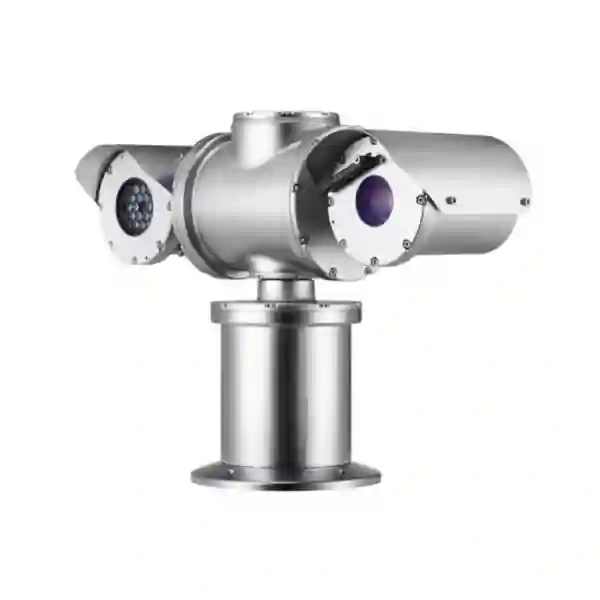
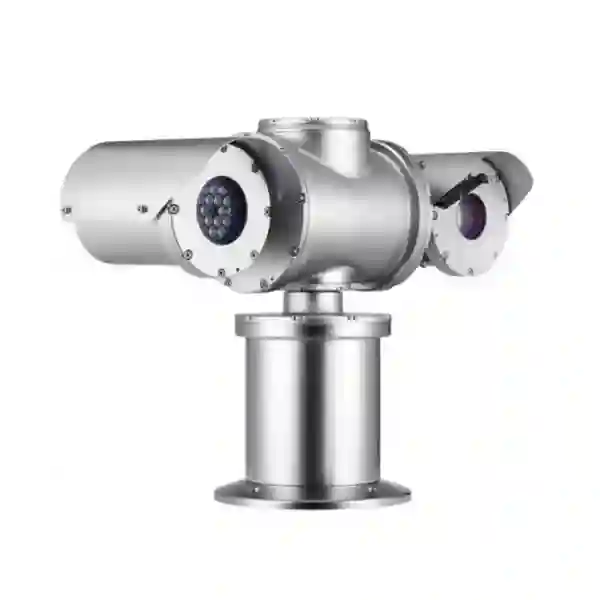
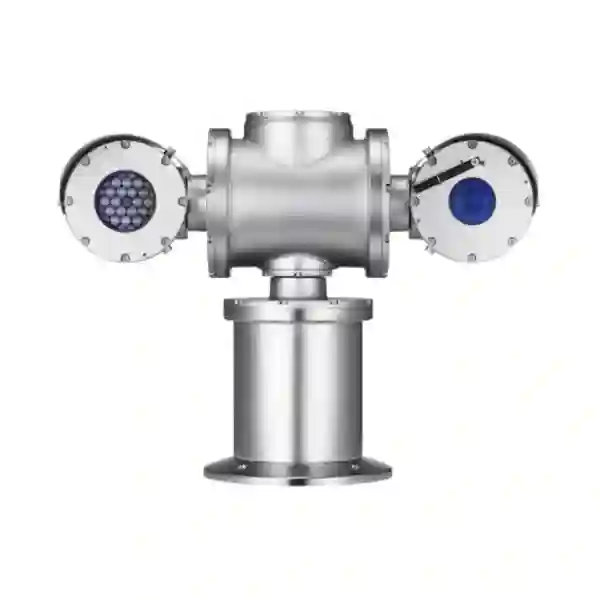
Hanwha TNU-6322ER explosion-proof PTZ camera
Monitor complex industrial areas with a 2MP positioning network camera featuring 32x optical zoom, integrated infrared illumination rated up to 200 metres, a 316L stainless-steel housing and published IECEx/ATEX protection markings. Evaluate the equipment against your exact hazardous-area classification and viewing task before procurement.
For Tanzania projects: request a specification-led quotation, certified-installation review and recorder-compatibility check. Local pricing and inventory must be confirmed separately.
Specifications at a glance
| Imaging | 2MP (1920 × 1080), 1/2.8-inch CMOS |
|---|---|
| Zoom lens | 4.44–142.6 mm; 32x optical |
| Infrared | Up to 200 m manufacturer-rated viewing length |
| PTZ | 360° endless pan; 180° tilt; up to 300 presets |
| Video | Up to 60/50 fps at 2MP (mode dependent); H.265, H.264, MJPEG |
| Image processing | 120 dB WDR, auto day/night (ICR), digital stabilization |
| Networking | 10/100BASE-T Ethernet; ONVIF Profiles S/G/T |
| Protection | IECEx/ATEX explosion-protection markings; IP67; IK10 |
| Construction | 316L stainless steel; built-in wiper |
| Electrical | 24 V AC; camera max 99 W, IR max 50 W |
| Mechanical | 611 × 438 × 235 mm; 36 kg |
| Operating range | −40 °C to +60 °C; up to 95% RH non-condensing |
Figures are manufacturer specifications for the stated model, not guarantees of site-level performance. Certification suitability, power design, image acceptance and installation details require project-specific assessment.
Choosing a camera for a hazardous industrial site
An ordinary outdoor security camera is not necessarily appropriate where flammable gases, vapours or combustible dust may be present. The first question for an industrial buyer is not simply how far the lens zooms. It is whether the camera equipment, its cable entries, associated connections and installation method can be accepted within the location’s documented hazardous-area classification. The Hanwha TNU-6322ER explosion-proof PTZ camera combines specialist enclosure construction with remotely directed viewing, but an appropriately qualified project team must still determine whether its precise protection marking fits the installation.
A second question concerns the operational purpose of surveillance. Some sites want to monitor a process line, others need to examine gates, tank areas, pipe corridors or the boundaries between controlled work zones. PTZ coverage is useful when an operator needs to investigate several directions from one position. It is less suitable where simultaneous, permanent evidence of several separate scenes is compulsory. Define the views that must be recorded continuously before selecting one moving camera in place of multiple fixed cameras.
A third question is whether the rest of the system can support the device. This camera needs a planned 24 V AC power source, physical mounting rated for its weight, network cabling and appropriate video recording. The initial budget should therefore consider design, installation, recording, protection and maintenance rather than the camera head alone. A practical request for quotation identifies the site conditions and expected surveillance outcome so potential omissions can be identified before procurement.
What makes the TNU-6322ER different
Hanwha Vision specifies 1920 × 1080 maximum video resolution from a 1/2.8-inch CMOS imaging device. It supports up to 60 frames per second in the applicable 60 Hz video mode with H.265 or H.264, and up to 50 frames per second in the corresponding 50 Hz mode. This means the project can consider smooth footage of moving industrial activities, subject to actual exposure settings, network capacity and recorder configuration. The manufacturer also lists MJPEG, allowing integration choices where required by supported systems.
The lens has a 4.44–142.6 mm focal-length range with 32x optical zoom. Rather than relying solely on digital enlargement, the camera changes its optical field of view to examine distant subjects. Its horizontal view changes from approximately 61.8 degrees at wide angle to 2.19 degrees at telephoto. These figures are useful inputs for a coverage drawing, but they do not establish that a person, object label or incident detail will be identifiable from a particular distance.
The positioning mechanism supports continuous 360-degree panning and a 180-degree tilt range. Combined with manufacturer-listed infrared viewing up to 200 metres, the design offers flexible observation over large industrial areas in changing light. The IR figure is a rated illumination or viewable length, not a promise of forensic identification at 200 metres. A site-specific test should verify the actual task, image clarity, atmosphere, mounting height and environmental conditions.
Define the required observation task
Before specifying the camera, name the smallest object or activity that operators must see. A general overview of a yard requires different image detail from reading a vehicle marking, checking the position of an isolation valve, or determining exactly who entered an area. The 2MP sensor has a fixed pixel budget, and wider scenes spread those pixels across more of the site. Zoom can improve apparent detail in a selected direction, but only for the scene being viewed at that moment.
Plan the essential views on a drawing that includes the mounting location, distance to each target, expected obstructions, lighting and access routes. A long industrial aisle might benefit from a zoomed inspection preset, while an entrance may need a separate fixed camera to avoid missed events while the PTZ is looking elsewhere. Be clear about which views are needed for live operators, which must be captured in recorded video and which are required for an audit or incident investigation.
Assess the viewing geometry alongside the environment. Heat shimmer, rain, heavy dust, fog, glare from metallic equipment and vibration can reduce useful detail even with a long telephoto lens. The camera provides digital image stabilization and defog functions, but neither eliminates all environmental limitations. A suitable design will specify installation height, supporting structure, likely weather exposure and acceptance tests that demonstrate the actual operational requirements rather than relying on a quoted zoom multiplier.
32x optical zoom and field of view
The 32x optical zoom is particularly relevant when a camera must observe both a broad industrial scene and a smaller distant area. At the wide end, the lens is intended to give context, enabling operators to understand where an event is happening. At the telephoto end, the much narrower view concentrates available image pixels on the selected subject. This is valuable for directed inspection but should not be confused with continuous high-detail coverage across the complete surrounding area.
The manufacturer’s field-of-view figures are approximately 61.8 to 2.19 degrees horizontally and 36.2 to 1.24 degrees vertically. A narrow long-distance view can be sensitive to small movements of the camera or its support, making mounting rigidity important. Line-of-sight obstacles also become more significant when operators focus on equipment behind fences, structures or moving machinery. Consider representative mounting locations and test relevant scenes at both wide and telephoto settings during design.
The manufacturer specifies one-shot autofocus and a DC auto-iris lens, with an aperture range from F1.6 at wide angle to F4.4 at telephoto. These optical characteristics influence how the image behaves as lighting changes while zooming. An acceptance test should check focus acquisition, exposure, target contrast and how quickly operators can return to a useful overview. Recording policies should document when a PTZ is left in a tight view and whether alternate cameras protect important unattended areas.
Infrared performance after dark
The TNU-6322ER includes an infrared illuminator with a manufacturer-stated viewable length of up to 200 metres and a listed wavelength of 850 nm. This can support monitoring in low-light or dark conditions without depending entirely on general site lighting. However, a viewable range is not equivalent to a guaranteed distance for detecting, recognizing or identifying a particular object. The actual outcome depends on lens position, reflectivity, camera settings, scene contrast and local atmospheric conditions.
Infrared light can reflect strongly from nearby surfaces or be scattered by moisture and particles. Tank walls, metal cladding, fencing and airborne dust may produce uneven scenes. If a camera is installed beside reflective structures or points through obstructions, the useful range may be shorter than the headline figure. For a hazardous installation, additional lighting must be selected on its own suitability for the classified area; an ordinary security floodlight should not be assumed acceptable.
The built-in day-and-night function uses automatic infrared-cut-filter control, allowing the camera to change its response as illumination varies. During commissioning, evaluate dusk transitions, full darkness, work lights switched on and off, and incidents involving high-contrast reflective surfaces. Record sample footage at the actual intended distance. These checks provide far more reliable procurement evidence than treating a single IR range number as proof that every night-time surveillance objective has been achieved.
Explosion protection and certification matching
Hanwha Vision identifies IECEx and ATEX explosion-protection markings for the exact TNU-6322ER model. Its published specification includes gas marking Ex db IIC T6 Gb and dust marking Ex tb IIIC T80°C Db, with corresponding ATEX category information. These are specialist equipment markings, not a general statement that the camera is appropriate for every hazardous area. A competent designer needs to compare the complete certified configuration against the site’s zone, gas or dust group, temperature constraints and installation rules.
Explosion-protected equipment is only one part of a safe installation. The mounting hardware, enclosure interfaces, cable glands, termination arrangement and any associated equipment must be specified and installed correctly. The installation team should consult the current manufacturer instructions and the exact certificate schedules and conditions of use. Any modification, unapproved cable entry or unsuitable accessory may compromise compliance with the intended protection concept even though the camera body itself carries an appropriate marking.
An explosion-proof CCTV camera does not detect gas automatically, extinguish a fire or replace the site’s process-safety systems. Its purpose is to provide surveillance while using a construction intended for certain certified hazardous environments. Safety-critical actions should continue to depend on the facility’s approved gas-detection, alarm, control and emergency procedures. For procurement in Tanzania, the project owner should obtain specialist confirmation of applicable local regulatory and site approval requirements; do not infer local approval solely from IECEx or ATEX markings.
Understand the actual certified configuration
Buyers should ask for the latest certificate and manufacturer documentation relevant to the supplied configuration rather than accepting a generic declaration that the camera is explosion-proof. The document set should identify the model, markings, approved ambient conditions, installation restrictions and any important differences between camera variants. The electrical contractor or hazardous-area specialist can then check the camera against the facility’s classification drawings and equipment register. This approach makes approvals traceable and helps avoid expensive rework after delivery.
The published operating temperature range is minus 40 to plus 60 degrees Celsius, with non-condensing humidity up to 95 percent relative humidity. These are environmental specifications, not a blanket approval for every process temperature or surface-temperature condition. Solar loading, nearby hot equipment, enclosed spaces and local ambient extremes may affect an installation. Where dust layers or elevated operating temperatures are relevant, the engineering assessment must consider the certified installation constraints and temperature-class requirements.
Documentation should also address how the camera will be inspected and maintained. Access to a hazardous area may require isolation procedures, work permits, gas testing and competent personnel, depending on site rules. Buyers should ask who will handle commissioning, future firmware support, damaged-cable replacement and periodic inspections. Building these responsibilities into the project plan avoids assuming that ordinary CCTV servicing procedures are sufficient for a certified explosion-protected device.
Stainless-steel housing and environmental ratings
The model uses a 316L stainless-steel body. This material is often considered in demanding industrial environments where equipment may encounter moisture, industrial contamination or challenging outdoor exposure. Material selection nevertheless needs to reflect the actual chemicals, cleaning regimes and site conditions. Stainless steel is not immune to every form of corrosion. Request a compatibility assessment if the camera will be exposed to unusual chemicals, strong cleaning agents or aggressive process atmospheres.
Hanwha lists IP67 protection under IEC 60529 and IK10 impact resistance under IEC 62262. IP67 addresses dust ingress and a specified water-ingress test condition; it should not be read as approval for any cleaning pressure, chemical attack or prolonged underwater operation. IK10 relates to a defined mechanical impact test; it does not make the entire installed system immune to deliberate damage or mechanical collision. Cable entries, mounting and maintenance practices remain important to maintaining protection.
The built-in wiper can help clear moisture from the viewing window when correctly used and maintained. It is not a substitute for periodic cleaning or a promise of clear images under every weather condition. Before finalizing the mounting position, check access for inspection, wiper operation, window cleaning and safe servicing. Select an angle that reduces direct spray and mechanical interference where feasible, while keeping the required observation lines open.
Pan, tilt, presets and operator control
Continuous 360-degree pan allows the camera to rotate without an ordinary end stop, and its published tilt movement covers 180 degrees from minus 90 to plus 90 degrees. Hanwha specifies manual pan speeds of 0.5 to 80 degrees per second and manual tilt speeds of 0.1 to 60 degrees per second. This gives designers a basis for considering how quickly an operator can change view, although actual operating experience will depend on system configuration, user permissions and network responsiveness.
Up to 300 presets and manufacturer-listed swing, group, trace, tour, auto-run and schedule functions support repeatable camera positioning. In practice, a small, intentional set of named views is often better than hundreds of unused presets. For example, a project might define an entrance overview, loading position, perimeter corner and equipment inspection point. Each preset should be checked for framing, focus and operational meaning, and the site team should decide which position the camera returns to after manual intervention.
Automated patrol functions should be designed around evidence requirements rather than used without a plan. If a camera spends a long period watching one location, it is not simultaneously watching another. A patrol can improve routine situational awareness while still leaving temporal gaps in any single view. Where a location requires constant coverage, supplement the PTZ with fixed cameras or another monitoring method. Document who may take control, how conflicting control requests are handled and which events should trigger preset changes.
Image quality in difficult industrial lighting
The camera provides 120 dB wide dynamic range, automatic day and night switching, backlight compensation and image-processing options. These features can assist when sunlight enters a loading bay, a bright doorway sits behind a darker working area, or strong local lighting creates difficult contrast. They should not be presented as guarantees against blown highlights or underexposed detail. Test the exact scene during both normal operating periods and the most challenging lighting transitions expected on site.
The published minimum illumination figures are 0.05 lux in colour and 0.005 lux in black and white under stated test conditions. These values describe camera sensitivity in a defined setting and should not be interpreted as an assurance of usable identification-quality images at any distance. Exposure time, scene movement and image noise can all change the practical result. If the task involves moving vehicles or workers in dim light, examine sample footage for motion blur rather than evaluating only a still frame.
Digital noise reduction, image stabilization and a defog option offer further adjustment possibilities. Changing these settings can introduce tradeoffs: stronger processing may alter the appearance of fine detail, while certain exposure choices can improve brightness at the expense of capturing fast motion sharply. Commission the camera against a documented test sequence and retain appropriate reference footage. This makes future troubleshooting easier if a buyer later reports poor night detail or reduced visibility during unusual weather.
Analytics and event-driven monitoring
Hanwha lists analytic events that include motion detection, tampering, defocus, fog, face detection, audio detection, virtual areas and virtual lines. Depending on configuration, virtual-area events can cover intrusion, entry, exit, appearance, disappearance or loitering, while virtual lines can relate to crossing or direction. These tools may help operators review unusual activity or focus attention on defined areas. They must be tuned to the scene and should not be treated as error-free safety systems.
Analytics performance can be affected by camera movement, background activity, rain, insects, changing shadows and the scale of objects in view. A virtual boundary configured on one preset may not have the same meaning after an operator zooms or pans. Where analytics matter, confirm which functions are usable in the planned operating mode and how the selected recorder or video management system will handle their events. Include nuisance-alarm testing and missed-event checks during acceptance.
The camera also provides an alarm input and output, network-disconnect event handling and supported responses such as notifications or movement to a PTZ preset. These interfaces can be useful for a broader security design, but they do not by themselves establish compatibility with a plant’s existing alarm system. Any interconnection to process control or safety-related equipment requires separate engineering review, permitted wiring and clear responsibilities. Keep video analytics separate from certified emergency protection functions unless an approved system design explicitly defines otherwise.
Video compression, recording and bandwidth
H.265 and H.264 compression let the project balance image quality, network use and playback compatibility. Hanwha also lists MJPEG and WiseStream II, its video efficiency technology. Compression can reduce data demand compared with an unoptimized stream, but the saving varies with movement, noise, lighting, scene complexity and chosen settings. A windy or dusty scene may generate very different traffic from a quiet indoor test. Confirm actual bitrates under representative conditions rather than choosing a storage system from a single marketing estimate.
The camera supports multiple video profiles, with up to ten listed by the manufacturer, and unicast or multicast operation. A project may therefore use different streams for recording, live display and bandwidth-limited operator workstations, subject to configuration and recorder support. Frame rate, resolution, compression settings and retention policy must be planned together. Recording a high-quality stream for an extended retention period has a different storage requirement from occasional low-resolution live viewing.
Calculate storage using realistic bitrates, recording hours, retention duration and redundancy requirements. Consider whether the network will carry other cameras, industrial applications and remote users. If an operations room is distant from the camera, verify switching equipment, cable routes and bandwidth headroom. A resilient design also includes reliable time synchronization, tested incident export and agreed procedures for retaining footage. The camera’s published features do not establish the storage capacity or licence requirements of any proposed recorder.
ONVIF and management-system integration
The TNU-6322ER lists ONVIF Profiles S, G and T along with SUNAPI and Hanwha Vision Open Platform support. These interfaces are relevant when connecting the camera to network video recorders or video management software. Nevertheless, standards support does not mean every function will work identically across all systems. Before ordering, check the exact recorder model, firmware, software version and intended controls, especially for PTZ operation, event handling, audio and multiple streams.
Integration testing should confirm live view, recorded playback, preset recall, authorization and time synchronization. Verify whether a selected system exposes the analytics or alerts the operations team needs, rather than assuming that basic video connectivity proves full feature compatibility. Where a feature relies on a manufacturer-specific interface, document that dependency. The project should also plan whether camera controls will be limited to specific security operators and how access is logged.
For network architecture, distinguish the camera connection from the wider system. The manufacturer specifies an RJ-45 10/100BASE-T Ethernet interface, but the camera uses 24 V AC power rather than relying on a standard PoE switch as its power source. A network port alone cannot establish the required electrical supply. An integrator should specify appropriate network termination, switching, grounding and isolation alongside approved hazardous-area cable routes.
Network security and accountable access
Industrial CCTV networks should be managed as security infrastructure rather than as unmanaged consumer devices. Hanwha lists encrypted firmware, HTTPS, digest authentication, IEEE 802.1X network authentication, IP-based access control and logging facilities for this model. These features are useful starting points, but the system is secure only when appropriately configured and maintained. Assign named administrative responsibility and avoid sharing a single privileged account across an entire operations team.
The commissioning plan should include password and account policies, segmented network design where appropriate, controlled remote access and a process for reviewing manufacturer firmware updates. Any firmware change should be tested against the installed recorder, PTZ functions and operational requirements. Confirm the supported firmware version and lifecycle with the manufacturer or supplying channel before procurement, particularly when a camera is being integrated into a long-lived industrial system.
The site should decide how to handle access and event logs, time settings and network outages. A camera can have excellent optical specifications yet provide limited operational value if footage cannot be retrieved after an incident. Agree who can export recordings, where exports are stored, and how network access is restored following maintenance. Those decisions should align with the facility’s own information-security and operational procedures, not be assumed from the presence of an ONVIF interface.
24 V AC power and electrical planning
This device is specified for 24 V AC input. Hanwha lists maximum consumption figures of 99 W for the camera and 50 W for the IR section. The electrical designer should review the current manufacturer’s complete power guidance and the intended operating configuration when sizing the supply, protective devices and cabling. Do not substitute a PoE injector or assume an ordinary Ethernet switch will provide the required power. Voltage drop over long cable runs may be important in large industrial sites.
For installations in classified environments, electrical design also includes the permissible cable-entry arrangement and appropriate connection practices. The certification documents and installation guide take priority over generic CCTV habits. A competent installer should establish how the supply is isolated for maintenance, what protection and earthing are required, and whether surge or lightning protection is needed for the exposed location. None of these design responsibilities is removed by purchasing a pre-certified camera enclosure.
Power continuity matters where operators rely on surveillance during a process interruption. Evaluate the facility’s available supply, backup-power strategy and recovery expectations, including the associated networking and recording hardware. It is not enough to back up only the camera if its upstream switch or recorder loses power. Acceptance tests should include a controlled loss-and-restoration sequence and verification that the correct PTZ position, recording state and system time are recovered as intended.
Mounting a substantial 36 kg camera
Hanwha specifies approximate camera dimensions of 611 mm wide, 438 mm high and 235 mm deep, with a product weight of 36 kg. That is a significant load for a camera installation. A qualified structural or mechanical installer should evaluate the proposed wall, pole or support, including any relevant dynamic loading, vibration and local environmental exposure. The mounting arrangement must also preserve movement clearance for the pan and tilt mechanism and allow safe inspection without reaching into moving equipment.
A mounting position should balance field of view, mechanical stability, maintenance access and hazardous-area rules. Installations above process equipment may need special work permits and lifting arrangements. A support that flexes under wind or plant vibration can reduce useful detail at long zoom settings, despite the camera’s stabilization features. Avoid choosing the tallest possible mounting position automatically; it may make inspection difficult or put the camera behind structures that block critical views.
Hanwha lists specialist mounting accessories in its product family, but accessory choice should be confirmed for the exact camera and installation arrangement before procurement. Check manufacturer compatibility, loading, fastening details and the facility’s structural design. Accessories may be separate line items and may have different commercial availability. Include brackets, cable entries, supports and commissioning in the quotation request rather than assuming every mounting component is included with the camera.
Industrial use cases relevant to Tanzania
Potential applications include petroleum-related facilities, chemical processing areas, industrial loading and transfer points, and other sites where the responsible engineer has identified a relevant hazardous classification. In these settings, the value of the camera comes from enabling visual assessment of a defined process or access area while using equipment intended for the certified environment. A suitability assessment remains essential; naming an industry does not automatically mean every part of its premises is hazardous or that the model is the correct equipment.
A tank-area project might prioritize observing valves, access points and remote structures from a safe monitoring location. A processing facility might want to examine loading operations while preserving awareness of people near restricted routes. A large industrial yard may require an operator-controlled camera for investigations alongside fixed cameras for entrances. These examples describe possible design patterns, not confirmed installations, stock availability or supplied projects in Tanzania.
For Tanzania-based buyers, project requirements should identify the site location, environmental exposure, engineering standards applicable to the facility, and who has authority to approve hazardous-area equipment. Avoid assuming that the presence of international certification alone satisfies every local legal or site requirement. Reliable procurement starts with verified technical specifications and a locally appropriate engineering review. A final proposal should state what equipment, installation services and acceptance tests are actually included.
Commissioning and acceptance testing
A useful factory or site acceptance plan starts with the project’s important viewing tasks. Check wide and tight views, autofocus, preset accuracy, rotation clearance, night illumination, video recording, analytics and alarm signals where configured. Where distance matters, test at the real target position rather than an easier substitute. Ensure a representative operator can find the correct live view, recover a recording and distinguish the relevant object or activity under the conditions the system is expected to encounter.
Complete technical checks should cover power voltage at the device, the agreed network configuration, time synchronization, recorder integration and the relevant installation documentation. Electrical and hazardous-area inspection activities must be performed by personnel qualified for the scope. Keep a record of certificates, installed accessories, baseline firmware, configuration backups and approved photographs of the finished installation. These records are particularly useful when the site later needs troubleshooting or a change in operating responsibility.
Finally, verify what happens when part of the system fails. Test a controlled network interruption, the return of power, the ability to restore presets and the notification path for any important outage. Make sure the maintenance team knows which equipment can be serviced routinely and which requires special hazardous-area procedures. An installation should not be accepted solely because a live image appears on a screen; it should be accepted because the specified operational and safety-related requirements have been demonstrated.
Maintenance, inspections and long-term operation
Industrial cameras require maintenance planning even when their housing is designed for demanding environments. Inspect viewing surfaces, wiper condition, fastening integrity and the visible state of cabling according to the facility’s approved procedures. A sharp image can deteriorate gradually from dust or surface contamination, so trend image quality as part of routine checks. Do not assume that the IP67 rating permits any cleaning chemical or method; use manufacturer guidance and site-compatible procedures.
The camera’s mechanical functions also deserve periodic observation. Confirm that relevant presets still reach the right scene, the pan and tilt mechanism moves freely, and the selected analytics remain meaningful after site changes. New pipework, temporary structures or a changed vehicle route can invalidate an earlier coverage drawing. Record such changes so the surveillance design remains aligned with current site risks rather than with an outdated commissioning plan.
For spare-parts planning and support, confirm the exact model’s current commercial and firmware lifecycle through an authorized supply channel. Availability may differ by region and date. A buyer should ask how replacement equipment, accessories and technical support will be handled during the intended system life. The product description cannot guarantee continued availability, warranty coverage or a replacement path without an offer for the exact market and project.
How to compare other explosion-proof camera options
The most relevant alternative is not always another camera with a longer specification list. If the installation needs a permanent view of one location, a fixed explosion-protected camera may meet the requirement with less reliance on operator movement. If a broad site needs active investigation, a positioning camera such as the TNU-6322ER may be more appropriate. Compare camera type, certified area suitability, lens coverage, illumination, physical loads and integration costs together, rather than ranking products by zoom or megapixels alone.
Hanwha’s TNU-6322E is a related explosion-proof positioning model without the 200-metre integrated IR feature listed for the TNU-6322ER. Hanwha’s TNO-6322ER is a related explosion-proof camera with a manufacturer-listed 70-metre IR viewing length and different positioning characteristics. These differences may influence a shortlist, but each model’s full markings, mechanical configuration and suitable use case must be verified independently. Similar model names do not establish interchangeability of parts, mounts or certified installation designs.
A higher-resolution camera could also be considered where the project needs more image detail in a fixed field of view, but resolution alone is not the decision. Check low-light performance, optics, hazardous-area documentation, video retention, integration and lifecycle support. If continuous multi-direction recording is compulsory, multiple complementary cameras may offer stronger coverage than one PTZ. The best choice is the system that demonstrates the specified operational objective under actual environmental and engineering constraints.
Questions to include in a Tanzania quotation request
Provide the exact model name, requested quantity, site environment and intended observation task. Attach the hazardous-area classification documents where the project permits sharing them, and specify who will approve the equipment selection. Explain the required distances and whether operators need continuous monitoring, scheduled tours, manual investigation or event-driven movement. If images must be used for detailed identification, state that as an acceptance requirement so the design can be evaluated realistically.
Also describe available power, network connectivity, mounting structure, recorder or video management platform, expected retention and desired security controls. A complete scope may need electrical design, cable routing, certified accessories, lifting arrangements, recording hardware and commissioning. Ask the supplier to identify what is included, what is excluded, and which design assumptions remain unverified. This encourages comparable quotations and reduces the risk of a camera-only price being mistaken for a ready-to-operate project.
Before issuing a purchase order, request confirmation of the current manufacturer documentation, applicable certificate schedules, product lifecycle, lead time and commercial terms for the specific Tanzania project. Do not treat an online specification as proof of local inventory. Ask for a review of field-of-view and image-quality expectations, and agree on measurable acceptance criteria. The purpose of the quotation is to establish technical fit and a dependable procurement scope, not merely to collect a model number and a price.
Frequently asked questions
Is the Hanwha TNU-6322ER a thermal camera?
No. The published model uses a visible-light 1/2.8-inch CMOS image sensor with an integrated 850 nm infrared illuminator. It provides night viewing with IR illumination; it is not specified as a thermal-imaging camera that measures temperature. Choose a separate appropriately rated thermal system if the project requires temperature-based inspection or thermal detection.
Can this explosion-proof camera be used in any hazardous zone?
No. Hanwha provides specific ATEX and IECEx markings, but suitability depends on the site’s classification, relevant gas or dust group, temperature limitations and installation conditions. Have the exact certificate and installation configuration reviewed by a competent hazardous-area professional. Do not infer Tanzania-specific statutory approval from international equipment markings alone.
Does the 200 m IR rating mean a person can be identified at 200 m?
Not necessarily. The published 200-metre figure describes the infrared viewable range under manufacturer conditions. Identification requires enough subject pixels, contrast, focus and appropriate exposure in the real scene. Request a representative night-time test for the intended task, particularly when a camera will inspect distant moving objects.
Is the TNU-6322ER powered by PoE?
No standard PoE supply is specified for this exact model. Hanwha lists 24 V AC input, with maximum power figures for the camera and infrared portion. Design a suitable dedicated supply and approved cabling. The RJ-45 Ethernet connection provides networking and should not be mistaken for confirmation that the unit receives power from a PoE switch.
How much does the camera weigh?
The manufacturer’s product specification lists a weight of approximately 36 kg and dimensions of 611 × 438 × 235 mm. The actual mounting assembly adds its own load and installation considerations. Confirm the support structure, lifting method, fasteners and movement clearance before ordering hardware or positioning the camera.
Can I connect it to an existing NVR?
The camera lists ONVIF Profiles S, G and T, SUNAPI, H.265 and H.264, which may support integration with compatible network recorders and video management systems. Confirm the exact recorder, firmware and desired functions. Test PTZ presets, recordings, analytics and permission controls rather than assuming that ONVIF video support guarantees full integration.
What is the difference between TNU-6322ER and TNU-6322E?
Both are related Hanwha explosion-protected positioning cameras, but the TNU-6322ER explicitly includes integrated infrared illumination with a published 200-metre viewing length. The TNU-6322E listing does not specify the same integrated IR feature. Confirm current availability, certificates, accessories and environmental requirements for each exact model before selecting an alternative.
Is the TNU-6322ER waterproof and vandal resistant?
Hanwha lists IP67 and IK10 ratings. These relate to defined ingress and impact test standards, not unlimited resistance to high-pressure washdown, aggressive chemicals or any physical attack. Maintain proper cable seals and approved installation methods. Check the manufacturer’s cleaning instructions and planned environmental exposure.
What information is needed for a quotation in Tanzania?
Provide the model and quantity, location type, intended observation distances, hazardous-area classification, available 24 V AC infrastructure, mounting arrangement, existing network and recorder, and any required acceptance tests. Request written confirmation of pricing, supply availability, certification documentation and scope. No Tanzanian price, stock figure or lead time is assumed on this page.
Does the camera replace gas detection or process-safety alarms?
No. The camera provides visual surveillance and supported video-event functions. It is not a substitute for certified gas monitoring, automatic shutdown, emergency alarms or the safety management processes required by an industrial site. Treat security analytics as operational aids unless a separately approved engineering design explicitly defines a permissible role.
Request a TNU-6322ER project quotation
Share the intended observation distances, hazardous-area classification, model quantity, mounting details, available 24 V AC supply and recording platform. Ask for confirmation of equipment suitability, certification documents, project scope, availability and commercial terms before placing an order.
Contact FourTeck Tanzania through its verified sales or quotation channel. No third-party link or unverified destination is required.




Reviews
There are no reviews yet.