
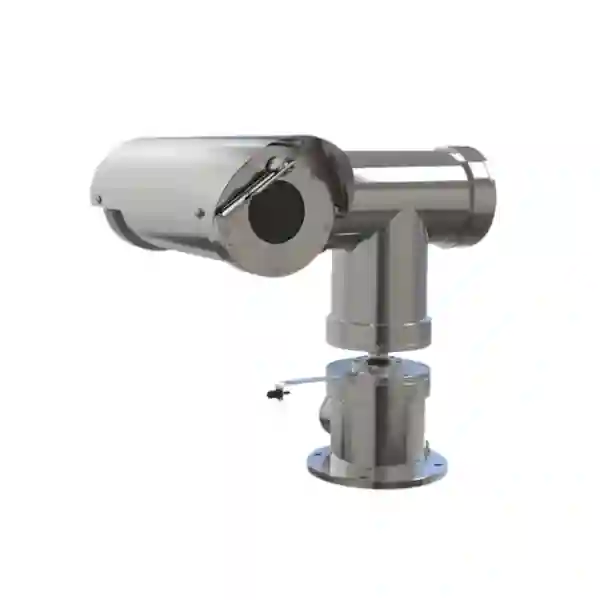
Hanwha Vision TNU-X6320E2WT1-Z
Review a specialist 2MP Full HD explosion-proof positioning camera for industrial video monitoring in challenging, potentially hazardous locations. The TNU-X6320E2WT1-Z combines 32× optical zoom, remote pan/tilt control, an integrated wiper and a corrosion-resistant stainless-steel camera station. Selecting it requires more than checking a picture: verify the hazardous-area classification, exact variant, power input, mounting structure, recording design and ongoing product support.
At a glance: verified product characteristics
Hanwha Vision identifies this exact model as a discontinued explosion-proof PTZ camera and names TNU-X6320A2WT1-Z as the replacement model. That lifecycle detail matters at the beginning of an enquiry. A customer maintaining an existing installation might need this legacy part or an equivalent replacement, while a team planning a new project may prefer to assess the manufacturer-named successor. Neither path should assume local availability, direct mechanical interchangeability or unchanged performance.
The original TNU-X6320E series datasheet describes a Full HD, network-connected positioning camera station with a stainless-steel construction, optical zoom, video analytics and tools designed for difficult viewing conditions. The specifications below distinguish documented characteristics from decisions that depend on the exact installation. Environmental certification is a selection input, not a substitute for project-specific engineering approval.
| Product type | Explosion-proof network PTZ / positioning camera |
|---|---|
| Image output | 1920 × 1080 (2MP), up to 60 fps |
| Lens | 4.44–142.6 mm; 32× optical zoom |
| Wide dynamic range | 150 dB on the discontinued E-series model |
| Camera station | Integrated wiper; 316L stainless-steel construction |
| Storage | Two microSD/SDHC/SDXC memory slots |
| Power supply | 110 VAC for the specified E2 variant |
| Ingress protection | IP66 / IP67 in series technical documentation |
| Lifecycle | Discontinued; manufacturer-named successor TNU-X6320A2WT1-Z |
Who should consider this camera?
An explosion-proof PTZ camera is a specialist instrument for facilities where ordinary surveillance equipment may not be suitable for the classified environment. Typical evaluation settings include hydrocarbon processing assets, fuel-handling zones, industrial terminals, process installations and carefully assessed chemical-handling operations. These are possible applications, not declarations that every location within those industries is a hazardous area. The actual zone or division, gas or dust group, temperature class, exposure conditions and required approvals must be identified before choosing any camera.
The Hanwha TNU-X6320E2WT1-Z is particularly relevant when an operator needs to monitor several distant points from a remotely controlled station rather than relying solely on a fixed field of view. Its zoom and positioning functions can help staff inspect designated targets from the control room. It should support, not replace, plant procedures, qualified safety systems or direct verification when a task requires physical inspection.
Explosion-proof design is a site engineering decision
The phrase explosion-proof does not mean a camera can be installed in every explosive atmosphere without further review. The exact marking and certificate scope must match the site’s classification, permitted ambient temperature, ignition-risk assessment and installation standard. The model suffix matters: Hanwha’s series configuration separates certification variants, voltage choices and optional fiber configurations. Substituting a similar-looking suffix can change the compliance evidence or physical configuration supplied with the order.
Begin with the facility’s hazardous-area drawings and the project’s electrical and instrumentation specification. Ask the responsible engineer to confirm the acceptable approval scheme, enclosure entry requirements, gland and sealing arrangements, earthing provisions, mounting limits and inspection regime. Cross-check the complete model designation on the purchase document and on the equipment nameplate. A marketing description, generic product category or third-party listing is not sufficient evidence of installation suitability.
Understanding the -Z configuration
The published configuration guide for the TNU-X6320E family associates the -Z suffix with a cLCus Class I, Division 1 certification configuration. The guide also differentiates other approvals within the family. The selected ${model} should therefore be reviewed as a specific certificate variant, not described as simultaneously carrying every series certification. Request the exact model’s certificate and current supporting documentation whenever the project has formal approval requirements.
For a Tanzanian installation, a certificate issued under a particular international or North American approval pathway should not be represented as proof of Tanzanian regulatory acceptance. The designer or authority responsible for the installation must establish which evidence is accepted and which additional checks apply. This distinction protects procurement teams from selecting a technically capable camera that cannot be documented for the actual location.
What Full HD at 60 fps means for operations
The 1920 × 1080 image format gives the system a recognizable Full HD viewing baseline, while an upper frame-rate capability of 60 frames per second can help display movement more smoothly where the network, compression profile and recording infrastructure support that configuration. A higher frame rate is not automatically the best setting. Bitrate, storage retention, bandwidth and the detail needed at the target should influence the final recording profile.
Review what the control room actually needs to see: an equipment condition, vehicle position, loading connection, operator movement or specific inspection point. A 2MP camera can be appropriate for planned viewing tasks, but resolution alone cannot guarantee identification, evidence quality or fine-detail recognition at a given distance. The lens setting, scene lighting, target size, vibration, atmospheric visibility and operator workflow all affect the result. Use actual camera views in the project acceptance test.
32× optical zoom and remote observation
The E-series optical system is documented with a 4.44–142.6 mm focal-length range and 32× optical zoom. Optical zoom changes the effective field of view without being the same as simply enlarging pixels digitally. In practice, the wide end can establish context around a process area; the telephoto end can support closer visual examination of a selected asset. The useful viewing distance remains application-dependent and should be tested with the target and lighting conditions.
Designers should specify the target points, operator positions and likely viewing sequences before deciding whether one movable camera can meet the task. When PTZ is pointed at one asset it does not continuously observe every other direction. Critical simultaneous views may require additional fixed cameras. Presets are helpful for repeat inspections, but they should be validated for framing, physical obstructions and any nearby equipment that could enter the scene after installation.
Pan, tilt, presets and repeatable surveillance
The published TNU-X6320E series technical sheet describes continuous 360-degree pan, a 180-degree tilt range and specified positioning speeds. These capabilities suit a planned viewing route where authorized operators move between meaningful points instead of improvising camera movement every time an alarm occurs. Preset plans can be grouped by operational need, such as tank connections, perimeter gates, transfer equipment or maintenance access routes.
Map each proposed preset to a named task and confirm the view after final mounting, not only on a bench. Check if pipework, cable trays, platforms or equipment movements will obscure it. Include a safe home view, permissions for manual override, and a procedure for returning to the routine observation pattern. Where a camera is used by several teams, control priorities and PTZ ownership should be specified to avoid conflicting commands during an incident.
WDR, contrast and challenging industrial lighting
Hanwha lists 150 dB Wide Dynamic Range for the legacy E-series camera, a useful characteristic when the scene includes bright daylight, shaded process structures or other strong contrasts. WDR helps the imaging pipeline handle differing brightness within a frame, but the result depends on the scene and chosen exposure settings. The rating should not be interpreted as a guarantee that every reflective or backlit object will remain legible.
A useful acceptance test includes morning and afternoon sun, nighttime working lights, backlit access points and any bright industrial processes that affect the view. Operators may need different profiles or preset-specific exposure preferences. The manufacturer-named successor is listed with a different WDR figure, so a replacement comparison must be made model by model rather than assuming that every numerical specification carries forward unchanged.
Low-light performance, haze and vibration
The E-series documentation specifies day/night functionality, defog processing and gyro-assisted digital image stabilization. These features address different problems. Day/night operation helps select an appropriate imaging mode as lighting changes; defog is a processing aid for reduced contrast; and stabilization can reduce the visible effects of some vibration. None can replace adequate lighting, a stable mount or an unobstructed optical path.
During a site assessment, record the minimum illumination at the actual targets, not only at the camera’s mounting location. Consider reflections from stainless steel, glare from moving vehicles, airborne dust, salt spray and hot surfaces. Where night operations matter, commission the camera under real operating conditions rather than relying solely on daytime samples. Site-specific tests should also confirm whether the selected shutter, compression and noise-reduction settings preserve the action that users must interpret.
Integrated wiper and environmental visibility
The camera station includes an integrated wiper intended to help clear its viewing window. In exposed industrial settings that feature rain, airborne deposits or spray, that can be valuable for maintaining a usable picture without immediate access to the camera housing. A wiper is not the same as a complete cleaning system: the nature of contamination, washer provision, maintenance access and window condition still need consideration.
Evaluate optional washing accessories separately against the exact device and project documentation. Verify the part numbers, physical mounting and installation permissions rather than assuming that every accessory in a product family fits every version. Establish a maintenance routine that includes inspection of the window, wiper blade and nearby drain paths. Excessive deposits can impair visibility, and cleaning intervals should be based on what actually accumulates at the installation.
Stainless-steel construction, ingress and corrosion
Hanwha’s E-series documentation describes electro-polished 316L stainless steel on welded assemblies, a toughened-glass viewing window and IP66/IP67 ingress protection. Such construction is relevant to outdoor and process-environment projects where dust, weather and exposure are significant design factors. Even so, no ingress rating eliminates the need to protect cable entries, fasteners, mounts and any connected equipment against the site’s actual conditions.
Check the specific corrosive agents, cleaning chemicals, coastal exposure and industrial wash-down practices against the project material specification. Stainless steel selection should not be reduced to an assumption that any chemical or marine atmosphere is harmless. The mounting system, gland arrangement and adjacent metals can influence longevity and serviceability. Installation drawings should cover the full assembly, not only the camera body, because the weakest component can determine the practical reliability of the system.
110 VAC power: verify the supply architecture
The E2 electrical configuration is specified for 110 VAC. That is a critical procurement and installation requirement, not a minor product attribute. Do not assume that the voltage available at the industrial distribution board is suitable for direct connection. Confirm the actual local supply, transformer or conversion requirement, protective devices, power quality and earthing method with a qualified engineer before equipment is ordered.
Account for the camera’s load, startup behavior, any associated accessory equipment, circuit segregation and required disconnect arrangements using the correct model’s electrical documentation. A site may also need surge protection, UPS continuity or a dedicated protected branch circuit depending on its risk assessment. In hazardous locations, electrical entries, enclosures and cable systems must satisfy the approved installation design. A generic power adaptor should not be treated as an acceptable substitute for engineered supply equipment.
Connectivity and network topology
The TNU-X6320E series describes an Ethernet network interface and standard IP video protocols. Plan the camera as one element in an industrial network rather than as an isolated gadget. Document its network segment, switch location, maximum cable route, cabinet environment, addressing approach and access from the recording or control-room platform. The details become more important when a camera is installed far from maintained IT infrastructure.
The series documentation includes optional single-mode fiber on specifically designated F2 models. The exact ${model} designation supplied here does not contain F2, so do not assume integrated fiber capability simply because the product family supports it. If the project requires a fiber backbone, verify the physical device interface and the approved network architecture. Where copper-to-fiber conversion is considered, its industrial and hazardous-area placement needs its own engineering review.
Video compression and bandwidth planning
The legacy series technical sheet describes H.265, H.264 and MJPEG streaming, as well as multiple streams and Hanwha’s WiseStream II capability. These options are useful because operators, recording systems and remote viewers may need different image sizes, bitrates and frame rates. A well-designed system can balance the high-detail stream needed for evidence against lighter streams useful for routine monitoring.
Bandwidth must be estimated from scene complexity and configured settings, not by a single advertised figure. Reflections, moving vegetation, loading activity, poor lighting and compression settings can materially affect results. Include simultaneous viewers, network overhead, alarm traffic and outage behavior in the calculation. Before handover, test the chosen profiles through the actual switches, radio paths or remote links and verify that the expected image quality survives peak operating demand.
Recording strategy and dual edge storage
The manufacturer lists two microSD/SDHC/SDXC card slots on the E-series camera. Edge storage can serve as a component of a recording design, but it is not a substitute for a documented retention policy or reliable centralized storage when the project requires it. Media endurance, file recovery, environmental conditions and the configured recording mode all affect the role of local storage.
Decide whether recordings will be continuous, event-driven or both. Define how footage is retained, protected, reviewed and exported; who can change those settings; and what happens when the central recorder becomes unreachable. Specify storage media that meet the manufacturer’s requirements and test failure modes. The fact that a camera can accept memory cards does not mean cards are included, approved for every project environment or sufficient for the required retention period.
Video analytics and appropriate alarms
Published TNU-X6320E series information includes motion detection and video analytics functions such as intrusion, line-crossing, tampering and related event detection. Analytics can improve operator awareness when events are thoughtfully configured, but they are not equivalent to certified safety instrumented functions or personnel life-safety alarms. Each rule should have a defined purpose, owner, response action and acceptable false-alert rate.
For industrial scenes, evaluate steam, shadows, changing light, moving machinery, rain and occasional maintenance activity as potential sources of nuisance alarms. Create regions that reflect true operational boundaries rather than drawing rules across the whole image. Commission alarms at the same working hours and environmental conditions in which they will be used. Review how the video management system receives the events and whether operators can retrieve the corresponding clip when investigating an alert.
Privacy, responsible monitoring and access
Industrial security footage can contain employees, contractors, delivery drivers and visitors as well as equipment. A camera positioned for process observation should be evaluated for privacy impact, legitimate viewing purpose and retention expectations. The camera family includes privacy-masking capabilities in the technical material, but masking does not replace a clear organizational policy for collection, access and disclosure.
Decide which staff roles can view live images, move the PTZ, search recordings and export evidence. A sensitive view may be appropriate for one function but unnecessary for another. Agree on signage and notice practices according to applicable site requirements, and ensure that operators understand why the camera is deployed. Access logs, documented permissions and periodic reviews make a surveillance system easier to govern than unrestricted shared access.
Cybersecurity and legacy-device support
A network camera belongs within the organization’s cyber-risk management program. The legacy TNU-X6320E series lists secure communication and authentication-related features, but a feature list alone cannot establish the security posture of a given firmware build. Before integration, identify the supported firmware, patch path, management method and vendor guidance for this exact discontinued product. Product retirement status increases the importance of a documented support decision.
Apply approved configuration practices such as unique administrator credentials, least-privilege roles, network segmentation, controlled remote access, clock synchronization and logging. Avoid exposing camera administration directly to the public internet. Test restoration procedures and maintain an asset register containing the full model number, firmware, IP address, location and responsible owner. Confirm with the manufacturer or responsible integrator whether required support and updates remain available for the exact hardware.
Video management and recorder compatibility
The E-series specification discusses ONVIF interoperability and Hanwha’s ecosystem interfaces, but a protocol label is not a promise that every VMS feature will work with every third-party recorder. Live video may be available while advanced analytics, PTZ presets, edge-storage playback or events require specific drivers, firmware versions or licensing. Build a compatibility matrix before committing to a wider system design.
Test the intended recorder or VMS with the actual camera model wherever possible. Confirm video discovery, stream selection, pan and tilt commands, preset recall, user rights, event ingestion, time synchronization and export format. Determine whether an integration uses a generic interoperability profile or a manufacturer-specific driver. Record the outcome, because replacement decisions become substantially easier when the functions required by the operations team have been explicitly documented.
Mechanical installation and structural loading
This is a substantial industrial positioning assembly, not a compact office camera. The mounting structure, flange, vibration environment, access route and lifting procedure deserve engineering attention. Check the manufacturer-approved bracket or pedestal arrangements, load capacity, fastener specification and corrosion environment. Structural design should account for the complete assembly, including relevant accessories and cable routing, rather than relying solely on a camera body weight taken from a generic family description.
Before work begins, verify access for safe installation, inspection and future removal. Consider wind exposure, crane or vehicle movement, nearby heat sources and the possibility of obstructed pan or tilt movement. Design the route from the approved field junction point to the camera station, keeping cables supported and protected. Do not improvise cable entries or modify the explosion-proof housing without manufacturer-approved instructions and competent hazardous-area oversight.
Typical industrial monitoring scenarios
At a fuel-transfer area, a PTZ can allow an authorized operator to check several relevant viewing points during a defined transfer sequence. At a process unit, presets may assist staff in visually reviewing external equipment condition or a specific access path. In a terminal yard, a wide view followed by optical zoom can assist investigation of a particular movement or security event. In each example, the camera supports human awareness and documented procedures, not automatic determination that an operation is safe.
Use task-based design questions: What does the operator need to observe? How often? From what distance? Under which lighting conditions? What competing events may occur while the PTZ is directed elsewhere? Is a fixed camera needed to maintain uninterrupted coverage? Does a responsible person review the image, or must the event be recorded for later investigation? The answers determine whether this model is a useful component or an unnecessarily complex choice.
Tanzania project planning without unsupported assumptions
For procurement and deployment in Tanzania, start from the actual facility and tender requirements rather than generic assumptions about local stock or installation coverage. Specify the country and site location on the enquiry, but also the operating environment, hazardous-area documentation, available electrical supply, network layout and intended video management platform. These facts are more useful to a supplier than a vague request for an industrial CCTV camera.
A quotation should distinguish the legacy device from the manufacturer’s named successor and indicate whether any proposed unit is new, refurbished, an existing spare or an alternative specification. Request written confirmation of availability, lead time, warranty terms and support arrangements for the exact offer. Do not assume that a certification shown on international marketing material automatically satisfies project requirements or that a supplier operates locally without verification. Ask for an installation and commissioning scope if the project needs one.
Commissioning checks before handover
Commissioning should prove that the installed solution meets the user requirement. Start with an equipment identity check against the ordered model, nameplate and certificates. Confirm mounting, cable entries, earth continuity, electrical protection, network addressing and permitted access before functional testing. Where work involves hazardous locations, the competent responsible team must complete all required inspections and approvals under the site’s procedures.
Then test the camera under representative operational conditions. Record image quality at wide and telephoto views, preset accuracy, day/night changeover, wiper operation, loss-of-network behavior, recording retrieval and any analytics configured for the site. Verify the actual recorder and operator workstations, not just a temporary engineer’s laptop. Deliver as-built drawings, configuration backup, credentials through a secure handover process, maintenance instructions and an explicit list of open issues.
Maintenance and lifecycle ownership
Long-term value depends on maintenance access, documented spares and accountable support. Prepare an inspection schedule for exposed optics, wiper components, mounting bolts, cable seals, corrosion, unusual vibration and the electrical condition of the installation. Any work on an explosion-proof enclosure must follow the relevant approved procedure and be performed by competent personnel. Simple cleaning or replacing a visible component should not be assumed to be an unrestricted activity inside a classified area.
On the network side, maintain configuration backups, review recording health, verify time accuracy and periodically test how quickly staff can retrieve a useful clip. Record failures, firmware changes and replacement parts against the asset register. For a discontinued model, keep support status visible in the maintenance plan and make a migration decision early enough to avoid a failure forcing an untested substitution.
Discontinued status: buying the original versus replacing it
Hanwha Vision explicitly marks the ${model} as discontinued and identifies TNU-X6320A2WT1-Z as its replacement. This is a manufacturer lifecycle indication; it does not establish whether old units remain available from a particular supplier or whether the successor is an automatic drop-in replacement. A request to repair an existing site must first establish whether replacement of only the camera is sufficient and appropriate.
For a successor comparison, verify the exact certification marking, supply voltage, mounting dimensions, cabling, video integration, feature behavior, firmware and environmental range. The manufacturer’s published data shows different WDR figures between the legacy E-series and the A-series successor. That illustrates why capability should be compared against the operational task instead of assuming a replacement preserves every specification. Obtain a written, line-by-line confirmation for any critical differences before approving a substitute.
Procurement information to include in a quote request
Use the exact model string TNU-X6320E2WT1-Z, not a shortened series reference. State whether the order is for replacement stock, an existing installed system or a new design. Include the camera position, hazardous-area classification, acceptable approval documentation, site power arrangement, network medium, desired recording system and any required mounting or cleaning accessories. The more accurately the request describes the installation, the lower the risk of a wrong suffix or incomplete accessories list.
Ask the quoting party to identify the exact proposed hardware, lifecycle status, electrical characteristics, documentation, warranty basis, delivery conditions and any exclusions. Where substitution is proposed, request a comparison showing each critical difference rather than a generic statement that a newer camera is better. Pricing, taxes, stock and delivery should be confirmed in the current written quotation; no amount on this information page should be interpreted as a local offer.
Practical selection checklist for the technical buyer
Before selecting the equipment, align five kinds of evidence: the operator’s intended view, the site’s classified-area requirements, the exact manufacturer’s model documentation, the proposed network and power design, and the long-term service plan. A camera that is optically capable but incorrectly matched to an electrical area or lacking support can undermine the entire installation. Conversely, a correctly approved enclosure with inadequate viewing geometry cannot deliver the desired surveillance outcome.
Do not let a single specification dominate the decision. The 32× optical zoom may be valuable, but PTZ coverage gaps may remain. Stainless-steel construction is useful, but the mount and cabling still need appropriate materials. Edge storage is helpful, but recording retention needs system design. Even a manufacturer-named successor requires checking. A technically complete quotation should make those dependencies visible so stakeholders can compare options without relying on marketing shortcuts.
How this camera fits into a complete system
A complete deployment normally involves the field camera station, an approved support structure, appropriate field wiring, engineered supply arrangements, switching and network paths, recording services, operator workstations, and controlled administrative access. Depending on the project, monitoring policies, cybersecurity reviews, storage design and maintenance access can be as important as optics. The camera cannot compensate for poor system architecture or an undefined response procedure.
Structure the project into requirements, design, compatibility review, installation, commissioning and ongoing maintenance. Record who owns each decision. In particular, assign responsibility for hazardous-area approval, electrical design, network security, recording retention, and operating procedures. A clearly specified scope improves long-term serviceability and helps procurement teams assess whether a quotation includes only the device or the work needed to create a usable monitoring solution.
Frequently asked questions
Is the Hanwha TNU-X6320E2WT1-Z still a current model?
No. Hanwha Vision identifies the model as discontinued and names TNU-X6320A2WT1-Z as its replacement. The discontinued designation does not by itself answer whether a supplier has remaining inventory, whether a unit is refurbished, or which support terms apply. Ask for a current, written offer and lifecycle information before ordering.
What is the camera’s resolution and optical zoom?
The legacy model is specified for Full HD 1920 × 1080 video at up to 60 fps and a 32× optical zoom lens. Resolution, zoom and frame rate should be evaluated together with real viewing distances, lighting, compression settings, bandwidth and the target detail required. A site demonstration or acceptance test is preferable to assuming that advertised numbers guarantee a particular identification task.
Does this camera need 110 VAC?
Yes. Hanwha lists 110 VAC power for the exact E2 variant. Verify the available site supply and engineered conversion or distribution arrangement before specifying the camera. Do not connect equipment on the assumption that the site’s mains matches the product. Cable entry, protection, isolation and hazardous-area rules are the responsibility of the competent project engineering team.
Is it suitable for every hazardous location?
No. A camera marketed as explosion-proof must still be matched to the site’s hazardous-area classification and the exact certificate and temperature marking of the ordered unit. Verify the applicable standard and acceptance requirements with the responsible engineer. A certification associated with the -Z version is not proof of universal approval for every gas, dust, zone or jurisdiction.
Does the model have integrated fiber connectivity?
The TNU-X6320E family offered optional single-mode fiber on designated F2 variants. The exact TNU-X6320E2WT1-Z model number provided here does not include the F2 designation. Do not assume a fiber port is built into this unit. Confirm the physical interface and any proposed conversion equipment before designing the network path.
Can the camera record on memory cards?
The manufacturer lists dual microSD/SDHC/SDXC slots for the E-series camera. Whether card recording is enabled, how much capacity is supported on the installed firmware and how it interacts with centralized recording must be confirmed in the exact product documentation and configuration. Card media, retention and reliability should be part of the recording design, not assumptions.
Will a third-party NVR support PTZ and alarms?
Interoperability depends on the recorder, its drivers and the camera firmware. Basic live video may be easier to integrate than event rules, presets, edge playback or specialized analytics. Request a compatibility check for the exact camera and NVR/VMS versions, and test key workflows before handover. An ONVIF reference alone does not guarantee every function.
Can the integrated wiper solve all dirt and weather problems?
No. The wiper helps maintain visibility across the viewing window, but contamination type, washer provision, exposure and maintenance procedures still matter. Check optional accessory compatibility and plan routine inspection. Persistent deposits, glare or damage can reduce the useful image even when the wiper operates correctly.
What should be checked when evaluating the replacement model?
Confirm the manufacturer-named successor’s approval variant, power requirements, mounting, cabling, interoperability, optics, recording, analytics, operating range and documentation against the current installation. Do not assume that a later model retains every specification: Hanwha publishes differing WDR values across these generations. Obtain a project-specific comparison and written acceptance of any material changes.
Is there verified Tanzania pricing or stock for this item?
No Tanzania-specific price, inventory quantity, delivery period or commercial guarantee is established in this product information. An accurate quotation should identify whether the requested discontinued model or an alternative is being offered, its condition and the complete associated service scope. Ask for current written confirmation rather than treating a historical overseas listing as a local offer.
What information helps a supplier prepare an accurate proposal?
Provide the full model number, intended operating site, hazardous-area documents, electrical supply information, mounting plans, network medium, recorder or VMS platform, required image coverage and any accessory preferences. State whether the camera is intended as a legacy replacement or part of a new system. These details make technical and commercial differences visible early.
Can the camera replace safety instrumentation or continuous fixed coverage?
No. Video observation and analytics are aids to awareness and security workflows; they are not substitutes for certified plant protection systems or required physical checks. A PTZ camera can look at only one direction at a time. If several targets require continuous observation, the system design may need dedicated fixed views alongside the movable camera.
What should be tested before final acceptance?
Verify the exact nameplate and certificate evidence, electrical and mounting inspection, network and security settings, image quality in real lighting, presets, wiper operation, recording retrieval, alarms, failure behavior and handover documentation. The test should be carried out on the final installation with the intended operator and recorder platform, including any applicable hazardous-area sign-off.
Request an exact-model assessment
For a Tanzania project, request technical confirmation of the Hanwha Vision TNU-X6320E2WT1-Z or an appropriately reviewed successor. Share the required hazardous-area certification, site supply voltage, mounting details, network interface, recording platform and intended camera views. Ask for a written quotation that explicitly states lifecycle status, proposed model, accessories, documentation, service exclusions and current commercial terms.
The next step is a suitability and availability review, not an assumption of stock or guaranteed compliance. Any final selection should be approved by the responsible facility and hazardous-area engineering team before purchase or installation.




Reviews
There are no reviews yet.