
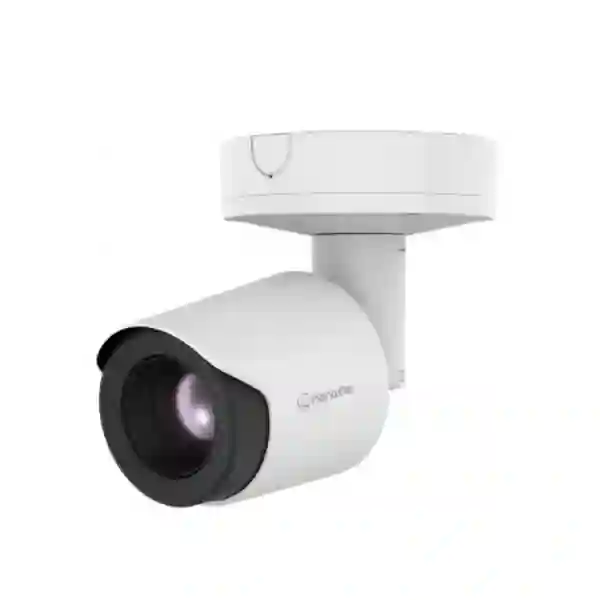
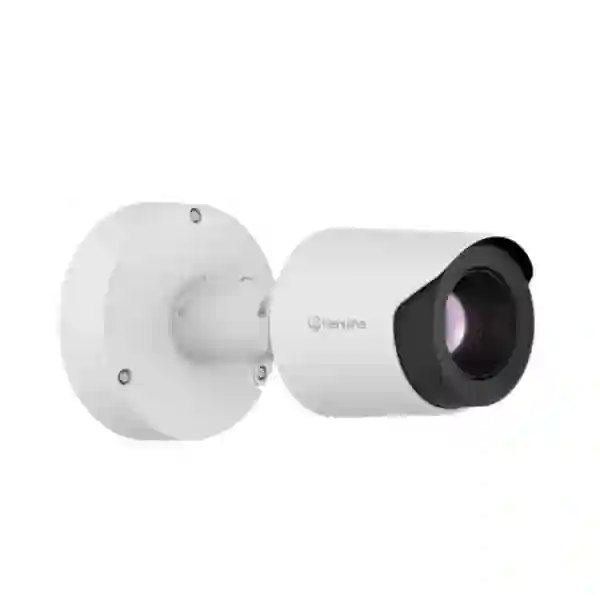
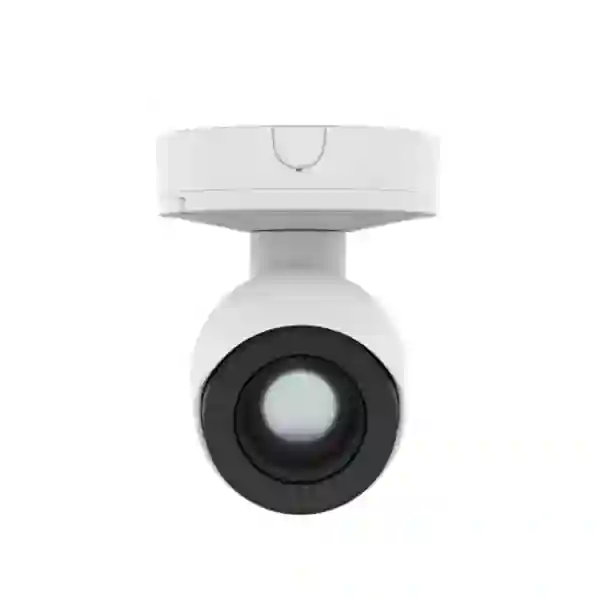
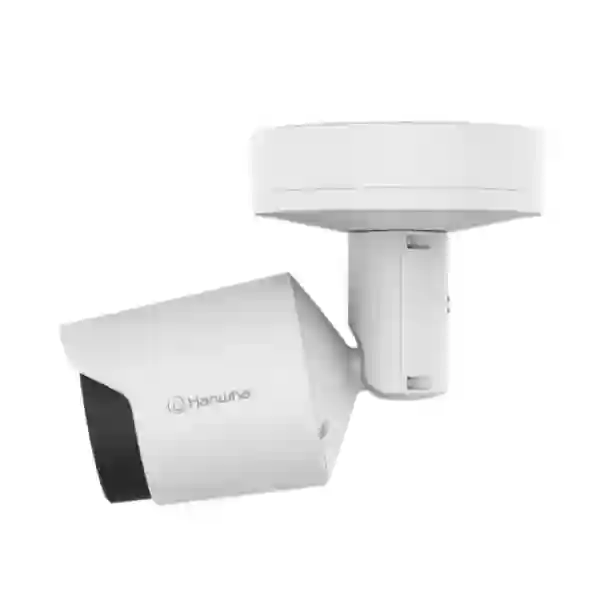
Hanwha TNO-C3080T 60 mm AI Thermal Camera
Protect defined long-range approaches with thermal imagery and AI person/vehicle classification. The Hanwha TNO-C3080T is best evaluated as part of a site-specific perimeter plan, with coverage geometry and realistic detection criteria agreed before purchase.
Verified specifications at a glance
These figures describe the product, not a guaranteed result for every site. In particular, published AI detection distances must not be confused with theoretical DRI criteria.
| Thermal detector | Uncooled microbolometer, native 384 × 288, 17 µm pixels |
|---|---|
| Lens and view | 60 mm fixed-focus athermalized; 6.2° H × 4.7° V |
| Minimum object distance | 88.3 m |
| Thermal sensitivity | NETD ≤20 mK at 25°C, F1.0 |
| Published AI person distance | Up to 399 m (1.8 m target) |
| Published AI vehicle distance | Up to 531 m (1.45 m target) |
| Video | H.265 / H.264 / MJPEG; up to 30 fps |
| Connectivity | RJ-45 Ethernet; ONVIF S/G/T/M; SUNAPI |
| Local storage | One microSD-family slot, up to 1 TB |
| Power | 802.3af Class 3 PoE or 12 VDC |
| Environmental | IP66/IP67, IK10; operating −40°C to +60°C |
| Approximate body | Ø107.3 × 275 mm; 2.34 kg |
Good candidate when
- A distant, defined approach is the priority
- AI person or vehicle alerts are required
- Visible-light illumination is unreliable
- A site survey can confirm the narrow view
Review other options when
- The area is wide, near, or frequently changing
- Face or number-plate identification is essential
- Accurate radiometric temperature data is needed
- Obstructions prevent a clear thermal sightline
A long-range thermal camera for planned security coverage
The Hanwha Vision TNO-C3080T is a network thermal surveillance camera intended for sites where detecting an approaching person or vehicle matters more than producing a colour photograph. Its 60 mm telephoto lens presents a narrow view of distant areas, making it a candidate for protected boundaries, designated approaches, and controlled access corridors. The camera combines a 384 × 288 uncooled thermal detector with on-camera analytics that distinguish people and vehicles. For buyers in Tanzania, the practical starting point is not the biggest published distance number; it is the location of the camera, the width of the area that must be observed, and the response expected after an event. A useful proposal therefore starts with the site drawing and a defined alarm objective.
Choose this model when a relatively narrow, distant zone needs persistent observation in darkness and changing illumination. Do not choose it simply because it is described as long range. A loading area close to the mounting point, a broad car park, or a building entrance may need a wider field of view or an additional visible-light camera. Thermal imagery is valuable for revealing temperature contrast, but it does not replace every security task. Ask for an application-specific coverage assessment before selecting quantities or mounting locations. The right design can combine thermal detection, clear visual verification, recording, and a human response process without expecting one camera to perform all four functions equally well.
What the 60 mm telephoto lens changes
The fixed 60 mm lens provides a nominal horizontal field of view of approximately 6.2 degrees and a vertical field of view of approximately 4.7 degrees. This is substantially narrower than the view from a typical wide-angle surveillance camera. At a distance, the narrow angle concentrates the scene on a selected approach and helps allocate more image detail to objects in that corridor. The trade-off is limited coverage to the sides. A person who moves outside the configured zone may not enter the image at all. Before ordering, mark the actual area of interest on a plan, identify the farthest and nearest required detection locations, and evaluate whether one camera can frame the whole operational task.
Hanwha specifies a minimum object distance of 88.3 metres for this lens. That matters when someone expects a telephoto camera to protect an entrance immediately below the pole or a nearby fence section. Do not assume near-field performance is equivalent to distant-object performance. The lens is fixed-focus and athermalized, which supports operation across temperature changes without making it an adjustable zoom camera. The camera mounting assembly has physical adjustment ranges, but that is not the same as remote pan-tilt-zoom tracking. If the required scene changes regularly, design for separate camera views or assess a suitable PTZ solution instead.
Thermal imaging versus conventional CCTV
A conventional colour camera relies on visible light, with performance influenced by illumination, glare, shadows, headlights, and night-lighting arrangements. Thermal imaging senses long-wave infrared radiation associated with thermal contrast in the scene. The TNO-C3080T operates in the 8–14 micrometre spectral band, so its main purpose is to show warm or cool objects against their surroundings rather than read a vehicle number plate or show clothing colours. For a remote site, this makes thermal imaging especially interesting when normal lighting is unavailable, undesirable, or inconsistent. It can provide a complementary layer to visual cameras that are assigned to identification and evidence capture.
Thermal performance still depends on the scene. High humidity, heavy rainfall, dense fog, heat-soaked backgrounds, reflections, obstructions, and minimal temperature difference can reduce usable contrast or the confidence of analytics. Thermal vision should never be marketed as seeing through walls or as immune to all weather. Use representative site conditions when agreeing detection objectives. For a secure gate, a paired visible-light camera may provide the face, vehicle marking, or colour information that thermal imagery cannot supply. A well-designed system combines the unique strengths of both types instead of describing either one as a universal replacement.
Understanding the native sensor resolution
The thermal detector uses a 384 × 288 uncooled microbolometer with a 17 micrometre pixel pitch. Hanwha also lists video resolutions of 768 × 576 and 384 × 288. Those output formats should not be confused with two different sensor sizes. The native sensing array is 384 × 288; an enlarged output frame does not create additional independent measurements of the scene. For project evaluation, native pixel count, field of view, target size, and environmental contrast all deserve more attention than a large output-frame figure considered alone. A specification comparison that ignores lens choice can easily lead to the wrong conclusion about usable range.
Because this is a thermal camera, image usefulness is tied to the number of detector pixels that represent a person or vehicle at the intended working distance. Far away, a target may be detectable while occupying too few pixels for meaningful detailed interpretation. Close to the camera, the telephoto lens can make an object appear large but may not frame the surrounding environment well enough. Ask the designer to calculate image coverage at the critical distances, show the planned detection lines, and provide realistic acceptance criteria. That is a stronger buying basis than comparing nominal resolutions without site context.
Thermal sensitivity and image contrast
The published noise-equivalent temperature difference is no greater than 20 mK at 25 degrees Celsius and F1.0 test conditions. This describes the camera’s thermal sensitivity under a specified measurement method. In plain language, sensitivity is one factor that helps the camera represent small temperature differences. It should not be interpreted as a guaranteed ability to find every person in every background, or as a statement that the camera measures industrial process temperatures to that accuracy. The actual picture is influenced by lens transmission, the environment, mounting position, surface characteristics, and image processing as well as the detector specification.
The TNO-C3080T offers image palettes such as white-hot, black-hot and several colour representations. A palette changes how thermal values are displayed to an operator; it does not change the underlying measured scene. Choose the palette that makes targets and surrounding structures easy to distinguish on the control-room monitors. Test the chosen palette during daylight, after sunset, and after surfaces have warmed during the day. Operators should understand that the apparent brightness of an object is not proof of the object’s identity, intent, or exact temperature. Clear training makes the thermal image more useful during real incidents.
AI classification: what an alert means
On-camera AI analytics can classify a person or a vehicle and support object detection, virtual-line crossing, directional crossing, and virtual-area events such as intrusion, enter, exit, and loitering. These are useful functions when a security team wants more focused alarms than simple scene motion. For example, a boundary rule could be placed across a defined approach, or a virtual area could highlight activity in a restricted zone after working hours. The system can then direct attention to a camera view and an event time rather than asking staff to watch every stream continuously. Each event rule still needs practical tuning for its environment.
An AI classification is an automated judgement, not a promise of perfect recognition or a replacement for an operator. Animals, unusual vehicle shapes, partial occlusion, changing thermal backgrounds, or targets too small in the image can affect results. Classifying an object as a person does not identify the person, determine authorization, or establish intent. Define an alarm response that includes verification, escalation, and recording where appropriate. During commissioning, walk and drive realistic routes at representative distances to identify missed events and nuisance alerts. Use the results to refine detection zones, thresholds, and operational procedures before accepting the installation.
Realistic person and vehicle AI ranges
Hanwha lists an AI person detection distance of up to 399 metres for a 1.8 metre person and an AI vehicle detection distance of up to 531 metres for a 1.45 metre vehicle. These figures are particularly relevant when evaluating the TNO-C3080T as an AI-triggered perimeter camera. They are not universal guaranteed ranges: target dimensions, thermal contrast, weather, installation height, scene clutter, and analytics settings can affect practical results. A 399 metre requirement on one site is not automatically equivalent to a 399 metre requirement on another. Use the manufacturer’s stated target assumptions as a reference rather than removing them from the specification.
For a buyer comparing quotations, ask every supplier to state the required range for a specific target, the type of alert required, and the intended detection probability under the agreed conditions. If the goal is simply to notice distant thermal movement, that is a different objective from reliable AI classification followed by a useful security response. When people may approach from several directions, calculate horizontal coverage as well as maximum range. A camera with long reach and a narrow field of view may leave sizeable gaps outside its image. Coverage quality is the product of correct placement and system design, not a single marketing number.
Why DRI distances are not AI alert guarantees
The datasheet separately provides DRI figures derived from Johnson-type image criteria. For a person, the stated detection, recognition, and identification values are approximately 2,127 metres, 532 metres, and 266 metres. For a vehicle, the corresponding figures are approximately 5,436 metres, 1,359 metres, and 679 metres. These are theoretical criteria based on the angular size of defined targets and assigned pixel-density thresholds. They are not the same test as the camera’s AI person and vehicle detection distances. Treating a theoretical detection figure as the promised reach of a configured intrusion alert would mislead the buyer.
In a project schedule, label each distance with the task it describes. Thermal target detection, algorithmic person classification, security recognition, and identity determination are different concepts. Even the word identification in a DRI table should not be taken to mean that a thermal image can confirm a person’s face or a registration plate. Include a separate camera for visual identity evidence if that is an operational requirement. During a site acceptance test, select meaningful distances along the real route and document whether operators can detect, classify, verify, and respond in time. That test converts a datasheet comparison into a usable security outcome.
Perimeter security and controlled boundaries
The most natural application for a long telephoto thermal camera is a defined distant boundary that a site needs to monitor continuously. Consider the route from the outer perimeter toward a restricted facility, not only the fence itself. The camera should have an unobstructed view of the part of that route where an early alert provides operational value. An intrusion rule can be associated with a virtual area, and a line crossing rule can differentiate the movement direction that should trigger an incident. A control room can use the signal to decide whether to inspect another camera or dispatch a team according to site procedure.
A perimeter design also needs to address dead ground, vegetation, gates, corners, natural pathways, and elevated surfaces. A narrow telephoto image may perform well along one approach while missing an adjacent path only a short distance away. Draw the viewing cone over a site plan and compare it with pedestrian and vehicle routes. Determine what happens when the target pauses, doubles back, or disappears behind an obstruction. Security coverage should be reviewed together with lighting, fencing, access control, and human response, because an alarm that cannot be verified or acted upon may create little value regardless of the camera specification.
Industrial facilities and production sites
Industrial operators may need to know whether a person or vehicle has entered a remote safety or security exclusion area. The TNO-C3080T can be considered for these areas when thermal contrast and a long, narrow sight line align with the objective. AI classification can help distinguish the relevant human or vehicle activity from broad scene movement, but each configured event should be tested near equipment, exhaust sources, moving machinery, and heat-emitting structures. Hot industrial backgrounds can be complicated thermal scenes, especially at different times of day. A site survey is needed before any claims about reliable local performance.
This model should not automatically be treated as a calibrated process-temperature inspection instrument. Hanwha lists limited region-of-interest condition-monitoring functions, but the product’s central proposition is AI thermal surveillance. If the project requires accurate temperature readings, alarm thresholds tied to specific degrees, machine-condition diagnostics, or documented measurement uncertainty, specify those requirements independently and assess an appropriate radiometric device. Security monitoring and process thermography may use related thermal technology while solving different operational problems. Defining that distinction early helps procurement teams buy the right equipment rather than relying on the word thermal alone.
Logistics yards and vehicle approaches
A yard with distant internal roads can benefit from knowing that a vehicle has entered a designated area or crossed a controlled line. The telephoto lens can watch a selected section of a route without requiring the whole yard to be evenly illuminated. A configured vehicle-classification event can flag movement at an unexpected hour, creating an opportunity for visual confirmation from another camera. It is important to design around the direction of travel, mounting height, vehicle dimensions, and any buildings or parked equipment that block the view. One camera should not be presumed to see across rows of containers or through stored materials.
The system should also distinguish operational traffic from genuine exceptions. A facility may have maintenance vehicles, scheduled deliveries, security patrols, and after-hours authorized access. Configure different zones or schedules where necessary, and avoid designing an alarm that fires repeatedly during routine operations. If the security team needs to identify a truck, driver, number plate, or cargo, add suitable visible-light coverage at a location where the subject can be captured clearly. Thermal analytics can provide an early movement signal; operational identification still needs dedicated equipment and an appropriate viewing geometry.
Utilities, remote infrastructure and sensitive assets
Remote utility compounds, communication equipment areas, water facilities, or substations may contain long approaches that are costly to illuminate constantly. A fixed telephoto thermal camera may fit a plan that aims to alert staff when a person or vehicle approaches a protected asset from a known direction. Its compact network-video role makes it relevant to an integrated site security architecture, while the actual installation must follow the asset operator’s safety, electromagnetic, access, and mounting requirements. Camera selection should never be used to bypass those requirements or imply that a listed industrial environmental rating alone approves installation in a hazardous location.
At a remote site, the end-to-end response matters as much as the image. Consider the reliability of network backhaul, local recording, power continuity, lightning and surge protection, and the mechanism for remote maintenance. A camera may continue generating video during darkness, yet an unavailable link can prevent a control room from receiving an alert. Plan how staff will distinguish a network outage from inactivity, and determine where evidence is stored if connectivity fails. Specify local safety procedures for installation and service. The result should be a maintainable security system rather than an isolated high-specification camera on a distant pole.
Recording, codecs and stream planning
The camera supports H.265, H.264, and MJPEG video compression with a maximum published frame rate of 30 frames per second. Its network specification includes multiple streaming profiles and WiseStream codec features. These give integrators choices when balancing image quality, live monitoring, network bandwidth, and recorded storage. The most suitable profile depends on target movement, retention rules, viewing clients, and actual scene complexity. Do not calculate storage using only the camera’s maximum frame rate; recording hours, event frequency, codec settings, bit rate, and the number of cameras are also essential inputs to a credible storage estimate.
When planning an installation, request a recording schedule that specifies whether video is continuous, event-triggered, or both. Decide how long video must remain available, who can export it, what audit trail is expected, and how clips are backed up if required. Confirm the chosen recorder and software can decode the intended thermal streams and record event metadata. A lower bit rate can save capacity but may also reduce visual clarity around critical incidents. It is better to test a representative night and day recording than assume that default stream settings are suitable for every perimeter.
Integration with an existing video management system
Hanwha lists ONVIF Profiles S, G, T, and M alongside SUNAPI and its Open Platform interfaces. Those published interfaces make the camera a candidate for many network-video environments, but they do not prove full feature support in every recorder or video management system. Basic video display, event reception, classified-object metadata, search tools, and alarm handover can have different compatibility requirements. Confirm the exact VMS product, version, device integration method, and licensed features before purchasing. Where an existing system is important, ask for a working compatibility demonstration rather than assuming that an ONVIF logo covers every desired function.
A good integration plan identifies how the operator receives an event and which actions follow. The camera may send supported notifications, record locally or to network storage, or interact with another system through configured interfaces. Whether these functions appear in the chosen VMS depends on the integration. Map out the actual workflow: sensor event, classification, notification, camera call-up, operator assessment, incident log, and escalation. If another camera is meant to move to a preset, verify that the surrounding system supports the handover. Clear system boundaries prevent expensive surprises during commissioning.
Events, zones and practical alarm workflows
The device provides AI events for object detection, virtual-line crossing, direction, intrusion, loitering, enter, and exit conditions. It also offers conventional analytics such as motion, tampering, audio-related events, and shock detection. An operator should not enable every event simply because it is available. Start with two or three operationally meaningful rules: for instance, entry into a restricted zone, movement across an outer boundary in a defined direction, or a vehicle remaining in an area where it is normally absent. Position those rules over stable parts of the image with enough target pixels for consistent assessment.
The next decision is where each alert goes. An event may lead to a control-room notification, a recording marker, a snapshot, or an approved external alarm input or output workflow. Specify how an incident is acknowledged, when it is escalated, and how repeated alarms from the same scene are managed. Include periods of legitimate maintenance and test activity in the schedule. During acceptance, create events under normal operating conditions and confirm that staff see useful information rather than a stream of irrelevant notifications. Alarm quality is measured by practical response, not by the number of analytics settings enabled.
Cybersecurity and device administration
A network camera is a managed IT device and should be treated as such. Hanwha lists signed and encrypted firmware, secure boot, secure communication options, authentication controls, IEEE 802.1X support, device certificates, secure storage, and event or system logs. The secure element is specified with FIPS 140-3 Level 3 and Common Criteria EAL6+ attributes. These are meaningful product design characteristics, but they do not make an installed system automatically secure or compliant with every customer’s policy. Actual protection depends on configuration, account management, network architecture, update procedures, and surrounding infrastructure.
Plan a dedicated camera network or suitable segmentation, limit administrative access, disable unnecessary services, and use approved time synchronization. Set unique credentials, remove unused accounts, enforce least privilege, and document who may export footage. Configure HTTPS and other secure transport features where supported by the complete system. Check the manufacturer’s current firmware guidance before deployment and establish responsibility for future updates. Keep configuration backups in a controlled location and test recovery. For remote access, prefer centrally managed secured connectivity rather than exposing a camera login directly to the public internet. Security should be part of commissioning and routine maintenance.
Network connectivity and remote links
The camera uses a shielded RJ-45 Ethernet interface with support for common IP networking and a published 10/100/1000BASE-T connection. It can work as part of a locally switched network, while remote access depends on the project’s router, firewall, backhaul, and video system. Ethernet link speed is not the same as the camera’s continuous video bandwidth requirement. A site designer must account for stream profiles, recording destinations, live viewers, event traffic, and occasional administrative access. Where several cameras share one uplink, the aggregate traffic and available capacity matter more than a single port specification.
If the location depends on a wireless bridge, fibre run, or cellular backhaul, review latency, packet loss, power stability, and service interruptions. Determine whether recording continues locally during an outage and how event records will be recovered afterward. Place time synchronization and DNS services where they remain available when required. If analytics are processed at the camera, understand what is performed on the device and what requires connectivity to another platform. Avoid claiming that any particular Tanzanian network provider is compatible or has reliable coverage at the intended site without project-specific verification.
Edge recording and evidence continuity
Hanwha specifies a microSD, microSDHC, or microSDXC slot supporting up to 1 TB of edge storage. That capability can be useful for local event recording or resilience when the main network recorder becomes unavailable, subject to the camera configuration and card requirements. A memory card is not necessarily an adequate replacement for a correctly sized central evidence archive. Its capacity, endurance, write behaviour, retention schedule, and service accessibility should be checked against the planned workload. Installers should use an appropriate supported card and verify that the camera actually records and retrieves test events after a simulated link interruption.
Think about who will retrieve evidence and how a file becomes part of an incident record. Timestamp accuracy, time-zone handling, access permissions, integrity checks, export formats, and chain-of-custody procedures may all matter. A remote guard should not need to climb a pole or open a housing to recover routine footage. Confirm whether the VMS offers remote retrieval of relevant clips and how large transfers affect a limited network connection. Test an actual incident workflow from the first alarm through final file export. Evidence continuity is an operational process, not simply the presence of a card slot.
Environmental resilience for outdoor deployments
The published protection characteristics include IP66 and IP67 ingress protection, IK10 impact resistance, NEMA 4X, and relevant environmental testing against demanding conditions. The camera’s specified operating temperature range is minus 40 to plus 60 degrees Celsius, with a stated non-condensing humidity range up to 95 percent. These details support consideration for demanding outdoor installations, but ratings must still be understood in their correct technical context. They do not eliminate the need for appropriate connectors, cable sealing, drainage, structural mounting, protective routing, and lightning or surge design. Every enclosure penetration is a potential installation weakness if handled incorrectly.
Tanzania contains diverse weather and site environments, so project design should be based on the specific location rather than a national assumption. Coastal corrosion exposure, wind-driven rain, dust, and high solar loading are different design considerations. Check the mounting hardware, junction accessories, cable glands, and supporting infrastructure as a complete assembly. Use installation methods allowed by the manufacturer and inspect seals after service. Do not interpret an IP rating as permission for arbitrary water pressure, underwater operation, or use outside published limits. Long-term reliability usually depends on good installation discipline as much as the camera body itself.
Power design and backup capacity
The TNO-C3080T supports IEEE 802.3af Class 3 PoE or a 12 VDC power input. Hanwha lists maximum power consumption of approximately 10.8 W on PoE and 9.4 W on 12 VDC. These values help a designer size a compatible switch, power supply, or backup system. They do not include the total energy demand of a network switch, wireless bridge, fibre converter, recorder, UPS losses, or other equipment in the same cabinet. For long cable runs and remote poles, review voltage drop, allowed cable length, conductor quality, surge protection, and the power budget of every port in the proposed system.
A system designed for incident response should specify the necessary uptime during power interruptions. Determine whether the camera, the local network switch, recording equipment, and the alert path all have sufficient backup power to operate together for the desired period. If only the camera remains powered while its switch or backhaul fails, remote monitoring may stop. Test restoration after an outage and record the reboot and reconnection behaviour. For a remote site, a coherent power architecture can matter more to incident coverage than a minor difference in camera specifications. Confirm final electrical arrangements against applicable site standards.
Mounting geometry, height and stable sightlines
The aluminium camera body is specified at approximately 2.34 kilograms, with dimensions of about 107.3 mm diameter by 275 mm length. The mount must support the installed camera and all associated hardware under relevant wind and environmental conditions. Because the field of view is narrow, small changes in aim can shift the surveillance corridor considerably at longer distances. A rigid mounting surface, correct fasteners, and a clear method of final alignment therefore deserve attention. Check available accessories, junction-box fit, service access, and the route used for the network and power cables before the pole or wall work is finalized.
Placement should be reviewed from both a geometric and a security perspective. An elevated camera may reduce near-field obstruction but change the apparent size and shape of a target. A low mounting position may show an approach clearly while being more vulnerable to obstruction or tampering. Vegetation growth, seasonal changes, vehicle parking, structures, and planned construction can all alter a line of sight. Mark the target zone physically, view it at the intended camera height, and retain an image of the accepted scene for future maintenance comparisons. An installation drawing should include the actual direction of view, not merely a dot marking the camera pole.
Commissioning and acceptance testing
A professional commissioning plan should start with documented objectives: which target class, which direction of travel, what distance, which alert, and what response time. Confirm the camera model and lens against the purchase order, apply an approved firmware version, configure the network securely, and verify the actual view. Record the software versions of the camera, recorder, and video management system. Then test thermal visibility, target classification, recording, and alert delivery across meaningful site scenarios. A walking test at the closest required location should be included alongside tests near the intended far boundary.
Do not accept a camera merely because it produces a picture in the control room. Inspect whether the selected field of view covers all of the intended pathway; whether alerts carry enough context to be useful; and whether an operator can retrieve a recording afterward. Run representative tests in different ambient conditions where feasible, including after sunset. Document target size and movement, installation height, detection zone, and observed results. Any failure should lead to a clear adjustment, retest, or design change. A signed acceptance record with screenshots and configuration notes gives the owner an objective basis for future support.
Reducing nuisance alarms and missed detections
Analytics perform best when rules correspond to real security decisions. Poorly drawn zones can trigger on routine movement outside a protected area or miss an approach that skirts the edge of the image. A camera pointed toward a changing industrial background may encounter thermal features different from those of a quiet open boundary. Review the scene with the people who understand the site’s normal activity. Configure lines and areas around meaningful thresholds, and consider the direction of travel, operating schedule, and likely target behaviour. The goal is a manageable signal that causes the right response, not the largest possible count of detected objects.
Use a log of observed false alerts and missed events during the initial operating period. Record when they occurred, the weather or scene conditions, the target class, and any obstruction. Adjust one parameter at a time so the impact can be understood. Avoid solving false alarms by setting sensitivity so low that required detections disappear. Also avoid placing the rule at an extreme range based solely on a nominal specification. The right balance is specific to the site. Periodic review after construction changes, vegetation growth, or seasonal conditions can keep the system aligned with its original purpose.
Thermal surveillance and privacy-aware operation
Thermal video does not normally provide the same visible facial detail as a conventional camera, but recorded movement patterns and associated metadata can still be sensitive in an operational setting. A project owner should decide why the scene is monitored, who may view it, what areas should be excluded, and how long footage should be retained. Hanwha lists configurable privacy masks and video access controls, which may help implement a broader site policy. A mask is only one control: staff permissions, secure exports, audit logs, and written access procedures are equally important. Apply the laws and policies relevant to the actual installation.
When a camera covers a boundary near public movement or a neighbouring property, the design should minimize monitoring beyond the legitimate objective where feasible. Thermal classification does not grant permission to monitor every passing person without a defined purpose. Document the operating rationale and consider signage or other appropriate notice as advised by the site owner. Establish a process for handling footage requests and investigating misuse of account access. The correct privacy response depends on deployment facts; this product description is not a legal determination or a claim of local regulatory approval.
Choosing this telephoto model versus a wider lens
A 60 mm thermal lens is attractive when a distant corridor or approach is the priority. The same lens can be a poor match for monitoring a wide near-field perimeter in one image. Before choosing this model over another lens option, make a simple comparison table: required minimum distance, maximum working distance, horizontal span, target type, and camera height. A wider lens may cover more area with fewer blind spots while providing fewer pixels on a distant target. A longer lens can better concentrate detail at range but makes alignment and the number of coverage positions more critical. There is no universally best focal length.
Also consider whether the project values early thermal detection, object classification, visual verification, or positive identity evidence. Those objectives may require different devices or a combination of devices. Thermal surveillance can be a valuable first layer in a layered design, but it will not read a number plate or provide daylight colour detail. If the site has two distant approaches separated by a wide angle, do not expect a fixed narrow view to cover both simultaneously. Provide a plan or annotated photograph to the quotation team so they can recommend an appropriate arrangement and avoid a lens mismatch.
What should appear in a technical quotation
A useful quotation for a thermal surveillance project should identify the exact Hanwha Vision TNO-C3080T model, camera quantity, proposed mounting locations, supported power arrangement, required switches or converters, and the method for connecting to a recording or VMS platform. It should state whether additional visible-light cameras, storage, network infrastructure, mounting accessories, commissioning, and training are included. An apparently low camera-only price may not describe a complete working perimeter system. Ask for a clear scope of supply and exclusions rather than comparing totals with different components or assumptions.
The project should also document expected detection tasks, target assumptions, installation distances, coverage drawings, and the acceptance test. Where operating conditions are challenging, a field demonstration may be appropriate. Request clarity on applicable supplier support, product sourcing, firmware maintenance, configuration handover, and any site-specific installation work, without assuming that a particular service or warranty is included. Confirm lead times and current availability through the actual quotation process. No stock level, local price, delivery promise, or special authorization is asserted here. Good procurement records make both commissioning and later support more predictable.
Maintaining consistent performance after installation
Long-term surveillance quality depends on maintenance as well as initial setup. Establish a routine to inspect the housing, seals, bracket stability, cable glands, junction box, and the view for new obstructions. Check that stored footage can still be retrieved and that representative person and vehicle events reach the operator. Review firmware advisories through the appropriate approved support process, keeping a change record. A thermal camera may continue streaming even when the configured analytics no longer match a changed site layout, which is why periodic functional tests should be included in maintenance schedules.
The operator should have a documented way to report unusual image contrast, camera movement, missing events, or repeated nuisance alarms. If a device must be replaced, preserve the approved configuration and document the new aiming and acceptance results rather than assuming the previous setup will transfer perfectly. Validate timestamps and recording retention after maintenance. Review site changes such as new fencing, buildings, parked equipment, or vegetation. A disciplined maintenance plan keeps performance tied to the original requirement and helps determine whether future changes need a different lens, additional camera, or revised detection zone.
Operator training and incident response
A control-room operator needs more than a product feature list. Training should explain what a thermal image represents, how person and vehicle classifications appear, and what the configured line or area rules mean. Staff should know the difference between an AI alert and confirmed unauthorized activity. Give operators a simple workflow for calling up relevant views, checking the event time, using available visible-light cameras for verification, and recording their decision. They should understand that environmental effects can reduce contrast and that a person partially hidden by an obstruction may be difficult to classify reliably.
Practice at least a few realistic incidents during handover. Include an expected event, an authorized movement that should not cause an escalation, and a simulated network or recording problem. Confirm that staff know whom to contact when the alert cannot be verified. Protect access to exported clips and document incident numbers consistently. If a security team works in shifts, the procedures should be usable without relying on one technician who configured the camera. Good operator preparation turns available analytics into a measured operational benefit and reduces the chance that nuisance alerts are ignored.
A Tanzania-specific planning perspective
For a Tanzania deployment, start from the actual operating environment and the customer’s practical constraints rather than unsupported general statements about local coverage. Ask whether the site is exposed to high solar load, wind-driven rain, dust, corrosion, network interruptions, or extended periods with no onsite staff. These factors can affect mounting, protected cabling, backup power, maintenance access, and the choice of recording architecture. The published environmental specifications provide a technical starting point, but only a project survey can establish whether the whole installed system suits a particular facility.
Currency, importation, local approvals, support coverage, and shipment dates should be confirmed through a project quotation if they are relevant. This page does not represent them as already verified. Likewise, a customer’s network service, power arrangement, and VMS licensing must be checked for the named deployment. Buyers can provide a site drawing, expected person and vehicle routes, estimated distances, lighting conditions, and existing recorder details. That information lets the equipment selection focus on coverage and performance instead of a generic country-wide promise.
Site-survey questions before purchasing
Before choosing a camera position, ask where an unauthorized person is most likely to approach, where a vehicle could enter, and what safe response distance the security team requires. Measure the nearest and farthest points where a positive alert would be useful. Identify fences, trees, buildings, parked vehicles, reflective surfaces, terrain changes, and any sources of persistent heat. Note the direction in which targets move and the times when the scene normally contains authorized activity. A clear answer to these questions helps determine whether the camera’s narrow telephoto view is an advantage or an unnecessary restriction.
The survey should also identify available poles or walls, approved cable routes, access for safe maintenance, PoE switch capacity, recorder locations, and available backup power. Check network security requirements and retention policies before assuming the camera can simply be added to an existing system. If operators rely on a control room, document how alarms appear and how far away the responding team is. Finally, agree on how to prove successful detection after installation. A completed survey should reduce design uncertainty, not merely become a photograph collection.
A layered design instead of a single-camera promise
A long-range thermal camera often works best as the early-detection layer of a wider security system. The thermal view highlights activity along a specified route, a visible-light camera supplies contextual details, the VMS organizes alarms and recordings, and an access-control or guard procedure provides the response. The TNO-C3080T can contribute thermal observation and classified-object events to such an architecture. However, it should not be advertised as independently guaranteeing intruder identification, preventing trespass, or securing every side of a facility. Those outcomes require a design supported by physical safeguards and people.
When designing a layered system, define which device owns each task and what information crosses between devices. For example, an AI alarm might prompt an operator to view a nearby colour camera, but the handover needs the correct time, location, and available integration features. If different vendors’ systems are involved, verify the actual event mapping in a pilot. Specify how the system behaves during power loss, network interruption, and camera maintenance. A layered proposal is more transparent and useful to the buyer than broad claims about complete automatic protection.
How to evaluate the final purchasing decision
The decisive question is whether the TNO-C3080T is the right optical and analytical fit for the location. Compare its 60 mm field of view, minimum object distance, native 384 × 288 detector, published person and vehicle AI distances, and integration capabilities against the specific objective. Then assess operational constraints: environmental exposure, power, network architecture, storage retention, cybersecurity, and response procedures. Do not allow a theoretical DRI range to substitute for a site-specific AI acceptance criterion. The most expensive part of a security installation can be the correction of an avoidable lens or coverage error.
If the required scene is distant and narrow, the model may be a strong candidate. If the area is near and wide, or if identity evidence is the primary requirement, request a different optical arrangement or supplementary cameras. A sound project proposal should explain both reasons to choose this device and reasons not to. Buyers should receive the model, scope, commissioning plan, and acceptance criteria in writing before committing to a deployment. That creates a practical decision path rather than relying on a list of impressive but disconnected product features.
Buyer questions about the Hanwha TNO-C3080T
The answers below address practical selection, integration, and operation questions for teams evaluating an AI thermal camera in Tanzania.
Is the TNO-C3080T a normal colour CCTV camera?
No. It uses a thermal detector and presents temperature contrast rather than a visible-light colour photograph. That can help with surveillance in darkness, but it cannot be expected to capture clothing colours, faces, or number plates with the detail of an appropriate conventional camera. Pair it with visible-light cameras when identity evidence is part of the objective.
What is its actual thermal detector resolution?
The native uncooled microbolometer is 384 × 288 pixels. Hanwha lists 384 × 288 and 768 × 576 video output formats. An enlarged video frame should not be interpreted as a different native thermal sensor. Evaluate field of view, target size, and required distance alongside detector resolution rather than using the output-frame dimension alone.
How far can its AI detect a person?
Hanwha’s published AI detection figure is up to 399 metres for a specified 1.8 metre person target. Practical results are affected by thermal contrast, weather, scene obstruction, target position, and analytics configuration. A real project should validate an agreed detection requirement at the actual mounting location rather than treating the maximum published figure as a guaranteed service distance.
How far can it detect vehicles with AI?
The manufacturer’s stated AI detection distance for a specified vehicle target is up to 531 metres. This is a model reference figure, not an assurance that every vehicle and background will produce the same result. Size, angle, thermal background, environmental conditions, and camera alignment all influence the usable result. Confirm the task through a representative field test.
Why does the datasheet show a longer detection distance?
The larger values belong to theoretical DRI image-criteria calculations, not the separately published AI person and vehicle classification distances. DRI detection, recognition, and identification have specific meanings based on target dimensions and pixel thresholds. They should not be used interchangeably with guaranteed analytic event performance or with visible-light identification of a person.
Can the camera see through walls or dense obstacles?
No. Thermal imaging needs a usable line of sight to the relevant thermal scene. A wall, substantial vegetation, parked container, or other obstruction can hide a target. Environmental effects can also reduce contrast. Plan viewing positions with actual obstructions shown and avoid claiming that thermal technology provides unrestricted visibility through solid objects.
Is the 60 mm lens adjustable remotely?
The 60 mm lens is fixed-focus, and the camera is not described as a remote optical zoom or PTZ model. Published pan, tilt, and rotation values relate to physical adjustment. If the security requirement includes changing views or following moving subjects across a broad area, assess a suitable moving camera or a multiple-camera arrangement.
How close can the camera focus?
Hanwha specifies a minimum object distance of 88.3 metres for this model. This is an important design consideration when the requested surveillance area starts close to the mounting location. A camera intended for long-range observation may not be the right choice for a nearby entryway or other short-range task.
Does the TNO-C3080T provide temperature measurements for machinery?
Do not assume that it is a calibrated industrial thermography instrument. Its central application is thermal surveillance with AI object classification. If a project requires temperature thresholds in degrees, calibrated inspection data, or documented measurement accuracy, define those needs separately and select a device specifically documented for that role.
What type of power supply is supported?
The camera supports IEEE 802.3af Class 3 PoE or 12 VDC. Hanwha lists maximum power demand around 10.8 watts on PoE and 9.4 watts on 12 VDC. Total system backup capacity must also include any switches, communication equipment, storage devices, and losses associated with the installation.
Can it record onto a memory card?
It has a microSD-family card slot with a stated maximum capacity of 1 TB. Storage suitability depends on card endurance, configuration, recording settings, and the desired retention period. Verify event recording and retrieval during commissioning, and do not assume a card provides the same operational resilience as a managed recording system.
Can it work with an existing NVR or VMS?
The manufacturer lists ONVIF Profiles S, G, T, and M, as well as SUNAPI. These interfaces are useful starting points, but exact video, event, and analytics compatibility must be confirmed against the chosen recorder or VMS version. Ask for a supported-device check and test the functions that operators will actually use.
Is the camera suitable for outdoor environments?
It carries published IP66/IP67 and IK10 ratings plus other stated environmental tests, with a specified operating range from minus 40 to plus 60 degrees Celsius. Real suitability depends on the complete installed assembly, correct sealing, mounting, cabling, power protection, and local exposure. Environmental ratings are not a substitute for a proper site survey.
What happens when the network connection fails?
Behaviour depends on how recording and alert delivery have been configured. The device offers local storage and network-event functions, but loss of the remote link may prevent a control room from receiving an alarm immediately. Test local recording, reconnection, time synchronization, and later footage retrieval as part of the overall system acceptance procedure.
How should we plan the number of cameras?
Start with a measured site plan, desired alert distance, target directions, and the camera’s narrow 6.2 degree horizontal field of view. Mark each required coverage corridor and identify blind areas. The quantity should result from geometry and the response objective, not a simple perimeter-length rule. Where coverage overlaps or visual verification is needed, additional camera types may be appropriate.
Can a price or delivery date be confirmed from this product information?
No price, stock position, local delivery schedule, warranty term, or special sourcing status has been confirmed for this listing. Request an up-to-date quotation that identifies the exact model and the required accessories and installation scope. This prevents confusion between a camera-only supply and a complete operational surveillance system.
Request a project-specific quotation
Share your site layout, desired person or vehicle detection distance, approximate mounting height, recording platform, and power or network constraints. Ask FourTeck Tanzania to confirm the exact Hanwha Vision TNO-C3080T configuration, current commercial terms, and the proposed scope before ordering.
For the best technical outcome, request a coverage review and written acceptance criteria. No local stock, price, delivery date, regulatory approval, installation coverage, or warranty promise is implied by this product description.




Reviews
There are no reviews yet.