
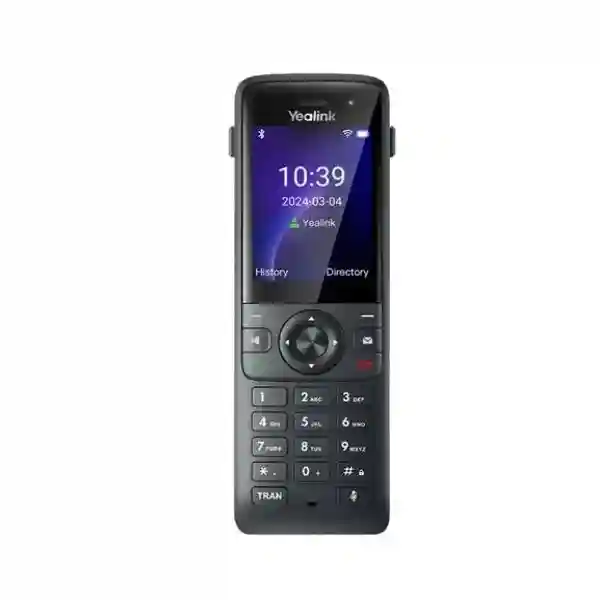
Yealink AX83H Wi-Fi IP Phone Tanzania
The Yealink AX83H is designed for business users who need reliable voice communication without being tied to an Ethernet desk point. It connects over dual-band Wi-Fi 6, supports IEEE 802.11k/v/r roaming, works with up to four SIP accounts and includes Bluetooth 5.0 for compatible wireless headsets. For organizations in Tanzania evaluating cordless voice endpoints for offices, warehouses, retail operations, hospitality spaces and other mobile work environments, the AX83H offers a practical bridge between enterprise SIP telephony and modern wireless LAN infrastructure.
What the AX83H solves
Traditional desk IP phones work well where users remain at assigned workstations, but many business roles are mobile by nature. Supervisors walk production or warehouse areas, hotel teams move between service points, retail managers cover multiple zones, and support staff may need an extension while away from a desk. The AX83H lets those users carry a SIP endpoint with them while using the organization’s Wi-Fi network as the access layer. The result is a familiar enterprise calling model without requiring a wired handset at every place where a user may need to communicate.
Where it fits best
The handset is especially relevant where the wireless LAN already has reliable coverage and voice users need mobility across multiple access points. Yealink positions the AX83H for environments including SMEs, offices, warehouses, supermarkets and hotels. It can also suit other controlled business spaces where SIP calling, roaming and portable operation are useful. Successful deployment depends on more than handset specifications: access-point placement, channel planning, roaming support, QoS, SIP platform compatibility and network security should be reviewed together.
Verified Yealink AX83H highlights
Built-in 2.4 GHz and 5 GHz wireless networking with IEEE 802.11a/b/g/n/ac/ax support.
IEEE 802.11k, 802.11v and 802.11r support helps the handset move between compatible access points with less interruption.
Supports up to four VoIP accounts, call transfer, hold, waiting, forward, voicemail, intercom and local 5-way conferencing.
Yealink Optima HD Audio, Smart Noise Cancellation, full-duplex hands-free operation and HAC-compatible handset support.
Built-in Bluetooth supports compatible wireless headsets for users who need hands-free communication while moving.
A 2000mAh battery is rated by Yealink for up to 9 hours of talk and 200 hours of standby under laboratory conditions; charging cradle and USB Type-C charging are supported.
Technical specification overview
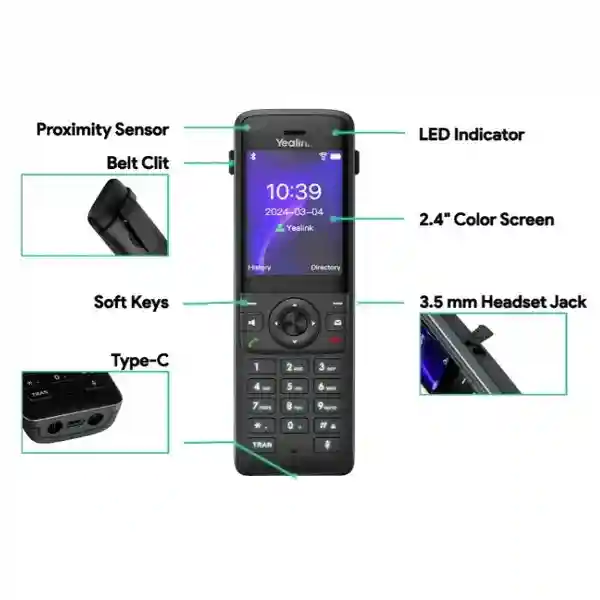
| Display | 2.4-inch 240 × 320 TFT color screen, keypad backlight, vibration and LED indicators. |
| SIP and conferencing | Up to 4 VoIP accounts and local 5-way conferencing. |
| Wireless LAN | Dual-band 2.4G/5G Wi-Fi 6, IEEE 802.11a/b/g/n/ac/ax, with 802.11k/r/v roaming support. |
| Bluetooth | Bluetooth 5.0 for compatible wireless headset connection. |
| Audio | HD handset and speaker, Smart Noise Cancellation, full-duplex hands-free speakerphone, HAC support and common wideband/narrowband codecs including G.722. |
| Security | SRTP, TLS 1.3, HTTPS certificate management, AES256 configuration-file encryption, OpenVPN, IEEE 802.1X, WPA/WPA2/WPA3 and secure boot. |
| Management | Browser and phone configuration, auto-provisioning via FTP/TFTP/HTTP/HTTPS, PnP, TR-069 and Yealink device/cloud management support. |
| Physical | 151 × 49.5 × 21 mm handset, approximately 126 g, 3.5 mm headset jack and Type-C port. |
| Power | 5V/1.2A adapter specified by Yealink; package documentation lists handset, charging cradle, rechargeable battery, belt clip, quick start guide and power adapter. |
Wi-Fi design matters as much as the phone
The AX83H is a Wi-Fi voice endpoint, so wireless quality directly affects the calling experience. A handset can have strong roaming capabilities and still perform poorly on a congested, weak or badly tuned WLAN. Yealink’s AX-series guidance states that compatible access points should support mainstream Wi-Fi standards and that 802.11r fast transition is an important requirement for multi-AP voice roaming, while 802.11k and 802.11v are recommended to improve access-point discovery and steering. For a production deployment, coverage should be assessed where staff actually walk, not only where laptops are normally used.
Voice traffic benefits from predictable RF coverage, sensible transmit power, channel planning, appropriate security, VLAN design and QoS. The design should also consider stairways, corridors, loading zones, shelving, concrete walls and other features that affect signal behavior. Before purchasing a large quantity, a pilot can validate roaming, call quality, battery workflow, headset behavior and SIP features in the real facility.
Integration, provisioning and security planning
The Yealink AX83H supports SIP v1 and SIP v2, IPv4 and IPv6, static or DHCP addressing, call-server redundancy, STUN for NAT traversal and a range of enterprise call functions. That makes it suitable for many standards-based VoIP environments, but feature behavior can vary by PBX, hosted voice platform, SIP service and provisioning template. Buyers should confirm the exact calling features they require before rollout, particularly if workflows depend on call park, pickup groups, multicast paging, recording, LDAP directories, XML applications or special dial-plan behavior.
For fleets, centralized provisioning is more efficient than configuring every handset manually. The device supports auto-provisioning methods and Yealink management platforms, enabling administrators to standardize firmware, SIP settings and operational parameters. Network teams should also coordinate device identity, Wi-Fi authentication, SIP credentials, certificate handling and password policy. Security controls listed by Yealink include SRTP for media, TLS 1.3, WPA3, IEEE 802.1X, AES256 configuration-file encryption and secure boot. The correct combination depends on the organization’s wireless and telephony architecture.
FourTeck’s broader Tanzania business technology portfolio is useful when the handset forms part of a wider project involving IP PBX, switches, Wi-Fi access points, firewalls or structured network upgrades. Buyers comparing endpoint options can also review the specialist FourTeck IP phone solutions site for broader telephony context.
Who should consider the Yealink AX83H?
Supervisors and operations staff can remain reachable while walking between receiving, storage, picking and dispatch areas, provided the wireless network is designed for continuous voice coverage.
Service teams may need extension calling away from fixed desks. A portable SIP handset can keep front-of-house and operational communications connected across covered areas.
Managers and floor staff can take or place internal calls while moving between customer areas, stock rooms and service counters instead of returning to a fixed phone.
Mobile employees can carry their SIP extension between work areas where a well-managed WLAN supports seamless roaming and sufficient capacity.
Yealink AX83H Tanzania
For organizations searching for the Yealink AX83H in Tanzania, the buying decision should start with the communication workflow rather than with the handset alone. The AX83H is best suited to people who need to move around a business site while retaining access to SIP calling. That may include warehouse supervisors, hotel operations teams, retail managers, facilities staff, support engineers, logistics personnel and office users who work across shared spaces. Because the phone uses Wi-Fi instead of a dedicated DECT radio system or wired Ethernet at the handset, it can be attractive where an enterprise wireless network already covers the places where staff need to communicate.
A Tanzania deployment should confirm wireless design before ordering at scale. Dual-band Wi-Fi 6 gives the handset access to both 2.4 GHz and 5 GHz networks, but actual voice quality depends on RF coverage, AP density, interference and roaming configuration. If users walk through several rooms, floors or operational zones during calls, the access-point environment should support the roaming features the AX83H is designed to use. It is especially useful to test handoff behavior in corridors, stairwells, lift lobbies, storage aisles and other transition spaces that are sometimes ignored during ordinary Wi-Fi surveys.
The SIP side should be reviewed in parallel. The AX83H can register up to four VoIP accounts and includes common enterprise call functions, but buyers should confirm compatibility with their PBX or hosted SIP service, required codecs, extension policies, call routing and provisioning method. For larger fleets, automated provisioning and centralized management can reduce setup effort and improve consistency. If the project also needs access points, switching, firewall policies or IP PBX design, it is more efficient to size those elements together than to treat the handset as an isolated purchase.
Tanzania buyers requesting a quotation should specify expected quantity, current PBX or SIP platform, number of sites, Wi-Fi environment, headset requirement and whether configuration support is needed. This allows the quotation process to focus on a workable solution rather than only on unit price. FourTeck can also help evaluate related network and telephony requirements through its Tanzania technology portfolio.
Yealink AX83H Wi-Fi IP Phone Dar es Salaam
Businesses in Dar es Salaam often operate in environments where teams move between offices, counters, storage areas, workshops, hospitality spaces or multiple floors. The Yealink AX83H can suit these workflows by providing a portable SIP extension over the business Wi-Fi network. Instead of installing a fixed telephone at every possible point of use, an organization can assign mobile staff a handset that follows them through areas with suitable WLAN coverage. This is particularly relevant for facilities where operational speed depends on immediate internal communication.
Dar es Salaam sites can vary greatly in construction and RF conditions. Concrete walls, glass partitions, metal shelving, equipment rooms and crowded wireless environments can all influence performance. A purchasing team should therefore avoid assuming that ordinary laptop Wi-Fi coverage automatically equals voice-grade coverage. Voice calls are sensitive to brief packet loss and roaming delays, so a site intended for AX83H mobility should be assessed for signal consistency and access-point handoff along real walking paths. Where 5 GHz coverage is strong, it can offer useful capacity; 2.4 GHz may extend further in some spaces but can be busier and more prone to interference.
The AX83H’s four SIP accounts make it possible to support multiple identities or call contexts where the phone system permits that model. Bluetooth 5.0 can help staff who need hands-free communication, while the 3.5 mm headset interface provides another accessory path. The 2.4-inch screen and physical keypad make the device familiar for users who prefer a purpose-built business phone rather than a mobile application. Battery planning should still reflect shift length, call volume and access to charging points; Yealink’s published battery figures are laboratory ratings, not guaranteed runtime in every deployment.
When asking for a Dar es Salaam quote, include whether the project is for a new PBX, an existing SIP system or an endpoint refresh. Mention the number of handsets, floors, access points and any roaming challenges already observed. That information makes it easier to identify whether the AX83H can be deployed directly or whether the Wi-Fi environment should be tuned first.
Yealink AX83H Wi-Fi IP Phone Mwanza
For businesses in Mwanza, the Yealink AX83H offers a practical option where staff need to stay connected while moving through a site rather than remaining at one desk. It may be relevant for hospitality properties, distribution operations, retail environments, offices, service facilities and warehouses that already use or plan to use SIP telephony. The key advantage is architectural: the handset communicates over the WLAN, so the same carefully designed business Wi-Fi environment can support data devices and mobile voice endpoints without a network cable to each handset.
That convenience places more importance on wireless planning. A Mwanza organization should map the actual areas in which calls need to remain active. Strong coverage in reception but weak coverage around storage, service corridors or back offices can produce a poor user experience. The AX83H supports 802.11k/v/r roaming to improve transitions between compatible access points, but those capabilities work best when the access-point infrastructure is configured to support them. WLAN design should consider client load, signal overlap, channel use, security settings and the wired uplinks feeding the APs.
On the voice side, the phone supports multiple codecs, call transfer, hold, forwarding, waiting, voicemail and other typical IP-PBX functions. These features can help organizations standardize mobile users on the same extension environment used by desk phones. Centralized provisioning is valuable for multi-handset deployments because changes can be managed systematically rather than performed device by device. Security should be planned as part of that process, with strong Wi-Fi authentication, protected SIP transport where supported by the call platform and disciplined credential management.
Mwanza buyers can improve quotation accuracy by sharing the PBX brand or hosted voice service, expected handset quantity, Wi-Fi access-point platform and any accessory requirements. If the project includes broader network upgrades, planning phones, wireless coverage and switching together can reduce integration issues and make the deployment easier to support over time.
Yealink AX83H Wi-Fi IP Phone Arusha
Organizations in Arusha looking for a mobile business phone can consider the Yealink AX83H when their operational teams need a SIP extension that moves with them. Hospitality, travel-related operations, offices, retail sites, warehouses and service organizations can all have staff who spend significant time away from a desk. A Wi-Fi handset addresses that requirement with a dedicated voice device that does not depend on users carrying a personal smartphone or keeping a softphone application active.
For hospitality and multi-area properties, roaming is particularly important. The AX83H supports IEEE 802.11k/v/r and can move between compatible access points, but the WLAN must provide proper overlapping coverage. Site teams should test guest-facing spaces, back-of-house routes, staff areas and transitions between indoor zones. If there are dead spots or overloaded access points, those issues can affect voice. A wireless survey or at least a structured pilot is sensible before a large purchase, especially where users will maintain calls while walking long distances through the property.
The handset’s HD audio and Smart Noise Filtering are relevant in operational environments where background sound can make calls difficult, although no noise-cancellation system can compensate for every acoustic condition. Bluetooth 5.0 gives users the option of compatible wireless headsets, while the physical handset remains useful when users need a simple, purpose-built device. The four SIP account capability may suit organizations with multiple line identities or service roles, subject to PBX configuration.
For Arusha procurement, include the intended use case in the request: front office, operations, engineering, housekeeping coordination, warehouse supervision or another role. Also state whether the phones need to integrate with an existing PBX and whether the Wi-Fi network is centrally managed. This context helps determine whether the AX83H is the right endpoint and what configuration work should be included in the project scope.
Yealink AX83H Wi-Fi IP Phone Dodoma
The Yealink AX83H can serve Dodoma organizations that want business-grade SIP calling for employees who are frequently away from a fixed workstation. Offices, institutional facilities, warehouses, service operations and multi-room sites can use a Wi-Fi handset to keep staff reachable while they move. Because the AX83H is a dedicated enterprise voice endpoint, it gives administrators more structured control over provisioning, SIP registration and device settings than an ad-hoc collection of personal mobile phones and consumer calling applications.
A successful deployment should begin with an inventory of the existing network. Confirm whether access points support the Wi-Fi standards and fast-roaming features needed for the planned mobility pattern. Review where users will start and end calls, how they move between coverage zones and whether there are areas with thick walls or high client density. Wi-Fi 6 support is valuable, but the handset still relies on the design quality of the surrounding network. Voice traffic should also receive appropriate QoS treatment across the wireless and wired infrastructure where the network supports it.
The AX83H’s feature set includes common calling tools such as transfer, hold, waiting, forwarding, voicemail and local 5-way conferencing. For teams that coordinate work across departments, these functions can support faster internal communication. Centralized configuration methods and Yealink management options can make a multi-device rollout easier to maintain, especially when firmware or SIP settings need to be standardized.
Dodoma purchasers should request a solution based on role and network conditions, not only unit quantity. Sharing the PBX type, extension plan, WLAN platform, number of buildings or floors and expected call patterns helps produce a more useful proposal. Where a site also needs new wireless access points, switches or telephony infrastructure, the AX83H should be evaluated as part of that wider design.
Yealink AX83H Wi-Fi IP Phone UAE
The Yealink AX83H is also relevant for UAE organizations seeking a portable SIP handset for enterprise wireless environments. Offices, hospitality properties, retail groups, logistics facilities and warehouses frequently have roles that require staff to move while remaining reachable on an internal extension. The handset’s Wi-Fi 6 connectivity, 802.11k/v/r roaming support and Bluetooth 5.0 make it suitable for modern WLAN-based voice deployments where mobility is a core requirement.
In dense UAE commercial environments, Wi-Fi design should account for high client counts and overlapping networks. Large offices and hotels may have dozens or hundreds of wireless devices sharing spectrum, so handset performance cannot be assessed only from headline Wi-Fi capability. Channel planning, AP placement, roaming behavior, VLAN configuration and QoS should be validated under realistic load. Where users traverse lifts, long corridors, back-of-house spaces or multiple floors, those routes deserve specific test calls before a full rollout.
The AX83H supports up to four SIP accounts and multiple enterprise calling features, allowing it to operate as part of a broader IP telephony system. Centralized provisioning and management can be important for multi-site UAE deployments where administrators need consistent templates, firmware levels and security settings. The device also supports security mechanisms including WPA3, SRTP and TLS 1.3, although end-to-end protection depends on how the PBX, certificates and network are configured.
For UAE projects involving cross-regional operations, FourTeck’s wider network can help organizations coordinate telephony requirements. Buyers can use the AX83H as one endpoint type among desk phones, conference devices and other SIP clients, selecting each device according to job role rather than forcing a single model across every user category.
Yealink AX83H Wi-Fi IP Phone Uganda
Uganda businesses evaluating mobile voice endpoints can use the Yealink AX83H where staff need an extension that follows them around a Wi-Fi-covered workplace. Logistics sites, hospitality environments, shops, office facilities and warehouses are typical examples of locations where a portable SIP phone can improve reachability. The device uses the organization’s wireless network and does not require an Ethernet connection at the point of use, which can simplify handset mobility when the WLAN is already designed for consistent business coverage.
The important design question is whether the network can support real-time voice as users move. The AX83H’s roaming features help, but access-point configuration must be compatible and coverage should overlap correctly. Ugandan sites with several buildings or separated operational zones should confirm how voice users move between them; Wi-Fi roaming does not replace the need for continuous radio coverage. A pilot deployment can reveal transition points where calls become unstable and allows engineers to optimize AP settings before more handsets are added.
The device’s four SIP accounts, local 5-way conferencing, HD audio and headset options make it flexible for different staff roles. IT administrators can use provisioning methods to reduce repetitive setup and apply consistent configuration. Security settings should align with the business network, particularly if enterprise Wi-Fi authentication and protected SIP signaling are required.
Organizations operating in Uganda can also review FourTeck Uganda IT and VoIP solutions when planning local or regional deployments. For an AX83H quotation, specify the quantity, current PBX, required accessories, site count and whether configuration or wireless-network assessment should be included.
Yealink AX83H Wi-Fi IP Phone Kampala
For Kampala offices and commercial facilities, the Yealink AX83H provides a portable alternative to conventional desk phones when mobility is central to the user’s job. It can be useful for employees who spend time moving between meeting areas, storage rooms, service desks, reception points and operational zones but still need a stable business extension. The physical keypad and purpose-built calling interface can also be easier to standardize for operational teams than relying on different personal smartphones.
Kampala sites with dense Wi-Fi usage should assess capacity as well as signal strength. A handset may show strong signal while competing with many other devices for airtime. Voice deployment therefore benefits from sensible AP density, channel allocation, roaming support and traffic policy. The AX83H supports dual-band Wi-Fi 6 and can use 5 GHz where coverage is adequate, helping organizations place mobile voice on a modern wireless foundation. Network teams should still validate the full path from the handset through APs, switches, firewall and SIP system.
Users who spend long periods on calls may value Bluetooth headset support or the 3.5 mm connection. The local 5-way conference function can assist small teams that need to bring multiple parties into a voice discussion without moving to a separate conference room. Because runtime varies with actual usage, charging points and shift patterns should be considered during deployment planning rather than relying only on the published laboratory battery figures.
A Kampala purchasing request should distinguish between a simple handset order and a complete voice project. If the PBX and WLAN are already proven, the focus can remain on compatibility and provisioning. If the site has roaming or call-quality problems, adding new endpoints without correcting the network may not deliver the expected result.
Yealink AX83H Wi-Fi IP Phone Arua
The Yealink AX83H can be considered by Arua organizations that need internal SIP communication for users who work across a site rather than at fixed desks. Portable business calling can be valuable in warehouses, hospitality, retail, service facilities and office compounds where supervisors and operational staff need to remain contactable. The AX83H delivers that mobility through enterprise Wi-Fi, so it fits best where wireless coverage is dependable in the areas users actually occupy.
Before deployment, an Arua site should verify access-point coverage and roaming. If a user begins a call in an office and walks into storage or a service area, the handset needs a smooth transition between compatible APs. Weak overlap, interference or poor AP placement can disrupt calls even when internet access appears acceptable for ordinary browsing. Testing voice along typical routes gives a more accurate picture than measuring signal at stationary desks.
The AX83H’s four SIP accounts and common IP-PBX functions allow a business to integrate mobile users with its standard extension plan. Administrators can apply centralized provisioning, and security features such as WPA3 and TLS support help fit the handset into structured enterprise policies. The exact PBX feature set should still be validated, as some calling functions depend on the server configuration and provisioning profile.
For procurement, Arua buyers should provide the handset quantity, intended user roles, current voice platform and available Wi-Fi infrastructure. If operations span more than one site, consider whether management, configuration templates and extension numbering should be standardized across locations. This reduces support complexity and makes future expansion more predictable.
Yealink AX83H Wi-Fi IP Phone Mbarara
Mbarara businesses that need voice mobility can use the Yealink AX83H as a dedicated SIP handset for covered workplace areas. The device can serve employees who need to answer extension calls while away from desks, such as managers, logistics teams, facilities personnel, store supervisors and hospitality staff. Because it communicates over Wi-Fi, organizations can take advantage of an existing enterprise WLAN instead of running a phone cable to every mobile work point.
The WLAN should be treated as part of the voice system. Wireless coverage, AP handoff and network congestion influence the call experience, particularly when users walk during conversations. The AX83H supports Wi-Fi 6 and 802.11k/v/r roaming, but these capabilities need compatible infrastructure and sensible configuration. A test should include locations where signal changes rapidly or where physical obstructions affect propagation.
For IT teams, centralized provisioning can simplify deployment of multiple handsets and keep configurations consistent. The phone provides common enterprise functions such as transfer, hold, forward, waiting, voicemail and conference calling. Bluetooth 5.0 can support compatible wireless headsets for users who need their hands free, while the charging cradle gives the handset a defined place to return between shifts or periods of use.
A useful Mbarara quote request should include more than the number of devices. State whether the organization already has a SIP PBX, whether the Wi-Fi network covers all operational areas and whether roaming has been tested with real-time applications. This helps separate straightforward endpoint supply from a project that also requires network or telephony design work.
Yealink AX83H Wi-Fi IP Phone Gulu
For Gulu organizations, the Yealink AX83H can support portable business communications where staff work across warehouses, service areas, offices, hospitality spaces or other multi-zone facilities. The handset lets a SIP extension travel with the user, reducing dependence on fixed desk phones for roles that are inherently mobile. It is most effective when the underlying Wi-Fi network has been designed to provide continuous voice-ready coverage throughout the intended operating area.
Wireless design should focus on the full user journey. A call may start near an office access point, continue through a corridor and end in a loading area or stock room. The AX83H can use fast-roaming standards to transition between compatible APs, but it cannot overcome gaps where no usable signal exists. Gulu sites considering multiple handsets should test these paths and adjust AP positioning, radio settings or capacity where required.
From a telephony perspective, up to four SIP accounts provide flexibility for line registration, while standard call-control functions support everyday business use. The device can also be centrally provisioned, which is valuable when a business wants consistent settings across a fleet. Security configuration should be aligned with the organization’s WLAN and PBX, and administrators should protect both Wi-Fi credentials and SIP credentials as part of normal endpoint management.
For a Gulu deployment proposal, provide the current PBX details, handset quantity, expected roaming area and whether Bluetooth headsets are needed. If the existing network has not been tested for voice mobility, include that as a planning item before finalizing a larger purchase.
Yealink AX83H Wi-Fi IP Phone Kenya
Kenyan businesses can deploy the Yealink AX83H where enterprise users need a portable SIP extension across Wi-Fi-covered facilities. It fits scenarios such as offices, distribution centers, hotels, retail environments and warehouses where employees move between operational areas throughout the day. The Wi-Fi handset model can be especially useful for organizations already investing in managed wireless infrastructure and wanting to extend the same mobility principle to business voice.
The AX83H should be evaluated with the network rather than as a standalone gadget. Wi-Fi 6 provides a modern wireless interface, while IEEE 802.11k/v/r support is intended to improve roaming between compatible access points. In practice, coverage design, AP configuration, interference, channel planning and wired network quality still determine how smoothly calls behave. Larger Kenyan sites should test at busy times, when client density and network load more closely resemble real operating conditions.
For voice integration, buyers should confirm the PBX or hosted SIP platform, provisioning method and any required features such as directory integration, call park, pickup or paging. Four SIP accounts and local 5-way conferencing give the handset flexibility, while Bluetooth 5.0 and the 3.5 mm jack provide headset choices. Security options can fit enterprise policies, but configuration should follow the organization’s standards rather than relying on default settings.
Organizations planning cross-border deployments can review FourTeck Kenya networking and VoIP solutions alongside the Tanzania project. Standardizing endpoint models, provisioning and WLAN design across regional sites can simplify support when business requirements are similar.
Yealink AX83H Wi-Fi IP Phone Kuwait
The Yealink AX83H is a relevant option for Kuwait businesses that need business calling mobility inside Wi-Fi-covered premises. Warehousing, hospitality, retail and office operations can benefit when employees carry a dedicated SIP handset rather than returning to a fixed desk for every call. The device’s dual-band Wi-Fi 6 capability supports modern enterprise WLANs, while its compact form factor and physical controls are suited to routine business telephony.
In Kuwait commercial properties, indoor wireless environments may include dense AP deployments, concrete structures, metal storage systems and a large number of connected devices. Those conditions should be considered when planning voice. Fast roaming can improve handoff between access points, but calls still depend on clean RF coverage and sufficient network capacity. Testing in aisles, service corridors, loading areas and other operational spaces is more valuable than assuming that a general-purpose office WLAN will automatically meet voice requirements.
IT teams can integrate the AX83H with standards-based SIP environments and use centralized provisioning for larger fleets. Security features support protected deployment models, and Bluetooth headset connectivity can help mobile staff who handle equipment or paperwork while speaking. Battery workflow should be included in operational planning, with charging locations matched to shift patterns and usage intensity.
When requesting a Kuwait quote, specify quantity, PBX platform, site type, user roles and whether network assessment or configuration services are part of the requirement. This keeps the proposal focused on a complete communication outcome rather than treating every handset as an isolated item.
Yealink AX83H Wi-Fi IP Phone Ghana
Ghanaian organizations can consider the Yealink AX83H for operational users who need to stay reachable across a business site without carrying a wired desk phone. The Wi-Fi handset model is appropriate where a managed WLAN already exists or is being designed for consistent coverage. Warehouses, hotels, retail operations, offices and other mobile work environments are natural use cases because staff often move between zones while still needing access to the company’s SIP extension system.
The AX83H uses both 2.4 GHz and 5 GHz bands and supports Wi-Fi 6, but selecting a modern handset does not eliminate the need for wireless engineering. A Ghana deployment should check signal consistency, access-point overlap and roaming configuration in all calling areas. Voice applications expose brief network interruptions that may not be obvious during email or web browsing, so test calls while walking between AP coverage zones are important.
Administrators can use standard SIP features and provisioning capabilities to fit the handset into existing business telephony. Up to four accounts provide registration flexibility, while HD audio, Smart Noise Filtering and headset support are useful for varied workplace conditions. If the organization expects to deploy dozens of handsets, device naming, provisioning templates, firmware policy and credential management should be defined before rollout.
Ghana buyers should state whether the requirement is endpoint-only or part of a wider PBX and WLAN project. A structured request should list handset quantity, number of sites, telephony platform, Wi-Fi equipment and user roles. That information supports a more accurate recommendation and makes it easier to identify integration work before deployment begins.
Yealink AX83H Wi-Fi IP Phone Nigeria
The Yealink AX83H can suit Nigerian organizations that want mobile SIP voice within offices, warehouses, hospitality sites, retail facilities and other Wi-Fi-enabled business environments. The handset gives a dedicated extension to users who need to move, helping organizations keep internal calling structured without requiring employees to rely entirely on mobile applications. It is particularly useful where the wireless network is already a core part of daily operations.
Nigeria deployments should treat network resilience as a central design concern. The handset depends on the availability of the WLAN, switching infrastructure and the PBX or SIP service. Power protection for network equipment, stable uplinks and clear failover planning can therefore matter just as much as handset features. Wi-Fi roaming should be tested in the specific facility, especially across large floors, stairways, stock areas or spaces with metal structures that affect RF behavior.
The AX83H’s published features include four SIP accounts, local 5-way conferencing, Bluetooth 5.0, Smart Noise Filtering and security technologies suited to enterprise networks. These capabilities can support different staff roles, but the exact call experience depends on server-side feature support. Buyers should verify important functions against the chosen PBX rather than assuming that every SIP platform implements each feature identically.
For Nigerian procurement, a clear bill of requirements should include the handset count, accessories, charger expectations, PBX compatibility, WLAN readiness and desired support scope. If the business operates across several branches, standardized templates and endpoint policies can make deployment easier to maintain as additional sites are added.
Yealink AX83H Wi-Fi IP Phone Seychelles
In Seychelles, the Yealink AX83H can be particularly relevant to hospitality, resort, service and business environments where teams move between operational areas but need direct access to SIP calling. A dedicated Wi-Fi handset allows users to remain on the organization’s extension system while moving through covered indoor areas. This can support front-office coordination, engineering, housekeeping, stores, logistics and other functions where timely voice communication matters.
Hospitality deployments should test both guest-facing and back-of-house coverage. A property may have excellent wireless service in public spaces while staff corridors, service rooms or storage areas receive less attention. Since operational users may travel through these zones during calls, the roaming path should be validated end to end. The AX83H’s support for 802.11k/v/r can help on compatible networks, but access points need appropriate placement and configuration to deliver the intended experience.
For users handling tasks while communicating, Bluetooth 5.0 headset support can be practical. The device’s physical keypad and compact color display provide a conventional telephony interface, while four SIP accounts allow flexibility for different line roles. Centralized management becomes useful in larger properties because the IT team can standardize configuration instead of manually maintaining every handset.
Seychelles buyers should request the AX83H with details about property size, Wi-Fi infrastructure, PBX platform and expected user movements. For resort environments with several buildings or outdoor transitions, confirm whether Wi-Fi coverage is continuous in every area where voice is expected. The right outcome may include WLAN adjustments as well as handset deployment.
Buying guidance: what to confirm before ordering
List the call platform, required features, codecs, extension model and provisioning method. Standard SIP support is broad, but business workflows should still be validated.
Confirm all operational areas have voice-ready signal, compatible roaming support and adequate capacity. Test walking calls before a large rollout.
Align WPA/WPA3, 802.1X, SIP transport, certificates, credentials and device management with the organization’s security standards.
Define who carries the handset, where they move, how long shifts last and whether headsets, paging or group-call functions are important.
Quotation checklist for Yealink AX83H projects
A complete quotation request helps avoid delays and reduces the risk of selecting an endpoint that does not fit the existing phone system. Include the details below when contacting FourTeck:
Frequently asked questions
Does the Yealink AX83H need Ethernet?
The AX83H is designed as a Wi-Fi handset and connects to the network wirelessly. It does not rely on an Ethernet cable at the handset. The business still needs a properly designed wired and wireless infrastructure behind the access points.
How many SIP accounts does the AX83H support?
Yealink specifies support for up to four VoIP accounts. How those accounts are used depends on the PBX or SIP service and the organization’s extension design.
Does the AX83H support Wi-Fi roaming?
Yes. The handset supports IEEE 802.11k, 802.11v and 802.11r roaming. Compatible access points, appropriate WLAN configuration and continuous coverage are needed to obtain a good roaming experience.
Can I use a Bluetooth headset?
The AX83H includes Bluetooth 5.0 for compatible wireless headset connectivity. It also has a 3.5 mm headset jack for supported wired headsets.
What is the AX83H battery rating?
Yealink lists a 2000mAh battery with up to 9 hours of talk time and up to 200 hours of standby time under laboratory conditions. Actual runtime depends on usage, signal conditions, settings and battery condition.
Is the AX83H suitable for warehouses?
Yealink identifies warehouses as one of the device’s intended wireless scenarios. Suitability for a specific warehouse depends on Wi-Fi coverage, roaming, RF conditions, operational handling requirements and PBX compatibility.
Can the AX83H be centrally provisioned?
Yes. Yealink documents browser and phone configuration, auto-provisioning methods, PnP, TR-069 and support for its management platforms. Centralized configuration is especially useful for multi-handset deployments.
Does it support secure Wi-Fi and SIP?
Published security capabilities include WPA/WPA2/WPA3, IEEE 802.1X, SRTP, TLS 1.3, HTTPS certificate management and secure boot. Security still depends on correct end-to-end configuration of the handset, WLAN, PBX and certificates.
Decision recap
Choose the Yealink AX83H when the user needs a portable business SIP phone, the organization has reliable Wi-Fi across the working area, and the phone system can support the required SIP features. Its strongest fit is not as a universal replacement for every desk phone, but as a purpose-built mobility endpoint for staff who move. Dual-band Wi-Fi 6, 802.11k/v/r roaming, Bluetooth 5.0, four SIP accounts, local 5-way conferencing and centralized management options make it a capable business handset when paired with the right network.
If the WLAN has coverage gaps or roaming problems, solve those first or include them in the project scope. If users remain at fixed desks, a wired PoE desk phone may be simpler. If mobility is essential and the Wi-Fi network is ready, the AX83H is a strong candidate for evaluation. Regional businesses with operations in East Africa can coordinate related requirements through FourTeck’s connected regional presence, including Tanzania, Uganda and Kenya.
Consultation and deployment planning
For a Yealink AX83H project in Tanzania, share the quantity, user roles, PBX platform and Wi-Fi environment with FourTeck. The most useful recommendation may include the handset alone, or it may identify related requirements such as access-point tuning, IP PBX configuration, VLANs, QoS or centralized provisioning. The goal is to make the phone work consistently in the real environment rather than simply matching a specification sheet.
FourTeck can help customers frame the requirement across telephony and network layers. Start with the existing environment and operational problem, then validate compatibility and deployment details before finalizing the order.


Reviews
There are no reviews yet.