
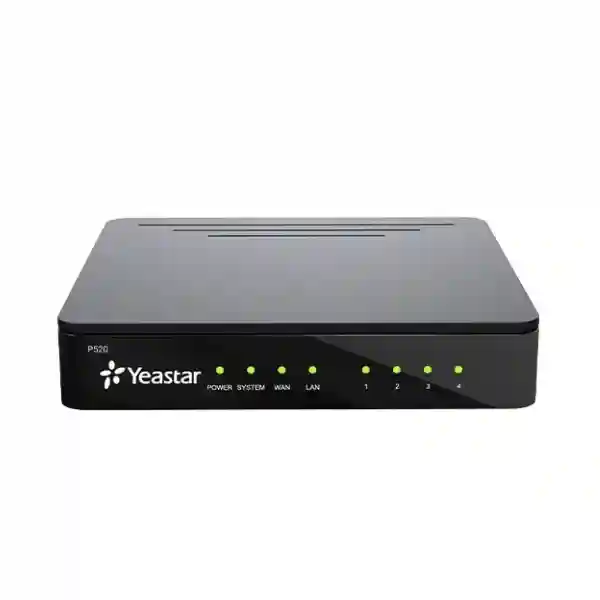
Yeastar P520 IP PBX Tanzania
The Yeastar P520 IP PBX is a compact on-premises business phone system for small organizations that want modern VoIP calling, unified communications and flexible connectivity without moving every communication function to a public cloud service. Yeastar positions the P520 as the smallest appliance in the P-Series range, with support for 20 users and up to 10 concurrent calls. That capacity makes it especially relevant to offices, professional firms, retail sites, clinics, schools, small hotels, workshops, warehouses and branch operations that need structured call handling but do not require a high-capacity enterprise PBX.
For a Tanzania buyer, the important question is not simply whether the PBX has enough extension capacity. A successful deployment also depends on the type of incoming and outgoing trunks, the number of simultaneous calls expected during busy periods, whether legacy analogue phones or PSTN lines must remain in use, whether cellular connectivity is required, and how remote users will connect. The P520 supports modular telephony choices and Yeastar Linkus unified communications, so it can serve as the centre of a carefully planned small-business communications environment. FourTeck can help structure a quotation around the required PBX, modules, compatible SIP endpoints, network readiness and deployment scope.
Yeastar P520 overview and verified capacity
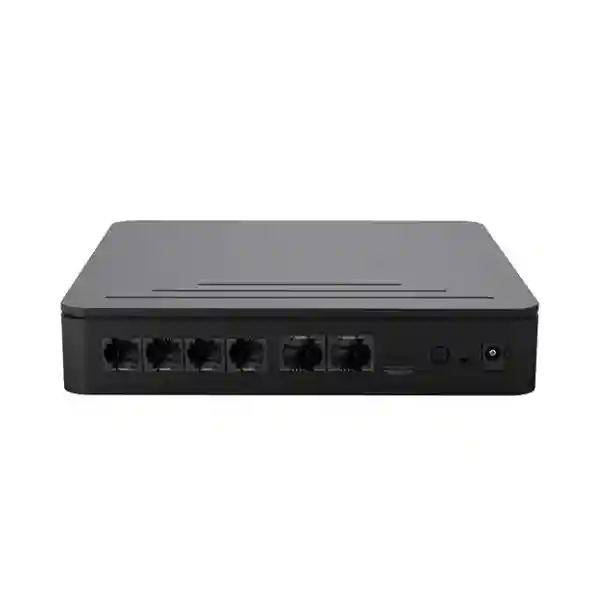
The P520 is part of Yeastar’s P-Series Appliance Edition. Current manufacturer information lists 20 base and maximum users, 10 concurrent calls, up to 4 FXS ports, up to 4 FXO/BRI ports and up to 1 cellular port through supported modular hardware. The model does not provide an E1/T1/J1 interface. Yeastar’s installation information also states that the P520 has two onboard module slots, allowing the hardware to be adapted for selected analogue, BRI or cellular requirements. This modular approach is useful when a small business is moving from traditional telephony toward SIP while still needing to preserve selected lines, analogue endpoints or mobile-network connectivity.
A P520 quotation should therefore start with extension count and call concurrency rather than desk-phone count alone. A business may have 18 extensions but only four simultaneous calls, while a reception-heavy operation with fewer people may generate eight or ten simultaneous calls at peak time. Understanding that distinction prevents under-sizing and makes it easier to compare the P520 with larger P-Series appliances if growth or call-centre activity will quickly increase demand.
Business communication features
Yeastar’s P-Series platform brings everyday calling and collaboration functions into a single management environment. Depending on the selected plan, configuration and firmware, organizations can use features such as IVR, ring groups, queues, voicemail, call recording, audio conferencing, presence information, personal and company contacts, operator-style call handling and Linkus clients for web, desktop and mobile devices. These functions help a small organization move from basic line-and-extension telephony to a more managed customer-contact workflow.
Linkus is particularly important when employees move between desks, branches and remote locations. Rather than treating the PBX as a box that only serves physical handsets, the platform can extend communication to supported client applications. The practical benefit is continuity: users can access business calling and collaboration tools from supported devices while the organization keeps central control of extensions and call policies. Remote access must still be designed securely, with appropriate credentials, firewall rules, encryption options and firmware maintenance.
The P520 should not be specified solely from a checklist of software functions. Some advanced P-Series capabilities have model or plan limitations, and Yeastar specifically notes that certain API and hotel-PMS capabilities are not supported on the P520. Buyers planning specialized integrations should therefore verify the exact feature requirement before purchase rather than assuming that every function available elsewhere in the P-Series portfolio applies to this entry model.
Connectivity, trunks and telephony modules
One of the P520’s useful characteristics is its ability to sit between modern SIP communications and selected traditional telephony interfaces. A new deployment may use SIP trunks and IP phones from the start. Another business may still have PSTN lines, analogue fax equipment, analogue extensions or a requirement for mobile-network connectivity. With the correct supported modules, the appliance can be configured around those needs rather than forcing an immediate replacement of every legacy element.
FXS interfaces are used when the PBX needs to serve analogue endpoints such as selected analogue telephones or compatible fax devices. FXO interfaces are relevant when analogue PSTN lines need to terminate on the PBX. BRI modules address compatible ISDN BRI scenarios, while supported cellular modules can provide GSM/3G/4G connectivity where appropriate. The P520 supports up to two telephony modules, so the desired port combination should be checked before ordering. Maximum published figures do not mean every maximum can necessarily be achieved at the same time with an arbitrary module mix.
For procurement, list every existing line and endpoint before selecting modules. Include SIP trunks, analogue carrier lines, analogue phones, fax devices, mobile SIM requirements, door phones and any remote branch connections. This simple inventory often prevents a mismatch between the ordered chassis and the actual installation requirements. It also helps determine whether a separate gateway is more practical than filling both onboard module positions.
Network and deployment planning
The PBX connects to the business LAN and is administered through a web interface. Yeastar documents LAN and WAN interfaces and supports single, bridge and dual Ethernet modes on the P-Series appliance platform. For the P520, network design should consider IP addressing, VLAN strategy, DHCP or static assignment, DNS, internet stability, firewall behavior and quality-of-service policies for voice traffic. Good voice quality depends as much on the LAN and WAN environment as on the PBX itself.
During implementation, place the PBX on a stable, protected network segment and ensure the switching environment can support all connected IP phones. If phones are powered through PoE, calculate the switch PoE budget rather than assuming every switch port can deliver the required power simultaneously. If the business uses remote users or remote SIP endpoints, design the internet edge deliberately and apply Yeastar’s supported secure access methods rather than exposing management interfaces casually to the internet.
Power continuity also deserves attention. A small PBX can keep the communication system operational during short utility interruptions only when the router, switches, optical-network terminal or modem, PBX and critical phones remain powered. A UPS plan should therefore cover the complete voice path. For sites that depend on SIP trunks, backup internet connectivity may be more valuable than adding redundancy only at the PBX itself.
Yeastar P520 IP PBX Tanzania
For Tanzania, the Yeastar P520 fits organizations that want to replace fragmented telephone lines and ad-hoc mobile calling with a managed small-business communications platform. The 20-user limit is appropriate for compact offices and branches where the total number of named users remains controlled and where peak simultaneous traffic can stay within 10 calls. Typical buying scenarios include a new office moving to SIP trunks, a company retaining a few analogue lines while introducing IP phones, a clinic wanting better call routing and voicemail, a school administration office needing a central attendant, or a retailer that wants calls directed among sales, accounts and management extensions.
Tanzania procurement should begin with a written requirements sheet. Record the number of employees who need extensions, the expected growth over the next two or three years, the number of incoming numbers, the preferred trunk type, the number of reception or queue agents, and whether analogue devices must remain. If the site expects rapid staff growth beyond 20 users, it is usually better to compare larger P-Series models before buying rather than treat the P520 as a short-term purchase. Likewise, if the business regularly expects more than 10 active calls, capacity should be reconsidered at design stage.
Internet and local network conditions are equally important. SIP calling requires stable connectivity, predictable latency and properly configured firewall behavior. A Tanzania business with a main fibre connection and a secondary broadband or wireless connection can improve continuity by planning WAN resilience at the router or firewall layer. Voice VLANs, suitable switching and UPS protection can further reduce avoidable call-quality problems. The P520 itself is only one element of the final solution; phones, headsets, switches, router/firewall, trunk service and power backup should be treated as one communications design.
FourTeck’s Tanzania site can be used as the starting point for local product enquiries at FourTeck Tanzania technology solutions. When requesting a quotation, provide the site location, user count, number of concurrent calls, desired phone models, existing telephone lines and whether installation or migration support is required. That information allows the proposed bill of materials to reflect the actual operating environment instead of relying on a generic PBX bundle.
Yeastar P520 IP PBX Dar es Salaam
Businesses in Dar es Salaam often need a phone system that can handle a busy reception, multiple departments and a mix of office-based and mobile staff without becoming complicated to administer. For a company with up to 20 users, the Yeastar P520 can centralize extensions, call routing and unified communications while keeping the PBX on premises. A professional-services office might assign extensions to reception, sales, accounts, operations and management; a retail or logistics office may prefer ring groups that direct incoming calls to the right team; a clinic may use IVR and queues to separate appointments from administration.
Dar es Salaam buyers should pay close attention to concurrency. Twenty users do not mean twenty callers can be active at once. The P520 is rated for up to 10 concurrent calls, so reception-heavy businesses should estimate peak demand. Consider inbound calls, outbound calls, internal conference participation and remote users during the busiest hour. If the phone system supports a sales desk that makes continuous outbound calls while customer service receives several inbound calls, the concurrency ceiling may become more important than the extension count.
Migration planning matters when replacing an older analogue or hybrid PABX. Make an inventory of existing PSTN lines, analogue extensions, fax equipment, door phones and any numbers that must be retained. The P520’s modular interfaces can support selected legacy connectivity, but the exact module combination must be matched to the requirement. In many offices, a staged migration is practical: keep essential existing lines, introduce SIP trunks, deploy IP phones in priority departments and then reduce legacy dependency after the new call flow has been tested.
A Dar es Salaam quotation should therefore include more than the PBX chassis. Ask for the recommended phones, any required FXS/FXO/BRI or cellular modules, PoE switching where needed, cabling checks, router or firewall readiness, UPS capacity, configuration, user onboarding and post-deployment support scope. This produces a clearer comparison between proposals and reduces the risk that a low hardware-only price hides missing components that are essential for operation.
Yeastar P520 IP PBX Mwanza
In Mwanza, the P520 can suit compact organizations that need dependable office telephony while balancing modern IP communications with existing connectivity. A trading company, tourism operator, education office, healthcare practice or regional branch can use a central PBX to make extensions predictable, route customer calls more consistently and give employees a common business identity instead of relying only on individual mobile numbers. For organizations with no more than 20 users, this can simplify both day-to-day communication and administration.
The first design decision is whether the deployment will be primarily SIP-based or hybrid. A SIP-first deployment usually uses IP phones and an internet-based trunk service. A hybrid deployment may retain analogue lines or devices through the appropriate telephony modules. Where cellular connectivity has a defined business purpose, the P520 can support a compatible cellular module, subject to the selected hardware and local service compatibility. Buyers should confirm the intended SIM and network use case before ordering rather than treating a cellular module as a universal backup mechanism.
For Mwanza locations where internet reliability varies by site, voice resilience should be considered as part of the WAN design. A backup internet connection can help, but automatic failover, NAT behavior and SIP registration need to be tested with the chosen router and provider. Power resilience can be equally important. Protecting only the PBX with a small UPS will not keep SIP calling available if the router, switch or access device loses power. The communication path should therefore be reviewed end to end.
When comparing quotes in Mwanza, ask vendors to state exactly what is included: P520 hardware, telephony modules, phones, licenses or plan requirements, configuration, site work, user training and support. Also confirm what is excluded. This makes it easier to compare like with like and to decide whether the P520 is correctly sized. If the expected staff count is close to 20 or call traffic is likely to increase rapidly, request a comparison with the next larger P-Series model before committing.
Yeastar P520 IP PBX Arusha
Arusha has many business environments where a compact unified communications appliance can be useful, including travel and tourism offices, lodges, professional services, NGOs, schools, clinics, retail businesses and branch offices. For smaller teams, the Yeastar P520 can create a structured calling environment with extensions, IVR, voicemail, queues or ring groups and Linkus clients, subject to the configured feature plan. The result is a more consistent customer experience than forwarding every enquiry to personal mobile numbers.
Tourism and hospitality-related buyers should be careful not to confuse general business PBX functions with specialized hotel PMS integration. Yeastar notes that hotel PMS integration is not supported by the P520 model. A small lodge or guesthouse may still use the P520 for its office and reservation team, but a property requiring deep room-status synchronization, minibar billing or other PMS workflows should verify the correct Yeastar model and module before purchase. This distinction is important because a generic statement that the P-Series supports hospitality features does not automatically mean every feature is available on P520.
Arusha buyers should also define the mix of desk phones and software clients. Employees who spend most of the day at a desk may prefer dedicated IP phones, while mobile managers or remote staff may benefit from Linkus clients. Reception staff may need multi-line visibility and a phone with more programmable keys. Selecting endpoints by job role normally provides better value than ordering the same handset for every user.
For installation, test local LAN quality, cabling, switch capacity and internet performance before migrating the main business number. A staged cutover can reduce disruption: configure extensions and call routes, test outbound calling, validate incoming numbers, verify emergency and after-hours behavior, then train users before final migration. This process is particularly useful for tourism and service businesses where missed calls can translate directly into lost enquiries.
Yeastar P520 IP PBX Dodoma
For small organizations in Dodoma, a centrally managed PBX can support predictable call handling across administration, customer service, finance and management without requiring a large enterprise platform. The Yeastar P520 is best considered when the organization expects no more than 20 users and can remain within 10 simultaneous calls. That may fit small offices, consulting practices, suppliers, training centres, associations and branch operations that want a professional call flow and unified extension plan.
Procurement teams should create a call-flow map before asking for prices. Decide what happens when a caller reaches the main number, which departments need direct extensions, whether unanswered calls should go to voicemail, which teams require ring groups or queues, and how calls should be handled after business hours. This map helps convert business requirements into PBX configuration and avoids buying hardware first and trying to define the workflow later.
Legacy-line planning is another practical issue. If an existing office still depends on analogue carrier lines or analogue devices, the required FXS and FXO interfaces should be counted separately. The P520’s modular design is helpful, but module slots are finite. If the requirement becomes too complex for two onboard module slots, a dedicated VoIP gateway or a larger PBX model may be more appropriate. The objective is not to force every requirement into the smallest chassis; it is to choose a design that remains manageable.
A complete Dodoma deployment plan should include network addressing, security settings, user passwords, call permissions, backup procedures, firmware maintenance and an administrator handover. Yeastar continues to publish P-Series firmware, so ongoing maintenance is part of responsible ownership. Before production updates, review release notes and maintain configuration backups. A PBX is operational infrastructure, and it should be maintained with the same discipline applied to routers, firewalls and servers.
Yeastar P520 IP PBX UAE
For UAE-based small offices, branch locations and satellite teams, the Yeastar P520 can be evaluated as a compact on-premises P-Series appliance where 20 users and 10 concurrent calls are sufficient. The same sizing principles apply: determine extension count, peak call concurrency, trunk type and integration requirements before choosing the hardware. Businesses moving from older PABX platforms may appreciate the ability to combine SIP calling with selected analogue or BRI interfaces through compatible modules, while newer sites may prefer an IP-first design.
Carrier and numbering requirements in the UAE should be discussed with the selected telecom provider and system integrator. Do not assume that a trunk configuration used in another country will apply unchanged. Confirm SIP credentials, number presentation, emergency-calling rules, firewall requirements and any provider-specific configuration before deployment. Where an organization operates across multiple countries, document each site’s trunk provider and numbering plan so extensions and outbound policies remain understandable.
Endpoint selection can be based on user roles. Reception may need a higher-feature phone, managers may value mobile and desktop UC access, and general office users may only need a reliable SIP handset. The network should provide appropriate VLAN segmentation, QoS and PoE capacity. Remote access should be deployed using supported secure methods rather than opening broad inbound firewall rules. Password policy, country-code restrictions and call-permission controls can further reduce misuse risk.
For UAE-related enquiries and broader regional projects, organizations can also review FourTeck UAE solutions and the specialist IP PBX Dubai resource. These links are useful when the same customer has offices in Tanzania and the UAE and wants to coordinate a common communication strategy while respecting local carrier requirements.
Yeastar P520 IP PBX Uganda
Uganda organizations considering the P520 should approach it as a small-business communications appliance rather than a generic phone-system box. Its published limits of 20 users and 10 concurrent calls define the starting point. Within that envelope, companies can design extensions, IVR, ring groups, queues, voicemail and supported Linkus access around their workflow. Small branches, professional firms, schools, retail locations and service companies can benefit from having a managed call flow and a shared business identity.
A common requirement is to mix SIP with traditional connectivity. Before ordering modules, identify whether the office needs analogue PSTN lines, analogue endpoints, BRI or a cellular channel. The P520 has two onboard module slots, so the chosen combination must be deliberate. Buyers should also confirm whether existing phones are SIP-compatible and whether their firmware is supported for the intended provisioning approach. Reusing compatible phones can reduce migration cost, but very old devices may be more expensive to support than replace.
For remote and hybrid users, test real-world internet conditions rather than relying only on headline bandwidth. Voice quality depends on latency, packet loss and jitter, and these can vary even when download speed appears high. If several remote users connect through mobile broadband, test during peak periods. Security is equally important: enforce strong credentials, restrict unnecessary exposure and keep appliance firmware current.
Uganda customers coordinating cross-border supply can review FourTeck Uganda technology solutions. A useful quotation request should specify the deployment city, user count, phone quantity, preferred trunk, current analogue requirements, remote-user count and desired support scope. This gives the supplier enough information to propose the correct modules and surrounding network components.
Yeastar P520 IP PBX Kampala
Kampala businesses with compact teams often need stronger call handling than a collection of mobile phones but do not need a large contact-centre platform. The Yeastar P520 occupies that middle ground for organizations within its 20-user and 10-concurrent-call limits. It can give reception a main business number, provide internal extensions, route calls to departments and support collaboration through Linkus clients. For customer-facing firms, that creates a more controlled experience and makes it easier to separate personal and business communications.
When replacing a traditional PBX, list what the current system does well before designing the new one. Existing hunt groups, night mode, direct numbers, analogue devices and call restrictions may be business-critical even if users never describe them formally. Mapping those behaviors allows the new P520 configuration to preserve necessary workflows while adding VoIP and unified-communications features. It also exposes requirements that might need extra modules or a different model.
Kampala offices should plan the local network at the same time. If IP phones share access switches with computers, implement sensible VLAN and QoS policies where supported. Confirm that PoE switches have sufficient power budget, especially when using phones with larger displays or sidecar modules. Provide UPS protection for the PBX, network switch, router and internet access equipment. Where continuity is important, test backup connectivity with the SIP service rather than assuming automatic recovery.
A good installation also includes user onboarding. Staff should know how to transfer calls, park calls, use voicemail, change presence, access Linkus and recognize any limitations of remote calling. Administrators should receive credentials, a configuration backup and a clear support path. These operational details have more influence on user satisfaction than adding features that nobody understands or uses.
Yeastar P520 IP PBX Arua
For smaller organizations in Arua, the Yeastar P520 can provide a structured business phone system where extension requirements are modest and the office needs a practical path from conventional calling toward SIP. A regional office, NGO branch, education centre, healthcare practice or trading company may use the PBX to centralize reception, provide internal extensions and control how calls reach different staff. The appliance model is particularly relevant when an organization prefers local hardware control rather than relying entirely on a hosted PBX.
Connectivity planning should reflect the actual site. If SIP trunks will be the primary external calling method, confirm internet stability, router behavior and provider interoperability before migration. If existing analogue lines remain important, determine the number of FXO ports required. If analogue phones or fax equipment must be retained, count the required FXS ports separately. The P520 can support modular interfaces, but its two slots mean a mixed requirement must be designed rather than improvised.
Remote administration can reduce travel for routine changes, but it should be implemented securely. Use supported remote-access methods, strong administrator passwords and limited permissions. Maintain configuration backups and record major changes. If the PBX is part of a wider multi-site organization, standardize extension ranges and naming where practical so staff can understand the system when moving between sites.
For procurement in Arua, ask for a clear separation between hardware supply and professional services. Hardware may include the P520, modules, phones, PoE switch and UPS. Services may include system design, configuration, cabling work, trunk setup, number migration, testing, user training and support. Separating these line items helps decision-makers understand total deployment cost and compare proposals without confusing a bare appliance price with a complete operational solution.
Yeastar P520 IP PBX Mbarara
Mbarara businesses can consider the P520 when they need a professional small-office phone platform but want to keep capacity aligned with current staff numbers. The system’s 20-user ceiling can suit a branch office, clinic, distributor, training provider, retail administration team or professional practice. With suitable configuration, incoming calls can be answered by reception, routed through an IVR, directed to ring groups or placed into queues, while voicemail and Linkus clients provide additional flexibility.
Before choosing the P520, estimate both current and future extension demand. If a company has 16 staff today and plans to recruit another eight within a year, buying strictly for today’s count may lead to an early replacement. Conversely, an organization with eight stable users does not need to purchase a much larger PBX solely for theoretical expansion. Capacity planning should be connected to a realistic hiring and branch-growth forecast.
The same principle applies to trunks. A SIP trunk can be efficient for a modern deployment, while analogue or cellular connectivity can be retained for specific reasons through supported modules. Confirm call rates, number availability and provider requirements separately from the PBX purchase. The phone system manages calls; it does not replace the carrier service. Buyers should therefore compare recurring telecom costs and one-time hardware costs independently.
Installation should finish with acceptance testing. Test inbound calls to every published number, outbound calls from representative extensions, transfer behavior, voicemail, IVR options, queue overflow, after-hours routing and remote users. If analogue or cellular modules are installed, test those paths separately. Record the final configuration and hand it over to the person responsible for communications. A structured acceptance checklist reduces the chance that small routing errors are discovered only after customers begin calling.
Yeastar P520 IP PBX Gulu
The P520 can be a practical fit for small Gulu offices that need a controlled internal extension system and more professional inbound-call handling. Organizations that currently depend heavily on staff mobile numbers can use a PBX to create a consistent public number and route calls to teams rather than individuals. This is useful when staff roles change, because the business can keep its main communication identity while updating extension assignments internally.
For a Gulu site, network simplicity is valuable. Keep the design documented: assign the PBX a known network address, maintain a record of extensions, use a consistent naming scheme and document trunk credentials securely. If IP phones use the same LAN as computers, avoid unmanaged growth that creates duplicate addressing or broadcast problems. A modest, well-configured switch and router can support voice more reliably than a larger but poorly documented network.
Power and connectivity resilience should be scaled to business impact. A professional office that can tolerate brief telephone outages may need only standard UPS protection. A service organization whose revenue depends on incoming calls may justify a larger UPS, backup internet and clearly defined mobile fallback. The P520 can participate in such a design, but resilience comes from the full communications path rather than from the PBX alone.
When purchasing, request the exact model and module list in writing. Confirm which ports are included by default and which require modules. Ask whether any selected P-Series plan features have recurring subscription requirements. Verify that the proposed phones and trunks are compatible with the deployment approach. This procurement discipline is more useful than comparing a single advertised price, because two P520 proposals can represent very different complete systems.
Yeastar P520 IP PBX Kenya
In Kenya, market listings show strong commercial interest in the P520 as a small-business PBX, but buyers should distinguish third-party promotional claims from current manufacturer specifications. Yeastar’s present product information lists the P520 for 20 users and up to 10 concurrent calls, with modular FXS, FXO/BRI and cellular connectivity. When comparing local supplier pages, use the manufacturer figures as the reference and ask the seller to clarify any difference before purchase.
For Nairobi and other Kenyan cities, the P520 may suit professional offices, retailers, small contact teams and branch sites that want an on-premises appliance with Linkus unified communications. The same design questions apply: how many users, how many simultaneous calls, which external trunks, which analogue interfaces and what remote-user requirements? A quote that answers those questions is more useful than a package defined only by handset quantity.
Kenya businesses that already have SIP-capable phones may be able to reuse them if interoperability is confirmed. New deployments should select phones according to job role and network environment. Receptionists may need more line keys, executives may need Bluetooth or larger displays, and general users may need only dependable HD voice and PoE. Standardizing on a small number of phone models can simplify provisioning and support.
Organizations with projects across Tanzania and Kenya can also review FourTeck Kenya solutions for regional coordination. A cross-border organization should keep local telecom-provider settings separate while standardizing extension conventions, security policies, handset profiles and user training wherever practical. That approach combines local carrier compatibility with a more consistent operational model.
Yeastar P520 IP PBX Kuwait
Kuwait-based small offices can evaluate the Yeastar P520 when an on-premises PBX is preferred and the required capacity fits within 20 users and 10 concurrent calls. The appliance can support a modern SIP-first deployment while also accommodating selected traditional interfaces through supported modules. This makes it relevant to businesses that are upgrading gradually rather than replacing every telecom component in one project.
Local trunk and numbering requirements should always be verified with the selected operator or integrator. SIP trunk authentication, number presentation, emergency calling and firewall settings can vary by provider. The PBX should be configured after those details are confirmed. If an office uses analogue lines, count the required FXO ports. If analogue phones or fax devices remain, count FXS ports. The P520’s two module slots should be mapped against that requirement before the equipment is ordered.
Security should be treated as a design requirement. Use strong passwords, limit extension calling permissions, disable unnecessary services, maintain firmware and review call logs for unusual activity. For remote workers, prefer supported secure remote-access methods. If the organization has strict IT governance, include PBX configuration backup, administrator role separation and change control in the operating procedure.
A Kuwait quotation should identify one-time and recurring costs separately. One-time items can include the PBX appliance, modules, phones, PoE switching, UPS and professional installation. Recurring items may include SIP trunk service and optional P-Series plan features. Keeping these categories separate makes it easier to calculate total cost of ownership and compare the P520 with hosted alternatives or larger appliance models.
Yeastar P520 IP PBX Ghana
For small businesses in Ghana, the Yeastar P520 can be considered where a compact on-premises platform is preferred and user requirements remain within 20 extensions. A central PBX can help professionalize customer communication by routing calls to departments, using IVR or ring groups and keeping business calling separate from employees’ personal numbers. Linkus clients can add flexibility for supported desktop, web and mobile workflows.
The published maximum of 10 concurrent calls should be matched against busy-hour traffic. A business with 20 extensions may still fit comfortably if only a few people are on external calls at once. A smaller outbound sales team, however, may approach the concurrency ceiling even with fewer total users. Estimate the busiest 15- to 30-minute period and include expected growth. This provides a more realistic sizing basis than employee count alone.
If the office is migrating from analogue services, decide which legacy components still provide business value. Some analogue lines may be retained for continuity, while old extensions can be replaced by SIP phones. Fax requirements should be tested because fax over IP behavior depends on the carrier and configuration. Cellular modules can serve defined use cases, but local network and regulatory compatibility should be confirmed before purchase.
For wider African projects, FourTeck Africa solutions can provide additional regional context. A Ghana buyer should send a requirements list that includes city, user count, concurrency estimate, trunk type, existing lines, phone quantity, remote users and desired support. This supports an accurate bill of materials and reduces the chance that essential modules or network items are omitted.
Yeastar P520 IP PBX Nigeria
Nigeria has a wide range of small and growing businesses that can benefit from structured VoIP communications, but PBX sizing should be based on each site’s actual traffic. The P520 supports 20 users and up to 10 concurrent calls, making it a candidate for compact offices and branch locations rather than high-volume call centres. A professional-services company, retailer, distributor, clinic, school or local branch can use the appliance to centralize calling, voicemail and department routing.
Connectivity resilience often deserves early attention. If the main SIP service depends on one internet link, an outage can affect external calling even when the PBX itself is healthy. Businesses that consider voice mission-critical can evaluate backup WAN connectivity, but failover should be tested with the chosen SIP provider and router. For sites that use mobile connectivity as part of the telephony design, select the proper supported module and confirm service compatibility before deployment.
Power design should include the PBX, switches, routers, access devices and critical phones. A UPS sized only for the PBX may not maintain service if the rest of the network shuts down. Where generator or inverter systems are available, define how long the communications stack should remain operational and calculate the required load. This practical planning is more valuable than focusing only on the low power draw of an individual appliance.
Procurement teams should also verify P-Series plan requirements for the desired software features. Some functions vary by plan, firmware or model. The P520 also has specific limitations for certain APIs and hotel PMS integration. Buyers with CRM, workflow automation or specialized hospitality needs should therefore provide the exact integration requirement during quotation so the recommended architecture can be validated before purchase.
Yeastar P520 IP PBX Seychelles
For Seychelles businesses, the P520 can be evaluated as a compact appliance for smaller teams that want centralized business calling and unified communications. The 20-user capacity is well suited to modest offices, service businesses, tourism-support teams, clinics, retail operations and branch sites, provided concurrent traffic remains within 10 calls. Because island operations can place extra importance on remote support and logistics, careful planning before equipment shipment is especially valuable.
The bill of materials should be finalized before ordering. Confirm the chassis, every required telephony module, phone quantity, PoE switching, power adapters where applicable, UPS requirements and any accessories. If existing analogue lines or devices must be preserved, map them to FXS or FXO requirements. If the deployment is SIP-only, verify provider interoperability and internet edge configuration. Avoid ordering unneeded modules simply as insurance; unused hardware increases cost without improving service.
Remote support readiness should be part of acceptance. Administrators should have secure access, current backups and documented network settings. Users should receive short training for transfers, voicemail, hold, conference and Linkus functions relevant to their roles. If a site depends on remote technical assistance, maintain clear documentation of the router, firewall and switch environment so troubleshooting does not begin from zero each time.
For organizations operating across multiple islands or countries, a common extension-numbering convention can simplify internal communication. However, local trunks and emergency-calling requirements should remain site specific. The P520 can be standardized as a branch appliance only where every branch stays within its user and call limits. Larger branches should use an appropriately sized P-Series model instead of forcing the same hardware everywhere.
Choosing phones, headsets and network accessories
The PBX is only the core of a business phone solution. Endpoint selection affects user experience, support effort and cost. General office staff may need a straightforward SIP phone with PoE, headset support and programmable keys. Reception staff may benefit from more line keys, a larger display or an expansion module. Managers who work away from their desks may rely more heavily on Linkus desktop or mobile clients. Selecting by role usually gives better value than buying the same premium phone for everyone.
Headsets should be chosen for the user’s work pattern. Staff who spend hours on calls may need a comfortable wired or wireless headset with suitable acoustic protection and microphone performance. Occasional users may not need a dedicated headset. Check phone and headset compatibility before purchase, particularly when electronic hook switch or Bluetooth features are required.
Network accessories matter too. A managed PoE switch can simplify phone power and VLAN configuration. A capable router or firewall can prioritize voice, manage multiple WAN links and control remote access. UPS capacity should cover the complete communication path. These items should appear in the solution design whenever required rather than being treated as unrelated infrastructure after the PBX is installed.
P520 sizing and buying guidance
Good fit
Choose P520 when your organization expects up to 20 users, no more than 10 concurrent calls and a manageable requirement for modular analogue, BRI or cellular interfaces. It works well for compact offices that want P-Series unified communications without buying more appliance capacity than they need.
Compare a larger model
Consider a larger P-Series appliance when your projected user count is close to or above 20, busy-hour concurrency may exceed 10 calls, you need more telephony interfaces, or specialized features and integrations are not supported on P520. Buying the right model initially can be more economical than replacing an undersized appliance.
Quotation checklist for Yeastar P520
A useful quotation request gives the supplier enough detail to design the complete system. Before asking for pricing, prepare the following information:
- Total number of users and expected growth over two to three years.
- Estimated peak concurrent external calls.
- Number and type of SIP trunks or traditional carrier lines.
- Required FXS, FXO, BRI or cellular interfaces.
- Number and type of IP phones, conference phones and headsets.
- Remote or hybrid users who need Linkus access.
- Desired IVR, queue, recording, reporting and after-hours behavior.
- Existing cabling, switches, PoE capacity, router/firewall and UPS.
- Any specialized integration requirement that must be verified against P520 support.
- Installation, migration, training and support scope.
Frequently asked questions
How many users does the Yeastar P520 support?
Yeastar’s current product information lists the P520 for 20 users. If your current or near-term requirement may exceed that number, compare the larger P-Series appliance models before purchase.
How many simultaneous calls can P520 handle?
The manufacturer lists up to 10 concurrent calls. Busy reception desks, outbound sales users and queue-heavy environments should estimate peak traffic to ensure this is sufficient.
Can the P520 connect to analogue lines or phones?
Yes, with appropriate supported telephony modules. FXS can connect selected analogue endpoints, while FXO can connect analogue PSTN lines. The exact module combination should be planned before ordering.
Does P520 support BRI and cellular connectivity?
The P520 supports compatible modular BRI and cellular options, with manufacturer-published maxima of up to 4 FXO/BRI ports and up to 1 cellular port. Actual configurations depend on selected modules and regional availability.
Can employees use mobile or desktop clients?
Yeastar P-Series supports Linkus clients for web, desktop and mobile workflows. Exact feature availability can depend on plan and firmware, so define your remote-work requirements during quotation.
Does the P520 support every P-Series integration?
No. Yeastar documents specific P520 limitations, including certain API and hotel PMS capabilities. Specialized integration requirements should be verified before purchase.
Is P520 suitable for a call centre?
It can support small queue-based customer-service workflows within its user and concurrency limits, but high-volume contact centres should evaluate larger models. Estimate active agents and simultaneous calls before deciding.
What should be included in a P520 deployment?
Depending on the site, a complete deployment may include the PBX, telephony modules, SIP phones, headsets, PoE switching, router/firewall configuration, UPS protection, trunk setup, call-flow configuration, testing and user training.
Related FourTeck regional resources
Organizations planning multi-country deployments can use FourTeck’s regional sites to coordinate requirements while keeping carrier and regulatory details local. Start with FourTeck Tanzania for the Tanzania project, review FourTeck Uganda for Uganda deployments, FourTeck Kenya for Kenya requirements, and FourTeck Africa for broader regional projects. UAE-oriented buyers can refer to FourTeck UAE. These links help customers align procurement and solution design across regions without assuming that telecom-provider settings or local commercial terms are identical.
Decision recap
Choose the Yeastar P520 when you need a compact on-premises P-Series appliance for up to 20 users and 10 concurrent calls, with the option to combine SIP communications with selected FXS, FXO, BRI or cellular connectivity. It is strongest when the requirements are clearly defined and remain within its capacity. It should not be selected only because it is the smallest or lowest-cost P-Series chassis.
Before ordering, confirm user growth, call concurrency, telephony modules, trunk service, phones, network readiness, remote access, required software features and any specialized integrations. A properly scoped P520 can provide a clean migration path from basic telephony to a more unified business communications environment, while an undersized or poorly planned system can create avoidable limitations. FourTeck can use your requirement list to prepare a solution-focused quotation for Tanzania and related regional projects.
Talk to FourTeck about your P520 requirement
Send the number of users, expected simultaneous calls, trunk type, existing analogue lines, phone quantity, location and desired installation scope. This allows the sales team to review whether the P520 is the right size and identify the modules and supporting network components required for a complete deployment.




Reviews
There are no reviews yet.