
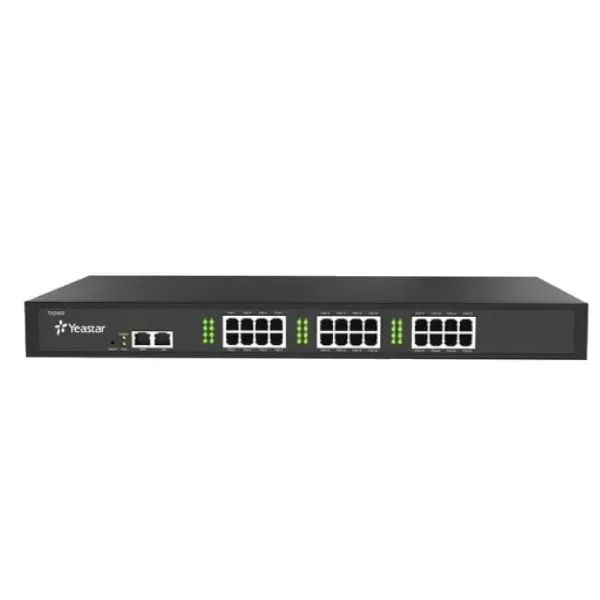
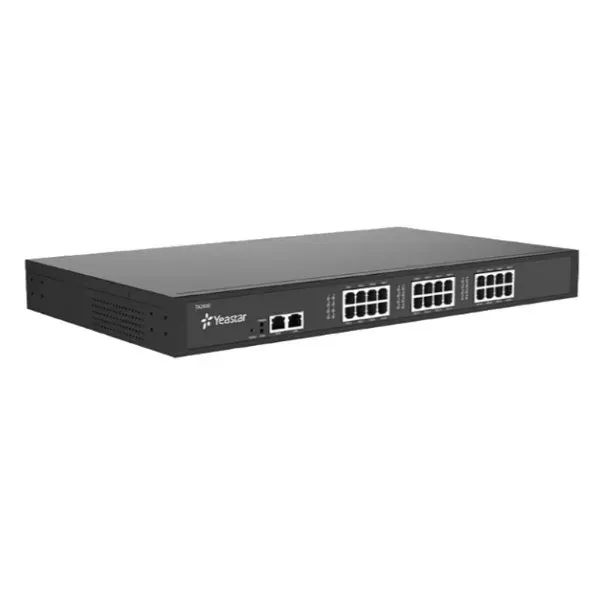
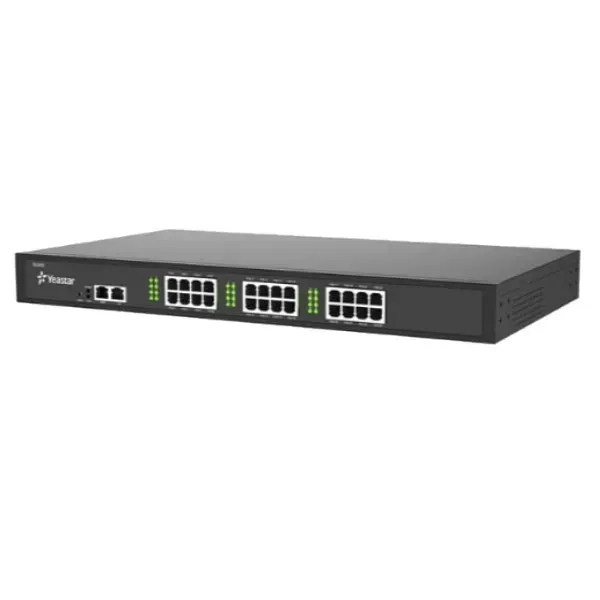
Yeastar TA2400 FXS VoIP Gateway Tanzania
The Yeastar TA2400 gives organizations a structured way to connect up to 24 analog endpoints to a modern IP telephony environment without replacing every working analog telephone or fax device at once. It is built for businesses, institutions, hospitality properties, healthcare environments, multi-building sites and branch networks that need an FXS gateway with SIP/IAX2 interoperability, secure VoIP transport options, dependable fax support and practical web-based administration.
What it solves
Bridges existing analog phones, fax devices and analog extensions into SIP-based call control, helping preserve useful endpoint investments during a VoIP migration.
Who it suits
Businesses with many analog extensions, hotel rooms, clinics, schools, apartment or campus environments, remote offices and sites that want centralized IP PBX routing.
Buying focus
Confirm endpoint count, cabling, PBX/SIP compatibility, fax requirements, network quality, rack space, power protection and the hardware revision before deployment.
Yeastar TA2400 overview
The TA2400 belongs to Yeastar’s TA Series of analog VoIP gateways. The defining characteristic of this model is its 24 FXS interfaces, which provide analog subscriber lines to conventional telephones, fax machines or other compatible analog devices while the gateway communicates with a SIP- or IAX2-based VoIP platform over Ethernet. This architecture is useful when the organization wants the control, routing and manageability of IP telephony but still has a substantial installed base of analog endpoints that remain serviceable.
Official Yeastar specifications list 24 RJ11 FXS ports and one RJ21 connector for the TA2400, along with LAN and WAN 10/100 Mbps Ethernet interfaces. Supported signaling includes SIP (RFC3261) and IAX2. Transport options include UDP, TCP, TLS and SRTP, which means a deployment can be designed with security controls that match the PBX, network and operational policy. Supported codecs listed by Yeastar include G.711 alaw/ulaw, G.722, G.723, G.726, G.729A, GSM and ADPCM. Voice-processing functions include ITU-T G.168 line echo cancellation, dynamic jitter buffering and packet-loss concealment.
Fax is frequently the reason organizations retain analog connectivity, so the TA2400’s support for T.38 and pass-through fax is especially relevant for offices that still depend on multifunction devices or dedicated fax equipment. DTMF can be carried using RFC2833, SIP INFO or in-band methods. QoS-related capabilities include DiffServ, ToS and 802.1p/Q VLAN tagging, while network functions include DHCP, DDNS, OpenVPN, PPPoE, static routing and VLAN support. Management protocols include SNMP, RADIUS and TR-069, and Yeastar also documents remote-management capability for TA1600/TA2400/TA3200 V3 or later in its central-management environment.
Technical specifications and deployment facts
| Item | TA2400 specification |
|---|---|
| FXS interfaces | 24 × RJ11 FXS, plus 1 × RJ21 |
| Ethernet | LAN 10/100 Mbps and WAN 10/100 Mbps |
| VoIP protocols | SIP RFC3261, IAX2 |
| Transport | UDP, TCP, TLS, SRTP |
| Codecs | G.711 alaw/ulaw, G.722, G.723, G.726, G.729A, GSM, ADPCM |
| Fax | T.38 and pass-through |
| DTMF | RFC2833, SIP INFO, in-band |
| QoS and VLAN | DiffServ, ToS, 802.1p/Q VLAN tagging |
| Network | DHCP, DDNS, OpenVPN, PPPoE, static route, VLAN |
| Management | Web-based administration; FTP, TFTP, HTTP, HTTPS, SSH; SNMP, RADIUS, TR-069 |
| Power | AC 100–240 V input, 12 V 5 A adapter class listed for larger TA models |
| Dimensions | 440 × 250 × 44 mm |
Why businesses choose a 24-port FXS gateway
Preserve analog endpoints
A staged migration can be more economical and operationally safer than changing every handset in one project. The TA2400 provides a transition point between familiar analog devices and a modern IP PBX.
Centralize call control
Analog devices can participate in centralized extension numbering, routing and PBX policies when properly integrated, allowing branches or legacy areas to fit into a broader VoIP design.
Support fax workflows
T.38 and pass-through fax options make the gateway relevant where finance, administration, healthcare or legacy document processes still depend on fax transmission.
Scale beyond small ATAs
Twenty-four ports reduce the need to manage many small adapters when an office, floor, hotel block or institutional site has a concentrated group of analog extensions.
Compatibility and integration planning
The TA2400 is designed for interoperability with SIP environments, but a successful project should still verify the exact PBX, softswitch or SIP service before rollout. Registration method, authentication, dial-plan format, codec preferences, DTMF mode, fax transport, NAT behavior and security settings should be agreed during design. Yeastar lists interoperability with a broad range of softswitches and PBX systems and provides dedicated integration guidance for its own P-Series platforms.
Network preparation is equally important. Voice traffic should not be treated as an afterthought on a congested LAN. VLAN design, QoS policy, switch capacity, firewall rules and WAN stability can materially affect call quality. At locations with unstable or heavily shared internet links, call paths should be mapped so critical voice traffic receives appropriate priority. Where analog phones are distributed across a building, the existing copper cabling should be labeled and tested before migration so gateway-port mapping remains easy to support.
For security, use HTTPS rather than unsecured administration where practical, restrict management access, apply strong credentials, keep firmware current for the exact hardware revision and use TLS/SRTP when supported end to end by the PBX and deployment policy. Yeastar’s published firmware information distinguishes between TA2400 V3 and V4, so technicians should never load firmware intended for the wrong hardware revision.
Yeastar TA2400 Tanzania
For organizations evaluating the Yeastar TA2400 in Tanzania, the most important question is usually not whether a 24-port gateway can connect analog phones—it can—but whether those 24 interfaces match the migration plan, cabling layout and PBX design. A headquarters, hotel, hospital, educational institution, government facility, industrial office or multi-tenant site may have analog handsets that are still functional and familiar to users. Replacing all of them with IP phones can increase project cost and introduce unnecessary disruption. The TA2400 allows those endpoints to remain in service while voice routing and policy move toward an IP-based architecture.
A Tanzania deployment should begin with an extension audit. Count active analog devices, identify fax lines, note any emergency or specialized analog equipment, confirm which copper pairs reach the communications room and document the call flows users need. If fewer than 24 analog endpoints are required, smaller gateway models may be more economical; if the site has more analog lines, multiple gateways or a higher-port design may be appropriate. This capacity check avoids buying by model name rather than by actual requirement.
Network readiness matters because voice quality now depends on IP transport between the gateway and PBX. The LAN should have clean switching, sensible VLAN separation and appropriate QoS. If the PBX is hosted or located at another site, WAN reliability and firewall policy become even more important. Customers should also confirm the desired codecs, SIP registration approach, DTMF behavior and fax method before deployment. For broader telephony planning, FourTeck Tanzania’s IP PBX and VoIP solution portfolio provides context on how gateways, SIP phones, networking and call routing fit together.
Procurement requests are easier to quote accurately when they include quantity, destination, existing PBX brand, number of analog phones, fax requirements, preferred rack location and whether installation/configuration assistance is required. FourTeck should be asked to confirm current commercial terms, availability and any project-specific services rather than assumptions being made from generic online listings.
Yeastar TA2400 FXS VoIP Gateway Dar es Salaam
Dar es Salaam organizations often operate dense office environments where large numbers of extensions are concentrated in one building, floor or campus. In such situations, a 24-port FXS gateway can be an efficient migration device because analog lines can terminate centrally near the network rack while the PBX sits locally or elsewhere on the IP network. Businesses moving from traditional analog or hybrid PBX platforms can use the TA2400 to preserve selected analog phones during a phased transition rather than forcing every department to change endpoints at once.
Before installing a TA2400 in a Dar es Salaam office, identify where analog cabling currently terminates. Older buildings may have cross-connects, unlabeled pairs or extensions routed through legacy distribution frames. Mapping those pairs before cutover reduces troubleshooting. The gateway’s RJ21 connector can be useful in structured multi-pair environments, while the individual RJ11 FXS ports can simplify direct patching for smaller groups. Which connection method is best depends on the site’s cabling standard and maintenance practices.
Power protection is another practical consideration. Voice gateways, switches, routers and PBX appliances should be connected to appropriate UPS infrastructure when business continuity is important. A gateway can only maintain calls if the network path and PBX remain powered as well, so the full voice chain should be considered rather than protecting a single device. For network preparation, FourTeck Tanzania’s IT and infrastructure services are relevant where switching, VLAN, cabling and configuration work form part of the same project.
When requesting a Dar es Salaam quotation, include the number of analog extensions to be retained, the PBX or SIP platform, expected concurrent calling, fax use, rack preference, network topology and target migration date. This enables the gateway to be assessed as part of the communication architecture instead of as an isolated hardware purchase.
Yeastar TA2400 FXS VoIP Gateway Mwanza
In Mwanza, the TA2400 can fit branch offices, hotels, healthcare facilities, education sites, logistics operations and administrative environments where analog handsets or fax devices remain useful but centralized VoIP is desired. A branch may want calls controlled by an IP PBX at headquarters while keeping local analog desk phones; alternatively, the PBX may be on the same site and the gateway simply converts endpoint access from analog to SIP. Both designs depend on a reliable, well-documented IP network.
A useful planning step is to divide the 24 ports by function before installation. Reception, administration, guest rooms, service desks, common areas and fax devices can be grouped and labeled. This makes dial-plan creation easier and helps support teams identify the physical endpoint when a user reports a problem. It also makes future migration manageable: selected analog users can later move to IP phones without disturbing the remaining gateway users.
Where the PBX is remote, WAN performance becomes part of voice quality. Packet loss, jitter and latency can affect conversations even if the analog handset and gateway are functioning correctly. The TA2400 includes jitter-buffer and echo-cancellation capabilities, but good network design is still necessary. Voice VLANs, QoS and sensible firewall configuration should be coordinated with the router and switches. If the location depends on a single internet circuit, the business should also consider what happens to branch calling during WAN interruption.
Procurement teams in Mwanza should confirm device revision, current firmware guidance, required accessories and installation scope before ordering. A detailed bill of materials may include the gateway, rack accessories where needed, patching, UPS protection, managed switching and PBX configuration. The goal is a supportable system with clear port mapping and documentation, not just a powered-on gateway.
Yeastar TA2400 FXS VoIP Gateway Arusha
Arusha businesses in hospitality, tourism, offices, education and services can have a particularly strong reason to retain analog endpoints: guest-room or back-office telephones may already be cabled throughout the property and remain adequate for basic extension calling. A 24-port gateway provides a way to connect a block of those phones to an IP PBX while leaving the physical room wiring largely unchanged. This can support phased modernization, but it should be engineered around the property’s actual extension count and call flow.
Hospitality deployments require careful numbering and labeling. Room extensions, reception, housekeeping, security and administration should be planned as separate groups, and any integration with property-management or call-accounting systems must be validated independently. The TA2400 supplies FXS connectivity; it does not by itself replace the application logic of a PBX or hotel system. Buyers should therefore identify the existing PBX features that must be preserved before a migration begins.
Fax and analog service devices should also be identified early. T.38 support is useful, but fax reliability depends on end-to-end configuration and the SIP environment. Where a critical fax machine must remain operational, test calls should be included in acceptance. Similarly, security and emergency-related analog devices should not be migrated without confirming their electrical and signaling requirements.
For an Arusha project, ask for a quotation that distinguishes hardware supply from configuration, cabling changes, PBX programming, user testing and support. This makes commercial comparison clearer and helps management understand what is required for a complete migration. The FourTeck Tanzania business technology shop can also be used as a starting point when related IP phones, network equipment or infrastructure components are required.
Yeastar TA2400 FXS VoIP Gateway Dodoma
Dodoma organizations considering a TA2400 may include offices, institutions, campuses, clinics and public-service environments that already have extensive analog telephone cabling. The gateway is especially relevant where an organization wants to introduce SIP-based call control but prefers to keep part of the physical handset estate. Twenty-four FXS ports can cover a meaningful group of users while keeping the migration contained within one rack-level device.
Governance and documentation should be part of the design. Record each gateway port, extension number, user or room, cable label, PBX registration and any special call permissions. This becomes important when staff change, offices move or troubleshooting is required months after installation. An undocumented analog-to-IP migration can become difficult to support because both physical copper and logical SIP settings must be traced.
Security should also be planned deliberately. Limit access to the management interface, use HTTPS and secure passwords, restrict which network segments can administer the gateway and keep firmware aligned with the correct TA2400 hardware revision. Where TLS/SRTP is supported by the PBX and policy, it can add protection to signaling and media. Remote-management access should be enabled only in a controlled way that fits the organization’s security standard.
When requesting a Dodoma quote, provide a simple network diagram if possible. It should show the gateway location, PBX location, WAN path if the PBX is remote, switch/router role, VLANs and the number of analog endpoints. That information helps determine whether the project needs only a gateway or additional switching, UPS, firewall, cabling and configuration work.
Yeastar TA2400 FXS VoIP Gateway UAE
In the UAE, the TA2400 is relevant to enterprises, hospitality groups, warehouses, multi-site companies and facilities that still have analog endpoints but operate modern SIP telephony. The commercial case often comes from preserving installed cabling and devices while bringing extensions under centralized call routing. Where a building contains many analog room or service phones, a 24-port gateway can be easier to manage than a large collection of two-port adapters.
UAE deployments frequently involve structured network environments with managed switching, VLANs and centralized security, so the TA2400 should be placed into that design intentionally. Voice VLAN assignment, SIP signaling paths, firewall rules and quality-of-service markings should be coordinated with the wider LAN. If the PBX is hosted, internet resilience and NAT behavior also need attention. Security teams may require TLS/SRTP, restricted management networks and documented firmware procedures.
For multi-branch organizations, standardization can reduce support effort. A repeatable template can define gateway naming, port ranges, codec preference, DTMF mode, SIP registration, VLAN, NTP, admin access and backup procedure. Once validated, that template can be adapted for additional locations while preserving local extension requirements. This is more sustainable than configuring every gateway differently.
Customers seeking broader regional support can review FourTeck UAE integrated IT and telecom solutions. A quotation should still be based on the exact site, device revision, PBX environment, quantity and service scope rather than assumptions about stock or delivery.
Yeastar TA2400 FXS VoIP Gateway Uganda
Uganda organizations that need to connect groups of analog phones to a SIP platform can use the TA2400 as a consolidation point between legacy extension wiring and IP call control. This is useful for offices, schools, healthcare sites, hotels and branch networks that want to modernize without discarding every analog handset. The 24-port capacity is best suited to environments where extension density justifies a rack-level gateway rather than several small ATAs.
A practical Uganda design begins by separating local requirements from WAN-dependent requirements. If the PBX is on the same LAN, internal extension calls can remain local to the site architecture. If the PBX is centralized elsewhere, the WAN becomes a critical component and should be evaluated for reliability, latency and failover. Voice QoS can prioritize packets on managed networks, but it cannot compensate for a severely unstable internet service.
Analog line characteristics should also be considered. Caller ID format, ringing behavior, disconnect detection and DTMF can vary by application. Yeastar supports multiple Caller ID methods and standard FXS signaling options, but acceptance testing should confirm behavior with the actual phones and fax devices. A pilot with a representative set of endpoints is often preferable to connecting all 24 lines at once.
For regional procurement and related telephony planning, customers can review FourTeck Uganda IT and PBX solutions. Quote requests should include endpoint count, branch location, PBX type, fax use and whether remote configuration or onsite work is expected.
Yeastar TA2400 FXS VoIP Gateway Kampala
Kampala offices often have a mixture of modern IP users and established analog extensions. A TA2400 can support a hybrid migration in which departments with advanced requirements receive IP phones while basic desks, rooms or service areas remain on analog handsets. This approach lets the organization invest where new features deliver value while preserving simpler endpoints where basic calling is sufficient.
The communications rack should be reviewed before installation. The gateway’s 1U-class dimensions make it suitable for rack-oriented environments, but rack space, ventilation, patching and power should all be planned. Because analog cables may terminate away from the network rack, structured cross-connects and labeling may be required. A clean installation reduces future faults caused by ad-hoc patching or unclear cable ownership.
PBX integration should be validated with a test plan that covers inbound calls, outbound calls, internal extensions, transfers, caller ID, DTMF to IVRs, voicemail access and fax if used. If the business uses call recording, queues or hunt groups, those features are handled by the PBX and should be tested with TA2400-connected users just as they would be with IP phones. Security policy should define management access and whether encrypted SIP transport is required.
For Kampala procurement, the cheapest hardware quote is not always the lowest-risk option. Buyers should compare what is included: device supply, configuration, remote commissioning, cabling, documentation, firmware preparation and support. A clear scope allows different proposals to be evaluated on the same basis.
Yeastar TA2400 FXS VoIP Gateway Arua
Arua sites may use the TA2400 where centralized or hosted PBX services need to reach analog handsets at a branch. In this scenario, the gateway becomes the local endpoint concentrator and the IP network carries calls back to the PBX. The design can reduce the need for a full local legacy PBX, but it increases dependence on the branch network and therefore requires careful WAN and power planning.
Branch survivability should be discussed before deployment. If the WAN fails, what calls must still work, and is there a local alternative? The answer depends on the business and PBX architecture. Some organizations may accept temporary loss of centralized calling, while others require redundancy. The TA2400 should be considered within that business-continuity discussion rather than assumed to solve WAN outages on its own.
Power quality can be equally important. The gateway, switch, router and any local PBX equipment should be covered by appropriate power protection if voice availability is operationally important. UPS runtime should be calculated across the entire voice path. Where equipment is installed in a warm or dusty communications area, rack ventilation and routine cleaning should be part of maintenance.
For Arua procurement, send a port schedule and branch topology with the quotation request. Indicate whether analog phones already exist, whether new handsets are needed, which ports are fax devices, where the PBX is located and what support is expected. This lets suppliers size the complete solution rather than quote only the gateway.
Yeastar TA2400 FXS VoIP Gateway Mbarara
Mbarara organizations can use a 24-port gateway to modernize voice systems in phases. Rather than replacing every phone, the business can connect existing analog devices to an IP PBX and introduce SIP phones only where advanced functions are required. This can be especially practical for hotels, clinics, educational sites and operational facilities where many extensions are used for straightforward internal or external calling.
The gateway should be sized with spare capacity in mind but not massively oversized. If a site has 18 to 22 analog users and expects moderate growth, 24 ports may provide a sensible fit. If the site has only a handful of analog devices, a smaller gateway could reduce cost and complexity. If demand will soon exceed 24 ports, the design should determine whether a second gateway, a larger model or endpoint replacement is the better long-term path.
Maintenance planning should include configuration backups, firmware records, port labels and a documented PBX registration map. When an analog endpoint fails, technicians should be able to distinguish between handset, copper pair, gateway port, network path and PBX account problems. Structured documentation turns a potentially confusing hybrid system into one that can be diagnosed methodically.
A Mbarara quote request should therefore specify both current and future extension counts, desired PBX features, existing rack/network condition and whether training or handover documentation is needed. The TA2400 hardware is one component; successful migration depends on matching it to the calling workflow and infrastructure.
Yeastar TA2400 FXS VoIP Gateway Gulu
For Gulu businesses and institutions, the TA2400 can provide a controlled path from traditional analog extension networks to SIP-based telephony. A campus or multi-department site may have telephone cabling already distributed to offices, classrooms, reception points or service areas. Reusing that infrastructure through an FXS gateway can reduce the physical scope of a VoIP migration while still giving the PBX centralized control over numbering and call routing.
Cable quality should not be assumed. Existing analog pairs should be tested for continuity and labeled. Faulty joints, damaged pairs or undocumented cross-connects can cause problems that are mistakenly blamed on the gateway. A migration project should therefore include both logical configuration and physical line verification. Once ports are mapped, the final documentation should be kept with the rack and in the organization’s IT records.
The IP side should be equally structured. Put voice equipment on an appropriate VLAN where the network design supports it, apply QoS consistently and ensure firewall rules permit only required SIP and management traffic. Use secure administration and maintain firmware records. Where the PBX is remote, monitor WAN quality so call issues can be correlated with packet loss or internet interruptions.
For purchasing in Gulu, ask for an itemized scope that separates hardware, accessories, cabling, configuration, testing and support. This makes budgeting clearer and helps the buyer identify what internal resources must be provided. It also reduces the risk of discovering after delivery that the project needs additional infrastructure not included in the original hardware quote.
Yeastar TA2400 FXS VoIP Gateway Kenya
Kenyan businesses can deploy the TA2400 in offices, hospitality environments, schools, clinics and branch networks where analog endpoints need to coexist with SIP telephony. The main value is architectural: it decouples endpoint replacement from PBX modernization. The call-control platform can be upgraded first, while analog phones remain connected through the gateway until there is a business reason to replace them.
This approach is especially useful where cable replacement would be disruptive. Existing analog wiring can continue serving phones, while the TA2400 connects centrally to the Ethernet network. However, the old cabling should still be tested and documented. An apparently simple reuse project can become difficult if line ownership is unknown or multiple intermediate cross-connects exist.
The SIP environment should be validated with the PBX vendor or integrator. Decide how the 24 extensions will register, which codecs are preferred, how DTMF is transported, whether T.38 is required and whether encryption is enabled. Then test representative calls before full cutover. If the PBX is hosted, also review WAN failover and internet quality.
Customers looking for related regional services can visit FourTeck Kenya VoIP PBX and network solutions. Procurement requests should include quantities, project location, PBX platform and service scope so commercial terms can be confirmed accurately.
Yeastar TA2400 FXS VoIP Gateway Kuwait
Kuwait businesses with existing analog desk phones, room phones or fax devices can use the TA2400 as a 24-port bridge into SIP-based communication. The gateway is most appropriate where many analog endpoints are located within practical cabling reach of a central communications room. It can support a phased migration strategy, allowing organizations to preserve endpoint investment while introducing modern IP PBX call control.
Environmental and rack planning should be included in the project. Communications rooms need adequate cooling, clean power and organized patching. The TA2400’s 440 × 250 × 44 mm form factor is suited to rack-oriented installations, but sufficient ventilation and access for cabling should be maintained. UPS protection should cover the gateway and the network components required to reach the PBX.
Security-conscious environments should enable encrypted management and, where the PBX supports it, TLS/SRTP. Management access should be restricted to trusted networks. Firmware should be matched carefully to the TA2400 hardware revision because Yeastar publishes distinct V3 and V4 firmware branches. Configuration backups should be stored as part of normal change management.
A Kuwait quotation should define whether the requirement is supply only or includes commissioning, PBX integration, analog cabling, rack work and post-installation support. Where larger migration projects are planned, a pilot gateway can validate endpoint behavior and call flows before the organization commits to a broader rollout.
Yeastar TA2400 FXS VoIP Gateway Ghana
Organizations in Ghana may select the TA2400 when they have a sizable analog extension base but want the flexibility of modern SIP call routing. Rather than treating analog and IP telephony as separate systems, the gateway allows analog endpoints to participate in a centralized PBX design. This can simplify numbering across departments or sites and create a gradual path toward fully IP-based endpoints.
A good Ghana deployment evaluates endpoint type as well as quantity. Standard analog phones, fax machines and specialized analog devices should be listed separately because their signaling and testing requirements differ. Fax should be validated with T.38 or pass-through according to the SIP provider and PBX. Any device used for alarms, emergency communication or other special purposes should be checked for compatibility before migration.
Network and power resilience are central to reliability. Once analog calls depend on an IP gateway, a switch or router failure can affect multiple extensions simultaneously. Managed switching, VLAN design, QoS, UPS protection and documented cabling therefore become part of the telephony solution. Where branches connect to a remote PBX, WAN monitoring and failover planning should be included.
For related regional sourcing and project context, visit FourTeck Ghana business IT solutions. A procurement request should specify exact port demand, PBX brand, location, fax needs and installation expectations rather than relying on a generic model request.
Yeastar TA2400 FXS VoIP Gateway Nigeria
Nigeria’s large enterprise, hospitality, education and branch-office environments can make high-density analog gateways useful where existing telephone cabling remains in place. The TA2400 offers 24 FXS ports in a single platform, allowing a substantial group of analog users to be connected to a SIP or IAX2 call-control system. This can be preferable to deploying many small adapters that each require power, configuration and support.
Power design should receive particular attention in any site where continuity is important. The gateway is only one part of the voice chain; the switch, router, firewall, PBX and WAN equipment also need protection. UPS capacity should be sized based on the combined load and required runtime. If a generator or inverter is part of the site power strategy, switching and battery behavior should be tested to confirm voice equipment remains stable during transitions.
From a network perspective, separate voice traffic where appropriate, apply QoS and monitor WAN performance. The TA2400 supports secure transport technologies, but encryption and NAT settings must match the PBX. When a hosted PBX is used, firewall policy should be based on the service provider’s documented requirements rather than broad internet exposure.
Customers can review FourTeck Nigeria IT and communications solutions for regional context. For a quote, include the expected number of analog users, desired PBX platform, branch count, fax requirements, power environment and whether configuration services are needed.
Yeastar TA2400 FXS VoIP Gateway Seychelles
In Seychelles, hospitality and multi-building environments can be strong candidates for analog-to-IP migration because guest rooms, service areas and administrative spaces may already have established analog telephone wiring. The TA2400 can connect groups of 24 analog endpoints to a SIP-based PBX while allowing the physical extension infrastructure to remain in use. This reduces the number of endpoints that must be replaced at the same time as the PBX.
Island or distributed-site operations should pay close attention to supportability. A gateway configuration should be backed up, port mappings should be documented and a spare strategy should be considered according to business criticality. Remote management can reduce the need for onsite intervention for configuration tasks, but it should be deployed securely and according to the hardware revision and management platform supported by Yeastar.
Hospitality call flows can be more complex than ordinary office extensions, particularly if room status, billing, wake-up calls or property-management integration is required. Those functions are PBX or application features and should be validated separately. The gateway provides FXS access, not a complete hotel telephony application by itself. A pilot with a representative room block and service phones can confirm expected behavior before wider rollout.
When requesting a Seychelles quotation, specify the number of buildings, analog extension count per area, cabling termination points, PBX location, WAN topology and desired support model. This provides enough information to assess whether one TA2400, multiple gateways or a mixed analog/IP endpoint strategy is most appropriate.
Selection and sizing guidance
Choose the TA2400 because the project needs approximately this port density, not simply because 24 ports sounds future-proof. Count active analog phones, fax devices and reserve capacity. If the requirement is well below 24 ports, smaller TA models may offer a cleaner fit. If the requirement is expected to exceed 24 ports soon, compare the operational impact of multiple gateways against a larger-capacity architecture or a faster migration to IP phones.
Also examine concurrent calling. FXS port count describes how many analog endpoints can connect, but the wider PBX, SIP trunk and network must support the call load. For a hotel, hospital or service center, busy-hour calling patterns can differ significantly from a small office. The design should therefore consider user behavior, trunk capacity and WAN bandwidth rather than endpoint count alone.
Finally, confirm the exact hardware revision and firmware path. Yeastar currently publishes distinct firmware for TA1600/TA2400/TA3200 V3 and V4, and warns against applying firmware intended for the wrong revision. Revision verification should be part of receiving inspection and maintenance documentation.
Related FourTeck resources
Quotation checklist
For a useful Yeastar TA2400 quotation, provide the information below. It helps the supplier distinguish a simple hardware request from a complete migration project.
Frequently asked questions
How many analog phones can the Yeastar TA2400 connect?
The TA2400 provides 24 FXS ports for analog endpoints. The model also includes an RJ21 connector for multi-pair connectivity. Actual design should account for how the analog cabling terminates and whether all 24 ports are needed immediately.
Does the TA2400 support SIP?
Yes. Yeastar lists SIP RFC3261 and IAX2 support. It also lists UDP, TCP, TLS and SRTP transport/security options. PBX compatibility and the exact security configuration should be confirmed for the target deployment.
Can the TA2400 be used with fax machines?
Yes. Official specifications include T.38 and pass-through fax. Fax reliability still depends on PBX, SIP service and network configuration, so production fax workflows should be tested before final handover.
Can I keep existing analog phones when moving to an IP PBX?
That is one of the main uses of an FXS VoIP gateway. The gateway presents analog FXS interfaces to existing phones while connecting those extensions to the IP telephony environment. The endpoint and cabling should still be checked for suitability.
Does the TA2400 support VLAN and QoS?
Yes. Yeastar specifies DiffServ, ToS and 802.1p/Q VLAN tagging. These capabilities are useful when the gateway is integrated into a managed voice network, but switch and router policy must also be configured correctly.
What should I check before buying a TA2400?
Confirm analog port count, PBX/SIP compatibility, hardware revision, firmware path, fax requirements, analog cabling, rack location, network quality, VLAN/QoS design, power protection and the exact installation or configuration services required.
Is the Yeastar TA2400 remotely manageable?
Yeastar documents remote management for TA1600/TA2400/TA3200 gateways on V3 or later with supported central-management services. The exact device revision and subscription/service requirements should be verified before relying on remote management in a project plan.
Decision recap
The Yeastar TA2400 is a strong fit when an organization has a meaningful concentration of analog endpoints and wants those endpoints integrated into a SIP-based voice architecture. Its 24 FXS ports, broad codec support, T.38 fax, VLAN/QoS functions, secure transport options and management capabilities make it suitable for structured migration projects.
It should not be purchased in isolation from the network and PBX design. The best result comes from verifying port demand, cabling, call flows, SIP compatibility, fax behavior, power resilience, security policy and firmware revision before deployment. That preparation turns a gateway purchase into a predictable telephony migration.
Consult FourTeck Tanzania
Share your analog extension count, current PBX platform, site location and migration objective with FourTeck Tanzania. The team can then assess whether the TA2400 is the right port density and identify related requirements such as switching, VLAN configuration, cabling, UPS, rack preparation or IP phones.
For the most accurate proposal, request current pricing, availability, commercial terms and service scope directly rather than relying on unverified third-party listings.




Reviews
There are no reviews yet.