
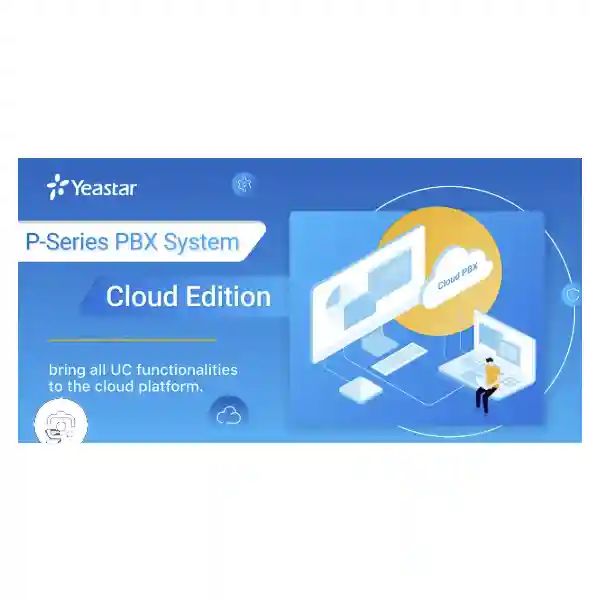
Yeastar P-Series Cloud Edition
Yeastar P-Series Cloud Edition gives businesses a cloud-hosted PBX and unified communications environment without requiring a dedicated PBX appliance or locally maintained server. It combines business calling, extension management, call routing, Linkus web, desktop and mobile clients, collaboration tools, contact-center functions, SIP interoperability and integration capabilities in a platform that can be expanded as requirements change. For Tanzania-based organizations evaluating a hosted phone system, the central buying question is not simply whether a cloud PBX has many features. The more useful question is whether the platform fits the organization’s users, call flows, SIP trunking, IP phones, internet reliability, security requirements, remote-working needs and future branch strategy. FourTeck Tanzania can help structure that assessment before deployment.
Choose Cloud Edition when you want Yeastar P-Series capabilities delivered as a managed cloud PBX rather than hosting the PBX server yourself.
Before ordering, confirm extensions, concurrent calling, recording needs, SIP trunk compatibility, endpoint strategy, integrations, branch requirements and subscription plan.
Cloud-hosted PBX
The PBX runs as a cloud service, reducing the need for a locally maintained PBX server while keeping centralized administration and business calling functions.
Unified communications
Voice, video, messaging, presence, conferencing and business communications can be brought into one platform, with feature availability depending on the selected plan and configuration.
Linkus clients
Users can work through Linkus web, desktop and mobile clients, supporting office, hybrid and remote-working communication without tying every user to a desk phone.
SIP and integrations
The platform works with SIP phones and trunks and provides integration options for business systems, APIs and selected third-party applications.
What is Yeastar P-Series Cloud Edition?
Yeastar P-Series Cloud Edition is the cloud-hosted deployment option within the P-Series PBX family. Yeastar positions P-Series as a business communications platform that combines calling, unified communications, collaboration, contact-center capabilities and integrations. In Cloud Edition, the PBX instance is hosted in the cloud rather than installed as a physical PBX appliance at the customer site. That changes the infrastructure model, but it does not remove the need for careful telephony design. A cloud PBX still depends on reliable internet connectivity, compatible SIP trunks, suitable endpoints, clear extension numbering, appropriate security policies and well-planned inbound and outbound call routes.
Current Yeastar documentation shows commercial Cloud Edition instances offered with Enterprise and Ultimate subscription plans, with monthly or annual subscription options. Yeastar also documents expandable extension capacity, call recording capacity and optional services such as high availability, AI transcription and AI receptionist resources. Plan availability and included features can evolve, so a quotation should be based on the current Yeastar commercial offering rather than a static feature list copied from an older brochure.
For buyers, the practical value of Cloud Edition is that the organization can move call control away from a locally maintained server while retaining a structured business phone system. Users can have extensions, call routing, voicemail, queues, IVR and collaboration features; administrators can manage the environment centrally; and businesses can connect SIP endpoints and compatible trunks according to their deployment design. Companies with branch offices, remote staff or mobile teams can particularly benefit from a platform that is not physically tied to a single office rack.
Key verified capabilities and buyer benefits
Business calling and routing
Build extension plans, inbound routes, outbound routes, ring groups, queues, IVR menus, voicemail and business-hour logic around how callers actually move through the organization. Good PBX design should start with a call-flow map rather than simply enabling features.
Web, desktop and mobile communications
Linkus clients allow users to access business communications from supported browsers, computers and mobile devices. This is useful for remote work, travelling managers, field teams and branch staff who need access to company extensions outside the main office.
Contact-center functions
Yeastar documents call-center capabilities within P-Series plans, including queue-oriented workflows and agent functions. Organizations should define expected agents, queue volumes, reporting needs and supervisory requirements before selecting the plan.
Integration and open APIs
P-Series Cloud Edition provides APIs and integration options for third-party business applications. Yeastar documents integrations across CRM, Microsoft Teams and other platforms, but compatibility should be checked against current firmware and the exact application edition in use.
SIP endpoint flexibility
Yeastar supports SIP-based IP phones and publishes provisioning guidance for many endpoint vendors. A successful rollout should still validate phone model, firmware, provisioning method, codecs, network VLANs, PoE and feature expectations.
Cloud service scalability
Commercial Cloud Edition instances can be ordered with extension quantities according to Yeastar’s current limits and expanded as needs grow. This makes capacity planning easier than buying a fixed physical chassis, but subscription cost and service limits should still be forecast over the expected lifecycle.
Technical planning checklist before deployment
Count named users, common-area phones, reception positions, queues, meeting-room endpoints and expected growth. Separate total extensions from simultaneous call demand.
Confirm provider compatibility, number porting or new DID requirements, concurrent call channels, outbound caller ID rules and emergency or regulatory obligations where applicable.
Review latency, jitter, packet loss, firewall behavior, QoS, redundancy, voice VLANs and branch connectivity. Cloud telephony quality depends on the path between users and the service.
Decide which users need desk phones, headsets, browser calling, mobile clients, conference devices or analog gateways. Confirm provisioning support before ordering large quantities.
Estimate recording minutes, retention expectations and access permissions. Recording laws and internal policies should be reviewed by the organization for each jurisdiction where calls are handled.
List CRM, Microsoft Teams, helpdesk, directory, SSO, database, hotel PMS or API requirements before licensing. Integration scope can affect plan choice and implementation effort.
Compatibility, IP phones and analog migration
Cloud Edition is a SIP-based business communications platform, so endpoint strategy matters. Some organizations will use desk phones for reception, finance, service counters and managers while giving mobile or browser clients to remote staff. Others may retain a large estate of SIP phones. Yeastar documents support for most SIP-based IP phones and provides auto-provisioning, manual provisioning and manual registration methods depending on the phone model. Before a bulk rollout, verify the exact phone firmware, provisioning method, feature keys, BLF behavior, codec preferences and any headset or expansion-module requirements.
Analog equipment does not need to be discarded automatically. Where a hotel, clinic, warehouse, school or office still has useful analog handsets or fax devices, a VoIP gateway can bridge them into a modern SIP environment. FourTeck Tanzania already lists several relevant Yeastar gateways: the Yeastar TA1600 FXS VoIP Gateway can connect a larger group of analog stations; the Yeastar TA2400 FXS VoIP Gateway is relevant where still more analog extensions must be retained; the Yeastar TA1610 FXO VoIP Gateway is designed for multiple analog PSTN line interfaces; and the Yeastar TA410 FXO VoIP Gateway can suit smaller PSTN-to-VoIP requirements. These products are not substitutes for the Cloud Edition PBX; they are integration components that can help preserve legacy devices or line interfaces during a staged migration.
For broader telephony planning, the FourTeck Tanzania technology shop provides an overview of business IT and telecom product categories, while the FourTeck Tanzania services page explains solution planning and deployment capabilities. The FourTeck Tanzania business technology overview is useful when the cloud PBX must be coordinated with switching, Wi-Fi, firewall, cabling and power infrastructure.
Yeastar P-Series Cloud Edition Tanzania
For organizations evaluating Yeastar P-Series Cloud Edition in Tanzania, the strongest reason to consider a cloud PBX is operational flexibility. A company can centralize extensions, call routing, voicemail, queues and user clients without maintaining the core PBX server as a physical appliance in its own office. That can simplify new-site launches and remote-user onboarding, but it also makes internet quality and network design more important. Before moving business calling to the cloud, Tanzanian organizations should review their primary and backup internet options, firewall policies, LAN switching, voice VLAN design and the quality of Wi-Fi used by mobile or laptop-based calling clients. Cloud telephony is only as dependable as the full path between the user, the PBX service and the SIP carrier.
A Tanzania procurement brief should begin with user roles. Reception staff may need busy-lamp keys, transfer controls and queue visibility. Sales teams may benefit from desktop and mobile Linkus access so they can use business identities while moving between office and field work. Managers may need call reports or integration with CRM. Customer-service teams may need call queues, recording and supervisor functions. Branch offices may require extension-to-extension dialing under one numbering plan. These needs should be written down before choosing a subscription plan because plan selection is more accurate when it is tied to workflows rather than a generic feature checklist.
SIP trunk planning is equally important. The selected provider must work with the intended PBX configuration, and the organization should understand how many simultaneous external calls are required during busy periods. A business with 100 extensions does not necessarily need 100 concurrent external calls, while a 20-agent service desk might have much higher simultaneous call demand than a 50-person administrative office. Existing telephone numbers, number porting, caller ID presentation and any required local telecom arrangements should be confirmed during the design phase rather than after the cloud PBX has already been provisioned.
Endpoint selection can be mixed. A Tanzania head office might keep desk phones for reception and fixed departments, issue headsets and desktop clients to call-handling staff, and use mobile clients for managers or remote workers. SIP phones should be tested for provisioning and required features. If the site has analog devices worth retaining, Yeastar FXS or FXO gateways can bridge specific legacy requirements without forcing a complete replacement project on day one. This phased approach can be helpful for hotels, schools, clinics and multi-building businesses where existing analog cabling still has practical value.
For organizations comparing suppliers in Tanzania, request a quotation that clearly separates subscription licensing, extension quantity, any optional services, SIP trunk work, phones or gateways, network changes, configuration, migration, training and support. That makes competing proposals easier to compare because a low headline price may exclude the work required to make the system production-ready. FourTeck Tanzania can help coordinate the broader environment through its company and solution background, IT and telecom services, and Tanzania contact and quotation page. The result should be a cloud phone system matched to real call volumes, users and infrastructure rather than an oversized or underspecified subscription.
Yeastar P-Series Cloud Edition Dar es Salaam
Dar es Salaam businesses often have a mix of office-based staff, field teams, customer-facing departments and branch operations, making a flexible cloud phone system attractive. Yeastar P-Series Cloud Edition can give these users a common business communications environment without placing the main PBX server in the office rack. This can be valuable for professional services firms, logistics companies, trading businesses, hospitality groups, healthcare organizations, schools and growing enterprises that need a consistent numbering plan and controlled call routing. The platform can support desk-phone users as well as web, desktop and mobile users, allowing departments to use different endpoint styles without creating separate phone systems.
A Dar es Salaam deployment should pay close attention to internet path resilience. Voice packets are sensitive to jitter, latency and packet loss, so a high advertised internet speed does not automatically guarantee good calls. The office LAN should be checked for overloaded switches, poorly placed Wi-Fi access points, flat networks with excessive broadcast traffic or large backup jobs that compete with voice. Where calling is operationally critical, businesses can evaluate secondary internet connectivity and firewall failover behavior. If dual connectivity is used, test how active calls and SIP registrations behave when the primary link fails; do not assume that failover will be invisible without validation.
Call-flow design is especially important for busy customer-facing operations. A reception team may require an IVR for sales, accounts, support and general enquiries. Service departments may need queues with overflow rules. After-hours calls may route to voicemail, a duty mobile user or a different branch. These workflows should be mapped using actual business hours and escalation rules. Recording should be enabled only where needed and managed according to organizational policies and applicable legal requirements. If the business needs CRM or Microsoft Teams integration, confirm the current P-Series plan and application requirements before finalizing licensing.
Dar es Salaam companies replacing an older PBX should inventory every extension and external line before migration. Include fax machines, gate phones, lift phones, security points, analog room phones and any specialized devices rather than counting only office handsets. Some devices may stay analog through a gateway, some may be replaced by SIP endpoints, and some workflows may no longer be necessary. A well-planned migration uses the project as an opportunity to simplify extension ranges and call routes rather than recreating years of legacy configuration without review.
When seeking a Yeastar P-Series Cloud Edition quotation in Dar es Salaam, provide the number of users, expected simultaneous calls, current SIP or PSTN services, required DIDs, list of IP phones, remote-user count, branch locations, recording requirements and integrations. Also state whether the LAN, PoE switching, firewall and Wi-Fi are already voice-ready. This information allows the solution to be priced as a complete working system rather than just a subscription line item. The FourTeck Tanzania quotation page is the verified contact route for a structured requirement discussion.
Yeastar P-Series Cloud Edition Mwanza
Organizations in Mwanza considering Yeastar P-Series Cloud Edition can use the platform to connect office users, remote staff and other sites under a centralized business calling environment. This can be useful for distribution operations, healthcare providers, education institutions, hospitality businesses, service companies and regional offices that want consistent extension dialing without deploying a separate PBX server at every location. A cloud model can also make user moves and branch expansion easier because the core call-control platform is not physically tied to one site, although every location still needs suitable internet and network infrastructure.
Connectivity assessment should come before migration. If the Mwanza office depends on a single WAN circuit, the business should decide how important external and internal calling remains during a connectivity outage. Some organizations may accept temporary loss of cloud calling, while others may require secondary internet, mobile fallback or separate continuity processes. The correct choice depends on operational impact rather than on a generic best practice. Within the office, voice traffic should have a clean path through switching and firewall infrastructure. Wi-Fi calling users require good roaming and coverage, especially if staff move through warehouses, hospitality spaces or multi-floor buildings.
The endpoint plan should reflect job function. Fixed reception and finance users may prefer desk phones; customer-service staff may need headsets and desktop clients; managers may use mobile clients when away from the office. If the organization already owns compatible SIP phones, they may be retained after provisioning tests. If analog devices remain useful, FXS gateways such as the Yeastar TA1600 can preserve selected analog handsets or fax devices while the core platform moves to the cloud. This allows budget and migration effort to be prioritized around the devices that actually need replacement.
Mwanza businesses should also consider how centralized administration changes support. Instead of troubleshooting only a PBX appliance, support teams need visibility into internet connectivity, endpoint registration, user clients, SIP trunks and firewall behavior. Document extension assignments, endpoint MAC addresses, VLAN settings, SIP credentials, DIDs and routing rules. Maintain clear ownership between the telecom provider, internet provider, internal IT team and PBX support provider so incidents do not become a cycle of each supplier blaming another part of the path.
For procurement, request a design that shows what is included in the subscription and what is separately supplied or configured. Ask how extensions are added, how optional recording or AI capacity is billed, how upgrades are handled, what happens when a user leaves, and how backups or administrative access are managed. A clear commercial model helps Mwanza organizations forecast operating costs and avoid surprises as extension counts grow. FourTeck Tanzania can connect the cloud PBX requirement with broader network, switching and firewall planning through its business IT services portfolio.
Yeastar P-Series Cloud Edition Arusha
Arusha has a broad mix of hospitality, tourism, education, NGO, professional-service and administrative organizations, many of which need flexible business communications across offices, guest-facing operations and mobile teams. Yeastar P-Series Cloud Edition can support a centralized cloud PBX model where users access calling and collaboration through desk phones or Linkus clients. For hospitality or multi-department operations, the value is not simply replacing an old PBX. The project can reorganize how calls reach reception, reservations, accounts, management, front office, back office and remote personnel.
Hospitality environments require particular care because legacy phone systems may be tied to room extensions, analog handsets, wake-up workflows or property-management processes. A cloud PBX migration should therefore start with a dependency audit. Identify room phones, service phones, reception consoles, guest calling requirements and any PMS integration. If analog room devices are retained, FXS gateway density and cabling should be assessed before the old PBX is disconnected. If devices are replaced with SIP phones, check PoE capacity and switch port availability across the property. A staged transition may be safer than a single cutover when many rooms are involved.
For NGOs and organizations with field staff, mobile and desktop clients can help keep employees reachable on business extensions without publishing personal phone numbers for every interaction. Teams can also use presence, messaging and other collaboration functions where enabled. However, user experience depends on mobile data or Wi-Fi quality, so remote-working policy should include expectations for connectivity. The system should also use role-based administration and secure credentials, especially where multiple departments or external support teams share responsibility for the platform.
Arusha deployment planning should also account for business continuity. If internet service is interrupted, cloud extensions at the site may lose their path to the PBX. Organizations should classify which users and call types are critical and decide whether secondary internet, alternate routing or mobile continuity is justified. UPS protection for routers, switches, access points and desk phones can help through short power events, but it does not solve a carrier outage. Business continuity must consider power and connectivity as separate risks.
When requesting a quote, Arusha buyers should include room or user count, existing PBX model, number of analog devices, IP phone inventory, internet links, integration requirements and expected future growth. If the system will support a hotel, school or multi-building campus, include a simple network diagram. This enables the cloud PBX, gateways, switches and licensing to be designed as one solution. FourTeck’s Tanzania shop can be used to review adjacent telecom and network categories during planning.
Yeastar P-Series Cloud Edition Dodoma
Dodoma organizations considering Yeastar P-Series Cloud Edition may include government-related offices, private enterprises, NGOs, education institutions, service businesses and branch operations that want a centrally administered communications platform. A cloud PBX can reduce dependence on a locally hosted PBX server and allow a common extension environment to support office-based and remote users. It can also simplify growth when departments expand because capacity is subscription-based rather than tied to the physical slot count of a legacy PBX chassis.
For institutional environments, governance matters as much as feature count. Define who can create users, change call routes, retrieve recordings, view reports, manage integrations and access administrator settings. Create an extension naming standard and document department ownership. Where staff turnover is common, establish a process for disabling accounts and reassigning numbers. If call recording is used, define retention and access permissions. These administrative controls should be agreed before go-live so the cloud system does not become difficult to manage as the number of users increases.
Network readiness should be reviewed at every connected site. Voice traffic is sensitive to congestion and unstable WAN links. A Dodoma office that connects many users over shared internet should identify large backup windows, cloud synchronization jobs or video traffic that could compete with calling. Managed switching, sensible QoS and firewall policies can improve predictability. For remote offices, it may be useful to test calls during peak internet usage rather than only during an installation window when the network is quiet.
Procurement teams should distinguish recurring subscription items from one-time implementation. A quotation may include Cloud Edition licensing, optional services, SIP trunk configuration, DIDs, endpoint supply, gateway hardware, headsets, network changes, migration, user training and ongoing support. Comparing proposals only by monthly or annual PBX subscription price can hide the real project scope. Ask vendors to state assumptions clearly, including the number of extensions, concurrent calls, recording capacity and any third-party licenses needed for integrations.
If the Dodoma site is migrating from analog infrastructure, retain only the legacy components that have a clear operational reason. The Yeastar TA410 FXO gateway, for example, can be relevant for specific analog trunk interfaces, while larger FXS gateways can retain analog phones. The objective should be an intentional hybrid design, not a permanent accumulation of old and new equipment without documentation.
Yeastar P-Series Cloud Edition UAE
Businesses evaluating Yeastar P-Series Cloud Edition in the UAE often operate in highly connected, multi-site environments with demanding requirements for mobility, customer service and system integration. The platform can support centralized cloud calling for offices, retail operations, hospitality, professional services, logistics, healthcare and regional headquarters. Users can work through SIP phones and Linkus clients while administrators maintain a common extension plan and routing model. For regional groups with teams in the UAE and East Africa, one of the major planning benefits is the ability to standardize user experience and call-handling practices even when each site has different local connectivity and telecom providers.
UAE deployments should be designed with local telecom and regulatory conditions in mind. SIP trunk availability, DID provisioning, caller ID behavior and number portability depend on the relevant service providers. Do not assume that a trunking arrangement used in another country can simply be copied. The solution provider should confirm the supported connection model and any requirements imposed by the carrier. Organizations that need recording, contact-center functions or integrations should also establish their internal compliance and data-handling expectations before enabling those features.
Large UAE offices may benefit from a mixed endpoint approach. Reception and service desks can use feature-rich desk phones, general users can use standard SIP endpoints, and mobile or hybrid workers can use Linkus clients. Meeting spaces can be handled separately according to conferencing requirements rather than forcing the PBX endpoint strategy onto every room. Where analog lines or devices remain, FXO or FXS gateways can support a staged migration. The most efficient design often removes obsolete dependencies but retains specific analog interfaces where replacement has little business value.
For multi-country procurement teams, document a global baseline and local variations. The baseline can define extension numbering, security standards, user roles, phone templates, naming conventions and support processes. Each country can then specify its local SIP trunk, numbers, emergency calling, regulatory needs and internet design. This approach makes support easier because administrators know which parts should be consistent and which parts are intentionally different.
FourTeck’s regional network can support broader research for businesses coordinating communications across markets. The FourTeck UAE technology site provides a UAE regional reference, while the Tanzania team can coordinate the local side of a multi-country project. A useful quotation request should include extension count by country, preferred numbering strategy, SIP providers, integration list, recording needs and the ownership model for administration and support.
Yeastar P-Series Cloud Edition Uganda
Ugandan organizations can use Yeastar P-Series Cloud Edition to centralize communications for a single office or multiple branches while giving users access through SIP phones and Linkus clients. This can suit professional services, NGOs, distribution businesses, education institutions, healthcare providers and regional companies that need a shared extension environment without operating a separate PBX appliance at every location. The design should begin with call flows and branch connectivity rather than with the subscription alone.
For multi-site Uganda deployments, map each office’s internet connectivity and decide what happens during a WAN outage. A Kampala headquarters may have different connectivity options from smaller regional branches, so the same continuity design may not fit every location. Voice VLANs and QoS can help keep calls stable on a busy LAN, but they cannot compensate for an unreliable internet circuit. Where calling is mission-critical, review backup connectivity and firewall failover. Also consider whether users can temporarily use mobile clients over cellular data if an office connection fails.
Cloud Edition can also support more consistent administration across branches. Instead of maintaining separate numbering plans, businesses can define extension ranges for departments or locations and create predictable transfer patterns. Reception teams can route calls to remote departments without asking callers to redial different branch numbers. Managers can use presence and client-based communication where enabled. If the organization uses CRM or Teams, integration requirements should be confirmed before licensing because different workflows and application editions can change implementation scope.
Uganda procurement should include a clear endpoint list. Existing SIP phones may be reusable after testing, while analog phones may require gateways. Count not only desk phones but conference rooms, security desks, reception consoles, fax devices and common-area phones. Where analog trunks remain, FXO gateways may have a role. A phased migration can reduce disruption in sites where telephone service is deeply integrated into daily operations.
For Uganda-specific technology planning, FourTeck maintains a regional site at FourTeck Uganda, which covers IP PBX, VoIP and networking solutions. Customers coordinating Uganda and Tanzania locations can use this regional structure to keep the overall PBX design consistent while adapting connectivity and carrier details locally.
Yeastar P-Series Cloud Edition Kampala
Kampala is a natural hub for organizations managing customers, branches and mobile teams across Uganda. Yeastar P-Series Cloud Edition can provide a centralized cloud phone system for these environments, allowing business numbers and extensions to be managed consistently while users connect from office phones, computers or mobile devices. A Kampala deployment can be particularly useful when the business expects to add branches because new users do not require a new physical PBX at every office.
The strongest deployment plans separate user count from concurrent call count. A company may have many staff but relatively few simultaneous external calls, while a customer-service department may generate heavy concurrent traffic from a smaller user group. SIP trunk channels, queue design and recording storage should therefore be based on busy-hour behavior. Gather call statistics from the existing system where possible, or estimate from department workflows instead of guessing from headcount.
Kampala offices should also review firewall and NAT behavior before cutover. SIP systems can be affected by inconsistent NAT, aggressive session timeouts or poorly configured security rules. If phones are provisioned remotely, administrative access should be controlled and credentials should be unique. Organizations using branch offices should document whether traffic goes directly to the cloud PBX or through VPN or central network paths. Simpler is often better when it preserves security and operational visibility.
User adoption deserves planning. A technically correct PBX can still frustrate staff if they do not know how to transfer calls, use queues, set presence, access voicemail or switch between desk and mobile clients. Build short role-based training for receptionists, agents, managers and general users. Keep the extension directory clear, and use consistent labels on programmable keys. For mobile users, define whether they are expected to use the Linkus app for all business calls or only as a backup to desk phones.
When requesting a Kampala quote, provide department structure, user count, call-center or queue requirements, existing numbers, phone models, internet connections, branches and desired integrations. If the system will be part of a broader East African standard, mention Tanzania and Kenya requirements at the same time so numbering, endpoints and administration can be designed with regional growth in mind.
Yeastar P-Series Cloud Edition Arua
For organizations in Arua, a cloud PBX can be useful when the goal is to connect a branch or regional office to a larger communications environment without installing a complete local PBX server. Yeastar P-Series Cloud Edition can provide extension-based calling, routing and client access over the internet, allowing an Arua office to participate in the same phone system used by headquarters or other branches. NGOs, healthcare organizations, education institutions, service businesses and distributed enterprises may find this model practical where users need internal dialing and centralized administration.
The main technical question is connectivity. Cloud calling needs a stable path, and a branch connection that works acceptably for email may still produce poor voice if latency and packet loss fluctuate. Test the real network during busy periods and monitor Wi-Fi separately from wired performance. If the office uses shared connectivity for large file transfers, CCTV remote viewing or cloud backups, schedule or prioritize traffic so voice does not compete unnecessarily. A small number of well-configured users on a stable link can perform better than a larger bandwidth service with inconsistent quality.
Arua branch design should also consider what happens during outages. Users may need a documented mobile fallback process or secondary internet path. Reception calls could be rerouted to another office if the branch becomes unreachable, depending on the SIP and PBX configuration. These continuity rules should be designed before an incident. The cloud PBX makes centralized rerouting possible, but the exact behavior depends on how numbers and trunks are configured.
Endpoint strategy can remain simple. Standard SIP phones may be enough for fixed staff, while managers and travelling employees can use mobile clients. Avoid overcomplicating the branch with features that users will not use. Instead, focus on dependable calling, clear extension numbers, voicemail, transfers and the few routing functions that matter to the local operation. If analog devices must remain, use a gateway only for those specific endpoints and document the reason.
A quotation for Arua should state the number of users, branch internet details, desired extension range, whether calls should route through a central company number, current phones and any required recording or integration. This helps determine the appropriate subscription and avoids treating a remote branch as if it has the same infrastructure as a large headquarters.
Yeastar P-Series Cloud Edition Mbarara
Mbarara businesses can use Yeastar P-Series Cloud Edition to replace or modernize traditional phone systems while maintaining centralized control of extensions and call routing. The platform can suit branch offices, healthcare, education, hospitality, retail, distribution and service organizations that need staff to remain reachable across desks, computers and mobile devices. A cloud approach can be especially useful when an organization is opening new branches because the PBX core does not have to be purchased and maintained separately at each site.
Before migration, review current phone usage rather than simply copying every old extension. Identify unused extensions, duplicate ring groups and outdated call routes. Talk to reception and department leaders about the calls they struggle to handle. This discovery process can reveal opportunities to simplify IVR menus, improve overflow routing and reduce missed calls. The new system should solve current communication problems, not reproduce them in the cloud.
Mbarara organizations with customer-facing teams should estimate peak call concurrency and queue volume. If the system will record calls, decide which departments need recording and how long recordings should be retained. If managers need reports, specify which metrics are useful. Buying every optional capability can increase cost and complexity without adding value, while under-specifying concurrency or recording capacity can cause operational problems. A structured requirement is the best way to balance these choices.
Network and power readiness should be part of the project. Cloud telephony removes the PBX server from the site but does not remove local dependencies. Routers, switches, access points and IP phones still need power, and the internet link remains critical. UPS protection can help during short interruptions, while alternate connectivity may be needed for longer outages. If users depend heavily on Wi-Fi calling through laptops or mobiles, test coverage at real work locations rather than only near the access point.
For a Mbarara quote, provide user roles, phone inventory, current numbers, branch connections and desired integrations. If the office shares a common system with Kampala or Tanzania, include the regional numbering plan and support ownership. Standardized templates can make future branch deployments easier because the organization can repeat a proven design instead of building a new PBX configuration from scratch each time.
Yeastar P-Series Cloud Edition Gulu
Gulu organizations may consider Yeastar P-Series Cloud Edition when they want modern business calling without maintaining a physical PBX server locally. The platform can support branch users, remote personnel and department call flows through a centralized cloud instance. This is relevant for NGOs, education, healthcare, logistics, service organizations and businesses that coordinate with teams in Kampala or other cities. The cloud model can simplify extension management, but good connectivity and endpoint planning remain essential.
A practical Gulu deployment begins with connectivity assessment. Measure internet stability over time and identify whether important users can be placed on wired Ethernet rather than Wi-Fi. Where Wi-Fi is necessary, make sure access points are properly positioned and not overloaded. If the organization already operates CCTV, cloud backups or large file transfers on the same connection, check how those workloads affect voice. Managed switches and QoS can help on the LAN, but the WAN provider must also deliver sufficiently stable service.
For organizations with remote field staff, Linkus mobile and desktop clients can make business extensions more accessible without requiring each person to remain at a desk. Define a simple policy for presence, voicemail, business hours and call forwarding so users know how to stay reachable without accidentally routing calls to unavailable colleagues. Managers should also know how to disable access quickly when a device is lost or an employee leaves.
Legacy migration should be selective. If the site has a few analog phones in security posts or service areas, keeping them through an FXS gateway may be cheaper and less disruptive than replacing cabling. If the old PBX has analog incoming lines, an FXO gateway may have a temporary role during migration. However, every retained analog dependency should be documented, because undocumented legacy components often become the hardest part of future support.
A Gulu quotation should include branch size, internet design, extension quantity, expected concurrent calls, endpoint models and support requirements. Organizations that operate multiple Ugandan branches should also decide whether administration is centralized in Kampala, handled locally or shared with an external support provider. Clear ownership improves change control and makes troubleshooting faster.
Yeastar P-Series Cloud Edition Kenya
Kenyan businesses evaluating Yeastar P-Series Cloud Edition can use it as a cloud-hosted alternative to an on-premises PBX while still supporting structured business call routing, SIP endpoints, mobile users and integrations. Nairobi headquarters, branch networks, professional services, hospitality groups, distribution businesses and support teams can all benefit from a common communications platform when it is matched carefully to local SIP carrier and network conditions. The primary design goal should be predictable calling and manageable administration rather than maximum feature count.
A multi-branch Kenya deployment can standardize extension numbering and user templates across locations. For example, departments can use consistent extension ranges while each branch retains local numbers or routing where needed. Centralized call flows can also reduce the need for every branch to maintain its own reception system. However, network quality should be tested at each location because cloud PBX performance is site-dependent. A well-connected Nairobi office and a smaller remote branch may require different failover and endpoint strategies even if they use the same PBX platform.
Kenya-based organizations should define SIP trunk and DID requirements with the carrier before go-live. Number porting, caller ID, channel capacity and emergency calling should be checked explicitly. If the company has regional operations in Tanzania or Uganda, avoid forcing all external traffic through one country unless the design and regulatory conditions support it. A better regional architecture often uses a common PBX administration model while preserving appropriate local telecom services.
Integration planning can add significant value. Sales teams may want CRM call logging and click-to-call. Customer-service teams may need queues, recording and reports. Corporate users may want Microsoft Teams-related workflows. Each integration should have an owner, a test plan and a clear reason for use. Avoid enabling integrations simply because they appear on a feature list; every added dependency increases support scope and should provide a measurable workflow benefit.
FourTeck’s Kenya regional technology site covers IP PBX, VoIP and unified communications themes for organizations operating there. For groups with Tanzania and Kenya sites, using a consistent planning checklist for users, trunks, endpoints and network readiness can reduce deployment variation and simplify future support.
Yeastar P-Series Cloud Edition Kuwait
Organizations in Kuwait can consider Yeastar P-Series Cloud Edition when they want a business phone system delivered from the cloud with centralized management, SIP connectivity and user access through desk phones or Linkus clients. The platform can fit professional services, retail, logistics, hospitality, healthcare and multi-site enterprises that need flexible extension growth and modern unified communications capabilities. As with any cloud PBX, the commercial decision should include recurring licensing, carrier services, endpoint costs, internet resilience and implementation work rather than comparing subscription price alone.
Kuwait deployments should confirm local SIP trunking and numbering requirements with the selected telecom provider. The PBX can support SIP connectivity, but number provisioning and external call rules are carrier-dependent. Where a business operates several branches, it may be useful to centralize extension administration while maintaining local calling arrangements appropriate to each site. Document DIDs, inbound routes, outbound caller ID policies and fallback behavior so future changes do not create unexpected call-routing problems.
Endpoint choice should match role and workplace design. Reception and support teams may need physical phones and headsets, while mobile professionals may prefer desktop and smartphone clients. If the company already owns standards-based SIP phones, evaluate reuse before replacing them. A pilot with a small group can confirm provisioning, key functions and user acceptance. For large migrations, standardizing a limited set of approved endpoint models simplifies support and spare management.
Businesses using call recording, AI transcription or AI receptionist functions should confirm current availability, plan requirements and consumption model when the quotation is prepared. These capabilities are evolving quickly, and the correct commercial configuration can change over time. Treat AI features as optional workflow tools rather than assuming they are automatically included for every user. Establish which departments benefit, how data will be handled and who can access generated content.
FourTeck maintains a Kuwait regional technology site for IT, VoIP PBX and network-security requirements. Companies coordinating Kuwait and Tanzania locations can use a common PBX design standard while adapting the carrier, regulatory and connectivity details for each market.
Yeastar P-Series Cloud Edition Ghana
Ghanaian businesses can use Yeastar P-Series Cloud Edition as part of a modern communication environment that brings extensions, call routing and unified communications into a centrally hosted service. The platform can suit organizations with one office or several branches, particularly where staff need to work from multiple devices or locations. A cloud PBX can simplify physical infrastructure at the site, but it still depends on a well-designed network and suitable internet path for reliable real-time voice.
Procurement in Ghana should start by defining the operational problem. Some companies need to replace an aging PBX that is difficult to maintain. Others need to connect new branches, enable remote work, improve queue handling or integrate calls with CRM. These are different projects and may require different plans or implementation effort even when the same Cloud Edition platform is selected. A requirement-led approach prevents unnecessary licensing and makes it easier to measure whether the migration succeeded.
The network assessment should include LAN and WAN behavior. Check firewall policies, DNS reliability, switch congestion, Wi-Fi coverage and peak-hour internet quality. If a site uses cloud applications and video meetings heavily, voice should be protected from congestion where possible. Organizations can also evaluate secondary internet links for critical locations. During pilot testing, place calls from the same desks and wireless areas where staff will work after launch; lab tests alone do not show the full user experience.
Migration can be staged. Start with a department or branch, validate SIP trunking and endpoints, then expand. If analog handsets or lines must remain temporarily, gateways can bridge them into the new system. This is especially useful when a building has extensive analog extension cabling or specialized devices that are not ready for replacement. The key is to record which legacy components remain and why, so they do not become hidden dependencies.
FourTeck’s Ghana IT solutions site includes IP PBX and business telephony within its technology portfolio. Multi-country businesses can use a consistent cloud PBX architecture across Ghana and Tanzania while allowing each location to use its appropriate carrier and connectivity design.
Yeastar P-Series Cloud Edition Nigeria
Nigerian organizations evaluating Yeastar P-Series Cloud Edition may be looking for a scalable way to support office users, branches, customer-service teams and mobile staff without deploying separate PBX servers at every location. A cloud PBX can help standardize extension management and call routing, but the project should be designed around connectivity diversity, call volumes and business continuity. Larger multi-site organizations may have very different network conditions from one branch to another, so a common platform should not imply identical infrastructure at every site.
Nigeria deployments should treat internet resilience as a core telephony consideration. Where a site has multiple connectivity options, the firewall and routing design should be tested for voice failover rather than configured generically. SIP registrations, NAT mappings and active calls may behave differently when links change. For critical call centers or service desks, conduct failover tests before production. If temporary mobile-client access is part of the continuity plan, ensure users know how and when to switch.
Call centers should size the system from operational statistics. Count agents, supervisors, expected simultaneous calls, queue volume, recording demand and reporting requirements. If omnichannel messaging, AI transcription or AI receptionist functions are being considered, confirm the current Yeastar plan and service requirements during procurement. These capabilities should be connected to a real workflow and budget rather than added as untested extras.
Security administration deserves equal attention. Use strong unique credentials, restrict administrative access, apply role-based permissions and maintain a controlled process for user onboarding and offboarding. SIP endpoints should be kept on supported firmware and provisioned through documented methods. When remote phones are deployed, avoid exposing unnecessary services to the internet. Cloud hosting reduces local server maintenance, but it does not remove the organization’s responsibility for secure endpoint and network configuration.
FourTeck’s Nigeria regional technology site can support broader research for organizations with requirements there. For businesses operating in both Nigeria and Tanzania, a standardized PBX template combined with local carrier and network design can make administration easier while respecting country-specific conditions.
Yeastar P-Series Cloud Edition Seychelles
Seychelles organizations in hospitality, tourism, professional services, public administration and multi-site operations can consider Yeastar P-Series Cloud Edition when they need a centrally managed business phone system without maintaining the PBX core as an on-site server. The cloud model can give users a consistent extension environment while supporting desk phones and Linkus clients. For hospitality in particular, the communications design may need to connect reception, reservations, administration, guest-service departments and management rather than treating all extensions as identical.
Island and distributed-site operations should assess connectivity carefully. A cloud PBX relies on a stable internet path, so the business should understand the resilience of its chosen connection and whether a secondary service is available. If multiple properties or offices are connected, test inter-site calling and external calling from each location. Use managed network infrastructure, document firewall rules and monitor voice quality after deployment so recurring issues can be tied to measurable network conditions rather than handled as vague complaints.
Hospitality projects should inventory analog room phones and property-management dependencies before migration. In some cases, retaining room phones through FXS gateways may be more practical than replacing every endpoint. In other cases, moving to SIP phones may simplify future support. The correct choice depends on room count, cabling, desired features, PoE availability and lifecycle plans. Any PMS or hotel-management integration should be validated against the exact software and current Yeastar documentation.
Businesses with seasonal staffing should also consider user lifecycle management. Cloud extensions can be easier to add and remove than hardware-bound legacy extensions, but administrator processes still need discipline. Define who creates accounts, assigns numbers, resets passwords and removes access. If mobile clients are used by temporary personnel, ensure accounts are disabled promptly when contracts end.
A Seychelles quotation should include property or office count, extensions by site, trunking requirements, analog endpoints, remote users, integration needs and connectivity details. Because the platform can scale, buyers should plan for realistic growth without overbuying unused capacity. The best deployment is one that is understandable to administrators and easy to support after the initial implementation team has left.
Licensing, subscriptions and scaling guidance
Yeastar’s current Cloud Edition commercial model uses subscription plans rather than a one-time appliance license. Official purchasing documentation identifies Enterprise and Ultimate plans for commercial P-Series Cloud PBX instances, with monthly or annual billing choices. Yeastar also documents optional capacity or service additions, including extension expansion, recording-minute expansion, high availability and AI-related capacity. Because feature packaging changes over time, buyers should request a current plan comparison with the quotation instead of relying on an old screenshot or third-party price list.
Extension quantity is one of the primary sizing inputs, but it is not the only one. Yeastar’s current purchase workflow shows Cloud Edition instances being configured by extension count within documented service limits. Concurrent calls are a separate consideration. Recording, AI transcription and AI receptionist usage can also introduce capacity decisions. Businesses should therefore prepare a simple workload table showing total extensions, peak simultaneous calls, recorded departments, expected recording retention and any AI-enabled teams.
Subscription reviews should be part of annual telecom governance. Remove inactive users, confirm that optional services are still required, review call-center capacity and check whether new integrations or branches have changed the design. A cloud PBX can scale quickly, which is useful, but unused licenses can accumulate just as quickly when there is no ownership process.
Related FourTeck resources for a complete voice solution
Review IP telephony, networking, switching, firewall and supporting infrastructure categories that may be required around a cloud PBX.
IT and telecom services
Use this page when the requirement includes planning, deployment, configuration, documentation or support beyond product licensing.
Yeastar TA1600 FXS Gateway
Useful when a cloud PBX migration must preserve a moderate number of analog telephones or fax endpoints.
Yeastar TA2400 FXS Gateway
Relevant to higher-density analog endpoint retention during staged IP telephony modernization.
Yeastar TA1610 FXO Gateway
Consider when several analog PSTN interfaces must be integrated into an IP-based voice design.
Yeastar TA410 FXO Gateway
A smaller analog-line gateway option for selective PSTN integration during migration or hybrid operation.
About FourTeck Tanzania
Understand FourTeck’s broader business-technology positioning when telephony is part of a multi-system project.
Contact and quotation
Send user counts, site details and integration requirements so a more accurate cloud PBX proposal can be prepared.
Regional FourTeck network references
Businesses operating in several countries can use FourTeck’s regional network to coordinate related IT and telecom requirements. Relevant regional references include FourTeck Uganda for Uganda communications and networking projects, FourTeck Kenya for Kenya IP PBX and unified communications needs, FourTeck Kuwait for Kuwait business IT and VoIP requirements, FourTeck Ghana for Ghana business telephony and infrastructure, and FourTeck Nigeria for Nigeria IT and communications projects. These links are useful for regional planning, but the local carrier, licensing, regulatory and connectivity details should still be validated for each country.
Quotation checklist
A useful Yeastar P-Series Cloud Edition quotation should be based on a complete requirement rather than only the product name. Prepare the following information before requesting pricing:
Frequently asked questions
Is Yeastar P-Series Cloud Edition hosted by Yeastar?
Yes. Cloud Edition is Yeastar’s cloud-hosted P-Series option. Businesses that want to run P-Series on their own infrastructure should evaluate the other P-Series deployment models instead.
What subscription plans are available?
Current Yeastar commercial documentation identifies Enterprise and Ultimate plans for P-Series Cloud Edition instances. Exact included features and optional services should be confirmed at quotation time because product packaging can change.
Can existing SIP phones be reused?
Often yes. Yeastar supports SIP-based IP phones and provides provisioning guidance for many models. Reuse should be validated using the exact phone model, firmware and required feature set before a large deployment.
Can analog phones connect to P-Series Cloud Edition?
Analog phones require an appropriate FXS gateway or other compatible analog-to-SIP interface. This can be useful in hotels, clinics, schools or offices that want to retain existing analog endpoints during migration.
Does Cloud Edition support remote and mobile workers?
Yes. Linkus web, desktop and mobile clients are designed to give users access to business communications beyond a fixed office desk. User experience depends on network and device conditions.
Can Yeastar integrate with CRM or Microsoft Teams?
Yeastar documents integrations for CRM platforms, Microsoft Teams and other business applications. The exact integration method, supported editions and P-Series plan requirements should be checked against current documentation before purchase.
How many extensions can a Cloud Edition instance support?
Yeastar’s current commercial purchase workflow supports configuring Cloud Edition instances within documented extension limits and allows expansion. The correct quantity should be confirmed in the current quotation rather than relying on an old fixed specification.
Does moving to cloud PBX eliminate the need for UPS and network planning?
No. The PBX server may be cloud-hosted, but local routers, switches, Wi-Fi access points and IP phones still depend on power and connectivity. UPS and internet continuity planning remain important for critical calling.
What information is needed for a quote?
Provide user and extension count, expected simultaneous calls, existing numbers, SIP or PSTN services, phones, branches, recording needs, call queues, integrations, internet design and migration scope. This allows the proposal to include the real deployment rather than only a subscription.
Decision recap
Yeastar P-Series Cloud Edition is a strong fit for organizations that want a cloud-hosted business phone system with modern unified communications, SIP endpoint flexibility, Linkus clients, integration options and scalable subscription capacity. It is not a shortcut around network design. Successful deployments still require correct SIP trunking, stable internet, a voice-ready LAN, suitable endpoints, defined call flows and disciplined administration.
For Tanzania and regional projects, start with a user and call-flow workshop, then confirm connectivity, phones, analog migration, licensing and integrations. That sequence produces a more accurate quotation and a cleaner migration plan than beginning with a generic license count.
Consult FourTeck Tanzania about your Yeastar cloud PBX design
Share your extension count, current phone system, existing numbers, SIP provider if known, branch locations, phone models, recording requirements and desired integrations. FourTeck Tanzania can use that information to help structure the Yeastar P-Series Cloud Edition requirement together with supporting IP phones, gateways, LAN, firewall and connectivity considerations.



Reviews
There are no reviews yet.