
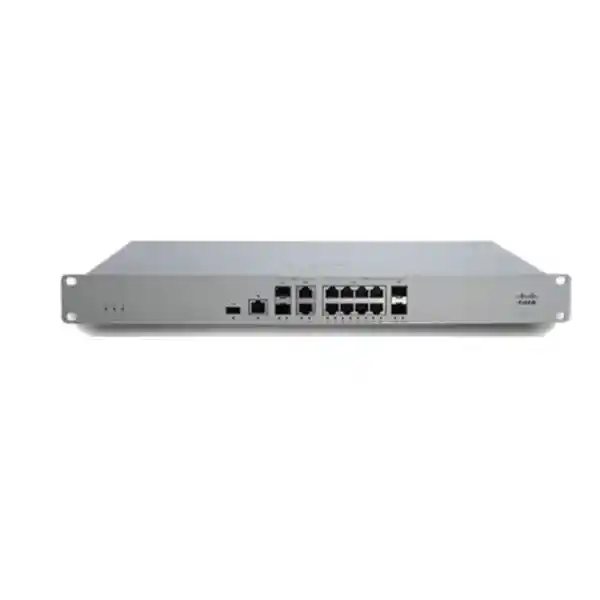
Cisco Meraki MX85
Cisco Meraki MX85 is a rack-mountable security and SD-WAN appliance designed for small-to-medium branch deployments that benefit from centralized cloud administration. Cisco positions the MX85 for environments of up to 250 users and publishes 1 Gbps stateful firewall throughput. Its combination of Meraki Dashboard management, Auto VPN, traffic shaping, WAN balancing, automatic failover, VLAN services and security controls makes it relevant for organizations that want consistent branch networking without managing each site as an isolated firewall.
For Tanzania buyers, the practical decision is not simply whether the MX85 can connect to the internet. The more useful questions are whether its performance profile matches the security services you intend to enable, whether its GbE interfaces suit the current and planned WAN design, how many branches and VPN tunnels are expected, what Meraki license tier is required, and how the device will integrate with switches, Wi-Fi, servers, cloud services and remote users.
The MX85 is best considered when a branch needs rack mounting, centralized Meraki administration, multiple WAN connectivity options, up to 250-user sizing guidance and secure connectivity to other branches or cloud environments. Confirm licensing and workload-specific throughput before ordering.
Cisco Meraki MX85 overview and verified capabilities
Cisco describes the MX85 as a small-to-medium branch security and SD-WAN appliance for up to 250 users. Sizing should still account for traffic mix, security inspection, VPN use and growth.
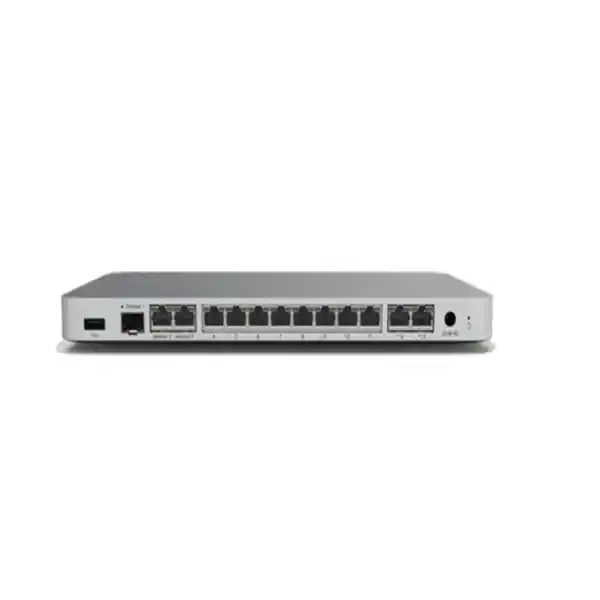
The platform provides two 1GbE SFP and two 1GbE RJ45 WAN interfaces, with one RJ45 WAN port supporting PoE+, plus eight 1GbE RJ45 and two 1GbE SFP LAN interfaces. Cisco documents a maximum of two active WAN uplinks in normal operation.
Meraki Dashboard provides web-based configuration, monitoring, firmware management, client visibility, alerting, event logs and remote diagnostic tools that are especially useful across distributed locations.
The MX family supports Auto VPN, stateful firewall policies, VLANs, DHCP, NAT, application visibility, traffic shaping and remote-access options. Advanced security functions depend on the selected licensing tier and configuration.
Performance, licensing and procurement notes
Cisco currently publishes 1 Gbps stateful firewall throughput for the MX85. Current Cisco documentation also contains differing site-to-site VPN figures across pages and firmware-oriented sizing references, so procurement teams should avoid treating a single older number as a universal deployment guarantee. The correct planning method is to define the expected traffic profile, enabled security controls, VPN topology, WAN circuits and firmware or licensing context, then confirm the current Cisco sizing guidance for that exact use case.
The MX85 hardware identifier published by Cisco is MX85-HW. Cisco lists Enterprise, Advanced Security and Secure SD-WAN Plus licensing options in multiple subscription terms. Licensing is part of the operating model, so a quotation should make the selected tier and term explicit rather than presenting hardware alone as the complete solution. Advanced services such as intrusion prevention, content filtering and malware-oriented controls are associated with appropriate security licensing.
Buyers should also confirm the required power cord, compatible SFP transceivers, rack space, UPS protection, ISP handoff type, public addressing, VLAN plan and whether branch connectivity will use Auto VPN, non-Meraki IPsec, remote-access VPN or a combination. These details frequently determine whether installation is straightforward or delayed by missing accessories and network assumptions.
Where the MX85 fits in a Meraki branch design
The MX85 is most compelling when branch standardization matters. A company with several offices can use templates, common security rules, consistent VLAN conventions and centralized monitoring so administrators do not need to maintain unrelated device interfaces at every site. Auto VPN can reduce the manual work involved in building Meraki-to-Meraki tunnels, while application-aware policies and traffic shaping can help prioritize important services over less critical traffic.
The appliance should be assessed together with the LAN. Meraki or third-party switches, wireless access points, voice systems, cameras and servers may all sit behind the firewall. The MX85 provides multiple LAN interfaces, but a medium branch will commonly use managed switching for endpoint density, PoE and VLAN distribution. If your project includes switching or Wi-Fi upgrades, review Fourteck Tanzania’s integrated IT and network services because firewall sizing is more reliable when the whole branch architecture is understood.
For smaller Meraki environments, it can also be useful to compare the Cisco Meraki MX67, MX67C, MX67W, MX68 and MX68W. These product pages help procurement teams understand when a smaller branch model may be more appropriate, while the Cisco Meraki MX family page provides broader product-family context. The Fourteck Tanzania technology shop is also useful when the project includes supporting network equipment.
Cisco Meraki MX85 technical reference
| Recommended use | Small-to-medium branch, up to 250 users according to Cisco guidance |
| Stateful firewall throughput | 1 Gbps published by Cisco |
| WAN interfaces | 2 × 1GbE SFP and 2 × 1GbE RJ45, with one RJ45 PoE+; normal firmware behavior supports up to two active WAN uplinks |
| LAN interfaces | 8 × 1GbE RJ45 and 2 × 1GbE SFP |
| Form factor | 1U rack mount |
| Dimensions | Approximately 484.6 × 250 × 43.8 mm |
| Management | Cisco Meraki Dashboard |
| Hardware identifier | MX85-HW |
Cisco Meraki MX85 Tanzania
Organizations evaluating Cisco Meraki MX85 in Tanzania typically need a branch firewall that can combine internet-edge security, VPN connectivity, SD-WAN behavior and centralized administration. The MX85 is well aligned with offices where local IT resources are limited but a central team still needs visibility into WAN status, client activity, application use, firewall events and branch connectivity. Its rack-mount form factor also fits structured network rooms more naturally than desktop appliances when switches, patch panels, UPS systems and other infrastructure are already installed in a cabinet.
A Tanzania deployment should begin with a bandwidth and workload review. If the branch has a primary fiber connection and a secondary ISP, the MX85 can support WAN balancing and automatic failover, but the exact port mapping, handoff type and addressing need to be designed before cutover. Businesses should record whether each ISP provides RJ45 copper or fiber, whether static public IP addresses are required, and which services must remain reachable during a failover. For organizations using cloud applications, VoIP, video meetings or remote desktop services, application priorities can also be documented so the SD-WAN policy reflects real business traffic rather than generic rules.
Security planning matters just as much as internet speed. Buyers should decide whether they need basic firewalling and SD-WAN functions or the additional inspection and protection capabilities associated with higher Meraki license tiers. VLANs can separate corporate users, guest Wi-Fi, servers, cameras, voice devices and other device groups. Site-to-site Auto VPN can connect branches to a head office or other Meraki sites, while remote-access options can support approved users. Each of these functions should be sized together because throughput depends on the traffic profile and services being used.
For procurement, prepare the user count, current and planned ISP bandwidth, number of branch sites, VPN requirements, security features, rack availability, power protection and required subscription term. Fourteck Tanzania can then help structure a quotation discussion around hardware, licensing and supporting network requirements. Customers planning a wider upgrade can also review the Tanzania networking and cybersecurity service portfolio to connect firewall selection with switches, Wi-Fi, cabling and lifecycle support.
Cisco Meraki MX85 Dar es Salaam
Cisco Meraki MX85 buyers in Dar es Salaam often operate from head offices, professional workplaces, distribution facilities, hospitality properties, retail operations or multi-branch businesses where reliable internet access is operationally important. In these environments, the main value of the MX85 is not only firewall protection; it is the ability to combine security policy with WAN visibility and centralized branch management. A network team can monitor uplinks, examine client usage, review event logs and make configuration changes through Meraki Dashboard rather than depending on console access at the physical location.
For a Dar es Salaam office with two internet providers, deployment planning should identify which connection is primary, whether both links will carry normal traffic, and what applications should move to the alternate link when service quality changes. Automatic failover is useful, but continuity also depends on DNS, public addressing, upstream provider behavior and the way inbound services are designed. If the site hosts public applications, VPN gateways or partner connections, failover behavior should be tested instead of assumed. Power resilience should also be included in the network-room design because a redundant ISP strategy cannot help when the firewall, switch or modem loses power.
A branch with IP phones, cameras, access points and business systems should use segmentation intentionally. Guest wireless users normally should not share the same trust zone as finance workstations or surveillance devices. The MX85 can participate in a VLAN-based design, while managed switches carry those VLANs to the appropriate ports and wireless SSIDs. When the office uses Microsoft 365, cloud ERP, conferencing or other SaaS tools, traffic shaping can be aligned with the applications that matter most to staff productivity.
Before requesting a Dar es Salaam quotation, document the number of users, expected internet growth, VPN peers, license preference, SFP requirements, rack depth and available UPS capacity. If the deployment is part of a wider branch modernization, the Fourteck Tanzania shop can help identify related switching, wireless and infrastructure categories, while the Fourteck Tanzania contact page provides the verified route for a project discussion.
Cisco Meraki MX85 Mwanza
For organizations considering Cisco Meraki MX85 in Mwanza, remote manageability can be especially valuable when network administration is centralized elsewhere. A branch can be provisioned with standardized policies and monitored through the Meraki cloud, reducing the need to treat every configuration change as an onsite task. This operating model suits companies with a main IT function in another city, regional businesses with several branches, and organizations that want consistent firewall, VPN and traffic policies across locations.
The first design step should be to map the Mwanza site’s connectivity. Record the primary and backup internet services, actual throughput at business hours, latency to critical cloud services, and any applications that rely on stable tunnels to another office. If a site-to-site VPN is carrying ERP, file services, voice or management traffic, the firewall must be sized for that encrypted workload rather than only for ordinary web browsing. Cisco publishes 1 Gbps stateful firewall throughput for the MX85, but security and VPN planning should use the current workload-specific guidance and leave headroom for growth.
The physical environment matters too. The MX85 is a 1U rack device, so the installation should include suitable rack space, ventilation, cable organization and power protection. If the WAN handoff uses fiber, verify the required Cisco-compatible SFP type instead of assuming a copper patch cable will be sufficient. If the branch uses PoE switches for cameras, phones or access points, calculate UPS load for the whole critical network path, not only for the firewall.
A useful Mwanza procurement brief should include the number of users and devices, branch-to-branch topology, applications, ISP handoffs, remote access needs, security controls, VLANs and licensing term. The goal is to order a complete operating solution rather than a hardware appliance with missing assumptions. Buyers with smaller satellite locations can compare the MX67 and MX68 against the MX85 so each site receives a model aligned with its actual user and interface requirements.
Cisco Meraki MX85 Arusha
Cisco Meraki MX85 in Arusha can be relevant to hospitality groups, tour operators, professional offices, educational organizations, NGOs, logistics businesses and multi-site enterprises that need secure branch connectivity with centralized oversight. These environments often depend heavily on cloud applications, online reservations, payment services, voice and collaboration tools. A branch outage therefore affects more than ordinary web access, which makes WAN resilience, monitoring and predictable remote troubleshooting important parts of the firewall decision.
When two internet connections are available, the MX85 can support WAN link balancing and failover. However, an effective design must define which traffic uses which path and what happens when one provider becomes unstable rather than completely unavailable. Performance policies should focus on the real application mix: video conferencing may be sensitive to loss and latency, bulk backups may be less urgent, and guest traffic may need different treatment from operational systems. Meraki’s centralized monitoring helps administrators correlate user experience with WAN behavior, but the policy still needs to be designed around business priorities.
Arusha sites with guest Wi-Fi should pay particular attention to segmentation. Guest access can be isolated from administrative systems, cameras, point-of-sale devices and internal servers through a combination of VLANs, wireless configuration and firewall rules. Remote management does not eliminate the need for good local infrastructure: clean cabling, managed switching, documented VLANs and UPS-backed equipment remain essential. If the property or office has several buildings, fiber uplinks and switch placement may also affect the overall topology.
For quotation preparation, share the internet bandwidth, user count, guest-user estimate, number of access points, VPN requirements, security license expectations and whether the MX85 will replace an existing firewall. Migration planning should document current public IPs, NAT rules, VPN peers and any services exposed to partners. Fourteck Tanzania’s network and security services are relevant where the firewall is one part of a wider Wi-Fi, switching or branch-connectivity project rather than a standalone hardware purchase.
Cisco Meraki MX85 Dodoma
Businesses and institutions assessing Cisco Meraki MX85 in Dodoma can use the platform to standardize security and connectivity for a branch that depends on centralized applications, remote administration and secure communication with other sites. The Meraki operating model is especially useful when the network team wants consistent configuration and visibility without placing a full-time firewall specialist at every location. Dashboard-based monitoring, automatic firmware processes, event logging and remote packet-capture tools can reduce the amount of troubleshooting that must begin physically at the rack.
A Dodoma deployment should be designed around the actual service dependencies of the site. If staff use a central ERP platform, cloud document systems, remote desktops, voice over IP and video conferencing, the WAN plan should identify which services must survive an ISP outage and how much bandwidth the alternate path can realistically provide. A backup link that is much smaller than the primary connection may be adequate for essential traffic but not for every application. Traffic-shaping and SD-WAN policies should therefore distinguish critical workflows from discretionary traffic.
Security segmentation is equally important. Departments, guests, servers, cameras, phones and building systems may require different access rules. The MX85 can enforce policies at the gateway while managed switches and access points extend the segmentation through the LAN. If the site connects to other offices over Auto VPN, route design should be documented so networks do not overlap and access is granted only where required. Remote-access users should also be planned around authentication and minimum necessary access rather than broad network exposure.
Before procurement, confirm the rack environment, WAN handoff type, SFP needs, power cord, UPS, license tier, subscription period and migration window. Include current firewall rules and VPN details if the MX85 is replacing another platform. This reduces surprises during cutover and gives procurement a clearer bill of materials. Organizations with smaller branch profiles can review Fourteck Tanzania’s MX67W and MX68W pages when integrated wireless or lower branch scale may be more appropriate.
Cisco Meraki MX85 UAE
Organizations searching for Cisco Meraki MX85 in the UAE often manage regional headquarters, branch offices, retail estates, logistics operations and multi-country networks where a consistent cloud-managed security model can simplify operations. The MX85 provides a practical branch form factor with rack mounting, multiple GbE WAN interface choices, centralized Meraki Dashboard management and Auto VPN. For companies that already use Meraki switching, wireless or security products, this can help establish a repeatable configuration standard across sites.
UAE procurement should still begin with workload sizing rather than a model name. A site with a 1 Gbps internet circuit may not automatically be a perfect MX85 fit if it requires sustained heavy inspection, many VPN users or rapid future bandwidth growth. Conversely, a branch with lower average traffic but several WAN and LAN interface requirements may benefit from the MX85’s rack format and connectivity. The security license tier, term length and any remote-access licensing should be itemized so procurement can compare complete lifecycle cost rather than hardware prices alone.
Multi-country businesses can use Meraki templates and Auto VPN to reduce configuration drift between UAE and African branches. The policy design should still account for country-specific internet circuits, cloud routes, local services and application performance. A standard can define VLAN naming, security zones, guest access, VPN topology and alerting while allowing each site to use the bandwidth and addressing appropriate to its location. This balance between standardization and local detail is one of the strongest operational reasons to choose a centrally managed platform.
For related UAE infrastructure, Fourteck’s UAE IT and network solutions site provides regional context for firewalls, networking and structured infrastructure. Buyers planning a shared regional standard should prepare a branch matrix listing user counts, internet speeds, VPN roles, security services and future bandwidth for each site. That matrix makes it easier to determine where the MX85 is appropriate and where smaller or larger appliances should be considered.
Cisco Meraki MX85 Uganda
Cisco Meraki MX85 procurement in Uganda is relevant for organizations that want branch security, SD-WAN and remote administration in one platform. The value is particularly clear for businesses with a central IT team supporting several locations, because Meraki Dashboard can provide a common view of WAN health, clients, applications, alerts and configuration changes. Auto VPN can simplify connectivity between Meraki-equipped offices, while WAN failover can reduce dependence on a single service-provider path.
The correct Uganda design should document both normal and failure conditions. If the primary ISP is unavailable, which applications must continue? Does the backup link have enough capacity for voice, ERP and cloud applications? Are inbound services dependent on a public IP that exists only on the primary circuit? These questions should be answered before deployment so failover behavior supports business priorities. Where the backup connection has lower bandwidth, traffic shaping can help protect essential applications instead of allowing large updates or guest usage to consume the entire path.
For branch security, use VLAN and firewall policy to separate users and systems according to trust. Corporate endpoints, guest Wi-Fi, phones, cameras and servers do not all require the same access. If remote users connect to the branch, define who needs access, which internal resources are required and what authentication approach will be used. If the site participates in an Auto VPN network, avoid overlapping subnets between branches and document routing before cutover.
Uganda buyers can use the Fourteck Uganda IT solutions site for regional networking and infrastructure context. A useful quotation request should include the exact branch user count, ISP bandwidth, number of internet links, expected VPN topology, desired security license tier, rack environment and migration date. This gives the supplier enough information to discuss the MX85 as part of a complete operating environment rather than as an isolated appliance.
Cisco Meraki MX85 Kampala
In Kampala, the Cisco Meraki MX85 can suit growing branch offices and regional operations that depend on cloud services, inter-office VPN connectivity and centralized network governance. A single office may use the appliance for internet security and remote access, while a larger organization may deploy it as one node in a broader SD-WAN design. The common advantage is cloud-based administration: policies, monitoring and troubleshooting can be handled from Meraki Dashboard without requiring the administrator to be physically present at the site.
Kampala networks often combine business Wi-Fi, voice, user devices, cameras and servers. Those systems should not be placed on one flat network simply because they share the same switches. VLANs can create logical zones, and the MX85 can enforce communication rules between them. Guest wireless should normally have a clear path to the internet without unrestricted access to internal services. Cameras and building devices can be limited to the destinations they actually need. This improves policy clarity and can reduce the impact of a compromised endpoint.
Dual-ISP planning is another important use case. The MX85 supports WAN balancing and failover, but a successful deployment requires the network team to define primary and secondary services, test DNS behavior, validate VPN recovery and document how public-facing rules behave during a link change. If critical applications depend on fixed public addresses, the architecture may require additional planning beyond simply connecting two ISP routers.
For a Kampala quotation, provide current firewall details, internet speeds, expected growth, site-to-site tunnels, remote users, VLANs, license requirements and any SFP modules needed for fiber handoff. Consider whether a rack, UPS or managed switch upgrade is part of the same project. The Fourteck Uganda website is a relevant regional reference for networking and communication projects, while Tanzania-based multi-country procurement teams can coordinate shared standards through the wider Fourteck network.
Cisco Meraki MX85 Arua
For businesses evaluating Cisco Meraki MX85 in Arua, remote administration is likely to be one of the most important operational benefits. When a specialist networking team is located elsewhere, centralized configuration and troubleshooting can reduce the need for travel for routine policy changes, log review or basic diagnostics. Meraki Dashboard provides visibility into the appliance and connected clients, while standardized templates can help keep remote branches aligned with the organization’s wider security and network design.
Connectivity planning should recognize that a remote branch may not have the same ISP options or bandwidth as a headquarters location. The MX85 can support two active WAN uplinks in normal operation, but the business should define what each circuit is expected to do. A secondary connection may be intended for full business continuity or only for essential services. If capacity is limited, prioritize applications such as ERP, voice, email and approved operational systems while restricting nonessential downloads and guest traffic during failover.
Arua deployments should also be designed for maintainability. Label WAN circuits and LAN ports, document VLANs, keep configuration ownership clear and install the appliance in a suitable rack with stable power and ventilation. If fiber handoffs are used, confirm SFP compatibility and keep the required patching available. If the site depends on PoE switches for phones or access points, the UPS design should protect enough of the network path for the intended continuity target.
When requesting a quote, include device and user counts, current ISP details, remote-access requirements, branch VPN topology, license term and the applications that must remain available during outages. This information helps determine whether the MX85 offers appropriate headroom or whether another model should be considered. Organizations coordinating Arua with Kampala or other branches can use the Fourteck Uganda regional site as a reference point for related network and communication requirements.
Cisco Meraki MX85 Mbarara
Cisco Meraki MX85 in Mbarara can be considered by branch offices, education environments, healthcare-related organizations, retail operations and other businesses that need secure internet access plus dependable connectivity to central systems. The cloud-managed architecture is useful when the site is part of a larger organization because policies can be managed consistently and remote support teams can see WAN status, client behavior and application usage without waiting for local staff to describe every symptom.
Sizing should start with the business day rather than the ISP contract. Measure the traffic generated by users, cloud applications, software updates, backups, cameras and VPN flows during busy periods. If the organization plans to enable intrusion prevention or other advanced security services, use the relevant Cisco sizing guidance for that security profile. Leave room for growth instead of selecting a model that already operates close to the required ceiling on day one.
The MX85’s multiple WAN interface options can help with ISP diversity, but port behavior should be understood before installation, especially when combining SFP and RJ45 handoffs. Cisco documentation explains that paired SFP and copper interfaces have specific activation behavior, and normal operation supports two active uplinks. This is an important procurement detail because four physical WAN connectors do not mean four simultaneously active production internet links in the standard configuration.
A Mbarara project should therefore include ISP handoff details, cable or transceiver requirements, VLAN and IP plans, branch VPN design, remote-user requirements, subscription tier and power protection. If the branch needs switching, Wi-Fi or cabling work at the same time, plan those dependencies together. The Fourteck Uganda site provides additional regional solution context, while the MX85 page can serve as the technical starting point for the security and SD-WAN portion of the project.
Cisco Meraki MX85 Gulu
Organizations searching for Cisco Meraki MX85 in Gulu may be trying to solve a practical support problem as much as a firewall requirement: how to keep a branch secure, connected and manageable when the main IT team is not onsite. Meraki’s cloud management model addresses that operational challenge by allowing authorized administrators to review device health, configuration, client activity and events remotely. This can make troubleshooting more structured and can reduce configuration differences between branches.
A branch network should still be designed for local conditions. Start by identifying the primary internet circuit, backup option, expected uptime needs and the cloud or headquarters systems that staff use throughout the day. If failover is required, decide which applications receive priority when the secondary link is active. A lower-capacity backup can still be useful when policies protect business-critical traffic. Test VPN recovery, DNS behavior and application reconnection during commissioning so continuity is demonstrated rather than assumed.
Security zones should reflect device roles. User computers, guest Wi-Fi, cameras, phones, servers and operational devices can be separated with VLANs and firewall policies. Branch-to-branch access should be limited to necessary services. Remote access should use approved authentication and should not provide wider network permissions than a user’s role requires. These design choices are more important to real security than relying on a default configuration after the appliance is installed.
For Gulu procurement, document the number of users, internet speed, type of ISP handoff, VPN peers, remote workers, license requirements, rack and UPS environment, and whether the existing network is already segmented. This gives a clearer basis for comparing the MX85 with smaller or larger Meraki models. The Fourteck Uganda regional site can support related discussions around networking and communications if the firewall is part of a larger branch modernization program.
Cisco Meraki MX85 Kenya
Cisco Meraki MX85 buyers in Kenya commonly compare branch-security appliances on throughput, VPN capability, licensing, remote management and local network integration. The MX85 is positioned by Cisco for up to 250 users and offers a 1U rack design with GbE copper and SFP WAN options. It is particularly relevant to organizations that value a single cloud interface for security and SD-WAN operations across several sites rather than managing a collection of unrelated branch firewalls.
For Nairobi or other Kenyan business locations, a useful design exercise is to create a branch profile: users, devices, internet bandwidth, cloud applications, local servers, voice traffic, guest usage, VPN destinations and required security controls. This profile should be compared with the current Cisco sizing guidance rather than choosing the appliance solely from the headline 1 Gbps firewall figure. If the branch is expected to upgrade its internet connection within the subscription term, include that future bandwidth in the model-selection decision.
Network integration should include VLANs, switching and wireless design. The firewall can define security boundaries, but the LAN has to carry those boundaries correctly. A managed switch environment can separate departments, phones, cameras and guest access while supporting PoE for wireless access points and other devices. For multi-site organizations, Auto VPN can simplify branch connectivity and templates can make policies more consistent, but addressing plans must avoid subnet conflicts across locations.
The Fourteck Kenya IT solutions site is relevant for customers coordinating networking and security projects in Kenya. A complete MX85 quotation request should state the hardware quantity, subscription tier and term, SFP requirements, power-cord needs, current and future ISP speeds, number of VPN sites, remote-user needs and any installation scope. That level of detail makes commercial comparisons more meaningful and reduces the risk of receiving quotes that contain different assumptions.
Cisco Meraki MX85 Kuwait
Companies evaluating Cisco Meraki MX85 in Kuwait may be seeking a manageable branch security platform for offices, retail sites, professional environments or regional networks that also include locations in the UAE or Africa. The MX85 combines a rack-mount form factor, cloud administration and SD-WAN features that can make it easier for a centralized IT team to maintain consistent policies across geographically distributed sites.
The procurement decision should include subscription planning from the beginning. Cisco offers different MX85 license tiers and terms, and those choices influence the security functions available and the lifecycle cost. Buyers should make sure each quotation states the exact license type and duration. If remote-access VPN is required, confirm the current Cisco licensing and client requirements for the chosen method. If advanced inspection is important, size the appliance using the applicable security profile rather than relying on uninspected firewall throughput alone.
For resilient internet design, document the ISP handoffs and public-address requirements. The MX85 offers both SFP and RJ45 WAN connections, but physical connector count is not the same as the number of simultaneously active uplinks under normal firmware behavior. The final WAN design should account for Cisco’s port-pairing behavior, any required fiber transceivers and the way failover affects inbound services. Testing should include both complete link loss and degraded-path scenarios where possible.
The Fourteck Kuwait IT solutions site provides related regional context for network and security requirements. Organizations coordinating Kuwait with Tanzania, UAE or other locations should create a common branch standard covering VLANs, IP addressing, Auto VPN topology, security rules, logging and administrator roles. Standardization makes remote operations easier, while model selection can still vary by branch size and bandwidth.
Cisco Meraki MX85 Ghana
Cisco Meraki MX85 in Ghana is relevant to organizations that want to combine firewall security, branch VPN, WAN resilience and centralized monitoring. A growing company with several offices can benefit from using a common policy framework and a shared dashboard, especially when the central network team must support locations without dedicated onsite security specialists. The MX85’s positioning for small-to-medium branches provides a useful starting point, but the final decision should be based on workload and security services.
Start the Ghana sizing process by listing the number of active users and devices, current internet capacity, expected growth and the applications that consume the most bandwidth. Include encrypted VPN traffic, cloud backups, collaboration platforms and software distribution rather than counting only normal browsing. If advanced security controls are required, use the relevant Cisco performance guidance and preserve capacity for future upgrades. This protects the organization from having to replace the appliance immediately after an ISP upgrade or new cloud deployment.
The branch LAN should be planned in parallel. VLANs can separate corporate users, guests, cameras, voice endpoints and servers, while managed switches enforce the physical and logical topology. The MX85 can provide routing and security policy between those zones. If the company has multiple branches, Auto VPN can reduce manual tunnel configuration and Dashboard templates can help keep common settings aligned. Administrators should still document route ownership and subnet allocation to prevent conflicts.
For Ghana-related projects, the Fourteck Ghana IT products and solutions site offers a regional reference point. A clear quotation request should identify the required MX85 quantity, license tier and term, ISP handoffs, SFP requirements, VPN topology, rack and power needs, and whether installation or migration assistance is included. Commercial evaluation is easier when all suppliers are quoting the same technical scope.
Cisco Meraki MX85 Nigeria
Organizations researching Cisco Meraki MX85 in Nigeria may have distributed offices where consistent branch policy, internet resilience and remote visibility are important. The Meraki Dashboard model can reduce operational variation between locations because administrators use the same interface and can apply repeatable templates. This is useful for companies expanding beyond a single office, but it also creates a need for disciplined licensing, internet and configuration planning because the firewall is part of an ongoing cloud-managed platform.
WAN design should consider provider diversity and real application needs. A branch may have two internet circuits, but the secondary path may differ significantly in bandwidth or latency. Define the critical applications that must continue during an outage and shape traffic accordingly. If branches connect over Auto VPN, test tunnel recovery and application reconnection. If the office hosts inbound services, check how failover affects public IP addresses and NAT rules rather than assuming those services will automatically follow the outbound traffic path.
Security design should use segmentation and least-necessary access. Employee networks, guest Wi-Fi, surveillance equipment, IP phones, servers and management interfaces can be placed in separate VLANs with policies controlling permitted communication. Remote users should be assigned appropriate access rather than broad reach into the entire branch LAN. The MX85 supports many of the controls required for this design, while the selected license determines access to additional security capabilities.
For Nigeria projects, the Fourteck Nigeria IT services site provides related regional information. Procurement teams should submit a structured requirement that includes users, WAN links, bandwidth, applications, VPNs, license term, migration needs and physical infrastructure. This helps determine whether the MX85 is correctly sized and ensures the quotation includes the accessories and subscription components necessary for a usable deployment.
Cisco Meraki MX85 Seychelles
Cisco Meraki MX85 in Seychelles can be relevant for hospitality groups, corporate offices, service businesses and multi-site organizations that need a centrally managed network edge. Remote visibility is valuable where specialized IT staff may support the site from another location. Meraki Dashboard can provide status, alerts, client information and troubleshooting tools without requiring every issue to begin with an onsite visit, while Auto VPN can simplify secure connectivity to other Meraki-equipped branches.
Connectivity resilience deserves careful planning because the cost of an outage may be high for reservation systems, cloud platforms, payment services, voice and guest-facing operations. If two internet services are available, define whether the backup must support full traffic or only essential workloads. The MX85 can balance and fail over WAN links, but the applications and public-address requirements determine how seamless the business experience will be. Test critical services during commissioning and document what users should expect when the primary link fails.
Hotels and guest environments should separate visitor access from operational systems. Guest Wi-Fi, administration, point-of-sale, cameras, voice and building devices can be placed in different VLANs and controlled through policy. This segmentation must extend through the switching and wireless design, not only exist on the firewall. If the branch has many access points or cameras, evaluate LAN uplink capacity and PoE power alongside the MX85 so the entire network is balanced.
Seychelles procurement should include shipping and availability discussions separately from technical suitability because stock and delivery terms can change. Avoid assuming availability from a web listing. Instead, provide the required quantity, license tier and term, user count, internet speeds, ISP handoff type, SFP requirements, VPN topology and rack/power conditions when requesting a quotation. For multi-country groups, the Fourteck Africa IT solutions site can provide broader regional context for coordinated infrastructure planning across African operations.
Cisco Meraki MX85 buying checklist
Record active users, endpoints, phones, cameras, servers and expected growth instead of relying on employee count alone.
Document each ISP speed, handoff type, public addressing, failover role and planned upgrades during the license term.
Define the inspection, filtering and threat-protection functions you intend to enable so performance can be assessed under the actual policy.
List Meraki sites, non-Meraki peers, remote users, route requirements and critical applications that cross encrypted tunnels.
Specify the required Meraki license tier and subscription term; compare quotations only when those terms are equivalent.
Check rack space, power cord, UPS capacity, ventilation, SFPs, fiber patch leads, switching and cabling before installation.
Frequently asked questions about Cisco Meraki MX85
Is the Cisco Meraki MX85 suitable for 250 users?
Cisco positions the MX85 for small-to-medium branches with up to 250 users. That is a sizing guideline, not a guarantee for every workload. Heavy inspection, VPN traffic, unusual application patterns or future bandwidth increases can change which model is appropriate.
Does the MX85 support dual WAN?
Yes. The MX85 supports WAN balancing and automatic failover. Cisco documents four physical WAN connector options but normally allows a maximum of two active WAN uplinks, with specific pairing behavior between SFP and RJ45 interfaces.
What license does the MX85 need?
Cisco publishes Enterprise, Advanced Security and Secure SD-WAN Plus license options for the MX85 in multiple term lengths. The correct tier depends on the required security and SD-WAN functions. Ask for the exact license SKU and term in the quotation.
Can the MX85 connect branch offices automatically?
Meraki Auto VPN is designed to simplify site-to-site connectivity between Meraki networks. The IP addressing and routing plan still need to be coordinated so branches do not use overlapping networks and access rules match business requirements.
Is the MX85 a rack-mount firewall?
Yes. The MX85 is a 1U rack-mountable appliance, which makes it suitable for structured network rooms and cabinets where switches, patch panels and UPS systems are installed.
Why do some websites show different VPN throughput numbers?
Cisco documentation has published different MX85 VPN figures across product pages, datasheets and firmware-oriented sizing references over time. For procurement, use the current Cisco sizing guide that matches the firmware and security profile you expect to run rather than relying on one undated reseller specification.
Related Fourteck resources
Review the wider Meraki MX family when comparing branch sizes and security appliance options.Cisco Meraki MX67 Tanzania
Useful for comparing smaller branch requirements against the MX85.Cisco Meraki MX68 Tanzania
Another smaller-branch reference when the MX85 interface count or rack format is not required.Fourteck Tanzania Services
Connect firewall selection with switching, Wi-Fi, cabling, lifecycle and other IT infrastructure needs.
Decision recap
Choose the Cisco Meraki MX85 when your branch design benefits from 1U rack mounting, centralized Meraki Dashboard administration, multiple GbE WAN interface choices, secure SD-WAN, Auto VPN, WAN balancing/failover and a sizing profile aimed at small-to-medium branches. Do not select it from the user-count headline alone. Validate the required security services, expected throughput, VPN workload, growth, interface type and subscription tier.
For a quotation, provide your location, user/device count, current and future internet bandwidth, number of ISPs, VPN sites, remote-access needs, license preference, subscription term, SFP requirements, rack environment and migration scope. This information allows a more accurate hardware and licensing discussion and helps avoid missing accessories or incorrect assumptions.
Consult Fourteck Tanzania about the MX85
Fourteck Tanzania can help you organize the technical information needed to evaluate Cisco Meraki MX85 for a branch, upgrade or multi-site security project. The consultation can cover branch sizing, ISP handoff, licensing, VPN topology, VLANs, related switching and wireless requirements, rack infrastructure and quotation preparation. Availability, pricing, delivery scope and warranty terms should be confirmed at the time of quotation rather than assumed from a generic product page.
For regional projects, you can also reference Fourteck UAE, Fourteck Kenya, Fourteck Uganda, Fourteck Africa, Fourteck Kuwait, Fourteck Ghana and Fourteck Nigeria when coordinating multi-country technology requirements.



Reviews
There are no reviews yet.