
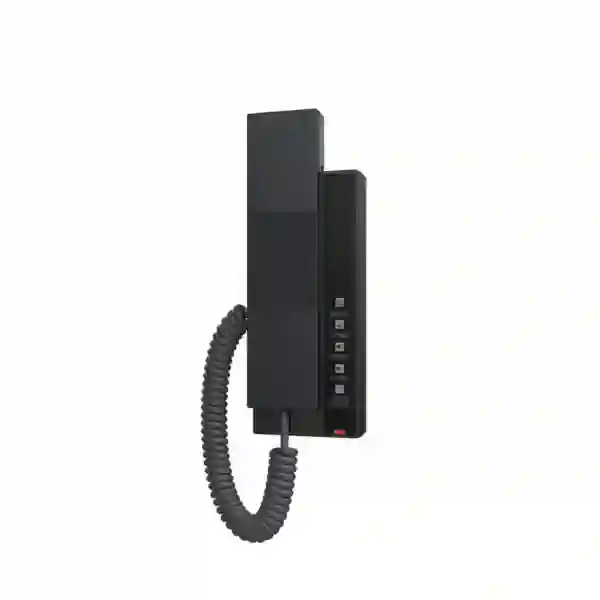
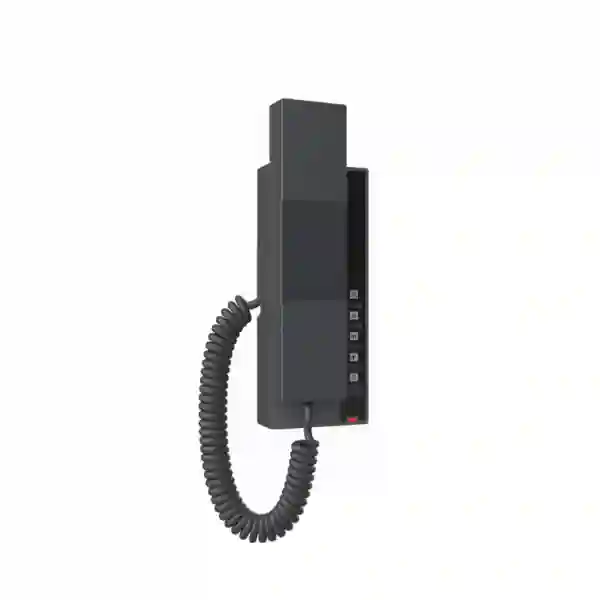
Fanvil H601 Hotel IP Phone
The Fanvil H601 Hotel IP Phone is a compact, screenless SIP handset designed for hotel rooms and other environments where users need a simple telephone interface without the complexity of a large display. Fanvil specifies two SIP lines, two programmable DSS keys, HD audio with G.722 and Opus, a 10/100 Mbps network interface, Power over Ethernet on the H601 model, IPv4/IPv6 support and a space-saving design that can be placed on a desk or mounted on a wall. The result is a practical endpoint for hospitality projects that prioritize one-touch service access, clear voice and tidy installation.
For Tanzania projects, the important buying question is not only whether the handset can register to SIP. A reliable deployment also depends on PBX compatibility, extension planning, PoE switch capacity, VLAN and Quality of Service design, cabling, UPS protection and a clear map of the service keys guests will actually use. FourTeck Tanzania can help buyers place the H601 in that wider telephony and network design rather than treating it as an isolated room accessory.
A wired, PoE-powered, screenless hotel SIP phone with two programmable service keys. If built-in Wi‑Fi is required, evaluate the separate H601W variant instead; do not assume wireless connectivity is present on the H601.
What makes the Fanvil H601 suitable for hospitality?
Hospitality phones have a different job from ordinary office desk phones. A guest does not usually need a directory-heavy interface, multiple pages of line keys or a large display. What matters is a familiar handset, dependable calling, fast access to hotel services and a footprint that works on bedside furniture or a wall. The H601 is designed around that simpler role. Its screenless layout keeps the interaction focused, while two programmable DSS keys can be assigned through the phone system for important service destinations such as reception, housekeeping, room service or another property-defined function.
The handset also supports wideband G.722 and Opus codecs. Those codecs can contribute to clearer voice when the PBX, network and far-end device support compatible wideband operation. The phone cannot by itself guarantee call quality: packet loss, jitter, poor switching, overloaded WAN links or incorrect SIP settings can still affect conversations. For this reason, hospitality buyers should consider the H601 together with the FourTeck Tanzania services portfolio, which explains how IP telephony, switching, cabling and supporting infrastructure can be planned as a coordinated system.
2 SIP Lines
Two SIP registrations give the endpoint flexibility for a primary room extension and an additional identity or service profile where the PBX design requires it.
2 Programmable DSS Keys
Programmable keys can provide one-touch access to hotel-defined services, reducing the need for guests to remember extension numbers.
HD Audio
G.722 and Opus wideband codec support can deliver more natural voice on compatible SIP call paths and well-designed networks.
PoE Connectivity
The wired H601 supports PoE, allowing power and network connectivity to share the Ethernet run when connected to a suitable PoE switch.
Verified Fanvil H601 technical highlights
| Item | H601 detail | Deployment relevance |
|---|---|---|
| Display | Screenless | Keeps guest interaction simple and reduces visual clutter. |
| SIP | 2 SIP lines | Supports a primary extension plus an additional SIP identity where required. |
| Programmable keys | 2 DSS keys | Useful for direct service shortcuts defined by the property. |
| Audio | HD audio; G.722 and Opus | Wideband voice capability for compatible call paths. |
| Ethernet | 10/100 Mbps | Suitable for a dedicated hospitality voice endpoint; cabling and switch design still matter. |
| Power | PoE supported | Can simplify room installation and centralize power through PoE switching. |
| IP mode | IPv4 / IPv6 / dual-stack | Supports contemporary network addressing strategies. |
| Placement | Desk / wall-mounted | Allows flexible placement in guest rooms, corridors and service points. |
H601 versus H601W: do not mix the variants
The H601 and H601W share a similar compact hospitality concept, but their network and power approach is different. Fanvil documents the H601 as the wired model with PoE, while the H601W is the wireless version with built-in Wi‑Fi. A procurement list that says only “H601 series” can therefore create avoidable confusion about cabling, power and network design. If the property has structured Ethernet to each room and wants centralized power through the access switch, the H601 is the natural model to evaluate. If Ethernet is impractical and the wireless design has been surveyed for coverage and capacity, the H601W may be a separate alternative.
For a wired H601 rollout, review the Dinstar C63GP PoE Business IP Phone page as a useful example of how FourTeck Tanzania approaches PoE, VLAN and PBX planning for SIP endpoints. The C63GP is not a hotel-phone substitute for the H601; it is a different user-class device, but the underlying infrastructure questions around PoE capacity, voice VLANs, switch resilience and SIP integration are relevant to both.
PBX compatibility, provisioning and room deployment planning
A hotel-phone project should begin with the phone system and guest-service workflow. Identify the PBX or hosted SIP platform, the extension range for guest rooms, which service destinations need one-touch access, how voicemail or message indication should behave, whether emergency or operator dialing rules are required, and how extensions will be reconfigured when rooms are renovated or repurposed. Registering the phone is only the first test. The project should also validate hold, transfer, incoming caller presentation, service-key behavior, time synchronization, voicemail indication and any hotel-specific calling restrictions that are enforced by the PBX.
The physical network should be documented at the same time. Count H601 units by floor, identify the access switches serving those rooms, calculate available PoE ports and total PoE power budget, and check uplink capacity back to the PBX or voice gateway. Voice traffic is light compared with video, but it is sensitive to packet loss, delay and jitter. A managed switch with suitable VLAN and Quality of Service controls can make troubleshooting much easier than a flat, undocumented network. The FourTeck Tanzania technology shop provides broader buying context for phones, switches, Wi‑Fi, firewalls and supporting infrastructure that may form part of the same project.
For new hotel construction or refurbishment, include telephone outlets and switch-room capacity in the design before furniture is fixed. Wall mounting may be useful where bedside space is limited or where a handset is needed in a corridor, lobby, service area or medical environment. Cable labeling, room-number mapping and a consistent extension naming convention reduce support effort after handover. If a property has multiple buildings, establish whether the voice system is centralized or distributed and what happens when a building-to-building link fails.
Related FourTeck Tanzania IP telephony options
PoE business endpoint
Compare the Dinstar C60SP PoE Business IP Phone for staff desks that need a conventional screen and office-oriented call controls rather than a hotel-room interface.
Wi‑Fi office endpoint
The Dinstar C60U-W Wi‑Fi IP Phone illustrates a different endpoint strategy where office users need wireless connectivity; it is not equivalent to the H601 hospitality handset.
More SIP accounts
The Dinstar C62UP PoE Business IP Phone is more suitable for employees who require a display and additional SIP identities.
Gigabit desktop role
The Dinstar C64GP PoE Business IP Phone targets richer office use cases where a color interface, PoE and Gigabit desktop connectivity are more important than the H601’s minimalist hotel design.
Fanvil H601 Hotel IP Phone Tanzania
Tanzania hospitality projects evaluating the Fanvil H601 Hotel IP Phone should treat the handset as one component of the guest communication system. The H601 is especially relevant where rooms need a compact wired SIP endpoint, the property has Ethernet available at the room, and the network can provide PoE from suitable access switches. Its screenless interface reduces unnecessary menu complexity for guests, while two programmable keys can provide fast access to selected services. Before ordering, the hotel should decide exactly what those service keys represent and confirm that the PBX can route them consistently across all rooms. Reception, housekeeping, room service and operator access are common workflow categories, but the final assignments should match the property’s own operating model.
Infrastructure planning is particularly important in Tanzania because sites can vary greatly in building age, cabling quality, rack organization, power conditions and internet dependence. A new hotel with structured Cat6 cabling and managed PoE switching can deploy the H601 in a very different way from an existing property that is migrating from analog room phones. For a retrofit, survey the existing outlets, cable routes and switch capacity before deciding that every room is immediately ready for IP telephony. Where legacy analog wiring must remain temporarily, the migration plan may need gateways or phased floor-by-floor replacement rather than a single cutover.
Voice continuity should also be defined. PoE centralizes power at the switch, which can simplify UPS planning, but keeping the phone powered is not enough if the PBX, firewall, router or SIP service becomes unreachable. Hotels that depend on the room phone for guest service should identify which upstream components need backup power and whether internal extension-to-extension calling must remain available during an internet interruption. Network segmentation can keep room phones logically separated from guest Wi‑Fi and staff devices, reducing unnecessary exposure and making support easier.
For broader planning, the FourTeck Tanzania business technology overview explains how IP phones, PoE switching, Wi‑Fi, firewalls, UPS and structured cabling can be considered together. A strong Tanzania quotation request should include room count, number of H601 units, PBX model or hosted service, desired service-key destinations, building count, switch models, available PoE capacity, cabling condition, extension plan, installation preference and any requirement for configuration, labeling, testing or documentation. That information allows the phone quantity to be translated into a complete deployment plan rather than a box-only order.
Fanvil H601 Hotel IP Phone Dar es Salaam
Dar es Salaam hotels, serviced apartments, hospitals, retail properties and mixed-use developments often need communication endpoints that can be deployed repeatedly across many rooms without creating a complex user experience. The Fanvil H601 fits that requirement when a wired SIP handset with PoE is preferred. Its two programmable keys can be mapped to the most important service destinations, helping a guest or visitor reach assistance without navigating menus. In a hotel, the H601 can serve guest rooms while richer desk phones are reserved for reception, reservations, administration and management. This user-role approach avoids paying for executive features in locations where a simple handset is operationally better.
Dense commercial buildings in Dar es Salaam may carry voice, guest Wi‑Fi, CCTV, building systems and business applications on the same switching infrastructure. The phone itself uses a modest 10/100 Mbps Ethernet interface, but the quality of the voice service still depends on how traffic is handled upstream. A managed voice VLAN can separate room endpoints from other devices, while Quality of Service can prioritize real-time voice where congestion exists. The access switch should have enough PoE ports and total power budget for the complete floor, not just a few trial phones. If cameras and wireless access points share the same PoE switch, calculate all loads together and leave sensible headroom for future expansion.
Hotels upgrading occupied properties should plan installation around room availability. It can be practical to configure and label phones in batches, test them against the PBX before they reach guest floors, and then replace endpoints according to an agreed schedule. The test plan should include inbound and outbound calling, one-touch service keys, reception transfer, voicemail or message indication if used, room-number presentation and any restricted dialing rules. Wall mounting should be checked against furniture placement, handset access, cable position and housekeeping routines rather than chosen solely for appearance.
Procurement teams in Dar es Salaam should request a quotation with room totals by building and floor, switch and cabling details, the existing PBX or planned SIP platform, service-key labels, required mounting method and any need for ongoing moves or changes after launch. For local project scoping, the verified FourTeck Tanzania contact page is the appropriate route for sharing those requirements. Clear information at the RFQ stage reduces the risk of discovering late that a floor lacks PoE, a legacy cable cannot support Ethernet, or the selected PBX profile needs additional configuration work.
Fanvil H601 Hotel IP Phone Mwanza
Mwanza organizations considering the Fanvil H601 may be building a new hospitality site, expanding a lodge or serviced accommodation property, modernizing a clinic or hospital, or replacing analog endpoints in a commercial facility. In each case, the value of the H601 is its focused role: it is a compact SIP phone rather than a feature-heavy executive terminal. Two SIP lines provide flexibility at the endpoint, two programmable keys can offer shortcuts to property services, and PoE can reduce the number of separate power adapters required in rooms. Those capabilities are useful when the network has been designed deliberately for voice.
A Mwanza rollout should pay close attention to branch connectivity if the PBX is hosted in another city or in the cloud. A room phone may be physically connected and powered yet still be unable to place calls if the WAN path is down. Before standardizing the H601 across a property, determine whether the telephone system is local, centralized at a head office or cloud based, and document the expected behavior during an internet outage. Some businesses may require only internal calling to continue; others may consider front-desk and emergency contact paths operationally critical. That requirement should shape the PBX, WAN and power design rather than being left to the handset.
Physical infrastructure deserves the same discipline. Verify cable lengths and termination quality, label each room port, map it to the correct access switch, and reserve PoE capacity for the full room count. In sites where racks are exposed to heat, dust or unstable power, equipment placement, ventilation and UPS protection are part of the communications design. A small unmanaged switch hidden on a floor may appear cheaper initially but can make VLAN separation, troubleshooting and power monitoring difficult later. Hospitality deployments benefit from a repeatable network standard because rooms are similar operational units and support staff need to identify faults quickly.
For a Mwanza quotation, state whether the project is greenfield or retrofit, how many rooms and service areas require phones, whether wall mounting is preferred, the PBX platform, switch models, available PoE, extension plan and whether centralized provisioning will be used. Also specify any non-room positions such as reception, offices, kitchens or security desks, because those users may need a different phone class. Separating guest-room endpoints from staff endpoints in the bill of materials creates a cleaner design and prevents the H601 from being stretched into roles for which a display, more keys or Gigabit networking would be more appropriate.
Fanvil H601 Hotel IP Phone Arusha
Arusha has a strong hospitality and tourism business environment, and the Fanvil H601 is particularly relevant to properties that want a straightforward room phone for guest communication without adding a large screen or complex navigation. The compact form can work on bedside furniture or a wall, while two programmable service keys can be aligned with the operating model of a hotel, lodge or serviced property. A property might prioritize reception and room service, while another might choose reception and an internal help desk. The technology should follow the guest journey rather than forcing every property into the same key layout.
For Arusha hospitality projects, consistency across rooms is often more valuable than maximizing features. The same handset, labeling scheme, extension plan and provisioning template can simplify training for front-office and technical teams. When a room phone is replaced, the new unit should be able to receive the correct configuration without technicians manually rebuilding every setting. That requires preparation at the PBX or provisioning platform level. Firmware policy, administrator credentials, SIP server details, VLAN values, codec preferences and service-key functions should be documented so replacements remain predictable.
Network and power resilience should be considered against the property’s service expectations. PoE is useful because it removes a separate room-side power supply and lets the phone draw power from the access switch. If the access switches and core voice equipment are UPS protected, short power events can be handled more gracefully than with scattered adapters. The design should still include the full call path: switch, uplink, PBX, firewall, router, SIP trunk and internet termination where applicable. A powered H601 is only one part of a functioning service.
Arusha buyers should also distinguish H601 from H601W during procurement. The H601 is the wired PoE model; Wi‑Fi belongs to the H601W variant. This difference affects both the bill of materials and the site survey. A wired installation depends on Ethernet outlets and PoE, while a wireless rollout depends on carefully planned RF coverage and capacity. For multi-site hospitality groups operating beyond Tanzania, the FourTeck Kenya IT and VoIP site can provide regional context for projects that also include Kenyan properties. A useful Arusha RFQ should include room counts, property layout, PBX platform, network topology, cabling status, service-key requirements, mounting preference and expected support process after handover.
Fanvil H601 Hotel IP Phone Dodoma
Dodoma organizations may consider the Fanvil H601 for hotels, accommodation facilities, hospitals, institutional residences, public-facing service areas and other locations that need a simple SIP phone rather than a full office desktop terminal. The H601’s screenless layout can be useful in rooms where the user should immediately recognize the handset and service buttons without learning a menu structure. Two SIP lines provide endpoint flexibility, and two programmable DSS keys can connect users to selected destinations defined by the PBX. Because the handset supports PoE, an organization with managed PoE switching can centralize both network and power delivery through structured cabling.
Institutional deployments in Dodoma should define governance around the voice system before mass rollout. Decide who owns extension numbering, who can change service-key destinations, how administrator credentials are controlled, which firmware versions are approved, and how room moves or device replacements are recorded. A hotel may need a room-number convention, while a hospital or residential facility may prefer ward, department or bed-area labels. Consistent naming matters because troubleshooting dozens or hundreds of identical phones becomes difficult when physical rooms, switch ports and PBX extensions are not mapped to one another.
Security is also a system-level consideration. Room phones are network devices and should not automatically share unrestricted access with guest or office computers. A dedicated voice VLAN, controlled firewall policies and management restrictions can reduce unnecessary exposure. Where the PBX supports encrypted SIP or related protections, the exact interoperability and certificate requirements should be tested before broad deployment. Procurement teams should avoid assuming that a feature listed by an endpoint automatically works identically with every PBX, SIP provider and firmware version.
For Dodoma purchasing, prepare a room-by-room quantity, identify the PBX and SIP trunk design, list switch models and PoE capacity, describe existing cabling and note any wall-mount requirements. If the project includes reception or administrative desks, separate those roles from guest-room phones so staff can receive models with displays, additional keys or headsets where needed. The H601 is strongest when it is allowed to remain a focused hospitality endpoint. A correctly scoped quotation should therefore distinguish guest rooms, service areas and staff positions, then include any switching, cabling, UPS, gateway or configuration work required to make the complete telephone environment operational.
Fanvil H601 Hotel IP Phone UAE
UAE hospitality properties evaluating the Fanvil H601 may be standardizing room telephony across hotels, serviced residences or mixed-use developments where clean installation and predictable guest interaction are priorities. The H601 suits the room role because it avoids a large display while retaining SIP connectivity, two programmable service keys, wideband audio support and wired PoE operation. Properties that already use structured Ethernet and centrally managed PoE switching can incorporate the handset into the same network architecture used for other controlled endpoints, provided the voice VLAN, switch capacity and PBX design are validated.
For hotel groups that operate in both the UAE and Tanzania, standardization can reduce support complexity. The same basic room-phone profile can define service-key behavior, naming conventions, extension ranges, allowed dialing, codec preferences and provisioning rules, while site-specific details are adjusted for local PBX, trunk and network conditions. Standardization should not be confused with blindly copying configurations. Each property still needs its own room count, switch capacity, WAN design and failover plan reviewed before rollout.
The model distinction between H601 and H601W is especially important when procurement teams compare wired and wireless projects. The H601 uses wired Ethernet and supports PoE; the H601W is the Wi‑Fi alternative. A new-build property with planned data outlets may benefit from the predictability of wired connections, while a retrofit with difficult cabling may investigate wireless options only after a proper Wi‑Fi design. Guest Wi‑Fi coverage alone should not be assumed sufficient for voice endpoints because channel use, roaming behavior, device density and segmentation requirements can be different.
Organizations coordinating UAE requirements can reference FourTeck UAE IT and telecom solutions for regional project context. For an H601 quotation, provide the number of properties and rooms, PBX platform, SIP services, desired one-touch keys, switch and PoE design, installation method, provisioning approach and any cross-country standardization requirement. That level of detail helps determine whether the H601 should be used throughout guest rooms or combined with other phone classes for reception, management, back office and service teams.
Fanvil H601 Hotel IP Phone Uganda
Ugandan hotels, clinics, hospitals, residences and commercial facilities can consider the Fanvil H601 where a compact PoE-powered SIP endpoint is needed in rooms or public-facing service areas. The phone’s two programmable keys can be mapped to important destinations, while the absence of a screen keeps the interaction straightforward. This is particularly useful when the phone’s role is predictable and users need immediate access to a small number of services rather than a feature-rich office interface. Two SIP lines provide additional flexibility for the voice design without turning the device into a complex multi-line console.
Uganda deployments that connect to a centralized or cloud PBX should examine WAN stability and failure behavior early. If a hotel relies on an internet connection to reach the PBX, room phones may lose external calling during an outage even though local PoE and cabling remain operational. A business should define whether local calls between rooms and reception must remain available, whether there is a secondary connection, and how staff communicate if the primary voice path fails. These decisions belong in the PBX and network architecture, not in the phone specification alone.
For properties with several floors, plan PoE switching by closet and floor. Count every H601, access point, camera and other powered device connected to each switch, then compare the combined load with the switch’s total PoE budget. Voice VLANs and documented port assignments make it easier to isolate faults and replace devices without disrupting unrelated services. UPS capacity should cover the network components that are truly required for voice continuity, including switches, routers, firewalls, PBX appliances and internet termination equipment where relevant.
The FourTeck Uganda IT and VoIP site provides regional context for organizations with Ugandan requirements. A useful H601 RFQ should list room count, property locations, PBX or hosted voice platform, existing network switches, cabling condition, PoE availability, preferred mounting method and service-key behavior. For organizations operating in both Uganda and Tanzania, also state whether the goal is a shared telephone standard across countries. This allows extension profiles, labels and management practices to be aligned while still respecting the network conditions at each property.
Fanvil H601 Hotel IP Phone Kampala
Kampala hotels and accommodation businesses often need many guest-room endpoints but only a smaller number of advanced staff phones. The Fanvil H601 can support that tiered design by serving rooms with a focused screenless interface while reception and administrative teams use models with displays, more programmable keys or headset support. This division is operationally sensible: a guest-room phone should be obvious to use, whereas a receptionist may need to monitor multiple lines, transfer calls rapidly and manage higher call volumes. Selecting phones by role rather than buying one model everywhere can improve usability and control costs.
In Kampala properties with existing structured cabling, the wired H601 can use Ethernet and PoE to simplify room-side installation. Before rollout, technicians should verify each outlet, patch-panel mapping and switch port. Legacy buildings may have telephone cable that is not suitable for Ethernet, so an analog-to-IP migration should never assume that old wiring can be reused unchanged. A cable survey can identify which rooms are ready, which require new runs and where additional access switching is needed. This is especially important when refurbishment schedules require rooms to remain in service during the project.
The phone’s 10/100 Mbps interface is appropriate for its voice role, but the upstream LAN should still be managed carefully. Separate voice traffic where appropriate, prioritize real-time packets, and avoid placing guest phones on the same unrestricted segment as guest laptops or unrelated devices. If the PBX is cloud hosted, measure real network behavior rather than relying only on advertised bandwidth. Stable latency and low packet loss are more important to voice than raw download speed. A pilot floor can reveal configuration, cabling and user-workflow issues before the property commits to a full deployment.
For a Kampala quotation, specify the exact H601 model to avoid confusion with H601W, and include the number of rooms, buildings and floors, PBX details, required service keys, PoE switch inventory, UPS design and installation schedule. If the hotel needs faceplate customization or standardized labels, include those requirements early so they can be assessed separately from core phone functionality. The best procurement package should also identify spare-unit requirements and the process for replacing a failed handset, because consistent provisioning and labeling can reduce room downtime far more effectively than relying on ad-hoc manual setup.
Fanvil H601 Hotel IP Phone Arua
Arua hospitality and institutional projects may prioritize simple, maintainable technology because technical support resources and spare access can differ from large capital-city environments. The Fanvil H601 can fit that philosophy when the objective is a standardized wired SIP room phone with few user-facing controls. Two programmable keys can be dedicated to the services that matter most, while PoE can eliminate separate power adapters in rooms. A consistent handset model across a property also reduces the number of different replacement devices and user instructions that staff must manage.
Maintainability starts before installation. Build a room schedule that maps each physical location to its Ethernet outlet, switch port, VLAN and PBX extension. Label both ends of cabling, document switch locations and keep a controlled provisioning template. If a handset fails, technicians should be able to identify the room profile and apply it to a replacement without reconstructing settings from memory. This practice is especially useful for properties that may rely on remote support from another city, because clear documentation lets an on-site employee provide accurate port and room information during troubleshooting.
Connectivity planning should include realistic failure scenarios. If the PBX is outside Arua, determine how the site behaves when the primary WAN link is unavailable. If guest communication is important during outages, the organization may consider a secondary path or a voice design with suitable local survivability, depending on the PBX platform. UPS planning should prioritize the switches and network edge that keep room phones functional. The H601’s PoE capability is helpful, but it cannot compensate for an unpowered router or unreachable PBX.
Arua buyers should therefore request more than a unit price. The RFQ should include room count, site topology, PBX location, WAN arrangement, switch models, PoE capacity, cable condition, service-key destinations and expected support model. If the deployment will be performed in phases, state the planned sequence so extension numbering and switch allocation can be prepared in advance. A phased approach can allow one floor or building to act as a pilot, giving the project team a chance to refine service-key labels, call restrictions, provisioning and user instructions before the same configuration is replicated across the remaining rooms.
Fanvil H601 Hotel IP Phone Mbarara
Mbarara hotels, healthcare facilities, educational residences and commercial properties can use the Fanvil H601 where rooms need a conventional handset connected to an IP telephony platform. The phone is most valuable when the role is intentionally simple: receive calls, place approved calls and reach important services quickly through programmed keys. This contrasts with office staff positions that may need directories, multiple monitored extensions or larger displays. A well-designed project can therefore combine H601 units in guest or patient rooms with a different class of business SIP phones in reception and administrative areas.
For new facilities, coordinate the phone design with the structured cabling plan. Every intended H601 location needs an appropriate Ethernet path to a PoE switch, and the switch needs sufficient power budget for all endpoints. Place communications closets where cable distances and maintenance access are practical, allow rack space for growth, and label room outlets consistently. If the property also uses IP cameras and access points, those devices may compete for the same PoE resources, so the total power requirement should be calculated at design stage rather than discovered after installation.
For existing buildings, the migration can be more complex. Analog room phones may use cable that cannot carry Ethernet, PBX extensions may not map cleanly to new SIP identities, and guest rooms may have limited access for installation work. A site survey should identify which areas require new cabling, where wall mounting is practical and whether temporary analog service must remain during the transition. A pilot set of H601 units can validate PBX registration, service keys, message behavior, call restrictions and front-desk transfer processes before the larger cutover.
Mbarara procurement teams should also consider spares and lifecycle support. Keeping a small controlled pool of replacement handsets can reduce room downtime, but spare units are only useful if provisioning is documented and configuration backups are maintained. The quotation request should therefore include the desired quantity, spare policy, PBX platform, number of buildings, floor distribution, switch infrastructure, mounting preference and any installation or configuration services required. That information creates a more accurate total project view than comparing handset prices alone, because cabling, PoE, UPS and PBX readiness often determine whether the room phone works reliably in daily operation.
Fanvil H601 Hotel IP Phone Gulu
Gulu properties considering IP telephony may be moving from standalone analog lines to a centrally managed extension system. The Fanvil H601 can serve the guest-room or service-room layer of that architecture when a compact wired handset is preferred. Two SIP lines allow flexible registration, and two programmable DSS keys can direct users to the services selected by the property. Because the H601 is screenless, it is not intended to replace a reception console or advanced office phone. Its strength lies in repeatable, uncomplicated room communication.
A migration project should inventory the existing environment before equipment is ordered. Count active room extensions, note any analog trunks or gateways that must remain, inspect cable type and condition, identify rack and switch locations and document how incoming calls are handled today. This information helps determine whether the change can be performed in one phase or should be staged. If guest rooms remain occupied, staging by wing or floor can reduce disruption. Preconfiguring phones with the correct room profiles before installation can also shorten work inside each room.
Network management becomes increasingly valuable as the number of endpoints grows. A managed switch can show link status, VLAN membership and PoE state, giving support staff more visibility than unmanaged equipment. Clear switch-port documentation lets a technician locate a room phone quickly when a guest reports no dial tone or a service key stops working. If the PBX is hosted remotely, monitoring the WAN path and keeping a record of outage behavior can prevent unnecessary handset swaps when the actual fault is upstream connectivity.
For a Gulu RFQ, provide room and phone quantities, the current and proposed PBX design, existing cabling, PoE switch details, UPS availability, service-key requirements and the expected installation sequence. Also identify whether reception, security, kitchens or administrative offices need separate phone types with more keys or screens. Keeping those roles distinct allows the H601 to remain optimized for rooms while other users receive endpoints matched to their workload. A complete proposal can then account for phones, switching, cabling, PBX configuration, testing and documentation as separate but connected parts of the same communications project.
Fanvil H601 Hotel IP Phone Kenya
Kenyan hospitality and commercial buyers may encounter several Fanvil H-series models, so exact model selection matters. The H601 is the wired, PoE-capable screenless hotel phone with two programmable keys. Buyers who need Wi‑Fi should compare the separate H601W rather than assuming wireless capability is included. This distinction affects both price comparison and infrastructure planning because wired PoE depends on Ethernet outlets and suitable switches, while a Wi‑Fi deployment depends on RF coverage, segmentation and room-by-room wireless performance.
Hotels with properties in Kenya and Tanzania may benefit from a common endpoint standard. A shared H601 profile can define which buttons reach reception or guest services, how room extensions are numbered and what calling restrictions apply. However, each property still needs its own network validation. Switch models, PoE budgets, internet providers, PBX hosting locations and cabling quality can differ even within the same hotel group. Treating standardization as a template rather than a rigid copy makes it easier to preserve a consistent guest experience without ignoring local infrastructure.
Procurement comparisons should look beyond the advertised handset price. Confirm whether the quotation refers to H601 or H601W, what accessories or mounting components are included, whether configuration is part of the scope, and whether the proposed PBX supports the required hotel call behavior. For bulk projects, request a pilot unit and test the intended configuration before committing to every room. The pilot should cover SIP registration, inbound calls, service-key destinations, message indication where used, allowed dialing, wall placement and network power. A short test can reveal compatibility issues that are much cheaper to solve before a large shipment or installation.
For Kenya-focused regional coordination, FourTeck Kenya covers VoIP phones, IP PBX and business networking. A cross-border RFQ should state the quantity needed in each country, the PBX platform used at each property, whether configurations should be standardized and what level of installation or remote support is expected. This information helps separate true product comparability from local service or infrastructure differences and lets procurement teams evaluate the total working extension rather than just the handset line item.
Fanvil H601 Hotel IP Phone Kuwait
Kuwait hospitality buyers looking at the Fanvil H601 should begin by confirming that a wired PoE room-phone design fits the property. The H601 is suited to environments where each room or service point can receive Ethernet from a managed switch and where centralized power through PoE is preferable to local adapters. Its screenless interface reduces visual complexity, while the two programmable keys can be assigned to the hotel’s highest-value guest services. The actual destinations should be defined during PBX design so that labels, dialing rules and operational procedures remain consistent.
In new construction, telephone deployment should be coordinated with cabling and interior design. The placement of bedside tables, wall panels and electrical outlets can affect where the handset is convenient to use. If wall mounting is planned, verify the wall surface, cable exit point and handset clearance before rooms are completed. Network closets should be sized for enough PoE ports and power budget to cover phones as well as other powered devices. A well-planned closet with UPS, cable management and clear labeling is easier to maintain than scattered small switches added after the building is occupied.
Hotels operating a centralized PBX should also document dependency on WAN or internet connectivity. If the PBX is in another building or cloud region, define what happens if that path is interrupted. Guest service procedures may need an alternative communication method during major outages. If the PBX is on site, backup power, server resilience and trunk availability become the focus. In both cases, the H601 is only the user endpoint; business continuity depends on the entire voice chain.
For procurement, request a quotation that identifies the exact H601 model, quantity, property and room distribution, PBX platform, switch infrastructure, PoE budget, cabling status and desired service-key functions. Ask suppliers to separate hardware, configuration, installation, testing and any recurring voice-service costs so the commercial comparison is clear. If the property is also evaluating H601W, request that wired and Wi‑Fi variants be shown as separate options with their different infrastructure assumptions. This prevents a model comparison from becoming misleading simply because one option depends on cabling and PoE while the other depends on wireless coverage and local power.
Fanvil H601 Hotel IP Phone Ghana
Ghanaian hospitality projects can consider the Fanvil H601 for guest rooms, serviced apartments, healthcare accommodation and other spaces where a simple SIP handset is more appropriate than an office phone with a large display. The phone supports two SIP lines, two programmable DSS keys, wideband audio codecs and wired PoE. This combination makes it suitable for standardized room deployments where the hotel wants a familiar handset and direct access to a small number of service destinations. The system designer should decide those destinations based on the property’s actual guest workflow.
The business case for PoE is strongest when the network is already designed for centralized power and management. Hotels can place the access switches in controlled communication rooms, protect them with UPS capacity and monitor port state from the network side. That approach can reduce scattered adapters and simplify support, but it requires correct switch sizing. Count every phone by floor, add other PoE devices such as cameras and access points, then confirm total power budget and uplink capacity. A phone project should not consume the remaining switch resources without leaving room for reasonable growth.
For properties migrating from analog systems, the technical change should be accompanied by a process review. Confirm room numbering, front-desk transfer procedure, wake-up or message functions handled by the PBX, emergency dialing policy and any call-barring rules. Some hotel functions may be provided by the PBX or property-management integration rather than by the handset itself. Buyers should therefore validate the complete workflow instead of assuming that replacing a room phone automatically reproduces every legacy feature.
Regional buyers can use FourTeck Ghana for Ghana-focused IT project context while coordinating a common H601 standard across African properties. A good RFQ should include quantity, building and floor breakdown, PBX and SIP trunk information, PoE switch details, cabling readiness, service-key requirements, mounting preference and any need for provisioning or installation. If multiple countries are involved, include the desired standard configuration and identify which items are site specific. This produces a clearer regional procurement plan than requesting a single unit price without the surrounding network and voice assumptions.
Fanvil H601 Hotel IP Phone Nigeria
Nigeria hotel and serviced-residence projects can use the Fanvil H601 as a room-level SIP endpoint where simplicity, PoE and one-touch service access matter more than a display. The screenless design gives guests a straightforward interaction, while two programmable DSS keys can be aligned with the property’s service model. The device supports two SIP lines and HD audio codecs, but those capabilities should be tested with the actual PBX and network. Wideband codec support is useful only when both ends of the call and the intermediate voice platform negotiate compatible settings.
Power resilience is an important planning topic for any IP telephony system. Because the H601 can draw power from the Ethernet switch, the property can place voice endpoints under centralized UPS protection rather than relying on individual room adapters. The benefit exists only if the other essential components are protected as well. Switches, PBX servers or appliances, firewalls, routers and internet termination equipment may all need backup according to the continuity target. The property should define how long essential voice services are expected to remain available during a power interruption and size the infrastructure accordingly.
Large properties should also plan for operational support. Create floor maps, document room-to-port relationships and use consistent extension and device names. Keep spare handsets under configuration control so a failed room phone can be replaced quickly. When deploying hundreds of units, small inconsistencies in labeling or service-key programming can become major support issues. A pilot floor can verify the process and provide training material for front-office and technical staff before the rollout expands.
For Nigeria-focused requirements, FourTeck Nigeria offers regional IT service context. A complete H601 request should identify room count, number of properties, PBX platform, SIP service, desired service-key destinations, network-switch models, PoE budget, UPS expectations, cabling readiness and any installation schedule constraints. Procurement teams should also make the H601/H601W distinction explicit so wireless assumptions do not enter a wired PoE project. Clear scoping helps suppliers quote the correct model and supporting infrastructure and gives the hotel a more reliable basis for comparing offers.
Fanvil H601 Hotel IP Phone Seychelles
Seychelles hospitality environments often place a premium on tidy room design, reliable guest service and manageable infrastructure across resort buildings. The Fanvil H601 can fit guest-room deployments where a compact screenless SIP handset is preferred and Ethernet can be provided to the room. Its two programmable keys can offer immediate access to selected property services, while PoE can simplify room-side power. For resorts, however, the phone decision should be tied closely to the physical topology because villas, separate buildings and long cable paths can create very different network requirements from a single urban hotel tower.
Where rooms are distributed across several buildings, network designers should map switch locations, fiber or copper uplinks and the maximum cable distance to each H601. Access switches may be placed in multiple communication closets, with fiber between buildings where appropriate. The voice VLAN and extension plan should remain consistent even when physical infrastructure is distributed. If links between buildings fail, the property should know whether phones in the affected area can still reach local reception or whether all calling depends on a central PBX path. This resiliency question is particularly important for properties where internal transport or guest assistance relies on telephony.
Environmental and maintenance conditions should also shape the deployment. Network hardware belongs in protected, ventilated spaces with clean power and documented patching. Room phones themselves should be placed where guests can reach them easily without exposing connectors to unnecessary damage. Wall mounting can save furniture space, but the handset cord, cable route and cleaning routine should be reviewed with housekeeping and facilities teams. A technical design works best when it also respects how rooms are actually serviced.
For a Seychelles quotation, include property type, building count, room count, distances between network closets, PBX architecture, PoE switch plan, uplink design, UPS requirements, service-key destinations and the preferred mounting style. If the property is part of an international hotel group, describe any brand-wide extension numbering or guest-service standards that should be preserved. The H601 can be a strong room endpoint within that standard, but reception, concierge and administration may still require different phone classes. A role-based bill of materials ensures each user gets the right interface while keeping the guest-room deployment simple and consistent.
Buying checklist for Fanvil H601 projects
Before requesting a final quotation, prepare enough detail for the supplier to distinguish handset supply from a complete voice deployment. Start with the number of rooms and non-room positions. Identify the PBX or hosted SIP platform, extension plan and trunk environment. Define what the two programmable keys should do. Confirm that room outlets are Ethernet-ready, list the access switches and calculate available PoE capacity. State whether phones will be desk placed or wall mounted and whether configuration, labeling, testing, user handover or documentation is required.
Rooms, floors, buildings, service areas and spare-unit policy.
PBX brand/version, hosted or on-site, trunks and extension conventions.
Ethernet cabling, switch models, voice VLAN, QoS and uplinks.
Available PoE budget and which upstream components require backup power.
Exact destinations, labels and operating-hours behavior.
Supply only, configuration, installation, testing, documentation and support.
Frequently asked questions about the Fanvil H601
Does the Fanvil H601 have Wi‑Fi?
No. The H601 is the wired model. Fanvil identifies the H601W as the Wi‑Fi variant. Buyers should specify the exact model because network and power planning differs between the two.
Does the Fanvil H601 support PoE?
Yes. Fanvil specifies PoE support for the wired H601. The access switch must provide compatible PoE and enough total power budget for all connected devices.
How many SIP lines does the H601 support?
Fanvil specifies two SIP lines. The actual way those registrations are used depends on the PBX, extension plan and property workflow.
What can the two programmable keys be used for?
They can be configured for property-defined service hotlines or other functions supported by the phone and PBX. In a hotel, common concepts include reception, housekeeping or room service, but the correct assignment should reflect the actual operating model.
Can the H601 be wall mounted?
Yes. Fanvil positions the H601 for space-saving deployments and supports wall-mounted installation. The final placement should account for cable routing, furniture, reachability and service access.
Is the H601 only for hotels?
No. Fanvil also identifies scenarios such as hospitals, shopping malls and supermarkets. The common requirement is a compact SIP endpoint with a straightforward interface.
Will the H601 work with any IP PBX?
It is a SIP endpoint, but exact interoperability should be tested with the intended PBX, firmware and required features. Registration alone does not prove every service key, message, transfer or security behavior will work identically.
What information is needed for a quotation?
Provide quantity, rooms and sites, PBX or hosted SIP platform, switch and PoE details, cabling readiness, desired service-key functions, mounting preference and whether configuration, installation or documentation is required.
Decision recap
The Fanvil H601 is a strong fit when you need a compact wired hotel SIP phone with two lines, two programmable keys, wideband voice support, PoE and flexible desk or wall placement. It is not the Wi‑Fi model, and it is not intended to replace richer reception or executive phones. The best deployment uses the H601 where a simple room interface is valuable and combines it with appropriate staff phones, a compatible PBX, managed PoE switching, voice-aware network configuration and documented provisioning.
For wider business-phone research across UAE, GCC and African markets, the FourTeck IP Phone specialist site provides additional brand and use-case context. Keep the final H601 decision tied to the actual property: room count, service workflow, network readiness, power continuity and PBX behavior are more important than selecting a handset from a feature list alone.
Consultation panel: prepare a cleaner Fanvil H601 quotation
Share the exact number of H601 phones, hotel or facility type, city and site count, PBX or SIP provider, current switch models, available PoE, room cabling, required programmable-key destinations and preferred installation method. Also note whether the requirement is handset supply only or a complete scope that includes extension configuration, switch or cabling upgrades, testing, labeling and handover. FourTeck Tanzania can then evaluate the endpoint in the context of the wider telephony environment and help identify supporting requirements before procurement is finalized.



Reviews
There are no reviews yet.