
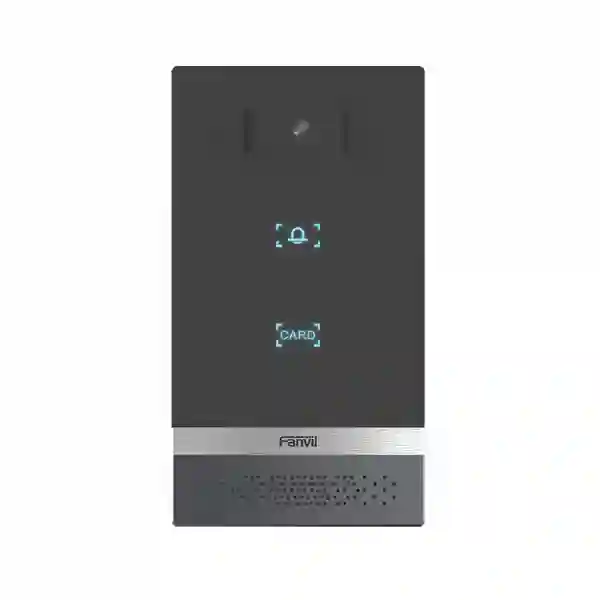
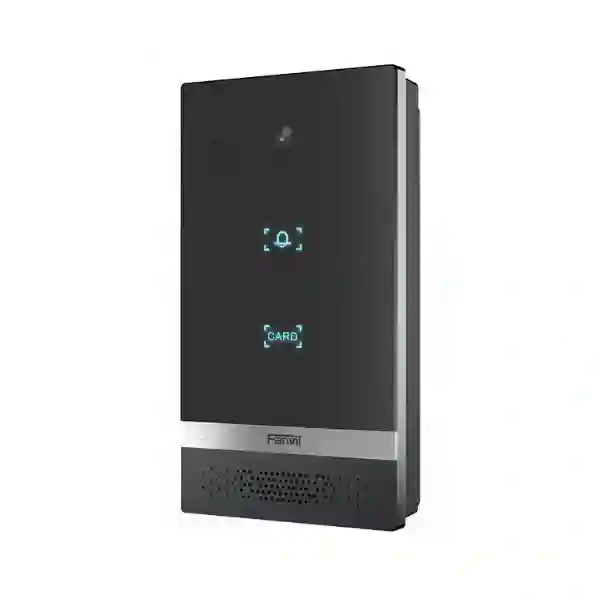
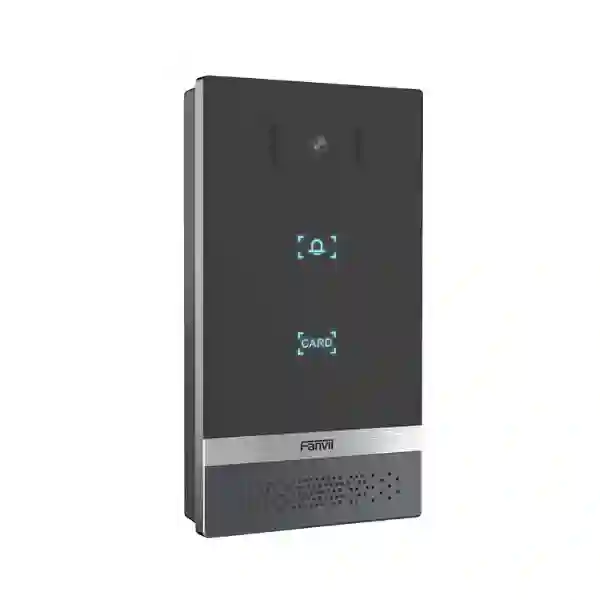
Fanvil i61 Video Door Phone
The Fanvil i61 is a compact IP video door phone designed for controlled entrances where visitors need a clear way to call, security teams need visual verification, and authorized users need managed door access. It combines SIP calling, ONVIF interoperability, a 2 MP infrared camera, RFID credential support, door-control interfaces and outdoor-ready protection in one aluminium unit. For Tanzania projects, it can fit office entrances, apartment blocks, gated facilities, warehouses, education sites, clinics, hospitality properties and industrial locations where entry communication must connect with the wider IP network.
What the Fanvil i61 solves
A modern entrance often has several separate requirements: a visitor must announce their arrival, the person inside must communicate with them, the visitor may need to be visually identified, and the door must open only after an authorized action. The Fanvil i61 consolidates these functions into an IP endpoint that can participate in a SIP communications environment while also interfacing with access-control hardware. Its single touch call button simplifies visitor interaction, while the built-in camera adds a visual layer that can be useful at reception doors, gates, staff entrances and controlled internal areas.
The official Fanvil specifications list two SIP lines, full-duplex HD audio, a 2 MP camera with a 120-degree horizontal and 60-degree vertical viewing angle, infrared capability, RFID card operation, DTMF remote door release, timed opening, a tamper alarm, Wiegand, short-circuit inputs and outputs, RS485 reserve, line-out for an induction loop, TF card support and Power over Ethernet. These features make the i61 relevant where a standalone doorbell would be too limited but a larger multi-button entrance panel would be unnecessary.
Successful deployment still depends on the surrounding system. The electric lock, exit button, door contact, network switch, SIP server or PBX, VLAN design, power continuity and physical mounting all need to be considered together. FourTeck can help buyers define those dependencies before ordering so the door phone is treated as part of a complete entrance workflow rather than as an isolated device.
Video verification
A 2 MP camera with wide-angle coverage and infrared support helps the receiving user see the caller and surrounding entrance area before deciding how to respond.
SIP communication
SIP support allows the door phone to operate as a network communication endpoint and call configured extensions or compatible receiving devices.
Access workflows
RFID cards, indoor switch operation, remote DTMF and timed opening provide several ways to build controlled-entry workflows around the door.
Outdoor resilience
IP66 and IK07 ratings plus the specified -40°C to +70°C operating range support deployment in demanding sheltered and outdoor entrance environments when installation is properly designed.
Verified Fanvil i61 technical highlights
| Camera | 2 MP, infrared support, 120° horizontal / 60° vertical viewing angle |
| Protocols | SIP 2.0 over UDP/TCP/TLS; ONVIF Profile S |
| Audio | Full-duplex hands-free HD audio with acoustic echo cancellation |
| Door access | RFID/IC card, indoor switch, DTMF remote opening and timed opening |
| Credential capacity | Up to 10,000 RFID cards according to Fanvil datasheet |
| Interfaces | Wiegand input/output, short-circuit input/output, RS485 reserve, relay, line-out for induction loop |
| Local storage | TF card slot, up to 128 GB stated in Fanvil product documentation |
| Power | 12 V DC / 1 A or IEEE 802.3af PoE Class 3 |
| Protection | IP66 / IK07 |
| Dimensions | 159.7 × 88 × 36.15 mm |
| Mounting | Wall-mounted; flush mounting requires the applicable accessory |
Integration and deployment planning
The i61 is most valuable when its communication, access and security interfaces are planned as one workflow. A typical deployment may connect the door phone to a PoE switch, register it to a SIP PBX or compatible communication platform, link the relay to an appropriate locking arrangement, connect a door contact or exit input, and make video available to compatible receiving endpoints or ONVIF systems where required. The exact topology should be designed around the door hardware, life-safety rules and the organization’s security policy.
Network design matters because an IP door phone is both a communication endpoint and a security device. Administrators should decide whether it belongs on a dedicated voice, security or access-control VLAN, which systems it needs to reach, how management access is restricted and how firmware updates are handled. PoE can simplify power delivery, but the switch must have sufficient PoE budget and the cabling must be suitable for the installation distance and environment. Where entrance operation is considered critical, UPS-backed network and lock power can be evaluated so short utility interruptions do not immediately disable the complete communication path.
For related architecture, browse the FourTeck Tanzania technology shop for connected business technology, and review FourTeck Tanzania integration services for network, IP telephony, access-control and infrastructure planning. Organizations with regional requirements can also use FourTeck Uganda, FourTeck Kenya and the FourTeck Africa technology network when standardizing related systems across multiple markets.
Fanvil i61 Video Door Phone Tanzania
For organizations searching for a Fanvil i61 Video Door Phone in Tanzania, the purchase decision should start with the entrance workflow rather than with the device alone. A single office entrance may need a visitor to press one button and call reception, while a warehouse gate may require communication with a security desk, controlled release of an electric lock and an auditable access procedure. Residential developments may want a SIP-based entrance point that can communicate with indoor stations or other compatible endpoints. The i61 is suited to these roles because it combines video calling and door-control interfaces in a compact outdoor-rated housing.
Tanzania deployments should account for network availability at the door, cable route quality, power continuity, mounting exposure and the type of lock already installed. PoE can simplify deployment by carrying power and network over one Ethernet cable, but the PoE switch should be sized correctly and protected against outages where entrance communication is business-critical. Outdoor installation should also consider cable protection, drainage, direct weather exposure and physical reach. IP66 and IK07 ratings improve environmental and impact resistance, yet sound installation practice remains essential.
For procurement teams, a useful quotation request should specify quantity, door type, desired mounting method, electric lock model where known, whether an exit button or door contact is required, the existing SIP PBX or receiving platform, the PoE switch environment and the number of authorized card users. If video needs to be consumed by a VMS or another ONVIF-compatible system, that requirement should also be stated. Compatibility must be verified against the actual platform and firmware rather than assumed from protocol support alone.
The i61 can therefore be evaluated as part of a complete IP entrance solution for offices, apartments, campuses, logistics sites, hospitality environments and industrial facilities across Tanzania. The practical objective is controlled communication at the door: identify the visitor, speak clearly, make an authorization decision and trigger the appropriate door action. When those steps are mapped before equipment is ordered, the resulting deployment is easier to configure, document and support.
Fanvil i61 Video Door Phone Dar es Salaam
Businesses in Dar es Salaam frequently combine reception areas, shared office buildings, warehouses, retail premises and gated compounds with centrally managed IP networks. In these environments, a Fanvil i61 can be positioned at a controlled entrance where a visitor needs immediate contact with reception or security without being granted unrestricted entry. The single speed-dial control keeps the visitor experience straightforward, while the camera gives the receiving user a visual context before the door is released.
For a city deployment, the design team should check how the entrance connects back to the communication network. A door near the lobby may be easy to cable directly to a nearby PoE switch. A gate at the edge of a compound may require a longer route, protected outdoor cabling, fiber conversion or a carefully designed intermediate network connection. The same applies to power: a PoE switch in a stable, UPS-backed communications rack can provide a cleaner support model than an unmanaged collection of local adapters, provided cable distance and electrical conditions remain within specification.
A Dar es Salaam office may use the i61 as an extension on an IP PBX so reception staff answer a call from the door like another internal endpoint. A logistics yard may direct calls to a security desk. A multi-tenant property may need a broader system architecture around the entrance, in which case the i61’s single-button design should be matched carefully to the intended user flow. Buyers should define who receives the call, what happens if that person does not answer, how the door is released and how credentials are administered.
Environmental exposure should be reviewed before mounting. Although Fanvil specifies IP66, IK07 and a wide operating temperature range, the installer still needs to provide secure fixing, protected cable entry and suitable positioning for the camera. For quotation accuracy, provide site photos, approximate cable distance, door and lock details, PBX information, PoE availability and expected credential count. That information helps turn a simple product request into a deployable entrance design.
Fanvil i61 Video Door Phone Mwanza
In Mwanza, the Fanvil i61 can serve organizations that need controlled visitor communication at offices, hospitality sites, schools, clinics, warehouses or secured residential properties. The main value is not simply that it has a camera; it is that voice, video and door-release functions can be integrated into an IP-based workflow. A visitor presses the touch button, the configured receiving endpoint is alerted, the user can communicate with the visitor and an authorized action can release the door when the deployment is configured for that purpose.
Sites should first decide whether the entrance is a pedestrian door, lobby door, internal secure door or external gate. That distinction changes the mounting height, lock interface, cable route and response procedure. A gate may also need protection for the network cable between buildings, while an internal office door may already have nearby structured cabling. The i61 supports PoE, which can simplify the physical design, but the switch must be able to supply IEEE 802.3af power and should be included in overall UPS and surge-protection planning where appropriate.
Security administrators in Mwanza should also plan credential lifecycle. Fanvil documents RFID support and a large card capacity, but real operational value comes from having a clear process for issuing, revoking and reviewing credentials. Staff turnover, contractors and temporary visitors can create risk if access permissions are not maintained. Where remote DTMF release is enabled, the organization should define who is allowed to operate it and through which receiving endpoints. Network access to the device should be limited according to the wider security architecture.
A useful procurement package includes the i61 quantity, surface or flush-mount preference, lock and power arrangement, target SIP platform, network switch details, expected card population and any ONVIF integration requirement. This allows the buyer to evaluate not only the door phone but also supporting components and installation dependencies. For Mwanza projects, that planning is especially helpful when equipment, access hardware and network work must be coordinated into one installation visit.
Fanvil i61 Video Door Phone Arusha
Arusha has a mix of offices, hospitality properties, institutions, residential developments and facilities that manage frequent visitors. The Fanvil i61 can be useful at a controlled entrance where the organization wants a simple call point rather than a complex multi-button panel. Its 2 MP camera, infrared capability and wide field of view help the recipient view the caller, while full-duplex audio supports a natural conversation between the entrance and the receiving user.
For hospitality or guest-facing environments, the visitor experience should be mapped carefully. The call should reach a staffed location during operational hours, and there should be a defined after-hours process. In an office, reception may be the primary destination and security a secondary destination. In a staff-only area, RFID credentials may be the main entry method while the call button is retained for exceptional access. The i61 supports these building blocks, but the final behavior depends on the SIP configuration, lock wiring and operating procedures created by the installer and customer.
Arusha sites should also consider mounting conditions. Camera placement affects whether faces can be seen clearly; a unit installed too high, too low or into strong backlighting may give less useful video even when the camera itself is functioning correctly. The wide-angle view is useful for entrance context, but the physical scene should still be reviewed. Network cabling should be protected from weather and physical damage, and any flush-mount accessory requirement should be included before building finishes are completed.
When requesting a quotation, include the number of doors, building type, daily visitor pattern, required card count, existing SIP system, PoE switch availability and whether CCTV or ONVIF integration is part of the project. If the entrance is being renovated, provide wall construction and lock information before finalizing the bill of materials. This avoids a common procurement gap in which the door phone arrives but the mounting, relay, lock power or network path has not been prepared.
Fanvil i61 Video Door Phone Dodoma
Organizations in Dodoma evaluating the Fanvil i61 typically need to connect visitor handling with an existing IP network and a controlled door. Government-adjacent offices, professional services, institutions, administrative campuses and commercial premises may all have entrances where staff need to identify a visitor before unlocking. The i61 provides a compact way to place two-way SIP communication and video at that point while also offering physical interfaces for door-control integration.
The network architecture should be documented from the start. The door phone needs an IP address, suitable switch connectivity and a route to the SIP platform or receiving devices. Administrators should determine whether DHCP or fixed addressing is appropriate, whether the endpoint should be on a dedicated VLAN, which management stations can reach its web interface and how credentials are protected. Because an entrance device affects physical security, the configuration should not be treated like an ordinary untrusted lobby appliance.
Dodoma procurement teams should distinguish between the product specification and the complete installed solution. The i61 may be the visible front-end, but a door project can also require an electric strike or magnetic lock, power supply, emergency release, exit button, door sensor, PoE switch port, structured cabling, patching and configuration of the PBX or receiving station. Applicable safety and building requirements must be considered when choosing how a door locks and releases. These supporting items should be listed explicitly in the quotation scope.
For multi-building sites, standardization can make support simpler. Using consistent extension naming, VLAN policy, card-administration practices and mounting conventions helps technicians understand each entrance without rediscovering the design. The i61 supports this style of repeatable deployment because the device can be configured as a network endpoint, but each door still needs a site-specific review. Provide floor plans, door photos and communication requirements when available so the final design reflects the real entrance rather than a generic template.
Fanvil i61 Video Door Phone UAE
For UAE businesses operating alongside Tanzania sites, the Fanvil i61 offers a way to use a consistent SIP-based entrance device across regional offices when the surrounding PBX and access-control architecture are compatible. Regional standardization can simplify spare planning, administrator training and configuration templates. A facilities or IT team managing both markets may choose the same door-phone model but adapt the mounting, lock hardware and call-routing behavior to each building.
In a UAE office tower or commercial facility, entrance integration can involve building access systems, reception desks, SIP telephony and network security policies. The i61’s ONVIF and SIP capabilities provide useful interoperability options, yet protocol support should never be treated as proof that every third-party platform feature will work identically. The correct approach is to list the intended PBX, VMS or access platform and verify the required call, video, relay and event functions against the versions in use.
Environmental and operational conditions also differ by project. External entrances may face heat, dust and direct exposure, while indoor lobby installations may prioritize appearance and flush mounting. Fanvil specifies IP66, IK07 and a -40°C to +70°C operating range, but cabling, enclosure details and mounting surfaces still determine the quality of the installation. Where the unit is installed outside, shading, water paths, cable glands and physical protection should be reviewed rather than relying on the device rating alone.
Procurement teams coordinating UAE and Tanzania operations should capture quantity by site, SIP account design, receiving destinations, credential policy, lock type, PoE availability and support responsibility. This makes it possible to build a repeatable configuration standard while keeping local installation requirements explicit. A common technical baseline can be valuable for regional companies, but the final system should always reflect each building’s access policy and applicable regulations.
Fanvil i61 Video Door Phone Uganda
Uganda organizations looking for a Fanvil i61 Video Door Phone may be planning an office entrance, gated facility, apartment development, institutional doorway or controlled internal zone. The i61 is relevant when a site needs more than a bell: it enables audio/video communication over SIP and can participate in access-control workflows through RFID credentials, relay operation and connected inputs. That combination can reduce the number of separate user-facing devices required at a door.
A Uganda deployment should begin by confirming how the call reaches staff. If the organization already operates a SIP PBX, the i61 can be assessed as an extension that calls reception, security or another designated endpoint. If the site does not already have a SIP platform, the buyer should decide whether the project includes one or whether another compatible receiving method is intended. This is an important design decision because the door phone’s value depends on a reliable response path.
Power and network continuity are also part of entrance reliability. PoE simplifies cabling, but a door phone connected to an unprotected switch may stop communicating when power fails. For critical facilities, the switch, network core, PBX and door-lock power arrangement can be reviewed together with UPS requirements. The physical installation should protect cable routes from tampering and weather, and administrators should restrict management access to the endpoint.
Buyers should provide a clear scope: door quantity, expected users, card count, existing lock, wall type, surface or flush mounting, PBX brand and version, network topology and any requirement to feed video into a security platform. FourTeck’s regional approach can help companies align the Uganda entrance design with related Tanzania or Kenya projects while keeping each site’s actual infrastructure and regulatory requirements separate.
Fanvil i61 Video Door Phone Kampala
Kampala offices and commercial buildings often have busy front desks, shared compounds and security-controlled entry points. The Fanvil i61 can provide a dedicated visitor communication endpoint without requiring the visitor to know an extension number or navigate a menu. A single touch call can be routed to the configured destination, where staff can speak to and view the visitor before using the allowed door-release method.
At a Kampala site, the busiest part of the design may be the integration rather than the unit itself. The installer needs to understand the lock voltage and type, whether fail-safe or fail-secure behavior is appropriate, how emergency egress is handled, whether a separate power supply is needed and where the door contact or exit button connects. These are site and safety decisions, not generic settings. The i61 supplies interfaces that can participate in the design, but the complete door system must be engineered correctly.
Network teams should decide how the endpoint is segmented and monitored. Because the device supports SIP and ONVIF, it may communicate with more than one system, so firewall rules should allow only the required paths. Credentials should be changed from deployment defaults, firmware should be maintained and administrator access should be controlled. If local TF storage is used, its purpose and retention policy should be documented rather than treated as an alternative to a broader video-management strategy.
For procurement, ask for a complete bill of materials rather than only the i61. Include mounting accessories if needed, lock interface components, PoE switch capacity, cable work, commissioning and integration. Define the acceptance test in advance: visitor presses button, designated endpoint rings, two-way audio works, video is visible where required, authorized release operates the lock, credentials function as expected and tamper or status behavior is checked. This makes handover much clearer for both facilities and IT teams.
Fanvil i61 Video Door Phone Arua
For sites in Arua, a Fanvil i61 deployment can be particularly useful where the entrance is physically separated from the main office or security desk. An IP door phone allows the call and video path to ride on the data network, which can be easier to integrate with modern communications than a traditional analog intercom. The single-button interface also keeps the visitor experience simple at clinics, education facilities, offices, compounds and logistics locations.
Connectivity planning should reflect the actual building layout. If the entrance is in the same structure as the network rack, standard structured cabling may be sufficient. If it is at a remote gate, cable distance, lightning exposure, outdoor containment and intermediate networking may need more attention. Fiber may be appropriate for some long or exposed runs, with local conversion and power designed at the far end. The correct choice depends on site conditions rather than a fixed distance rule from the product page.
Operational simplicity matters as much as technical capability. Staff should know who receives door calls, what to do when the primary responder is unavailable and how temporary or lost cards are handled. Administrators should have documented access to the device configuration and a backup of key settings. If the i61 is part of a larger rollout, consistent naming conventions can make support easier—for example, identifying each door by site, building and entrance rather than by an arbitrary extension number.
Arua buyers should request pricing only after confirming the complete requirement: door hardware, lock, call destination, card use, network path, PoE availability and mounting condition. This avoids comparing quotations that include different assumptions. One supplier may quote only the door phone while another includes cabling, lock components and commissioning. A side-by-side comparison should normalize those differences before the purchase decision is made.
Fanvil i61 Video Door Phone Mbarara
Mbarara businesses, institutions and hospitality properties can consider the Fanvil i61 when they need a controlled entrance to connect with a staffed response point. The device brings together a visible call control, speaker, microphone, camera and RFID area in a compact front panel. This can suit an entrance where the expected workflow is intentionally simple: call, verify, communicate and release if authorized.
Before installation, check the scene that the camera will see. Fanvil specifies a wide 120-degree horizontal field of view, which is useful for seeing more of the entrance, but wide coverage does not eliminate the need for good positioning. Avoid a mount that points directly into extreme backlight when possible, and place the unit at a height that captures visitors naturally. Infrared support helps in low light, but nearby reflective surfaces can affect the image and should be considered during commissioning.
The access-control portion should be planned around the organization’s real policy. RFID access may be convenient for staff, while visitors continue to use the call button. Remote DTMF release may be appropriate for authorized reception or security users. Timed opening can support defined operational windows where suitable. Each method should be enabled only when it serves a documented requirement. The organization should also decide how card records are maintained and how frequently access lists are reviewed.
For Mbarara procurement, provide the exact quantity and identify whether all doors are identical. Different entrances may need different locks, mounting accessories or cable work even when the same i61 is used. Request installation and configuration scope separately from hardware where necessary so responsibilities are clear. During handover, verify call quality, video view, card reading, lock operation, network connectivity, administrator access and the process for adding or removing users.
Fanvil i61 Video Door Phone Gulu
In Gulu, the Fanvil i61 can support controlled entry at offices, educational sites, healthcare environments, compounds and commercial facilities where staff are not positioned directly beside the entrance. Because it is an IP device, the door phone can communicate through the organization’s network to a configured SIP destination, helping centralize visitor handling. The camera provides visual context, while the access interfaces make it possible to integrate the device with appropriate door hardware.
A key planning question is resilience. If the entrance is operationally important, consider what happens during a power outage, network failure or PBX interruption. The answer may involve UPS-backed switching, an independent lock power arrangement, documented manual override procedures or alternative access routes. The i61 itself cannot remove those infrastructure dependencies; it should be included in the wider continuity plan for the site.
The physical environment also deserves attention. Outdoor-rated equipment performs best when installation details are equally robust. Protect cable entries, avoid exposed loose patch leads, use appropriate mounting hardware and confirm that the wall or post is stable. If a gate is distant from the main building, assess grounding, surge protection and media choice for the network path. These details often determine long-term reliability more than the headline feature list.
When comparing offers in Gulu, ask each supplier to state what is included: Fanvil i61 unit, mounting accessory, power supply if needed, lock components, cabling, PoE switch, PBX configuration, card enrollment, testing and user handover. Also ask which integration assumptions still need verification. A transparent scope makes it easier to select the right proposal and prevents the project from being delayed by small but essential parts that were not included in the original hardware price.
Fanvil i61 Video Door Phone Kenya
Kenya businesses with offices, gated sites, apartments or multi-branch operations can evaluate the Fanvil i61 as a SIP-based entrance endpoint that combines intercom and access functions. It is especially relevant when an organization already uses IP telephony or intends to standardize communications and security devices on managed Ethernet. The unit’s PoE capability can reduce local power adapters, while the network connection allows call routing to be managed as part of the broader communications environment.
For branches in Nairobi, Mombasa or other locations, standardization should focus on configuration and support practices rather than assuming every building is identical. A common template can define extension naming, SIP transport, VLAN assignment, administrator policy and card-management procedures. Each door then receives site-specific settings for the lock, relay timing, call destination and camera position. This balance between standardization and local detail can simplify regional support.
Organizations that want ONVIF integration should clearly define what they expect the video platform to do. Viewing a stream, recording video, responding to events and controlling a door are different functions and may involve different interfaces. Protocol compatibility is a useful starting point, not a substitute for interoperability testing. Where the i61 will connect to a third-party VMS or security platform, verify the required functions before a large rollout.
A Kenyan quotation request should include hardware quantity, expected deployment sites, SIP platform details, receiving endpoints, lock type, card population, PoE switching and any related installation work. If the buyer manages both Kenya and Tanzania, it can be useful to align the product and configuration standard while obtaining site-specific bills of materials. This approach makes cross-border support more consistent without hiding the differences between buildings, telecom environments and local installation requirements.
Fanvil i61 Video Door Phone Kuwait
For Kuwait deployments, the Fanvil i61 can serve as a compact door communication and access endpoint for offices, residential buildings, commercial facilities and controlled internal areas. Its aluminium housing, IP66 and IK07 ratings and wide stated operating-temperature range make it relevant for demanding environments, but installation conditions still need to be assessed carefully. External walls exposed to direct sun, dust or wash-down conditions require better cable protection and mounting discipline than an indoor lobby.
The device supports SIP communication and ONVIF, which is useful for customers that want entrance technology to connect with IP telephony and video systems. The exact integration path should be documented before purchase. If reception needs to answer calls on a desk phone, confirm video and door-release behavior on that endpoint. If security staff use a VMS, confirm what video and events are required there. If the door phone registers to a centralized PBX, validate network routing, firewall and quality-of-service requirements across the site.
Access credentials should be managed as part of the organization’s identity lifecycle. The i61 supports RFID cards, but a secure deployment needs procedures for enrollment, revocation, lost cards and contractor access. Door-opening records can be useful operationally, yet retention and access to those records should follow the organization’s policy. Remote release privileges should be granted only to users who actually need them.
Kuwait procurement teams should request a complete design where the door phone, lock hardware, exit method, power, PoE switching, network segmentation and SIP configuration are shown together. The goal is not merely to buy a rugged intercom; it is to build a predictable entry workflow. A documented acceptance test and configuration backup can make later maintenance easier, especially for organizations that operate similar Fanvil devices across several countries.
Fanvil i61 Video Door Phone Ghana
Ghana organizations can deploy the Fanvil i61 at business entrances where a conventional doorbell cannot provide enough information or control. A visitor can initiate a call with one touch, the receiving user can communicate over SIP, and the camera can provide visual context before entry is authorized. RFID support also allows the same entrance device to participate in routine staff access, reducing the need for a completely separate reader in some designs.
The best fit is a door where a single call destination or simple escalation path is acceptable. If a building requires directory search, multiple apartment buttons or a large on-device user interface, another panel type may be more suitable. Product selection should therefore begin with visitor flow. Ask how many organizations or departments share the entrance, who answers, whether after-hours routing is needed and how users should identify themselves.
Network and security planning should place the i61 inside a managed architecture. Keep administrative interfaces restricted, use strong credentials, update firmware according to change-control practice and allow only the network traffic required for SIP, management and any approved ONVIF integration. If the door phone is installed on the same physical switching infrastructure as business users or cameras, VLANs can help separate trust zones and make firewall policy easier to understand.
For a Ghana quotation, include site count, number of doors, camera viewing requirement, SIP platform, card quantity, lock type and installation environment. State whether the project is hardware supply only or whether configuration, cabling and commissioning are expected. If the buyer operates branches elsewhere in Africa, a standard Fanvil template may simplify future deployments, but every branch should still verify its door hardware, network path and emergency access requirements independently.
Fanvil i61 Video Door Phone Nigeria
Nigeria deployments can use the Fanvil i61 to connect entry communication with IP telephony and access-control infrastructure at offices, estates, warehouses, schools, clinics and corporate facilities. The product is most useful when the entrance needs a direct communication path to security or reception and the organization wants that path to be centrally managed on the network. The 2 MP camera and infrared support provide a visual component, while SIP handles the communication session.
Power planning is particularly important in any environment where utility continuity may vary. Because the i61 supports PoE, customers can centralize power at the network switch, which creates an opportunity to protect the door phone through a UPS-backed communications rack. However, the lock may have its own power demand and behavior, so the complete door should be reviewed. Backup power choices should reflect security and life-safety policies rather than simply keeping every component energized indefinitely.
At larger Nigerian sites, multiple i61 devices can be standardized with consistent extension names and network policies. Administrators should still document each physical entrance, relay behavior and emergency release arrangement. For card-based entry, define who manages credentials and what happens to lost, temporary or expired cards. For remote release, decide which users are permitted to unlock and ensure those endpoints are themselves secured.
Procurement teams should compare offers on total scope. One proposal may include only the Fanvil unit, while another includes locks, PoE switching, cabling, PBX programming, installation and commissioning. Ask suppliers to state exclusions and assumptions. If video is expected in a third-party VMS, request confirmation of the required ONVIF workflow. This level of detail makes the quotation more meaningful and reduces surprises when the equipment reaches site.
Fanvil i61 Video Door Phone Seychelles
In Seychelles, the Fanvil i61 can be considered for hotels, offices, villas, residential developments and commercial facilities where an IP-based visitor call point is required at a controlled entrance. The compact design is useful where there is one principal call action, while the camera and access-control features add more functionality than a simple intercom. Hospitality properties may use it at staff, service or controlled guest entrances depending on the broader access policy.
Coastal and island environments place extra emphasis on physical installation quality. Fanvil’s IP66 and IK07 ratings provide useful protection, but exposed cabling, fixings and connectors must also be suitable for the location. The installer should avoid creating water paths into the wall, use appropriate outdoor cable containment and consider corrosion resistance for surrounding mounting hardware. A sheltered mounting position can improve long-term reliability without compromising camera view.
Network architecture should take account of the property layout. A resort or distributed campus may have multiple buildings linked by fiber, with access devices on separate VLANs. The i61 can be connected as an IP endpoint, but the SIP call path and any ONVIF stream must traverse the network securely. If management is centralized, ensure remote administration is permitted only through trusted methods and not exposed unnecessarily to the public internet.
For Seychelles procurement, the buyer should specify whether the device is for an indoor lobby, sheltered exterior or fully exposed entrance; whether surface or flush mounting is required; the type of lock; the destination for calls; the credential count; and the network equipment already available. Shipping and installation planning should also account for small accessories that are difficult to substitute locally. A complete bill of materials and acceptance checklist reduces the risk of arriving on site without the correct mounting or door-interface components.
Buying guidance: is the i61 the right door phone?
Choose the Fanvil i61 when the project calls for a compact single-call video door phone with SIP communication, ONVIF capability, RFID access, PoE and physical door-control interfaces. It is a strong fit where one entrance needs to call a known destination such as reception, security or a designated extension. It can also suit controlled internal doors where staff use credentials but visitors need to call for assistance.
Consider a different device or architecture when the entrance needs a large visitor directory, many dedicated call buttons, facial recognition as the primary credential, a built-in large display or a proprietary building-management workflow not supported by the intended integration. The best product is the one that matches the entrance process, not necessarily the one with the longest feature list.
Before ordering, verify firmware compatibility with the receiving PBX or VMS, confirm the lock interface and power design, decide whether surface or flush mounting is required, check PoE capacity, document network segmentation, and confirm who will enroll credentials and support the system. Fanvil continues to publish i61 firmware updates, so lifecycle management should include controlled firmware review rather than treating the device as fixed after installation.
Quotation checklist for Fanvil i61 projects
List every door or gate and note whether the environments are identical or require different mounting and lock components.
State the PBX or receiving platform, preferred call destination and any escalation or after-hours routing requirement.
Define whether RFID, remote DTMF, indoor exit switch or timed opening will be used and who administers the permissions.
Provide the lock type, door construction, emergency release arrangement and any existing controller details.
Confirm Ethernet availability, PoE switch capability, VLAN design, UPS expectations and approximate cable distance.
Specify any ONVIF/VMS, access-control or monitoring integration and the exact functions that must be tested.
Fanvil i61 FAQs
Does the Fanvil i61 support SIP?
Yes. Fanvil specifies SIP 2.0 support over UDP, TCP and TLS. The exact behavior with a specific PBX, phone or application should be verified against the versions and features used in the project.
Can the i61 integrate with video security systems?
The official specification lists ONVIF Profile S support. This can provide a basis for video integration, but the required viewing, recording or event functions should be tested with the chosen VMS or security platform.
How can users open the door?
Fanvil documents RFID/IC card opening, indoor switch operation, remote DTMF and timed opening. The installed lock, relay wiring and access policy determine which methods are appropriate for a particular site.
Is the Fanvil i61 suitable for outdoor use?
Fanvil rates the i61 to IP66 and IK07 and specifies an operating range of -40°C to +70°C. Outdoor reliability still depends on correct mounting, protected cable entry and an installation appropriate to the site.
Does the i61 support PoE?
Yes. The current Fanvil datasheet lists IEEE 802.3af Class 3 PoE and 12 V DC / 1 A power options. Confirm that the connected switch has sufficient PoE capacity and suitable cabling.
How many RFID cards can it store?
Fanvil lists support for up to 10,000 RFID cards. Credential administration procedures should still be planned so cards can be issued, revoked and reviewed securely.
Can it be flush mounted?
Fanvil lists wall mounting and indicates that flush mounting requires an applicable accessory. Confirm the required accessory and wall construction before installation work begins.
What should I provide for a quotation?
Provide quantity, site location, door type, mounting preference, lock details, SIP/PBX information, PoE availability, credential count, installation scope and any ONVIF or third-party integration requirement. Photos and floor plans are useful when available.
Decision recap
The Fanvil i61 is designed for projects that need a single-button SIP video door phone with integrated access-control functionality. Its 2 MP infrared camera, full-duplex audio, RFID support, PoE, ONVIF compatibility, relay and input/output interfaces, tamper detection and IP66/IK07 ratings give system designers a flexible foundation for controlled entrances.
The right purchase decision depends on the complete door environment. Confirm the receiving SIP platform, lock and egress method, network segmentation, PoE capacity, mounting, card-management process and any VMS integration before finalizing quantity. Doing this early produces a more accurate quotation and a more supportable installation.
Plan your Fanvil i61 deployment with FourTeck
Share the number of entrances, intended call destination, existing PBX or SIP platform, lock type, mounting condition, PoE availability, expected RFID users and any video-security integration requirement. FourTeck can use those details to structure a product and deployment discussion around the actual site instead of quoting the door phone in isolation.




Reviews
There are no reviews yet.