
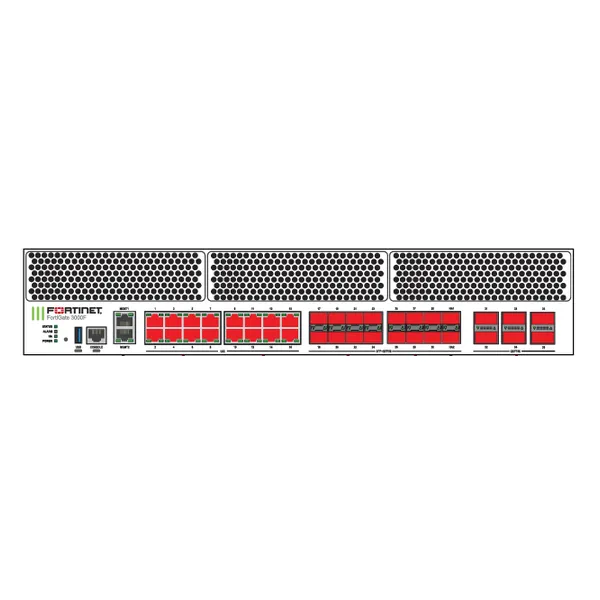
FortiGate 3001F (FG-3001F) Tanzania
The FortiGate 3001F is a high-capacity Fortinet firewall platform designed for demanding enterprise edge, data-center, campus and service-provider security. The appliance combines Fortinet NP7 and CP9 hardware acceleration with six 100GE QSFP28 slots, sixteen 10GE SFP+/25GE SFP28 slots, eighteen 10G Base-T interfaces, two onboard 960GB SSDs and dual AC power supplies. For organizations in Tanzania evaluating a firewall for substantial inspected traffic, branch aggregation, high-speed segmentation, VPN concentration or resilient internet-edge security, the important question is how the platform fits the complete architecture rather than whether one headline throughput number looks large.
FG-3001F Verified Hardware Overview
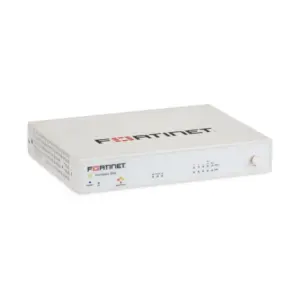
Fortinet positions the 3000F series as a high-performance next-generation firewall family. The FG-3001F is the storage-equipped member of the family: Fortinet ordering information identifies six 100GE QSFP28 slots, sixteen 10GE SFP+/25GE SFP28 slots including dedicated HA connectivity, eighteen 10G Base-T interfaces including management ports, NP7 and CP9 hardware acceleration, two 960GB SSDs and two AC power supplies. A DC-powered FG-3001F-DC variant also exists, so procurement teams should specify the exact power model rather than treating every 3001F quotation as identical.
100GE, 25GE, 10GE fiber and 10G Base-T connectivity supports modern core, WAN, server and data-center designs.
Fortinet NP7 and CP9 processors accelerate networking and security functions within the FortiGate architecture.
The FG-3001F includes two 960GB SSDs, distinguishing it from the base FG-3000F model.
The series uses a 2RU rack-mount design with redundant hot-swappable power supplies for enterprise environments.
Published physical information lists the FG-3001F at approximately 17.3 kg, with average and maximum power consumption around 420 W and 690 W respectively. Operating temperature is specified from 0°C to 40°C, with front-to-back forced airflow. These details matter during rack planning because a high-capacity firewall depends on adequate cooling, protected power, suitable rack depth and carefully planned cable paths. Buyers should validate the latest Fortinet datasheet and selected accessory list at order time, especially for rails, power cords, transceivers and subscription bundles.
What the FortiGate 3001F Solves
Large networks rarely have a single security requirement. A headquarters or data center may need to protect internet access, publish business services, connect dozens of branches, inspect encrypted traffic, segment users and servers, terminate VPNs and provide predictable routing across several carriers. The FG-3001F can form the policy and enforcement point for these workloads within a FortiOS environment. It is particularly relevant where smaller branch appliances no longer provide the interface density, storage, session capacity or security-performance headroom required by the architecture.
Correct sizing still matters. Security services such as intrusion prevention, application control, malware inspection and SSL inspection can change effective throughput. East-west segmentation can add traffic that never appears in ISP bandwidth figures. VPN traffic can be substantial for regional hubs. High availability can change switch-port and cabling requirements. For this reason, FourTeck recommends documenting peak traffic, encrypted traffic, WAN circuits, VLANs, public services, VPN topology, security profiles, logging retention and expected growth before approving a bill of materials.
Security, SD-WAN, VPN and Segmentation Planning
FortiGate platforms combine routing and security functions through FortiOS. In an FG-3001F deployment, this can allow network teams to coordinate firewall policy, secure SD-WAN, IPsec VPN, segmentation, application visibility and security inspection within one operating framework. The architectural benefit is not simply feature consolidation; it is the ability to apply security decisions to the same traffic paths that carry branch, cloud and internet connectivity.
Secure SD-WAN planning should begin with business applications. A financial transaction system, ERP session, voice call, video conference, backup transfer and guest web session do not necessarily need the same path-selection behavior. Define link-health measurements, acceptable latency and loss, preferred circuits and failure behavior before creating policies. For site-to-site VPN, document addressing, routing, encryption, authentication, failover and permitted application flows. An encrypted tunnel should not automatically become an unrestricted bridge between networks.
Segmentation is equally important. Large environments often contain user networks, server zones, management systems, guest access, cameras, building systems, development platforms and externally published services. The firewall policy should express the business trust boundaries between them. When the FG-3001F is used for internal segmentation as well as perimeter security, east-west traffic must be included in capacity planning. Central logging, configuration backup, administrator authentication and change control should be defined before production cutover.
FortiGate 3001F Tanzania
Organizations searching for FortiGate 3001F Tanzania are typically planning security for a substantial headquarters, data center, national branch hub, financial network, telecom environment, university campus, healthcare group, government institution or other high-capacity infrastructure. The FG-3001F is not a small-office gateway. Its high-speed interface mix and integrated storage make it relevant when the firewall must connect to fast core switching, multiple WAN services, server networks and security zones while maintaining a large operational margin.
A Tanzania project should begin with traffic evidence. Record present internet bandwidth and planned upgrades, but also estimate inter-zone traffic, branch VPN traffic, public-service flows and encrypted application demand. If the firewall will inspect traffic between data-center segments, the internal load may be larger than the external internet circuit. Define which FortiGuard services are required and which flows will receive SSL inspection. The result should be a protected-throughput requirement rather than a simple statement such as “we have a 10 Gbps internet line.”
Physical infrastructure deserves the same attention. The 2RU appliance requires appropriate rack space, front-to-back airflow and protected power. The network design may require QSFP28, SFP28 or SFP+ optics and compatible fiber. Dual power supplies improve appliance resilience, but the benefit is reduced if both feeds depend on the same unprotected power path. High availability similarly requires surrounding switch, carrier and power architecture to avoid hidden single points of failure.
FourTeck Tanzania’s integrated IT and security solutions provide context for planning the firewall with switching, servers, racks and connectivity. Buyers can also review the Tanzania technology shop for related FortiGate models. A useful quotation request should state the exact FG-3001F model, quantity, service term, expected security bundle, HA requirement, optics, management and logging needs, installation scope and destination.
FortiGate 3001F Dar es Salaam
Dar es Salaam enterprises can encounter dense combinations of internet traffic, cloud applications, branch connectivity, public-facing services and data-center workloads. For a large organization, the firewall may sit between carrier circuits and a high-speed core while also enforcing policies between server, user and DMZ networks. The FG-3001F’s 100GE, 25GE and 10GE connectivity gives architects flexibility to design these boundaries without forcing every link through the same interface speed.
A headquarters or colocation deployment should map all critical paths before port allocation. Identify ISP handoffs, core-switch uplinks, server aggregation, DMZ connections, management networks, HA links and out-of-band access. Determine whether optics are single-mode or multimode, what connector standards are used and whether existing switches support the required speeds. This prevents a common procurement problem where the firewall arrives before compatible optics, patching or switch capacity has been confirmed.
Dar es Salaam organizations with multiple carriers can also plan secure SD-WAN around business priorities. Instead of treating a second circuit only as idle backup, policies can be designed around measured path quality and application needs. However, resilience must be tested. DNS, public IP addressing, inbound services, VPN tunnels and SaaS sessions may behave differently during carrier failover. An acceptance plan should test each critical application rather than merely disconnecting a cable and confirming that web browsing continues.
For procurement, separate appliance cost, FortiGuard subscriptions, FortiCare support, optics, HA quantity, implementation and any management or analytics components. If replacing an existing firewall, provide an anonymized inventory of interfaces, routes, NAT rules, policies, VPNs and authentication dependencies. This gives the implementation team a realistic migration scope and helps avoid carrying obsolete rules into the new platform.
FortiGate 3001F Mwanza
For Mwanza organizations, an FG-3001F project may be driven by regional aggregation, data-center growth, secure access to centralized applications or the need to connect many branches through a high-capacity security hub. The first question is whether the workload genuinely needs this platform class. Measure peak traffic, session growth, VPN demand and internal segmentation flows. A large appliance should be selected because the architecture requires its capacity and interfaces, not because the model number appears future-proof.
Regional hubs often carry several traffic types simultaneously. Branch users may access ERP systems through IPsec VPN while local staff use cloud services and server networks exchange data across security zones. Backup windows can create sudden bandwidth spikes. Security inspection can add processing demand. Capacity planning should therefore consider time-of-day behavior and growth rather than a single average bandwidth measurement.
Operational ownership is important for a high-end firewall. Decide who can approve policy changes, how administrators authenticate, where configuration backups are stored and how firmware changes are tested. The FG-3001F’s onboard storage can support local operational requirements, but organizations with compliance or long-term analytics needs should still define a deliberate logging architecture. Centralized management and analytics may be appropriate when several FortiGate appliances are deployed across a group.
Mwanza procurement should also confirm rack readiness, cooling, power protection and fiber connectivity. High availability may require two appliances plus appropriate adjacent switching and independent power paths. A quotation request should state whether the project includes installation, migration, VPN recreation, SD-WAN policy design, security-profile tuning, testing and administrator handover. Clear scope allows technical and commercial teams to compare equivalent solutions.
FortiGate 3001F Arusha
Arusha organizations with large hospitality groups, institutional campuses, regional offices or centralized service environments may evaluate the FG-3001F when network security must support high-capacity core connectivity and multiple trust zones. Hospitality and campus networks illustrate why segmentation matters: guest access, staff systems, finance applications, servers, cameras and management interfaces should not automatically share the same security boundary.
When segmentation traffic crosses the firewall, architects should include those internal flows in sizing. A fast internet connection may represent only part of the load. Server-to-user traffic, backup services, application publishing and security inspection between VLANs can materially increase throughput. The FG-3001F’s high-speed ports can support integration with modern switching, but the VLAN, routing and policy architecture should be designed before cabling decisions are finalized.
Resilient WAN design is another consideration. Tourism, reservation, payment and cloud applications can be sensitive to internet interruption. Secure SD-WAN can help use multiple links according to configured health and policy, but business stakeholders should identify which applications receive priority when bandwidth is constrained. Failover testing should cover payment, booking, voice, VPN and cloud systems rather than assuming every session behaves identically when the public path changes.
For an Arusha quotation, include current and planned bandwidth, user and device estimates, server zones, guest networks, branch links, security services, required optics and HA objectives. If the environment uses high-speed core switching, share interface specifications so transceiver compatibility can be checked. FourTeck can then frame the request around the complete solution rather than a bare appliance.
FortiGate 3001F Dodoma
Dodoma institutions and enterprises may require a high-capacity firewall where multiple departments, public services, branch links and sensitive systems converge. In these environments, policy clarity is as important as performance. Start by identifying trust zones and the applications that must cross them. Administrative networks, user groups, servers, guests and externally accessible services should have documented purposes and access requirements.
The FG-3001F can provide substantial interface flexibility for core, WAN and server connections, but architects should avoid allocating ports without a topology plan. Document link speeds, VLAN trunks, routing relationships, HA interfaces and management access. If the appliance will connect to several upstream or downstream switches, identify how failure of each component affects service. Redundant firewall power supplies do not eliminate dependence on a single switch, carrier or UPS.
Government, education and regulated environments may also need stronger logging and change governance. Define retention requirements, administrator roles, authentication, backup schedules and approval processes before go-live. Onboard SSD storage is a useful distinction of the FG-3001F, but logging architecture should still reflect the organization’s audit and analytics requirements. Where multiple security devices exist, centralized operations may improve consistency.
Dodoma procurement teams should ask for a bill of materials that identifies hardware, FortiGuard services, FortiCare term, optics, rails or accessories, HA quantity and implementation services. Migration from an existing firewall should include discovery of routing, NAT, VPN, authentication and published services. A planned change window, rollback method and acceptance checklist make the transition more controlled.
FortiGate 3001F UAE
UAE enterprises considering the FortiGate 3001F often operate high-bandwidth headquarters, data centers, cloud-connected campuses or regional hubs. In these environments, 100GE and 25GE connectivity can be valuable where the firewall interfaces directly with high-speed core or aggregation infrastructure. The storage-equipped 3001F model is also relevant where local logging capability is part of the design.
Regional organizations with operations in the Gulf and Africa can benefit from consistent FortiOS design standards while sizing each location independently. Naming conventions, VPN templates, administrator controls, logging and change procedures can be standardized without forcing every site onto the same hardware. A large UAE hub may use FG-3001F while smaller branches use appropriately sized FortiGate appliances.
Commercial evaluation should compare the complete scope: exact hardware variant, FortiGuard bundle, FortiCare term, optics, HA requirements, management, analytics and implementation. For broader regional engagement, FourTeck UAE provides a UAE technology path, while FourTeck Fortinet UAE resources focus on Fortinet requirements. Multi-country projects should document destination, licensing ownership, renewal dates and configuration standards before procurement.
High availability at a regional hub should include the complete path from carrier to core, not only a second firewall. Independent power feeds, switch redundancy, routing behavior and failure testing all influence resilience. The result should be an architecture that remains understandable during an incident and maintainable after the original implementation team has handed over the system.
FortiGate 3001F Uganda
Ugandan organizations can evaluate the FG-3001F for large enterprise hubs, data centers and environments where many branch, internet and internal security flows converge. A regional group may use the platform to terminate site-to-site VPNs, enforce segmentation and provide secure internet access while maintaining consistent policies across multiple locations.
Before selecting the model, estimate protected throughput rather than relying only on ISP speed. Include traffic between internal zones, encrypted branch connections, public applications and security inspection. If the firewall is intended as a national VPN hub, document tunnel count, expected aggregate bandwidth, routing and failover behavior. If it is a data-center segmentation firewall, include east-west traffic that may never reach the public internet.
For multi-site organizations operating between Uganda and Tanzania, consistent object naming, administrative controls and change procedures can simplify support. Each site can still have its own WAN behavior and appliance size. FourTeck Uganda provides a regional route for Uganda-focused requirements, while the Tanzania project can maintain shared architecture standards.
Procurement should identify the exact appliance, subscription term, optics, power model, HA design and services. If the device will be remotely administered, secure management access and configuration backup are essential. A structured handover should include network diagrams, interface mapping, policy documentation, VPN information and renewal ownership so the platform remains manageable throughout its lifecycle.
FortiGate 3001F Kampala
Kampala headquarters and data-center environments can concentrate cloud traffic, branch VPNs, user internet access, servers and public services at one location. The FG-3001F can be considered when these combined workloads require high-speed connectivity and substantial security capacity. A topology map should identify internet egress, core uplinks, DMZ services, server segments and branch tunnels before interfaces and policies are assigned.
Multiple carriers can be incorporated into secure SD-WAN policies, but useful steering requires application priorities and meaningful health checks. Voice, collaboration and transactional applications may need tighter performance thresholds than bulk downloads. For VPNs, document routes and failover consistently so branch connectivity remains predictable when a WAN path changes.
Kampala projects should also plan physical resilience. The 2RU appliance requires rack space and controlled airflow. High-speed optical interfaces need compatible transceivers and fiber. Dual power supplies should connect to an appropriate resilient power design where available. If HA is required, adjacent switching and carrier architecture should be reviewed so the pair does not depend on another single point of failure.
A complete quotation should cover appliance quantity, security subscriptions, support term, optics, HA, centralized management or analytics where required and professional services. Migration planning should include backups, rollback and an acceptance test for routing, NAT, VPN, public services, critical SaaS and logging. This reduces uncertainty during cutover.
FortiGate 3001F Arua
An Arua requirement for FG-3001F should be justified by workload and architecture because this is a high-capacity platform. A regional aggregation point, data-center environment or unusually demanding enterprise site may require its interfaces and security headroom, while a conventional branch may be better served by a smaller FortiGate. Document peak traffic, branch relationships, internal segmentation and future growth before selecting the class.
Where remote connectivity is critical, the design should emphasize predictable VPN recovery and monitored WAN health. If multiple circuits are available, SD-WAN policies can prioritize business systems and provide controlled failover. Security inspection should be matched to the risk profile and available capacity rather than applied identically without considering application behavior.
Remote administration needs particular care. Define which management networks can reach the appliance, how administrators authenticate and where configuration backups are stored. Logging should support troubleshooting without requiring physical access to the site. If the platform is part of a larger Fortinet estate, centralized management can be evaluated to reduce inconsistent configurations.
For an Arua quotation, provide WAN types, expected bandwidth, branch destinations, VPN requirements, internal zones, required security services and support term. Include installation and migration scope if applicable. This information allows the supplier to validate whether FG-3001F is proportionate to the requirement rather than simply quoting the requested model without technical context.
FortiGate 3001F Mbarara
Mbarara enterprises planning a major firewall refresh can evaluate the FG-3001F when network growth has created high-speed core links, multiple WAN services, large VPN workloads or extensive internal segmentation. New SaaS applications, additional branches and more encrypted traffic can increase inspection demand even when employee count changes modestly. Capacity planning should therefore use traffic and application evidence.
The platform’s mix of 100GE, 25GE and 10GE interfaces can support varied integration points, but transceiver and cabling requirements must be checked before purchase. Network teams should define zones and VLANs before physical installation so ports are allocated deliberately. If the firewall will inspect east-west traffic, those flows should be included in sizing.
For multi-site operations, VPN and SD-WAN policies can follow a consistent template with documented exceptions for different circuits or applications. Renewal planning should also begin at procurement. Record the selected FortiGuard and FortiCare terms, device ownership and renewal responsibility so security services do not become an unexpected operational gap.
A Mbarara quote should separate appliance, subscriptions, support, optics and services. Where resilience is required, include HA and adjacent network changes. Installation planning should cover rack position, power, management access, backups and software policy. Acceptance testing should verify routing, NAT, VPN, security controls and logging before the old platform is retired.
FortiGate 3001F Gulu
In Gulu, an FG-3001F project may serve a large institutional hub, data-center function or organization consolidating connectivity for many remote locations. Because the appliance is capable of substantial workloads, the requirement should identify its intended role: internet edge, segmentation firewall, VPN concentrator, SD-WAN hub or a combination. Each role changes which interfaces and performance characteristics matter most.
Operational simplicity remains important even on a sophisticated platform. Rules, objects, services and security profiles should use naming conventions that future administrators can understand. Temporary policies should have owners and review dates. Logging should support investigation and troubleshooting without becoming unmanaged data. Configuration backups should be taken before major updates and changes.
If Gulu is connected to other regional sites, branch VPN design should document routing, encryption and failover. SD-WAN can steer traffic across multiple links when available, but application priorities must be agreed with business owners. Public services need separate continuity planning because inbound DNS and public addressing can behave differently from outbound traffic during a carrier failure.
A quotation request should state WAN connections, branch count, interface types, required subscriptions, VPN topology, availability objectives and existing migration dependencies. If HA is planned, both firewall and network dependencies belong in the architecture. Requirement-led procurement helps avoid paying for unnecessary components while ensuring essential resilience and security functions are included.
FortiGate 3001F Kenya
Kenyan enterprises with regional headquarters, campuses and data centers can consider the FG-3001F for high-capacity secure internet edge, segmentation and WAN aggregation. Organizations operating between Kenya and Tanzania may benefit from standardized policy concepts, VPN templates, administrator controls and logging while sizing each site according to its own traffic.
A regional hub may require 100GE or 25GE connectivity to core switching, while smaller branches do not. This is why hardware standardization should not be confused with architecture standardization. Use consistent naming, governance and security principles, then select the appliance that fits each workload. The FG-3001F can occupy the larger hub role within such a design.
As encrypted traffic dominates modern networks, SSL inspection strategy, certificate deployment and application compatibility deserve early discussion. Security teams should identify which traffic requires inspection and which exceptions are justified. Network teams should simultaneously map routing, WAN and high-availability requirements. Coordinating these decisions prevents security policy from becoming an afterthought to physical connectivity.
For Kenya-focused coordination, FourTeck Kenya provides a regional technology path. Procurement should compare complete scope including hardware, FortiGuard, FortiCare, optics, HA and implementation. Multi-country projects should maintain a common device register and renewal calendar so licensing and support remain visible across the estate.
FortiGate 3001F Kuwait
Kuwait organizations evaluating the FG-3001F may be planning a data-center edge, high-bandwidth headquarters, campus security project or regional VPN hub. High internet and core-network speeds make it important to size for inspection and internal traffic rather than raw routing alone. Measured utilization, encrypted traffic, session behavior and expected growth should be combined into a realistic requirement.
High-speed optical interfaces can integrate with modern switching, but buyers should confirm transceiver compatibility, fiber type, connector requirements and link speeds. For HA deployments, surrounding switching and power should provide independent paths where practical. Security teams should define zones, inspection profiles and logging while network teams finalize physical topology.
Commercially, FortiGuard services and support term materially affect the complete solution. Hardware-only pricing should not be compared directly with a proposal that includes subscriptions and implementation. Migration services can include configuration assessment, VPN recreation, SD-WAN policy design, security tuning, testing and handover; these should be explicitly documented.
For Kuwait requirements, FourTeck Kuwait provides a regional engagement route. Organizations coordinating Kuwait, UAE and African sites can use common design standards while allowing local carrier and application requirements to drive each configuration.
FortiGate 3001F Ghana
Ghanaian organizations may consider the FG-3001F when consolidating perimeter security, data-center segmentation, branch VPN and high-speed WAN controls at a substantial enterprise site. Before selection, teams should establish which traffic will receive IPS, application control, web security and encrypted-content inspection because protected workload is more representative than simple packet forwarding.
For distributed operations, the firewall can be evaluated as a hub for IPsec VPN and secure SD-WAN. Application steering can reflect link quality and business priority, while segmentation separates corporate, guest, server and management networks. The architecture should include DNS, authentication, routing and logging dependencies so migration does not overlook services outside the firewall configuration.
A Ghana quotation request should identify bandwidth, branch count, VPN needs, interface types, HA objectives and subscription term. If replacing another platform, include approximate policy, NAT and VPN scope so migration effort can be estimated. Compare complete solution scope rather than hardware price alone.
Organizations can use FourTeck Ghana for Ghana-focused project discussions. A requirement-led bill of materials gives procurement teams a clearer basis for evaluation and helps technical teams identify optics, subscriptions, power and deployment services before purchase approval.
FortiGate 3001F Nigeria
Nigerian enterprises with large headquarters, campuses, data centers and distributed branches can evaluate the FG-3001F where internet, inter-zone and VPN traffic create demanding security workloads. The combination of high-speed interfaces, hardware acceleration and integrated storage makes the model relevant to substantial deployments, but a sizing exercise should identify exactly which traffic will traverse the appliance.
Multi-WAN environments should define behavior during congestion and outage. Secure SD-WAN can steer applications across available paths, but useful policies depend on meaningful health checks and application priorities. Transaction systems, voice and collaboration may need stricter thresholds than general web access. For branch VPNs, tunnel design should include routing and failover rather than treating encryption as the entire solution.
Power and connectivity resilience should be considered across the complete path. Firewall availability depends on switches, carrier equipment, UPS systems and upstream services as well as the appliance. If HA is required, validate the surrounding architecture and test failure scenarios. Dual power supplies should be connected according to the site’s resilient power design.
Nigeria-focused enquiries can use FourTeck Nigeria. Quote requests should state model, quantity, destination, bandwidth, VPN needs, security services, term, optics and implementation scope. This distinguishes a straightforward hardware purchase from a larger migration or multi-site security project.
FortiGate 3001F Seychelles
Seychelles organizations may value resilient connectivity, secure remote administration and efficient use of available WAN links. A larger hospitality group, service provider, data-center function or multi-site enterprise can have a mix of staff systems, guest networks, cloud applications, servers and remote support requirements. The FG-3001F can provide a high-capacity policy point when the workload justifies its platform class.
Where multiple internet links are available, SD-WAN can direct traffic according to configured priorities and measured conditions. Guest traffic can be separated from operational systems, while VPN protects approved inter-site connectivity. Administrators should avoid exposing management services directly to untrusted networks and should maintain controlled roles, backups and a documented software process.
Procurement should clarify shipping destination, exact appliance variant, FortiGuard subscription, FortiCare term and optical accessories. If the firewall replaces an existing device, schedule discovery before the migration window so NAT rules, VPNs, public services and application dependencies can be captured. Acceptance testing should verify business applications and failover behavior, not merely internet browsing.
Because remote or island operations can make unplanned component changes more disruptive, the bill of materials should be checked carefully for optics, rails, power cords and spares where appropriate. The objective is a deployment package that can be installed and supported predictably rather than a hardware shipment that leaves critical dependencies unresolved.
Related FortiGate and Tanzania Infrastructure
Buyers comparing the FG-3001F can review smaller verified Tanzania FortiGate pages to understand how appliance classes differ. The FortiGate 100F Tanzania page covers a lower-capacity business firewall class. The FortiGate 200F Tanzania page is relevant for larger branch and enterprise-edge comparisons. The FortiGate 400F Tanzania page provides another enterprise step, while FortiGate 600F Tanzania and FortiGate 601F Tanzania help buyers compare a storage/non-storage pair in a different performance class.
The FourTeck Tanzania solutions overview explains how firewalls connect with switching, servers, Wi-Fi, structured cabling, racks and UPS infrastructure. The FourTeck Tanzania shop provides a broader product route, and the Tanzania contact page is the verified route for a formal requirement and quotation. For wider African projects, FourTeck Africa can support regional coordination.
FG-3001F Deployment and Migration Guidance
A high-end firewall migration should be treated as a controlled infrastructure change. Begin with discovery: interfaces, VLANs, routes, dynamic routing, NAT, policies, VPNs, public services, authentication, certificates, logging and management dependencies. Remove obsolete objects and rules rather than automatically copying years of configuration history. Build a target topology and policy model before the change window.
Physical installation can then be separated from logical migration. Confirm rack position, airflow, power feeds, optics and cable labeling. Establish management access and backups before production traffic is moved. Configure base routing, HA and monitoring, then migrate policies and VPNs in a staged manner where practical. Security profiles such as SSL inspection may require additional testing because applications can react differently to certificate inspection.
Acceptance testing should be business oriented. Verify critical SaaS, DNS, email, ERP, published applications, branch tunnels, remote access, failover, logging and administrative access. Record results and retain a rollback path until the new environment is stable. After cutover, review denied traffic and security events to identify dependencies that were not captured during discovery.
FortiGuard, FortiCare and Lifecycle Planning
The firewall appliance and its security subscriptions are related but separate procurement decisions. FortiGuard services can provide security capabilities and threat intelligence depending on the selected bundle, while FortiCare addresses vendor support options. Buyers should request the exact service SKU, term and included services rather than assuming every FG-3001F quote represents the same protection level.
Renewal ownership should be assigned from day one. Maintain a register containing device serial information, site, subscription term, support details and renewal date. For organizations operating multiple FortiGate appliances, aligned renewal planning can simplify budgeting and reduce accidental service gaps. Software lifecycle and approved upgrade windows should also be part of operational documentation.
Commercial comparison is most useful when proposals are normalized. One supplier may quote hardware only, another may include security services, and another may include migration and support. Separate these components so stakeholders understand the full lifecycle cost and scope rather than choosing from headline price alone.
FG-3001F Quotation Checklist
For a useful quotation, provide the deployment country and city; quantity; exact AC or DC model preference; current and planned internet bandwidth; estimated peak inspected traffic; number of users and devices; number and speed of WAN links; core and server interface requirements; VLANs and security zones; site-to-site VPN topology; remote-access requirement; public services; FortiGuard service expectations; preferred support and subscription term; 100GE, 25GE and 10GE optic requirements; HA requirement; logging and retention needs; centralized management requirements; current firewall model; migration scope; rack and power details; target deployment date; and whether configuration, testing, documentation or ongoing support is required.
Providing these inputs allows the sales and technical teams to determine whether FG-3001F is appropriately sized and to build a more complete bill of materials.
FortiGate 3001F FAQ
What is the difference between FG-3000F and FG-3001F?
The FG-3001F is the storage-equipped model. Fortinet ordering information lists two 960GB SSDs onboard for FG-3001F, while the base FG-3000F does not include that onboard storage. Both belong to the 3000F series, so buyers should confirm the exact SKU.
What interfaces does FG-3001F provide?
Fortinet lists six 100GE QSFP28 slots, sixteen 10GE SFP+/25GE SFP28 slots and eighteen 10G Base-T interfaces, including management and HA-related connectivity as specified in the official datasheet.
Does FortiGate 3001F support high availability?
The FortiGate platform supports high-availability designs, and the 3000F series includes dedicated HA connectivity and redundant power architecture. The complete HA design should also account for switches, WAN circuits, power and routing so the firewall pair is not surrounded by other single points of failure.
Is FG-3001F suitable for a small branch?
It is a high-capacity platform intended for demanding enterprise and data-center class environments. A conventional branch may be better served by a smaller FortiGate. Model selection should be based on inspected traffic, interfaces, sessions, VPN, segmentation and growth rather than choosing the largest appliance available.
What should be included in an FG-3001F quote?
Confirm exact hardware variant, quantity, FortiGuard services, FortiCare term, optics, rack accessories, power requirements, HA scope, management or analytics components and implementation services. Current availability and commercial terms should be confirmed at quotation time.
Decision Recap
FortiGate 3001F is a high-capacity Fortinet next-generation firewall with NP7 and CP9 acceleration, extensive 100GE/25GE/10GE connectivity, integrated SSD storage and redundant power. It is relevant to large enterprises, data centers, campuses, service-provider environments and regional security hubs where perimeter protection, VPN, secure SD-WAN and segmentation must operate at substantial scale.
The purchasing decision should be based on protected workload, interface design, security subscriptions, logging, high availability and operational ownership. Laboratory specifications are useful references, but production sizing should reflect the security services and traffic mix that will actually be used. A complete quote should therefore include the appliance, services, optics, resilience requirements and deployment scope rather than hardware alone.
Consult FourTeck Tanzania
For an FG-3001F discussion, share your current firewall, internet and core link speeds, user and device estimate, branch count, VPN topology, security services, internal segmentation needs, HA requirement, optics, preferred subscription term and deployment location. FourTeck can use this information to structure a clearer technical and commercial requirement for Tanzania or a coordinated multi-region project.

Reviews
There are no reviews yet.