
Grandstream Hotel IP Telephony
Grandstream GHP611W Tanzania
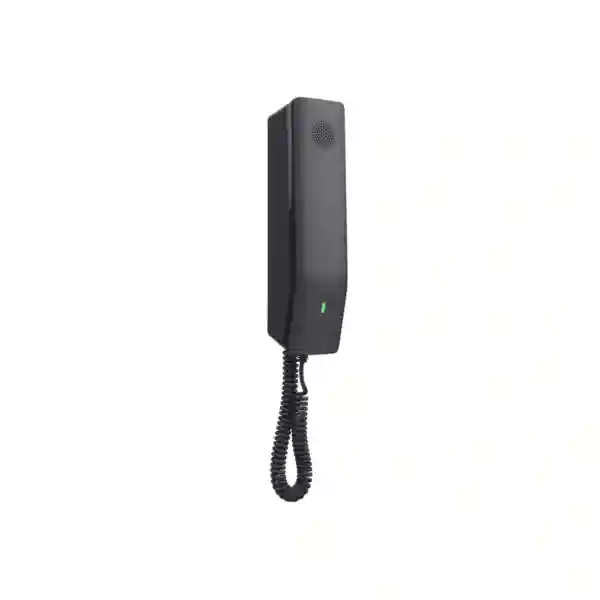
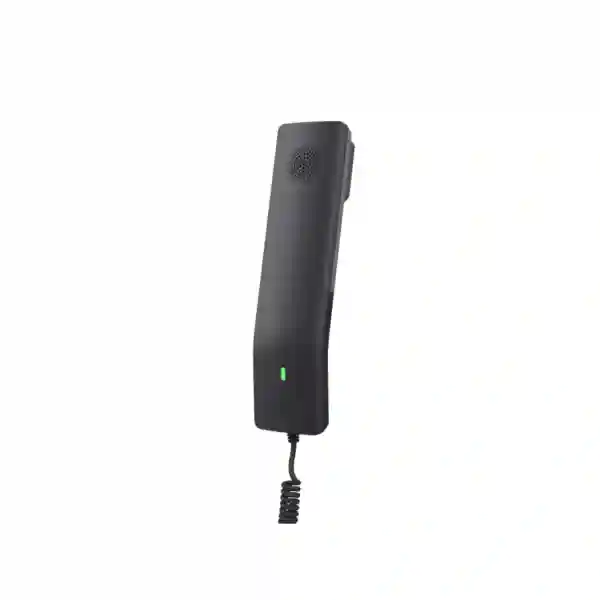
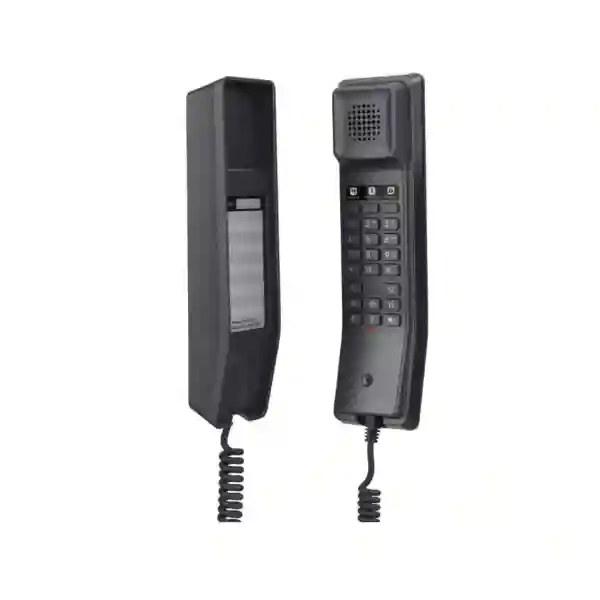
The Grandstream GHP611W is a compact black Wi-Fi hotel IP phone built for guest rooms and other spaces where straightforward calling, programmable access to common services and centralized endpoint management matter more than a large screen or a complex desk-phone interface. It provides two SIP accounts and two lines, ten speed-dial keys, three programmable keys, three-way voice conferencing, an HD speaker on the handset, full-band Opus support, Hearing Aid Compatibility and Grandstream Device Management System integration. The GHP611W is especially useful for hospitality, serviced residences, hospitals, dormitories and similar projects where many identical endpoints must be deployed, configured and maintained consistently.
Quick fit: Guest-room and hospitality SIP phone
Connectivity: Integrated dual-band Wi-Fi; capabilities vary by hardware revision
Management: Grandstream GDMS
Form factor: Compact black handset-led design, desk or wall installation
What the Grandstream GHP611W is designed to solve
Hotels and hospitality properties often do not need a full-featured executive desk phone in every room. They need a guest-facing endpoint that makes the important actions obvious: call reception, contact housekeeping, reach emergency or service numbers, make an internal extension call and connect through the property’s SIP-based telephone system. The GHP611W addresses that requirement with a compact interface, programmable keys and a speed-dial label that can be customized to match a property’s service workflow. The absence of an elaborate display can make the device easier for transient users who should not have to learn a complicated menu system.
The GHP611W is part of Grandstream’s GHP hotel-phone family. Grandstream documents two SIP accounts and two lines, ten speed-dial keys, three programmable keys, three-way audio conferencing, an HD speaker, full-band Opus support, advanced jitter resilience, centralized GDMS management, enterprise security functions and Hearing Aid Compatibility. The W variant adds integrated dual-band Wi-Fi. Grandstream’s newer documentation also notes hardware-version-dependent changes, including Wi-Fi 6 support and PoE availability on hardware version 5.0 and above. Because projects may receive different hardware revisions, procurement teams should confirm the exact revision and included power accessories before finalizing installation design.
For buyers in Tanzania, the GHP611W is most relevant where a compact Wi-Fi SIP endpoint can simplify room deployment. Wi-Fi can be valuable where installing a dedicated data cable at every bedside or guest-room telephone location is difficult, but wireless voice still depends on well-designed coverage, roaming behavior, network segmentation and consistent signal quality. A hotel should therefore evaluate the handset together with its PBX, wireless network and operational call flows rather than treating the phone as an isolated purchase.
2 SIP accounts / 2 lines
Supports two SIP registrations and two lines, giving integrators flexibility for room calling and alternate account requirements.
10 speed-dial keys
Common hotel services can be presented as direct actions, helping guests reach reception, housekeeping or other configured extensions quickly.
GDMS management
Grandstream Device Management System supports centralized configuration, provisioning, monitoring and firmware workflows for larger endpoint estates.
Wireless deployment
The GHP611W integrates dual-band Wi-Fi, enabling SIP deployment without requiring a wired data connection at every handset position.
Verified GHP611W feature summary
| Area | Verified capability | Deployment relevance |
|---|---|---|
| Voice accounts | 2 SIP accounts, 2 lines | Suitable for centrally managed SIP-based room telephony. |
| Programmable interface | 10 speed-dial keys and 3 programmable keys | Useful for reception, housekeeping, concierge, emergency or property-specific service shortcuts. |
| Audio | HD speaker, full-band Opus, 3-way audio conferencing | Supports clear voice use when the network is engineered properly. |
| Wireless | Integrated dual-band Wi-Fi; Wi-Fi 6 on hardware version 5.0 and above | Enables flexible room placement while requiring adequate RF coverage and voice-ready WLAN design. |
| Management | GDMS centralized device management and provisioning | Reduces repetitive handset-by-hand configuration in multi-room deployments. |
| Accessibility | Hearing Aid Compatibility (HAC) | Supports more inclusive guest-room communication. |
| Security | Secure boot and additional enterprise-level protections documented by Grandstream | Important for managed endpoint estates connected to business networks. |
Compatibility and deployment planning
A GHP611W deployment begins with the SIP environment. Confirm that the PBX or hosted voice platform supports standard SIP registration and the call features required by the property. Define room-extension numbering, reception groups, emergency-call handling, voicemail policy, after-hours routing and any speed-dial services before phones are provisioned. This is particularly important for hotels because the guest experience depends on service buttons doing exactly what their labels promise.
Wireless planning deserves equal attention. A phone used in a guest room may remain stationary, but voice is still sensitive to signal quality, interference and congestion. The WLAN should provide reliable coverage at the actual handset position, not merely in the corridor. Separate guest internet traffic from managed voice endpoints where appropriate, apply suitable security and network policies, and ensure DHCP, DNS, time services and SIP reachability are dependable. For large properties, centralized configuration and consistent wireless profiles can reduce support effort.
FourTeck Tanzania’s broader business technology solutions overview explains how IP telephony, Wi-Fi, switching and security need to work as one architecture. Buyers can also review the FourTeck Tanzania technology shop for related infrastructure and the technology services page when planning installation, configuration or broader integration.
Grandstream GHP611W Tanzania
For hospitality projects in Tanzania, the Grandstream GHP611W fits properties that want a compact SIP room phone without forcing every guest room to have a dedicated Ethernet drop at the handset position. Its integrated dual-band Wi-Fi can support a cleaner retrofit path in hotels, serviced apartments, lodges and residences where data cabling is already committed to televisions, access points, room controls or other devices. The practical advantage is installation flexibility, but that advantage only becomes real when the property has a voice-ready wireless design. Before buying room quantities, administrators should verify signal strength inside representative rooms, especially behind reinforced walls, in corners, near wardrobes or in layouts where the nearest access point is in a corridor.
The phone’s ten speed-dial keys and three programmable keys suit hospitality workflows because guests often need one-touch access to a small set of services rather than the feature depth expected from an office executive phone. A Tanzania hotel can map buttons to reception, housekeeping, reservations, concierge, security or other internal destinations according to its own call flow. The exact design should be documented centrally so the same service button behaves consistently across every room. Where multilingual guest information is needed, the swappable faceplate and speed-dial label can be planned as part of the room-standardization exercise.
Central management is another important consideration for Tanzanian properties with dozens or hundreds of rooms. Grandstream GDMS can reduce the operational burden of provisioning endpoints one by one, especially when a property must apply common SIP credentials, firmware policies or configuration templates. That does not remove the need for sound network design: voice VLAN policy, firewall rules, SIP reachability, DNS, NTP and wireless security still need to be configured correctly. If the PBX is on-site, its resilience and backup power should be considered. If it is hosted, internet reliability and failover strategy matter.
Procurement teams in Tanzania should request the exact GHP611W hardware revision, quantity, included power accessories and intended PBX environment in the quotation. Grandstream’s newer documentation notes Wi-Fi 6 and PoE on hardware version 5.0 and above, while earlier GHP611W revisions are documented differently. Confirming the revision prevents installation assumptions from being made from an older datasheet. FourTeck can also help align the phone with business Wi-Fi access-point planning where a hospitality property is upgrading wireless infrastructure at the same time.
Grandstream GHP611W Dar es Salaam
In Dar es Salaam, the GHP611W is relevant to hotels, serviced residences, hospitals, student accommodation and managed apartment projects that want a simple guest-facing SIP endpoint. Properties in dense urban areas often already carry heavy wireless demand from guest phones, laptops, TVs, streaming devices, point-of-sale terminals and staff systems. Adding room telephony over Wi-Fi should therefore be treated as a managed application rather than a casual extension of the guest network. A site survey should verify coverage in actual rooms, and the voice endpoints should be configured with appropriate network separation and access controls.
The GHP611W’s compact format can be helpful where bedside tables, wall areas and reception points have limited space. Because service access is based on programmable and speed-dial keys, hotel management can design a clear room-phone experience around the services that guests use most. This is particularly useful for properties that want a consistent standard across older rooms and newer renovations. Instead of requiring guests to navigate a menu, the phone can present direct calling options defined by the property’s PBX and operating procedures.
Dar es Salaam procurement teams should include the supporting system in the buying decision. The room phone needs a SIP platform, reliable IP connectivity, suitable wireless access points, power and a configuration method. If many handsets are being deployed, centralized GDMS provisioning can simplify rollout and future changes. For larger hotels, it can be sensible to test a small sample first: verify audio quality, button mapping, Wi-Fi roaming behavior, call transfer, emergency routing and how the endpoint recovers after power or network interruption. That pilot can reveal configuration issues before they are repeated across many rooms.
Where the hotel is also refreshing its wireless environment, FourTeck Tanzania provides context on high-capacity indoor wireless options and broader network and deployment services. These links are not a statement that a particular access point is mandatory for the GHP611W; they are useful references for the infrastructure layer that determines whether any Wi-Fi room phone performs consistently. A quotation request should therefore identify room count, expected phone quantity, PBX platform, wireless environment and whether existing access points will remain in place.
Grandstream GHP611W Mwanza
For Mwanza hospitality and accommodation projects, the Grandstream GHP611W provides a practical option where room telephony needs to be standardized without introducing a complex user interface. Hotels, healthcare facilities, residences and institutional accommodation can use the phone as a managed SIP endpoint with direct service buttons and a familiar corded handset. Its Wi-Fi capability can be especially useful in refurbishment projects where running new Ethernet cables into finished guest rooms would be disruptive, but the wireless network must still be engineered for predictable voice quality.
A Mwanza deployment should begin by mapping how calls are expected to flow. Decide whether each room has a unique extension, how guests reach reception, which internal services should appear on speed-dial keys, whether calls can be made outside the property and what happens when reception is busy or closed. These decisions belong in the PBX configuration and phone template, not in ad-hoc per-room setup. With many endpoints, GDMS can help maintain a common baseline and reduce drift between rooms after firmware or configuration changes.
Wireless coverage should be verified through actual room testing because building materials, floor layout and access-point placement can produce very different results even within the same property. A phone that sits beside a bed or on a wall can be in a weaker RF position than a guest’s mobile phone used near the center of the room. The network team should also keep voice traffic separate from high-volume guest traffic where appropriate and ensure the relevant firewall, DHCP, DNS and SIP paths are stable. If the property uses backup internet or multiple WAN links, failover behavior should be tested for the voice system rather than assumed.
Mwanza buyers should ask for the precise GHP611W hardware revision because power and Wi-Fi capabilities have changed across documented revisions. Include required quantities, PBX details, room layout and management expectations when seeking a quotation. FourTeck Tanzania’s business technology shop provides related networking and telephony context, while the FourTeck Tanzania approach explains why endpoint, network and service design should be considered together.
Grandstream GHP611W Arusha
Arusha has a broad hospitality profile that includes business hotels, lodges, tourism-oriented accommodation, serviced apartments and institutional facilities. In these environments, the GHP611W can be used as a compact in-room SIP phone when the goal is to give guests direct access to property services without cluttering the room with a large office-style device. The black handset-led design, speed-dial label and wall-or-desk installation options support rooms where space and visual simplicity matter.
For hotels serving international guests, usability should be designed before mass deployment. Button labels should correspond to actual operating procedures, and reception or housekeeping destinations should remain consistent even if back-end extension numbers change. A property can use PBX routing to preserve a simple guest-facing experience while administrators maintain more complex departmental call logic in the background. Three-way conferencing and two SIP accounts add flexibility, but most guest-room deployments will benefit more from reliability, clear audio and predictable service buttons than from exposing every available telephony feature.
Arusha properties should test wireless voice under realistic conditions. Guest Wi-Fi may be strongest in common areas but weaker behind room walls, and lodges can have dispersed layouts where access points serve separate buildings. The GHP611W’s Wi-Fi design means each phone depends on reliable radio coverage and IP connectivity. Where the site spans several blocks, buildings or accommodation wings, administrators should plan SSIDs, VLANs, DHCP scopes and PBX reachability so endpoints can be managed consistently. If an internet-hosted PBX is used, backup connectivity and power resilience become part of the telephony design.
A procurement request for Arusha should state whether the phones are for a new property, renovation or replacement, how many rooms are included and whether existing Wi-Fi is expected to carry voice. FourTeck can help review the wider environment through its Tanzania technology solution portfolio. Where outdoor or distributed wireless coverage is part of the same project, the outdoor Wi-Fi infrastructure reference shows the kind of network layer that may be evaluated separately from the phone itself.
Grandstream GHP611W Dodoma
In Dodoma, the GHP611W can support hotels, guest houses, institutional residences, hospitals and administrative accommodation where a straightforward room phone is more useful than a feature-heavy desktop handset. Its SIP-based design allows it to operate as part of a modern IP PBX environment, while integrated Wi-Fi gives installers flexibility when Ethernet cabling is not available at the preferred phone position. That can reduce disruption in existing buildings, although the wireless network still needs to provide stable coverage at every room endpoint.
For government-facing, institutional or business accommodation, centralized configuration can be valuable because rooms and departments often need a repeatable standard. Administrators can prepare a template with SIP settings, service keys, dialing rules and security parameters, then apply it consistently through Grandstream’s management tooling. This approach reduces manual configuration mistakes and makes later changes easier. If reception extensions, housekeeping groups or emergency numbers change, a centralized update process is preferable to visiting each room individually.
The local network should be treated as part of the voice system. Voice endpoints need dependable addressing, DNS, time synchronization and access to the PBX. Firewalls should allow only the required communication, and wireless policies should protect managed devices from unnecessary guest-network exposure. Where the property uses one SSID for many operational devices, segmenting phones into a controlled network can make troubleshooting and security management easier. Administrators should also consider UPS-backed network infrastructure so access points, switches, routers and the PBX do not fail immediately during short power interruptions.
Dodoma procurement teams should verify the GHP611W hardware revision and power method before ordering. Grandstream’s documentation reflects changes across revisions, so a quotation should identify the exact supplied hardware rather than rely on assumptions based on older online descriptions. FourTeck Tanzania’s contact and quotation page can be used to share the room count, intended PBX, Wi-Fi environment and required quantities. That information enables a more useful quotation than asking for a handset price alone.
Grandstream GHP611W UAE
For UAE hospitality projects, the GHP611W is suited to hotels, serviced apartments, staff accommodation, clinics and managed residences that want a compact room phone with integrated wireless connectivity. The same product characteristics that make it relevant in Tanzania apply in the UAE: two SIP accounts and lines, direct service keys, centralized GDMS management, HD audio and a simple form factor. UAE projects often involve strict interior-design standards and high room counts, so a compact handset that can be desk or wall mounted can be easier to standardize across different room categories.
In larger UAE properties, deployment planning should focus on scale. Rather than configuring phones individually, project teams can prepare templates for extension credentials, service buttons, dial plans and network settings, then use centralized provisioning and device management. The PBX design should define how calls move between rooms, reception, concierge, housekeeping, security and outside numbers. If the property operates multiple towers or buildings, administrators may also need consistent numbering and location-aware emergency procedures.
Wi-Fi room phones should be validated alongside the wireless environment. Modern hospitality WLANs can carry large numbers of guest and IoT devices, so voice endpoints should not simply share an unconstrained guest network. Coverage, airtime, VLAN design, QoS policy and firewall access can all influence call reliability. Grandstream notes Wi-Fi 6 support on newer hardware revisions, but buyers should still confirm the exact GHP611W revision being supplied. The phone’s capabilities should be matched to the property’s access-point generation and power design.
FourTeck’s regional network can support broader solution planning for UAE-linked projects. Buyers can review FourTeck UAE for regional IT and communication solutions and FourTeck IP phone solutions for telephony context. For projects standardized across Tanzania and the UAE, using a common handset family and documented configuration template can simplify spare strategy, user training and support, while local SIP services and deployment conditions should still be validated in each country.
Grandstream GHP611W Uganda
The Grandstream GHP611W can serve Ugandan hotels, hospitals, residences and institutional accommodation that want a compact SIP room phone with Wi-Fi. The main procurement question is not simply whether the phone supports SIP, but how it will fit the property’s PBX, wireless network, service workflow and support model. A successful deployment begins by defining extensions, reception routing, emergency calls, housekeeping access and whether guests can make external calls. These operational decisions determine the phone template and PBX configuration.
Integrated Wi-Fi can reduce the need for a wired network point at every handset location, which can be useful in renovations and properties where cabling routes are constrained. The trade-off is that wireless performance must be treated as a voice requirement. Coverage should be measured in guest rooms, not inferred from lobby or corridor signal levels. Administrators should consider interference, access-point density and how many devices already share the same radios. For multi-floor hotels, consistent wireless design and central monitoring make troubleshooting much easier.
The GHP611W’s ten speed-dial keys help make the guest experience predictable. Properties can provide one-touch access to commonly requested services while keeping the back-end numbering hidden from users. The three programmable keys and two SIP accounts create additional flexibility where needed. Grandstream GDMS supports centralized provisioning and monitoring, which is useful for large room counts and for organizations that want the same endpoint standard at multiple Ugandan sites.
Before ordering, Ugandan buyers should confirm exact hardware revision, quantity and power requirements. Newer Grandstream documentation references Wi-Fi 6 and PoE on hardware version 5.0 and above, so the installation plan should reflect the units actually quoted. Organizations operating across East Africa can review FourTeck Uganda and FourTeck Tanzania when seeking consistent solution standards across borders while preserving local telecom and infrastructure requirements.
Grandstream GHP611W Kampala
Kampala hotels and serviced residences often combine dense guest Wi-Fi usage with business communications, IPTV, property-management systems and staff devices. In that environment, the GHP611W should be considered as a managed voice endpoint that happens to use Wi-Fi, not as an ordinary guest wireless client. The hotel should validate coverage at the intended bedside or wall location, then make sure the phone can reach the SIP platform through a controlled network path. Dedicated or appropriately segmented voice SSIDs can simplify policy and troubleshooting.
From the guest perspective, the value of the GHP611W lies in simplicity. Ten speed-dial keys can represent hotel services, while the slim handset-led design minimizes desk clutter. Kampala properties can use the swappable faceplate and printed speed-dial label to match their own service language and brand presentation. The best configuration exposes only the functions guests actually need and leaves more complicated call routing in the PBX, where administrators can update rules centrally without changing the room experience.
For deployment teams, central provisioning becomes more important as room count grows. GDMS can help apply common configurations and firmware policies across endpoints. A pilot floor or sample room group is advisable before a full rollout. Test call quality, Wi-Fi stability, reception speed dial, room-to-room restrictions, voicemail behavior, emergency routing and recovery after loss of power. This verifies both the handset template and the surrounding network. If a hosted PBX is used, test voice performance during primary-internet congestion and any configured failover event.
Kampala procurement teams should include accessory and hardware-revision checks in the quotation. Grandstream’s current documentation indicates hardware-dependent wireless and powering capabilities, so the exact revision matters. For multi-country organizations, FourTeck’s Uganda and Tanzania web resources can support a standardized purchasing discussion, while each site’s carrier, wireless and power environment should be assessed separately. A good request for quotation should include the number of rooms, required spare percentage, PBX brand or hosted service, expected speed-dial functions and whether the existing Wi-Fi has already been surveyed for voice.
Grandstream GHP611W Arua
For Arua hotels, healthcare facilities, residences and accommodation projects, the GHP611W offers a way to standardize room telephony using SIP while keeping the physical handset simple. This can be valuable in properties where users change frequently and the phone should work with almost no instruction. Guests can use clearly labeled speed-dial keys for common services, while administrators manage extension details and routing centrally. The result is a guest-facing endpoint that can remain consistent even as internal departments or PBX logic change.
Wireless deployment needs careful consideration in buildings where network infrastructure may vary between wings or floors. The GHP611W can connect over dual-band Wi-Fi, but the best band and access point depend on signal strength, interference and building materials. Installers should test the exact handset position in representative rooms and identify weak zones before ordering large quantities. If the property uses outdoor links or separate accommodation blocks, the end-to-end network path to the PBX should also be tested for latency, packet loss and stability.
Grandstream’s management ecosystem can help Arua projects maintain a common baseline. With GDMS, administrators can provision and monitor endpoints centrally instead of treating every room as a separate configuration task. The hotel should still document extension allocation, button labels, emergency rules and firmware policy so the cloud-management platform reflects an agreed operational design. A configuration template is especially useful when devices must be replaced: a spare handset can be enrolled and brought into the standard more quickly.
Buyers should verify the exact GHP611W revision because Grandstream documentation notes newer hardware changes around Wi-Fi 6 and PoE. Confirm the quoted package, power method and any mounting requirements before installation. Where procurement is coordinated across Uganda and Tanzania, a common product standard can simplify administration, but local connectivity and support arrangements should still be documented. The important outcome is not simply to purchase a Wi-Fi phone; it is to create a room-telephony system that remains understandable, manageable and dependable for staff and guests.
Grandstream GHP611W Mbarara
Mbarara hospitality and institutional projects can use the GHP611W where compact room telephony, wireless network access and centralized SIP management are priorities. A typical use case is a hotel or serviced residence that wants every room to reach reception and key services through the same simple interface. Ten speed-dial buttons let the property build that interface directly into the handset experience, reducing the need for printed dialing instructions or a complicated on-screen menu.
The phone’s Wi-Fi capability can be attractive in renovations, but wireless design should be validated first. If guest rooms were built with thick walls or if access points are placed mainly for corridor coverage, the handset may not receive the same signal quality as a mobile device used near the room entrance. Voice is sensitive to unstable radio conditions, so installers should check signal strength and call quality where the phone will actually sit. They should also separate operational phones from open guest access where network policy requires it.
For a larger Mbarara property, centralized GDMS provisioning can help keep endpoints consistent. Administrators can apply common SIP settings, firmware and configuration policies, then monitor devices without visiting every room. The PBX should be planned with hotel call flows in mind: room-to-room restrictions if required, external calling permissions, operator routing, department groups, voicemail, emergency procedures and after-hours handling. Those decisions should be tested in sample rooms before full deployment.
Procurement should include a clear bill of requirements. State the number of rooms, the required spare quantity, whether the phone will be desk or wall mounted, which PBX is used and whether the wireless network is already suitable for voice. Confirm the exact GHP611W hardware revision and package contents because current Grandstream material distinguishes newer and earlier hardware. If the organization has multiple properties in East Africa, the GHP611W can be standardized across sites, but SSIDs, PBX credentials, carrier services and site-specific emergency rules should remain controlled locally.
Grandstream GHP611W Gulu
In Gulu, the GHP611W can fit hotel rooms, hospitals, staff residences, educational accommodation and similar environments that require basic SIP calling with centralized management. Its design is intentionally compact and guest-friendly: the handset carries the controls, the phone can be used on a desk or wall, and programmable service keys give administrators a direct way to expose the most important destinations. That makes it a practical alternative to installing a full-featured office phone in every room.
Wi-Fi deployment can simplify cabling where a property already has dependable wireless coverage. It should not, however, be used as a substitute for proper network design. Before rolling out phones, installers should verify that access points cover rooms with enough signal margin, that channels are planned sensibly and that voice endpoints can reach the PBX without passing through restrictive guest-portal workflows. Where the internet connection carries both guest traffic and hosted SIP, bandwidth management and failover planning become important to call continuity.
Operationally, the property should treat the room phone as part of its service system. A reception button must ring the intended operator group; a housekeeping key should route according to staffing hours; emergency calling needs to follow the property’s documented procedure. These functions can be simple for guests while remaining sophisticated in the PBX. GDMS can then keep endpoint configuration consistent across the building and help administrators maintain firmware and device visibility.
When requesting GHP611W pricing for Gulu, provide project context rather than just a unit quantity. Include room count, the selected SIP platform, desired service buttons, wireless environment, expected installation method and any need for spare devices. Ask the supplier to identify the hardware revision and power arrangement in the quotation. This is particularly important because newer Grandstream documentation references Wi-Fi 6 and PoE on hardware version 5.0 and above. A clear technical quotation reduces the chance of discovering power or network assumptions only after the phones arrive.
Grandstream GHP611W Kenya
Kenyan hospitality projects can use the GHP611W as a standardized guest-room SIP endpoint where Wi-Fi connectivity, compact design and central management are preferred. Hotels and serviced apartments often need room phones to do a small set of things very reliably: reach reception, contact service teams, place authorized calls and provide an accessible corded handset. The GHP611W supports that model with programmable keys, speed-dial labeling and a straightforward form factor rather than a large touch interface.
For Kenya deployments, the surrounding PBX and network should be designed before handsets are mass-provisioned. Define extension ranges, outbound permissions, emergency calling, ring groups and service-button destinations. If the organization uses Grandstream UCM or another SIP platform, verify interoperability in the intended firmware environment and test features that matter to the property. A pilot group of rooms can validate the configuration, especially if the hotel has multiple buildings or a mix of older and newer Wi-Fi coverage.
Wi-Fi is convenient but must be engineered for voice. The phone should connect to a secure managed SSID with predictable access to the SIP platform. In busy hospitality networks, guest streaming and event traffic can create congestion, so voice endpoints may benefit from dedicated policy and careful capacity planning. Newer GHP611W hardware revisions support Wi-Fi 6 according to Grandstream documentation, but buyers should still confirm the exact hardware revision supplied and should not assume that newer radio support alone fixes poor access-point placement.
Organizations operating between Tanzania and Kenya may value a shared endpoint standard. Common templates, button labels, firmware policy and spare strategy can reduce support complexity, while each country retains its own carrier and site configuration. Buyers can review FourTeck Kenya for regional solution context. For Tanzania-origin procurement teams managing Kenyan properties, the goal should be consistent design rules rather than blindly duplicating every network setting from one site to another.
Grandstream GHP611W Kuwait
Kuwait hotels, serviced residences, hospitals and staff accommodation can deploy the GHP611W where compact SIP telephony and wireless flexibility are required. The phone’s black handset-led design suits rooms where a small footprint is preferred, while speed-dial keys can provide direct access to reception, room service, housekeeping, security or other services. Because the endpoint is SIP-based, the service experience is ultimately shaped by the PBX and call-routing design behind it.
Large hospitality estates should standardize configuration. A documented template can define SIP accounts, codec preferences, service keys, dialing restrictions, firmware and network settings. Grandstream GDMS can then help administrators apply and monitor those settings centrally. This reduces the risk of rooms having different behavior after years of replacements, manual changes or maintenance. In a hotel environment, consistency is important because front-desk teams need to know how every room phone behaves when troubleshooting guest calls.
Wireless voice in Kuwait should be validated against the property’s actual access-point design and device density. A premium hotel may have many concurrent clients per floor, from guest devices to TVs and building systems. The GHP611W should use a controlled wireless environment with dependable PBX reachability. Newer hardware revisions add Wi-Fi 6 support according to Grandstream, but capacity planning, radio placement and segmentation remain necessary. Power arrangements should also be confirmed against the exact hardware revision supplied.
Regional buyers can review FourTeck Kuwait for broader IT and telephony solution context. Organizations standardizing across Kuwait, UAE and East Africa can use the GHP611W as a common room-phone family while maintaining country-specific SIP trunks, dialing rules and emergency procedures. A useful quotation request should list room quantity, installation style, PBX platform, required service buttons, wireless environment, hardware revision preference if relevant and any staging or configuration service required before delivery.
Grandstream GHP611W Ghana
For Ghana, the GHP611W is suited to hotels, serviced apartments, hospitals, campuses and managed accommodation that need a simple in-room SIP phone with centralized management. The integrated Wi-Fi option can reduce dependency on wired Ethernet at the handset position, which is useful in refurbishment projects or rooms where existing network outlets are already committed. As with every wireless voice deployment, however, the property should verify coverage where the handset will actually be installed.
The speed-dial and programmable-key layout lets a Ghanaian hospitality property translate its service workflow into a simple guest interface. Rather than asking visitors to remember internal extensions, the phone can offer labeled shortcuts to reception, room service, housekeeping, concierge or security. Administrators should map these functions to PBX groups rather than individual staff extensions where possible, so personnel changes do not force a reconfiguration of every phone.
GDMS is especially relevant where a property has many identical endpoints. Central provisioning can help with consistent SIP settings, firmware management and standardized configuration. The IT team should still document who owns the endpoint template, how replacements are enrolled and how credentials are protected. Network segmentation can keep managed voice devices away from uncontrolled guest traffic, while appropriate firewall policies can restrict communication to required services. If the PBX is cloud-hosted, internet resilience should be included in the telephony design.
Ghana procurement teams should ask suppliers to specify the exact GHP611W hardware revision and power package. Grandstream’s current documentation indicates that newer hardware revisions add Wi-Fi 6 and PoE support, so the delivered revision can affect installation planning. Buyers operating across Africa can review FourTeck Ghana for regional technology context and coordinate standards with FourTeck Tanzania where a group manages properties in both markets. Shared templates can reduce support overhead while local SIP and infrastructure requirements remain site specific.
Grandstream GHP611W Nigeria
Nigeria’s hospitality and serviced-accommodation market includes properties ranging from boutique hotels to large multi-floor sites, hospitals, staff residences and institutional lodging. The GHP611W can be deployed in these environments as a compact Wi-Fi SIP endpoint where room phones need to be simple for guests and manageable for IT teams. The phone’s two SIP accounts, speed-dial keys, programmable controls and GDMS support provide a foundation for consistent room telephony without adding unnecessary display complexity.
Wireless planning is particularly important in dense buildings. The fact that a guest’s mobile phone shows a Wi-Fi signal does not automatically mean a fixed voice endpoint will have the required quality at its installation point. Hotels should survey actual rooms, consider access-point loading and keep operational devices on appropriately controlled network segments. If voice depends on internet-hosted SIP, the property should also test how the system behaves during primary ISP degradation, congestion or failover. Resilience planning should include the network devices and power systems that keep wireless access points and routing equipment online.
The GHP611W can help simplify guest interactions by turning common services into direct keys. Behind those buttons, the PBX can implement more advanced routing such as ring groups, schedules and overflow rules. This separation between simple guest operation and sophisticated back-end routing is useful in properties where staff shifts and department structures change. Central provisioning can then keep the endpoint configuration consistent across all rooms and replacement units.
Nigeria buyers should include the exact hardware revision and required power method in their request because Grandstream documentation distinguishes older and newer revisions. For larger projects, ask for staged quantities or a pilot set if infrastructure is still being validated. Organizations can review FourTeck Nigeria for wider regional solution context. A technically complete quotation should capture quantity, room count, PBX model, wireless design, service-button requirements, mounting preference and whether centralized provisioning assistance is expected.
Grandstream GHP611W Seychelles
Seychelles hospitality properties often operate in environments where guest experience, compact room design and dependable communication are closely linked. The GHP611W can be used as a simple SIP room phone in resorts, hotels, villas and managed residences that prefer a wireless network connection rather than installing a dedicated data outlet beside every phone. Its speed-dial keys and programmable controls let a property expose essential services directly, while GDMS provides a way to manage multiple endpoints centrally.
Distributed resort layouts require special attention to wireless and network architecture. Separate villas, blocks or buildings may connect through fiber, wireless backhaul or routed segments. The GHP611W itself is only one endpoint in that chain. Voice reliability depends on the access point serving the room, the path back to the PBX and, for hosted SIP, the internet connection beyond the property. Before full rollout, test representative room types and remote buildings rather than assuming that coverage near the main reception reflects the entire resort.
The user interface can be tailored to a resort’s operational model. Common buttons might reach reception, housekeeping, spa booking, transport, security or dining services. These should normally route to groups or service destinations managed by the PBX so the phone does not need to be reprogrammed every time staffing changes. The property can also define restrictions on external calls and room-to-room dialing according to policy. In larger deployments, GDMS can help keep firmware and configuration uniform across the estate.
Seychelles buyers should confirm hardware revision, power method and package contents because newer Grandstream documentation references Wi-Fi 6 and PoE capabilities on hardware version 5.0 and above. For island or resort procurement, spare strategy is also worth planning: a small number of preconfigured replacement units can reduce service disruption if a handset is damaged. The broader FourTeck Africa network at FourTeck Africa can provide regional context for organizations coordinating projects across multiple markets.
Related infrastructure for a GHP611W deployment
A hotel phone performs only as well as the system around it. FourTeck Tanzania maintains content for wireless and network infrastructure that can help buyers understand related requirements. The FortiAP F Series Tanzania page is useful as a reference for managed business Wi-Fi architecture. The FortiAP FAP-221K Tanzania page covers an indoor high-density wireless product category, while the FortiAP FAP-231F Tanzania page provides additional Wi-Fi 6 infrastructure context. These products are not mandatory companions to the GHP611W; they illustrate the access-layer considerations that a Wi-Fi phone depends on.
For projects with distributed outdoor buildings or resort areas, the FortiAP FAP-222KL Tanzania page is a related reference for outdoor wireless planning. Buyers should select access points according to the actual WLAN design, client density, controller or firewall architecture and support model rather than choosing an AP simply because it appears on a related page.
GHP611W buying and quotation checklist
Quantity and room count: State active rooms, service areas and recommended spare quantity.
PBX platform: Identify the on-premises or hosted SIP system and current firmware where possible.
Wireless design: Confirm existing SSIDs, access-point coverage, segmentation and whether voice has been tested in rooms.
Hardware revision: Ask the quotation to state the GHP611W revision because power and Wi-Fi capabilities vary by revision.
Service keys: Define reception, housekeeping, security, concierge and other one-touch destinations.
Mounting and power: State desk or wall installation and confirm the power plan for the quoted revision.
Frequently asked questions about Grandstream GHP611W
Is the GHP611W a Wi-Fi hotel phone?
Yes. The GHP611W is the black Wi-Fi version in the GHP610/GHP611 family. Grandstream documents integrated dual-band wireless support, with Wi-Fi 6 added on hardware version 5.0 and above.
How many SIP accounts does the GHP611W support?
Grandstream specifies two SIP accounts and two lines. The phone can therefore register to SIP services according to the deployment design while maintaining a simple guest-facing interface.
Can the GHP611W be wall mounted?
Yes. Grandstream describes the GHP61x family as suitable for desktop or wall installation, allowing hospitality teams to choose the room layout that best suits furniture, space and guest access.
Does the GHP611W work with Grandstream GDMS?
Yes. The GHP series is supported by Grandstream Device Management System for centralized provisioning, configuration, monitoring and related device-management tasks.
Does the GHP611W support PoE?
Current Grandstream documentation states that all models with hardware version 5.0 and above can be powered by PoE. Earlier GHP611W documentation describes adapter power. Confirm the exact hardware revision supplied before designing the power plan.
Is the GHP611W only for hotels?
No. Grandstream also positions the GHP61x family for apartments, hospitals, dormitories, retail and similar environments that need a simple compact IP phone.
Decision recap
Choose the Grandstream GHP611W when the project needs a compact black SIP hotel phone with integrated Wi-Fi, centralized Grandstream management, direct service keys and a straightforward handset experience. It is particularly suitable for properties that want to avoid installing a large office-style phone in every room and where the wireless network is engineered well enough to carry managed voice endpoints.
Before ordering, confirm the exact hardware revision, power method, room quantity, PBX platform and wireless coverage. The phone is one part of the system; reliable service also depends on SIP configuration, Wi-Fi design, internet or WAN resilience, segmentation, firewall policy and operational call routing.
Consult FourTeck Tanzania about GHP611W
For a useful quotation, send FourTeck Tanzania the required quantity, property type, room count, current PBX or hosted SIP platform, expected service buttons and whether an existing wireless network will carry the phones. If the project includes a Wi-Fi upgrade or broader hospitality infrastructure, include the site layout and access-point information so dependencies can be reviewed together.
Use the FourTeck Tanzania contact page to request availability and a project quotation. Product availability, pricing, lead time, warranty conditions and exact supplied hardware revision should be confirmed in the current quotation rather than assumed from web content.




Reviews
There are no reviews yet.