
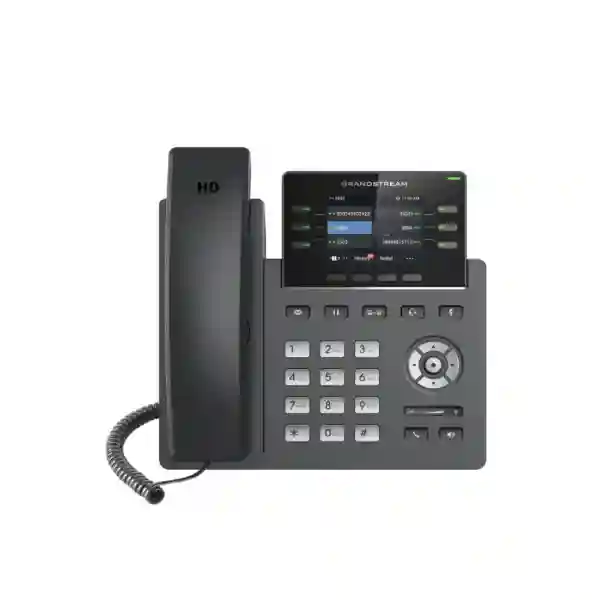
Grandstream GRP2613W Tanzania
The Grandstream GRP2613W is a 6-line professional IP phone designed for organizations that need reliable desk calling, flexible network connectivity and straightforward centralized administration. The Wi‑Fi 6 variant supports up to six SIP accounts and six multipurpose line keys, adds integrated dual-band 2.4 GHz and 5 GHz Wi‑Fi 6 plus Bluetooth, and includes dual auto-sensing Gigabit Ethernet ports with integrated Power over Ethernet. For businesses standardizing many endpoints, Grandstream Device Management System (GDMS) provides a centralized method to provision, configure, monitor and manage supported Grandstream devices.
For buyers in Tanzania, the important purchasing question is not only whether the GRP2613W has the right feature list, but whether it fits the intended PBX, SIP service, switching, Wi‑Fi, voice VLAN, power and call-flow environment. FourTeck can help organizations review those dependencies before quotation so the phone is selected as part of a workable business voice solution rather than as an isolated endpoint.
6 SIP accounts
The GRP2613W supports up to six SIP accounts and six multipurpose line keys, making it suitable for users who handle several extensions, identities or call roles.
Wi‑Fi 6 + Bluetooth
Integrated dual-band Wi‑Fi 6 and Bluetooth provide deployment flexibility where wireless connectivity or compatible Bluetooth accessories are preferred.
Gigabit PoE
Two switched 10/100/1000 Mbps Ethernet ports with integrated PoE support modern office networks and can simplify desk cabling when compatible PoE switching is available.
Centralized management
GDMS support helps administrators configure, provision, monitor and manage Grandstream endpoints from a centralized interface, which is especially useful for larger deployments.
What the Grandstream GRP2613W is designed to solve
Business telephony endpoints have to balance everyday usability with the technical needs of the IT team. The GRP2613W addresses this by combining a familiar desk-phone format with enterprise-oriented provisioning and security functions. Users get a 2.8-inch 320×240 color LCD, HD audio on the handset and speakerphone, Noise Shield technology intended to reduce background noise, and access to programmable keys for frequently used calling functions. Administrators get a SIP endpoint that supports centralized management, multiple accounts, Gigabit Ethernet, PoE and wireless connectivity.
The phone is particularly relevant to organizations that need repeatable deployment across multiple desks or branches. A single phone installed manually may be easy to configure, but a larger rollout benefits from planned extension naming, firmware standards, templates, VLAN assignments, user profiles, button layouts and a consistent provisioning method. The GRP2613W was designed with zero-touch provisioning and GDMS support for that scale-oriented operating model.
Wi‑Fi 6 expands the installation choices. A wired Ethernet connection remains appropriate when a structured network outlet and PoE are available, while the integrated wireless capability can help where cabling is difficult or where a desk layout changes frequently. The final choice should still consider signal quality, access-point capacity, security policy and voice Quality of Service. Wireless convenience does not remove the need for a stable voice network.
Verified Grandstream GRP2613W features
Six lines, up to six SIP accounts on the GRP2613W, and six multipurpose line keys.
Up to 24 digital BLF/VPK functions for monitored extensions, speed dial and other programmable use cases.
2.8-inch 320×240 TFT color LCD with a swappable faceplate for branding or identification.
Dual switched auto-sensing 10/100/1000 Mbps Ethernet ports with integrated PoE.
Integrated dual-band Wi‑Fi 6 supporting 802.11a/b/g/n/ac/ax plus Bluetooth on the GRP2613W.
HD audio with wideband codec support including G.722 and Opus, plus Noise Shield technology.
Secure boot, dual firmware images and encrypted data storage are included among the GRP Series security features.
Support for Grandstream Device Management System allows centralized configuration, provisioning and monitoring.
Compatibility, network design and deployment guidance
The GRP2613W is a standards-based SIP phone and Grandstream documents broad interoperability with third-party SIP devices and leading SIP/NGN/IMS platforms. Actual feature behavior still depends on the PBX, SIP service and configuration. Before ordering, confirm the intended extension platform, authentication method, codec policy, network addressing, VLAN plan, switch capabilities, firewall rules and whether any advanced call features rely on PBX-specific provisioning.
For wired deployment, review switch port availability and PoE capacity. The phone has dual Gigabit Ethernet ports, so a desk computer can often share the physical network path through the phone where the network design permits it. For Wi‑Fi deployment, confirm that coverage, channel planning and access-point density can support real-time voice. Strong signal alone does not guarantee call quality if the radio is congested or roaming behavior is poorly controlled.
For larger rollouts, define a repeatable template. Typical planning items include extension numbering, display names, emergency-call policy, BLF assignments, time zone, language, firmware version, NTP, provisioning method, administrator credentials, network policy and device naming. This reduces per-phone manual configuration and makes future support more predictable. The FourTeck Tanzania services page explains broader deployment, configuration and support capabilities, while the FourTeck Tanzania technology shop provides context for sourcing related business equipment.
Choosing the GRP2613W for different users
A useful way to evaluate the GRP2613W is by user role. General office users may value the clear color display, HD audio and familiar line keys. Supervisors and reception-oriented staff can use the available programmable BLF/VPK positions to monitor frequently called extensions or build faster call-handling workflows. Managers may value Bluetooth headset connectivity and the option to use Wi‑Fi 6 where a wired desk port is impractical. IT teams benefit from centralized provisioning and the ability to standardize endpoint settings across multiple users.
The phone should not be selected only because it supports six SIP accounts. If a user needs a much larger physical button field, an expansion module, touch-screen applications or specialized contact-center functions, another endpoint may fit better. Conversely, if a user needs only one extension with basic calling, a simpler phone may be more economical. FourTeck can help map user groups to endpoint profiles so organizations avoid over-specifying every desk while still giving higher-call-volume roles the functions they need.
Grandstream GRP2613W Tanzania
For organizations sourcing the Grandstream GRP2613W in Tanzania, procurement should begin with the intended voice architecture. The model can serve a single office, a distributed branch environment or a larger standardized endpoint rollout, but the correct configuration depends on the PBX or SIP platform, number of users, call handling requirements and local network. Businesses in professional services, hospitality, education, healthcare administration, retail, logistics and multi-branch operations may all use IP phones differently, so a quotation is more useful when it includes the operating context instead of only a handset quantity.
In Tanzania, network readiness is a major part of voice quality. A GRP2613W can connect by Gigabit Ethernet with PoE or by dual-band Wi‑Fi 6. Wired deployment is typically easier to control when structured cabling and PoE switching are already present. Wireless deployment can be valuable in offices where cabling is limited or desks move frequently, but signal quality, access-point load, channel planning and security should be checked. For either method, voice VLANs, Quality of Service, DNS, NTP and reliable routing to the SIP platform can improve operational consistency.
Power resilience also matters. PoE lets administrators power the phone from a compatible switch, which can simplify backup planning when the network rack is protected by a UPS. If the phone uses its power adapter instead, desk-level power continuity should be considered separately. Organizations should also decide how phones will be provisioned and updated. GDMS support is particularly useful when devices are spread across departments or sites because it provides a centralized management interface for supported Grandstream endpoints.
When requesting a GRP2613W quotation for Tanzania, provide the number of phones, PBX platform, SIP accounts per user, headset requirements, wired or Wi‑Fi preference, PoE switch availability and whether configuration is required. FourTeck can then align the endpoint request with business IT and telecom planning in Tanzania, including network switching, wireless coverage and supporting infrastructure rather than treating the phone as an isolated purchase.
Grandstream GRP2613W Dar es Salaam
Businesses searching for the Grandstream GRP2613W in Dar es Salaam often need an endpoint that can fit into a busy office network where voice, data, Wi‑Fi and cloud applications already share infrastructure. The GRP2613W is useful for environments that want a professional desk phone with six SIP accounts, integrated Wi‑Fi 6, Bluetooth and Gigabit PoE connectivity. Typical users can include front-office teams, account managers, supervisors, customer-service personnel and managers who need multiple line appearances or programmable call-handling keys without moving to a much larger console.
A Dar es Salaam deployment should be planned around the actual office layout. In a structured corporate office, Ethernet with PoE may be the most predictable approach because power and data can be delivered through one network cable from the switch. In renovated spaces, temporary offices or locations where adding cabling is difficult, Wi‑Fi 6 can provide additional flexibility. The wireless network still needs adequate signal, capacity and appropriate segmentation for business voice. Bluetooth can support compatible wireless headsets, which can be helpful for staff who spend significant time on calls.
For multi-floor or multi-department offices, centralized provisioning becomes more valuable as phone counts increase. Instead of entering the same settings manually at every desk, IT administrators can prepare templates and use GDMS-supported workflows to manage compatible devices. A consistent plan should cover extension naming, firmware, button assignments, time settings, voice VLANs and access policies. This becomes particularly important when organizations add branches later or need to replace devices without recreating every configuration from memory.
Before requesting a quote in Dar es Salaam, confirm whether the project needs phones only or a broader voice solution. The PBX, SIP trunk, PoE switch, firewall, Wi‑Fi infrastructure and UPS may all affect the final design. FourTeck’s Tanzania contact page can be used to submit quantities, site details and integration requirements for a more relevant commercial response.
Grandstream GRP2613W Mwanza
For businesses evaluating the Grandstream GRP2613W in Mwanza, the strongest use case is a managed SIP desk phone that can work in both structured and flexible network environments. The six-account capability is useful when a user handles more than one extension, business identity or call role, while the programmable virtual keys can be assigned to BLF monitoring, speed dial or other supported telephony functions. The 2.8-inch color display keeps the handset familiar for everyday office users, and HD audio with wideband codec support is designed for clear business conversation when the end-to-end voice path supports it.
Network design should be reviewed before a larger rollout. Where managed switches and structured cabling are already present, Gigabit Ethernet and PoE allow the phone to fit cleanly into the desk network. If a site has fewer network outlets or changing work areas, the GRP2613W’s dual-band Wi‑Fi 6 can offer an alternative connection method. Businesses should still evaluate access-point placement, interference and the number of simultaneous wireless clients. Voice is sensitive to delay and packet loss, so a network that feels acceptable for web browsing may still need adjustment for consistent calling.
Mwanza organizations with several departments or more than one operating location can also benefit from standardized provisioning. A repeatable configuration profile makes it easier to maintain extension labels, firmware, security settings and line-key behavior. GDMS support gives administrators a centralized interface for compatible Grandstream endpoints and helps reduce the need to treat every phone as a separate configuration project.
Procurement teams should provide more than the model number when requesting pricing. Include the number of users, expected SIP platform, whether each desk has PoE, whether Wi‑Fi will be used, headset requirements, call-flow features and whether installation or provisioning is expected. This information helps distinguish a simple hardware request from a complete business voice deployment and reduces the risk of missing supporting equipment.
Grandstream GRP2613W Arusha
The Grandstream GRP2613W can suit Arusha offices that need a professional SIP handset with both wired and wireless connectivity. Hospitality businesses, tour operations, administrative offices, education organizations and professional services often have different call patterns, yet they share the need for a phone that can be provisioned consistently and integrated with an existing voice platform. Six SIP accounts and six multipurpose line keys provide room for users who manage several numbers or roles, while up to 24 digital BLF/VPK assignments can help frequent callers reach colleagues or monitor extensions more efficiently.
For hospitality or customer-facing businesses, endpoint usability matters because front-desk and reservations teams may handle calls continuously. The GRP2613W includes Noise Shield technology, HD audio and Bluetooth, features that can support a more practical workstation when paired with a suitable PBX and compatible headset. The model also supports swappable faceplates, allowing organizations or service providers to customize visible branding or identification without changing the phone itself.
Arusha deployments should pay particular attention to network and power planning. With PoE, a compatible switch can supply power and network connectivity through Ethernet, simplifying desk cabling and allowing backup power to be concentrated in the network rack if the switch and upstream equipment are UPS-protected. Wi‑Fi 6 is an alternative where cabling is inconvenient, but business voice should be tested on the actual wireless network rather than assumed to work because data coverage is present.
Organizations with seasonal staffing or changing desk assignments can use centralized provisioning to make endpoint moves easier. A phone can be associated with the required configuration without rebuilding settings from scratch at each location. Before ordering, document the number of endpoints, SIP/PBX platform, intended connection method, PoE availability, headset types and any receptionist or BLF requirements. That procurement brief makes it easier to confirm whether GRP2613W is the right standard phone or whether a mix of simpler and higher-end models would be more appropriate.
Grandstream GRP2613W Dodoma
Organizations sourcing the Grandstream GRP2613W in Dodoma can use it as part of a structured business VoIP environment where endpoint consistency, security and manageable deployment are priorities. The handset offers six SIP accounts, a color LCD, HD audio, programmable digital keys, dual Gigabit Ethernet, PoE, Wi‑Fi 6 and Bluetooth. That feature combination makes it useful for administrative offices, professional teams and multi-department organizations that need more capability than an entry-level phone without moving into a large executive console.
A planned deployment should begin with call requirements. Determine whether each user needs a single extension or multiple identities, which staff need BLF monitoring, whether reception uses ring groups or queues, and whether the PBX provides the desired transfer, pickup, conference and voicemail behavior. The phone can expose many functions, but the PBX and SIP service still determine how those features operate in the complete system. Testing with the actual platform is therefore more valuable than relying only on a specification sheet.
Dodoma offices should also decide between Ethernet and wireless deployment desk by desk. Ethernet with PoE offers a straightforward path when managed switching is available. Wi‑Fi 6 can help where office furniture or building constraints make additional cabling difficult, but administrators should check coverage, authentication and client density. If voice shares wireless capacity with many laptops, phones and guest devices, segmentation and Quality of Service become more important.
For larger public-sector, institutional or corporate environments, lifecycle management should be included in the purchase plan. Define how firmware will be controlled, how administrator credentials are stored, how configurations are backed up and how replacement phones will be provisioned. GDMS support provides a useful centralized toolset for Grandstream environments. A clear procurement request should include quantity, deployment locations, PBX information, network readiness and desired services so the quotation reflects the complete requirement rather than hardware alone.
Grandstream GRP2613W UAE
The Grandstream GRP2613W is relevant to UAE businesses that need a standardized professional IP phone for offices, branches, service desks and distributed teams. Its combination of six SIP accounts, Wi‑Fi 6, Bluetooth, Gigabit Ethernet with PoE and centralized GDMS management fits environments where IT teams want flexible placement without giving up control over provisioning. In modern offices, some desks may have structured Ethernet and PoE while temporary spaces, project areas or reconfigured workstations may benefit from Wi‑Fi connectivity. One endpoint model that supports both can simplify hardware standardization.
For a UAE deployment, the phone should be evaluated as part of the full voice architecture. Confirm SIP trunk or hosted PBX compatibility, voice VLAN design, firewall behavior, QoS policy and site-to-site connectivity if extensions operate across multiple branches. Organizations with locations in Dubai, Abu Dhabi or other emirates may also want uniform naming, firmware and security settings so helpdesk teams can troubleshoot phones consistently regardless of site.
The GRP2613W’s Bluetooth support can be useful for users who prefer compatible wireless headsets, while up to 24 digital BLF/VPK positions can help supervisors, reception teams and frequent callers create efficient call-handling layouts. The swappable faceplate may also be useful for enterprise branding or service-provider deployments. Security features documented for the GRP Series include secure boot, dual firmware images and encrypted data storage, which support a more controlled endpoint lifecycle.
Organizations coordinating technology across the Gulf and Africa may also use the FourTeck UAE technology site for related regional requirements. When seeking a quotation, specify quantity, PBX, network method, headset needs, provisioning expectations and target locations so commercial and technical planning can be aligned from the start.
Grandstream GRP2613W Uganda
For organizations sourcing the Grandstream GRP2613W in Uganda, the model offers a practical balance between user-facing call controls and centralized IT administration. Businesses with a mix of office users, supervisors and front-desk teams can assign the six SIP accounts and programmable keys according to job role. The integrated Wi‑Fi 6 and Bluetooth options provide flexibility for locations where cabling or headset mobility matters, while dual Gigabit Ethernet with PoE supports conventional managed-network deployments.
Before standardizing on the handset, review how the organization’s PBX or hosted SIP service implements common functions such as transfer, call pickup, voicemail, BLF and conferencing. Standards-based SIP provides broad interoperability, but button behavior and feature codes can vary between platforms. A pilot with the intended PBX can validate templates before hundreds of endpoints are ordered. Administrators can then use centralized provisioning and GDMS-supported management practices to maintain consistency across sites.
Ugandan multi-site organizations should also account for branch connectivity. A phone may be physically located in one city while its PBX is hosted elsewhere, so call quality depends on the complete network path. Voice VLANs, stable internet, correctly sized firewalls and sensible QoS policies reduce avoidable problems. If Wi‑Fi is used, the voice SSID should be planned with coverage and client density in mind rather than treated as a simple replacement for an Ethernet cable.
FourTeck’s regional network includes a dedicated FourTeck Uganda site for customers coordinating Uganda requirements. A useful quotation request should list phone quantity, office locations, PBX type, PoE status, Wi‑Fi plans, headset preferences and whether deployment assistance is required. That information supports a more accurate bill of materials and reduces installation surprises.
Grandstream GRP2613W Kampala
Kampala businesses looking for the Grandstream GRP2613W are often balancing endpoint capability, office growth and network flexibility. The handset is suitable for users who need more than basic single-extension calling, offering six SIP accounts, six line keys and up to 24 digital BLF/VPK assignments. This can support reception workflows, departmental call handling, speed dial and monitored extensions when the connected PBX provides the corresponding functions.
The network choice can be adapted to the site. In a modern Kampala office with managed PoE switching, Ethernet offers a predictable path and allows the phone to be powered centrally. Where desks change frequently or cable installation is constrained, integrated dual-band Wi‑Fi 6 can provide an alternative. Organizations should still test voice quality under realistic load, especially if the same wireless infrastructure carries video meetings, guest access and cloud applications. Bluetooth can simplify headset use for staff who need to move around the desk while remaining on calls.
For IT teams managing several floors or branches, the GRP2613W is most valuable when deployed with a consistent operational standard. Create naming conventions, extension templates, approved firmware, security baselines and button profiles. Centralized management with GDMS can then support configuration and monitoring at scale. This reduces the chance that every handset ends up with a slightly different setup after months of ad-hoc changes.
Procurement should also include the supporting network. Check switch ports, PoE budget, firewall policy, voice VLANs, UPS coverage and PBX licenses or extension capacity before the phones arrive. A handset cannot compensate for an undersized or unstable voice network. Providing this information in the quotation request helps ensure the proposed solution reflects both endpoint quantity and deployment readiness.
Grandstream GRP2613W Arua
For organizations considering the Grandstream GRP2613W in Arua, network flexibility can be as important as the number of SIP accounts. The phone can connect through Gigabit Ethernet with PoE or through dual-band Wi‑Fi 6, giving IT teams options when desk cabling, office layouts or branch infrastructure differ from one location to another. The key is to choose the connection method that provides the most stable voice path at each site rather than using wireless automatically simply because it is available.
The six SIP accounts and programmable digital keys can suit staff who cover several functions, such as administration, customer service, sales or branch coordination. BLF assignments can help users see extension status where supported by the PBX, while speed-dial and other programmable actions can reduce repetitive keypad work. HD audio and Noise Shield technology are designed to improve everyday call experience, especially in open offices where background activity may otherwise be distracting.
Branch deployments benefit from documentation. Record which extension is assigned to which user, how the phone authenticates, which network it uses and what configuration template applies. If connectivity is changed later, these details make troubleshooting faster. GDMS can support centralized management of compatible Grandstream endpoints, allowing administrators to maintain settings without relying entirely on local manual access at every branch.
When requesting a GRP2613W quote for Arua, include the number of phones, whether PoE switches are already installed, the available internet link, PBX location, expected call volume and any headset requirement. If the branch will connect to a central PBX elsewhere, the WAN and firewall design should be reviewed at the same time. A clear technical scope allows the handset purchase to become part of a reliable voice system instead of a collection of individually configured devices.
Grandstream GRP2613W Mbarara
Businesses searching for the Grandstream GRP2613W in Mbarara can use the model for office telephony where a compact professional phone needs to support several call identities or programmable keys. Six SIP accounts provide flexibility for staff with multiple lines, while the digital VPK/BLF capacity can be configured for frequent contacts and monitored extensions. The phone’s 2.8-inch color display and dedicated calling keys retain a straightforward desk-phone experience for users who do not need a touch-screen endpoint.
Connectivity should be selected according to site conditions. Ethernet with PoE simplifies centralized power and can work well in offices with structured cabling. Wi‑Fi 6 is useful when desks cannot easily be cabled, but administrators should confirm signal quality, access-point loading and security configuration. For real-time voice, occasional packet loss or congestion can be more noticeable than it is for normal web use, so testing is important. Bluetooth offers additional flexibility for compatible headsets and can improve productivity for staff who are frequently on calls.
The GRP2613W also supports centralized management through GDMS, making it attractive for organizations that want consistent configuration across more than one office. A standardized deployment can define firmware, time settings, SIP server details, button assignments and security parameters once, then apply them systematically. This approach makes future moves, additions and replacements easier to administer.
A good procurement brief for Mbarara should include more than quantity. State whether the project is replacing analog phones, expanding an existing IP PBX or creating a new SIP environment. Include switch and PoE information, WAN connectivity, user roles, headset requirements and whether installation or configuration support is needed. With those inputs, the GRP2613W can be evaluated against the actual operating requirement rather than chosen solely from headline features.
Grandstream GRP2613W Gulu
For Gulu offices and branch operations, the Grandstream GRP2613W can serve as a centrally manageable SIP endpoint with both wired and wireless deployment options. The model is useful when staff need multiple lines, programmable call controls and the ability to standardize configuration across a growing set of phones. Up to six SIP accounts and six line keys support multi-role users, while digital BLF/VPK assignments can be used for frequent contacts, extension monitoring and other supported PBX functions.
A branch voice system depends heavily on the WAN. If the PBX is hosted centrally or in the cloud, every call relies on the site’s internet connection, routing and firewall behavior. The GRP2613W’s Wi‑Fi 6 capability gives placement flexibility, but it does not remove the need for sufficient bandwidth, low latency and stable wireless coverage. Ethernet with PoE remains an effective option where a managed switch and structured cabling are available. Whichever method is used, administrators should apply consistent network and security policies.
The phone includes security features such as secure boot, dual firmware images and encrypted data storage, but endpoint security also depends on operational practice. Change default credentials, limit unnecessary administrative access, keep firmware under management and use PBX-side security controls appropriate to the organization. Centralized provisioning can reduce configuration drift and help IT teams make controlled changes across devices.
Before ordering for Gulu, define whether each user needs the GRP2613W’s full feature set. Some desks may be better served by a simpler model, while reception or supervisory roles may benefit from the added programmable capacity and wireless options. A mixed endpoint strategy can control costs while matching capability to job role. Share the user count, PBX, expected call features, network readiness and deployment scope when requesting a quotation.
Grandstream GRP2613W Kenya
The Grandstream GRP2613W is a practical option for Kenyan organizations that want a business desk phone with modern wireless connectivity and centralized management. Its six SIP accounts and multipurpose line keys support users who handle more than one extension or business function, while up to 24 digital BLF/VPK positions can help receptionists, supervisors and frequent callers build faster workflows. Integrated Wi‑Fi 6 and Bluetooth distinguish the GRP2613W from the non-W variant and can be useful for flexible offices and headset users.
For deployments in Nairobi or other Kenyan locations, a pilot should confirm PBX behavior before a large purchase. SIP interoperability is broad, but organizations may have platform-specific requirements for BLF, provisioning, call pickup, voicemail or directory integration. Once the desired behavior is tested, administrators can standardize settings and use centralized management to maintain consistency across the fleet.
Network design is equally important. Gigabit Ethernet with PoE fits managed office networks, while Wi‑Fi 6 provides a wireless path when cabling is difficult. Voice traffic should be protected from avoidable congestion through sensible VLAN and QoS policy, and branch connectivity should be stable if the PBX is remote. Where a switch powers the phones, UPS protection at the network rack can improve continuity during short power events.
FourTeck’s Kenya technology site provides a regional path for customers coordinating Kenyan requirements. When requesting pricing, include the number of units, deployment cities, PBX platform, PoE availability, Wi‑Fi use, headset needs and any configuration service. This allows the endpoint, switching and voice-system requirements to be reviewed together rather than priced independently.
Grandstream GRP2613W Kuwait
Kuwait businesses considering the Grandstream GRP2613W can use it for professional office telephony where endpoint standardization, wireless flexibility and centrally managed provisioning are priorities. The phone supports six SIP accounts, six line keys and up to 24 digital BLF/VPK assignments, making it appropriate for users who handle multiple extensions or need one-touch access to frequent call functions. A 2.8-inch color display, HD audio and Noise Shield technology provide a practical everyday calling interface without the complexity of a full touch-screen desk terminal.
The integrated Wi‑Fi 6 capability is useful in offices where Ethernet outlets are not available at every desk, but the wireless network should be assessed for real-time voice traffic. Dual-band operation gives administrators flexibility, yet the best band and access-point design depend on distance, obstruction, interference and user density. Where structured cabling exists, the dual Gigabit ports and integrated PoE allow the handset to fit neatly into a conventional managed network.
For multi-site businesses, centralized management becomes a major operational advantage. GDMS support can help administrators provision and monitor compatible endpoints from one interface, maintain standardized firmware and apply consistent configuration templates. This is particularly useful when offices are added over time or when phones must be replaced without recreating settings manually.
Procurement teams should verify PBX compatibility, SIP licensing, headset preferences, switch PoE capacity and the desired call-control features before ordering. The goal is to ensure the device fits the complete solution, including firewall and WAN design. Customers coordinating broader regional requirements can also refer to FourTeck Kuwait for location-specific technology discussions.
Grandstream GRP2613W Ghana
For businesses sourcing the Grandstream GRP2613W in Ghana, the model is well positioned for office users who need multiple SIP accounts, programmable line functions and flexible connectivity. Six SIP accounts can support different extension or service identities, while up to 24 digital BLF/VPK positions can simplify call handling for frequent contacts and monitored extensions. The integrated Wi‑Fi 6 and Bluetooth capabilities also make the phone useful in offices where wireless placement or compatible headsets are part of the workstation design.
A reliable Ghana deployment should start with the PBX and network. Confirm whether the voice platform is on premises, hosted or located at a regional data center, then review firewall traversal, SIP registration, codec policy and WAN reliability. Ethernet with PoE gives a stable wired option and can centralize phone power at the network switch. Wi‑Fi 6 can reduce cabling constraints, but the wireless environment should be tested under normal office load and segmented appropriately for business voice.
Organizations operating several branches can benefit from centralized device management. GDMS support allows compatible Grandstream endpoints to be provisioned and monitored through a central interface, reducing repetitive manual configuration. A standard template can define firmware, display names, SIP servers, button assignments and security settings so new devices are introduced consistently.
When requesting a GRP2613W quotation for Ghana, provide quantity, office locations, PBX details, whether PoE is available, wireless requirements, headset needs and any requirement for installation or configuration. Customers with broader regional infrastructure needs can also use FourTeck Ghana as a related regional resource. A clear technical brief makes it easier to separate endpoint cost from network, PBX and deployment dependencies.
Grandstream GRP2613W Nigeria
Nigerian organizations evaluating the Grandstream GRP2613W can use it as a managed professional endpoint for offices, branches, reception teams and customer-facing departments. The phone combines six SIP accounts with a compact color display, HD audio, programmable digital keys, Gigabit Ethernet, PoE, Wi‑Fi 6 and Bluetooth. This makes it suitable for businesses that want a consistent desk-phone standard while retaining flexibility for both wired and wireless work areas.
Large Nigerian offices and multi-site organizations should place particular emphasis on provisioning and lifecycle management. When many phones are installed, small differences in firmware, button mappings and network settings can become expensive support issues. GDMS-supported centralized management allows administrators to apply a more consistent endpoint strategy and monitor compatible Grandstream devices without visiting every desk individually.
Call quality depends on the whole path between phone and PBX. If the PBX is hosted in the cloud or centralized in another city, WAN stability and firewall configuration can be as important as the handset. Ethernet with PoE is often the most controllable option in structured offices, while Wi‑Fi 6 can help in flexible spaces. In either case, voice VLANs, DNS, NTP, QoS and secure SIP configuration should be considered. Bluetooth can support compatible headsets for teams with high call volumes.
A quotation request should state whether the need is hardware-only, replacement of an existing IP phone fleet, or a complete voice solution. Include user count, PBX platform, switch and PoE details, call features, branch locations and deployment services. Customers coordinating Nigerian requirements can also review FourTeck Nigeria for related regional technology support and procurement context.
Grandstream GRP2613W Seychelles
For organizations sourcing the Grandstream GRP2613W in Seychelles, the model offers useful flexibility for offices where network outlets, room layouts and staffing patterns vary between sites. The phone supports six SIP accounts and can expose up to 24 digital BLF/VPK functions, making it suitable for users who handle multiple business numbers or frequently contact several departments. Integrated Wi‑Fi 6 provides an alternative to Ethernet in locations where new cabling is inconvenient, while Bluetooth can support compatible headsets.
Island and multi-site operations often depend heavily on WAN and cloud connectivity, so the voice design should be evaluated end to end. If a hosted PBX is used, stable internet, appropriate firewall policy and sensible QoS configuration are essential. If Ethernet is available, the phone’s dual Gigabit ports and integrated PoE can support a clean desk installation and allow central UPS protection at the network switch. If Wi‑Fi is used, administrators should verify signal strength, roaming and congestion with voice traffic rather than relying only on general browsing tests.
GDMS support can be particularly valuable when administrators are responsible for devices at more than one location. Central templates reduce the need for repetitive on-site configuration and help keep firmware, account settings and security policies consistent. Documenting each endpoint’s user, extension, site and network profile also makes replacement and troubleshooting faster.
When preparing a Seychelles quotation request, include unit quantity, PBX or SIP provider, site count, preferred connection method, PoE availability and headset requirements. Also identify whether configuration, remote provisioning or installation support is expected. This makes it easier to validate the complete solution and avoid ordering phones before the network and PBX dependencies are understood.
Related Tanzania FourTeck services and infrastructure
A GRP2613W deployment may require more than phones. FourTeck Tanzania describes IP PBX, SIP, call routing, queues, voicemail and branch telephony as part of its business communication scope. The same site also covers managed network switches, PoE, VLANs, Wi‑Fi access points, firewalls, structured cabling, racks and UPS systems. These supporting areas matter because a phone is only one endpoint on a larger network.
Overview of integrated IT, telecom, networking, security and infrastructure planning for Tanzania.
Business technology shop
Browse sourcing guidance across IP phones, IP PBX, switches, Wi‑Fi, firewalls, servers and related infrastructure.
IT and deployment services
Review solution planning, installation, configuration and lifecycle support capabilities.
Request a quotation
Send quantity, site, PBX and network details to start a commercial and technical discussion.
About FourTeck Tanzania
Learn more about the company’s integrated technology approach and regional context.
Quotation checklist for Grandstream GRP2613W
A complete quotation is easier to prepare when the technical assumptions are clear. Use this checklist before contacting sales:
- Required number of GRP2613W phones and planned deployment locations.
- Current or proposed IP PBX, hosted PBX or SIP service.
- Number of SIP accounts or lines each user needs.
- Whether BLF, speed dial, call pickup, queues or receptionist functions are required.
- Ethernet and PoE availability at each desk.
- Whether Wi‑Fi 6 will be used and whether business wireless coverage has been validated.
- Bluetooth or wired headset requirements.
- Voice VLAN, firewall and QoS readiness.
- Need for provisioning, installation, testing, documentation or user handover.
- Any branch, multi-country or centralized management requirements.
Frequently asked questions
How many SIP accounts does the Grandstream GRP2613W support?
Grandstream specifies up to six SIP accounts for the GRP2613W variant. The related GRP2613 model supports fewer accounts, so buyers should ensure the quotation explicitly identifies the GRP2613W when six accounts and integrated Wi‑Fi 6 are required.
Does the GRP2613W have Wi‑Fi?
Yes. The GRP2613W includes integrated dual-band 2.4 GHz and 5 GHz Wi‑Fi 6 with support for 802.11a/b/g/n/ac/ax. Wireless deployment should still be planned for voice quality, security and access-point capacity.
Does it support Bluetooth?
Yes. Bluetooth is included on the GRP2613W, which can be useful for compatible wireless accessories such as headsets.
Can the GRP2613W use PoE?
Yes. It includes dual switched auto-sensing Gigabit Ethernet ports with integrated PoE. The connected switch must provide compatible PoE and sufficient power budget for the deployment.
What is GDMS?
Grandstream Device Management System is Grandstream’s centralized platform for configuration, provisioning, management and monitoring of supported Grandstream endpoints. It is useful when administrators need to manage multiple phones consistently.
How many programmable BLF/VPK keys are available?
Grandstream specifies up to 24 digital BLF/VPK functions. Exact behavior depends on how the phone and PBX are configured.
Is the GRP2613W suitable for mass deployment?
Yes. Grandstream positions the GRP2613W for mass deployment and easy management, including zero-touch provisioning and GDMS support. A standardized provisioning plan is recommended for larger installations.
What should I confirm before buying?
Confirm PBX and SIP compatibility, user roles, number of accounts, required call features, switch ports, PoE capacity, Wi‑Fi quality, headset needs, firewall policy and provisioning method. These factors influence whether the phone will work as intended in your environment.
Decision recap
Choose the Grandstream GRP2613W when users need a professional six-account SIP desk phone with Wi‑Fi 6, Bluetooth, Gigabit PoE networking, HD audio, programmable digital keys and centralized Grandstream management. It is especially relevant where organizations want one endpoint standard that can be used on both wired and wireless desks. Before purchase, validate the PBX, network and provisioning design. For users with very simple calling needs, a lower-tier endpoint may be sufficient; for users who need a larger physical key field, touch applications or expansion modules, a different model may be more appropriate.
Regional FourTeck resources
Organizations managing technology across multiple countries may coordinate related projects through the FourTeck regional network. For East Africa, see FourTeck Kenya and FourTeck Uganda. For Gulf requirements, use FourTeck UAE. For West African projects, see FourTeck Ghana and FourTeck Nigeria. These links are useful when an organization wants to keep endpoint standards, voice architecture and network practices aligned across regional branches.
Talk to FourTeck about your GRP2613W deployment
Send your required quantity, Tanzania location, PBX or SIP platform, preferred wired or Wi‑Fi connection, PoE availability and any provisioning or installation requirement. FourTeck can use those details to prepare a more relevant commercial response and identify supporting network items that should be checked before deployment.




Reviews
There are no reviews yet.