
Grandstream GWN7816P Tanzania
The Grandstream GWN7816P is built for medium-to-large organizations that need a dense, manageable wired network with substantial PoE capacity. Grandstream specifies 48 Gigabit Ethernet PoE ports, six 10 Gigabit SFP+ uplinks, Layer 3 routing functions, IPv4 and IPv6 support, advanced VLAN controls, quality-of-service functions, security mechanisms, and multiple management methods. For Tanzania deployments, the product is especially relevant when IP phones, wireless access points, cameras, access-control devices, and other powered edge equipment must share a structured, centrally administered switching platform.
Fourteck helps buyers evaluate the switch as part of the broader network rather than as an isolated 48-port device. A useful procurement discussion includes endpoint count, PoE demand, uplink design, fiber requirements, rack and power conditions, VLAN architecture, resilience goals, management preference, and future expansion. This reduces the risk of choosing a powerful switch without validating whether its power budget, optics, cabling, topology, and routing plan align with the real site.
What is the Grandstream GWN7816P?
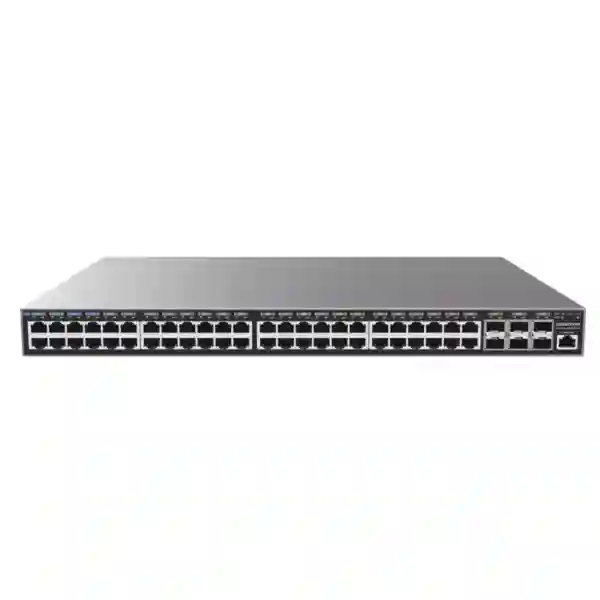
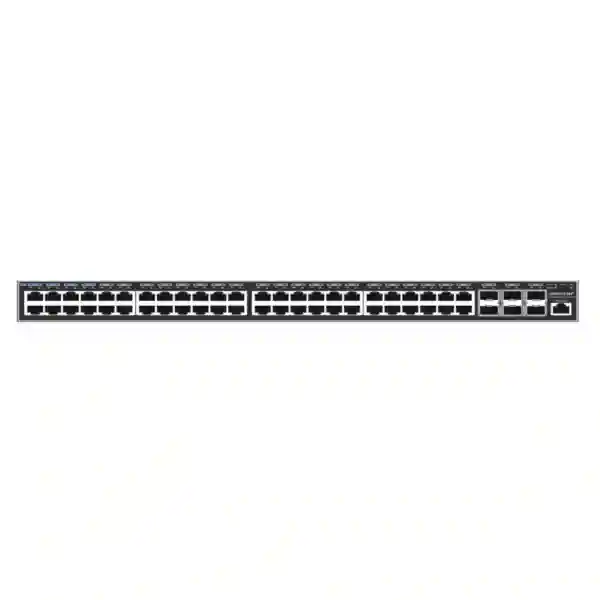
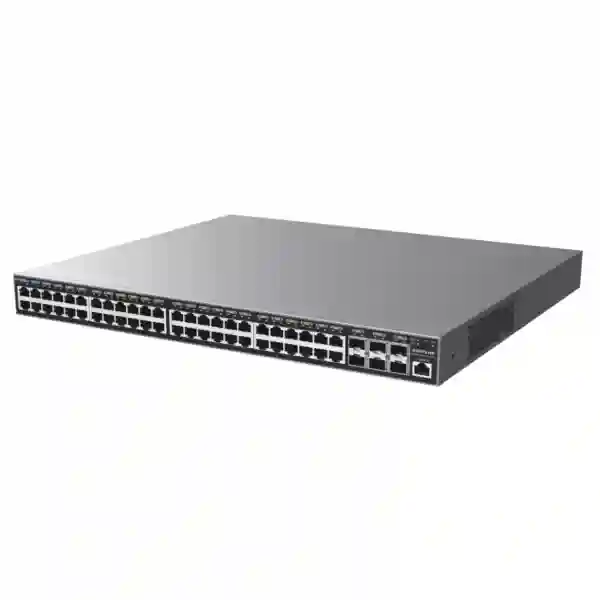
Grandstream positions the GWN7816P as an enterprise-grade 48-port Layer 3 managed network switch. The model provides forty-eight 10/100/1000Mbps Ethernet ports and six 10Gbps SFP+ ports. All forty-eight copper ports support Power over Ethernet, with ports 1–8 supporting up to 60W per port through PoE++ and ports 9–48 supporting up to 30W per port. Grandstream lists a maximum total PoE output of 740W with one power supply, total non-blocking throughput of 108Gbps, switching capacity of 216Gbps, and a forwarding rate of 160.704Mpps. These are important planning figures for businesses that want to consolidate data and device power onto one managed access or aggregation platform.
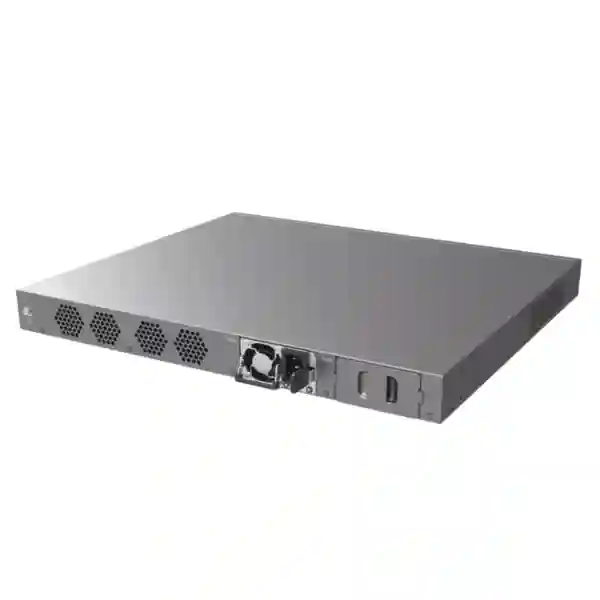
The switch supports VLANs, voice VLAN, link aggregation, spanning-tree technologies, IPv4 and IPv6 routing, DHCP functions, multicast controls, ACLs, QoS, authentication mechanisms, ARP inspection, IP source guard, DHCP snooping, port security, storm control, and other enterprise LAN functions. Management options include the local web interface, CLI, Grandstream cloud and on-premises management platforms, and compatible GWN infrastructure. A separately purchased hot-swappable power supply can be used to add power-supply resilience. Grandstream states an operating range of 0°C to 45°C, which means rack ventilation and site environmental conditions should be considered before installation.
For procurement teams, the key point is that the GWN7816P is not simply a high-port-count PoE switch. Its value comes from combining dense access, 10G uplinks, Layer 3 features, traffic segmentation, security controls, centralized management, and substantial power delivery. The correct fit depends on whether the organization actually needs those capabilities and can support them with appropriate cabling, optics, upstream firewalls or routers, rack space, UPS capacity, and operational processes.
GWN7816P technical specification snapshot
| Ethernet ports | 48 × 10/100/1000Mbps RJ45 |
| 10G uplinks | 6 × SFP+ 10Gbps |
| PoE standards | IEEE 802.3af/at/bt |
| PoE output | Ports 1–8 up to 60W each; ports 9–48 up to 30W each; up to 740W total with one PSU |
| Switching capacity | 216Gbps |
| Non-blocking throughput | 108Gbps |
| Forwarding rate | 160.704Mpps |
| MAC addresses | Up to 32K |
| VLAN scale | Up to 4K VLANs with multiple VLAN methods |
| Management | Local web UI, CLI, GWN cloud/on-premises management options |
| Form factor | Rack-mountable; 440 × 380 × 44mm; 6kg |
Why businesses choose a 48-port PoE++ Layer 3 switch
Dense PoE access
A single switch can provide data and power to many phones, access points, cameras, and compatible edge devices. This can simplify rack design and reduce the number of local power adapters, provided the total PoE load is calculated correctly.
10G uplink headroom
Six SFP+ ports give network designers options for high-speed uplinks, inter-switch connections, fiber runs, aggregation, or server connectivity. Optics, DAC support, distance, and redundancy design should be planned before ordering transceivers.
Segmentation and routing
Layer 3 functions make the switch useful where VLANs need routed connectivity and where traffic from voice, surveillance, wireless, user, server, and management networks must be separated and controlled.
Centralized operations
Organizations can choose local, cloud, or on-premises administration methods. This matters for multi-site environments where configuration consistency, visibility, backups, firmware processes, and role-based administration become operational priorities.
Planning PoE correctly
The most common buying mistake with a high-density PoE switch is to look only at the number of PoE ports. Forty-eight powered ports do not automatically mean every attached device can draw its maximum rated wattage simultaneously. The switch has an overall PoE budget, so the correct design begins with the expected power requirement of each endpoint. A business may have a mix of low-power IP phones, conventional access points, PTZ cameras, high-power Wi-Fi access points, door controllers, and other devices. The requirement should be summed using realistic maximum consumption, then compared with the available 740W budget while leaving sensible engineering margin.
Ports 1–8 support the higher PoE++ output, making them the logical candidates for compatible endpoints that need more than standard PoE+. That allocation should be documented so a future technician does not move a high-power device to an unsuitable port. The design should also consider UPS sizing. Power delivered by the switch ultimately comes from the rack electrical supply, so a heavily loaded PoE switch can materially increase UPS demand and runtime calculations. Cooling also matters because high PoE loads and dense switching generate heat inside the rack.
For related planning, Fourteck Tanzania’s integrated IT and networking overview explains how switching connects with cameras, phones, wireless, servers, firewalls, racks, UPS, and cabling. Buyers can also use the Tanzania technology shop to frame switch procurement alongside the endpoints the switch will power.
Compatibility, uplinks, and network integration
A managed switch sits in the middle of many dependencies. Before deploying the GWN7816P, document the existing firewall, routers, switches, servers, wireless infrastructure, voice platform, cameras, and network addressing. Decide which VLANs will exist and which device should perform inter-VLAN routing. In some networks, routing can occur on the switch; in others, the firewall should remain the policy enforcement point. The answer depends on the security architecture, traffic patterns, administrative model, and the need for inspection between network segments.
The six SFP+ ports provide meaningful 10G design flexibility, but physical media needs to be defined. A short rack-to-rack connection may use supported direct-attach cabling, while longer building or campus links may require fiber optics selected for the correct fiber type, connector, wavelength, and distance. The Grandstream datasheet notes support for DAC cables up to 5m. For wider LAN planning, review Fourteck Tanzania’s technology services, which cover design, deployment, configuration, documentation, troubleshooting, and lifecycle support.
Wireless projects are particularly dependent on switching. For examples of access-point procurement factors such as PoE, uplink capacity, VLAN design, and controller integration, see the Tanzania pages for FortiAP FAP-221K, FortiAP FAP-222KL, FortiAP FAP-231F, and the broader FortiAP F Series. These are different vendor products, but their deployment dependencies illustrate why switch power, uplinks, segmentation, and management must be coordinated across the LAN.
Grandstream GWN7816P Tanzania
For organizations searching for the Grandstream GWN7816P in Tanzania, the practical starting point is to define the network role the switch will play. A head office may use it as a high-density access switch for workstations, phones, wireless access points, cameras, and building systems. A larger site may use one or more units in access or distribution roles where 10G SFP+ uplinks carry aggregated traffic toward servers, core switching, or security infrastructure. A branch standard may use the same model where businesses want a repeatable configuration across several locations, even if not every site initially consumes all forty-eight ports.
Tanzania deployments should account for power quality, UPS capacity, rack ventilation, cabling quality, and the actual environmental conditions in the equipment room. The official operating range is 0°C to 45°C, so a hot or poorly ventilated rack can be a design problem regardless of the switch’s feature set. Structured cabling should be labeled and tested, patch-panel records should match switch-port documentation, and high-power PoE endpoints should be assigned deliberately. If the switch is supporting cameras or access points, uplink utilization and PoE draw should be monitored after commissioning so growth can be planned from evidence rather than assumptions.
Procurement should also separate hardware facts from project assumptions. The GWN7816P specification confirms its port count, uplinks, PoE standards, maximum total PoE output, management choices, and core switching features. It does not by itself confirm local stock, delivery lead time, warranty scope, installation effort, or suitability for a specific site. Those items should be confirmed through a quotation based on quantity, destination, accessories, optics, cabling, configuration, and support needs. This approach is useful for private companies, institutions, hospitality operators, healthcare organizations, education, retail, logistics, and multi-site businesses that need a documented network purchase.
For a Tanzania quotation, share the number of wired devices, PoE device types, estimated power draw, VLAN requirements, existing switches and firewall, desired uplink design, fiber distances, management preference, rack location, UPS arrangement, and expected growth over the next few years. Fourteck can then evaluate whether the GWN7816P is appropriately sized or whether a different switch combination is more economical and easier to operate.
Grandstream GWN7816P Dar es Salaam
Dar es Salaam businesses often operate dense office, retail, hospitality, professional-services, logistics, education, and multi-floor commercial environments where wired and wireless systems converge in the same racks. In that context, the GWN7816P can be evaluated as a high-port-count PoE switching platform for devices distributed across a floor or building. Its forty-eight Gigabit PoE ports can reduce the need to split phones, cameras, and access points across several smaller access switches, while the six 10G SFP+ interfaces provide useful headroom for uplinks between floors, racks, or upstream aggregation points.
A Dar es Salaam deployment should begin with a physical and logical network map. Physically, confirm rack depth, patch panels, cable routes, fiber paths, UPS power, cooling, and the location of high-power PoE endpoints. Logically, define business-user VLANs, voice, CCTV, guest Wi-Fi, management, servers, and any building or IoT networks. If the switch is replacing older equipment, record current addressing, trunks, spanning-tree behavior, uplink aggregation, and DHCP dependencies before migration. This is particularly important in busy sites where an unplanned cutover could disrupt phones, wireless access, surveillance recording, or business applications at the same time.
Commercial comparisons in Dar es Salaam should not focus only on the unit price of the switch. Fiber transceivers, patching, cabling remediation, rack accessories, UPS upgrades, configuration, labeling, documentation, testing, and any spare power-supply strategy can materially change total project cost. It is also useful to identify whether the organization expects future Wi-Fi upgrades, additional cameras, more IP phones, or server traffic that may drive higher uplink demand. The six 10G SFP+ ports can be valuable only when the surrounding design actually uses that capacity effectively.
When requesting a quote in Dar es Salaam, provide site type, number of floors, estimated endpoint count, PoE load, current switch inventory, firewall model, fiber distances, and intended management method. A clear requirement allows the switch to be assessed against the real network rather than purchased simply because it has forty-eight ports. If several buildings or branches are involved, include them in one requirement matrix so the design can standardize what should be common while preserving differences in scale, topology, and local conditions.
Grandstream GWN7816P Mwanza
For organizations in Mwanza, the GWN7816P is most relevant when a branch, campus, hotel, institution, healthcare facility, warehouse, or commercial site needs many powered network endpoints and wants stronger management than an unmanaged or lightly managed switch can provide. The buying decision should start with network growth. If a site already has twenty or thirty active ports and expects additional cameras, access points, phones, or operational devices, a forty-eight-port platform can provide expansion room while avoiding a rapid second replacement. The decision should still be based on realistic forecasts rather than buying unused capacity without a plan.
Mwanza deployments also benefit from strong remote-management discipline. When IT staff are responsible for several sites, consistent naming, VLAN standards, interface descriptions, backups, firmware control, and monitoring can reduce dependence on ad-hoc troubleshooting. The GWN7816P supports multiple management methods, making it possible to align operation with a local web workflow, command-line administration, cloud-oriented management, or on-premises management architecture. The appropriate method should be chosen before rollout so credentials, roles, logging, and change procedures are standardized from the first installation.
Power design should be treated as a separate engineering task. A branch can have enough switch ports yet still lack enough PoE budget for all intended devices. Build a list of each powered endpoint and its expected maximum draw, reserve the higher-output PoE++ ports for compatible devices that genuinely need them, and leave margin for growth. The switch and powered devices should be considered together when sizing UPS runtime. If CCTV continues recording during a short power interruption but the access switch shuts down immediately, the system has not achieved useful resilience.
For a Mwanza quotation, note whether the installation is greenfield, expansion, or replacement. Include rack condition, existing structured cabling, number of fiber uplinks, optical distance, device count, PoE requirements, and whether configuration or commissioning support is required. A phased rollout can be useful for distributed organizations: validate one site, document the final configuration, then replicate the working standard to additional locations with controlled site-specific adjustments.
Grandstream GWN7816P Arusha
Arusha organizations may evaluate the GWN7816P for hotels, offices, travel and tourism operations, schools, healthcare sites, NGOs, professional organizations, and multi-building environments where wired users, guest wireless, voice, cameras, and administration systems share the same infrastructure. In these settings, the main design benefit is not simply more ports; it is the ability to apply predictable segmentation. Staff devices, guests, IP telephony, surveillance, and management traffic can be separated with VLANs while routing and policy are coordinated with the broader network security design.
Hospitality and visitor-heavy environments need particular attention to peak demand. Guest occupancy, events, conferences, and meeting rooms can drive wireless usage sharply higher at certain times, which in turn increases traffic from PoE access points back through the wired switching layer. A 10G uplink design can help avoid bottlenecks when many access points or cameras aggregate onto one switch, but only when upstream devices and cabling are similarly capable. Monitoring during busy periods provides better capacity evidence than relying on average traffic during quiet hours.
Rack conditions should also be reviewed. The GWN7816P is an actively cooled enterprise switch, so it belongs in a properly ventilated rack environment with enough clearance and reliable power. The official operating range should be respected, and the combined heat from firewalls, servers, recorders, UPS systems, and other switches should be considered rather than evaluating one device alone. Good rack organization, power distribution, cable labeling, and documented patching can materially improve support when faults need to be isolated quickly.
For Arusha procurement, provide a device schedule separated by function: phones, cameras, access points, user ports, servers, control systems, and spare ports. Indicate which endpoints require PoE++, and identify required VLANs and uplinks. This makes it easier to decide whether one GWN7816P is sufficient, whether multiple switches should be distributed by floor, and whether fiber links are needed between wiring closets. Commercial terms, availability, warranty, and delivery should then be confirmed at the time of quotation rather than assumed from generic product information.
Grandstream GWN7816P Dodoma
Dodoma buyers in government, administration, education, healthcare, professional services, and growing private organizations often need structured procurement documents that define not only the model but also the intended network function. The GWN7816P can fit requirements for a forty-eight-port managed PoE access or distribution switch with Layer 3 capabilities, six 10G SFP+ uplinks, and enterprise security and management functions. Procurement teams should cite official specifications carefully and avoid mixing information from nearby GWN models, because port counts, PoE budgets, form factors, and power options can differ within a product family.
A technical schedule for Dodoma should identify mandatory and optional requirements. Mandatory items may include exact copper port count, PoE standards, required uplink capacity, VLAN support, routing functions, authentication, management access, and rack compatibility. Optional items may include secondary hot-swappable power supply, specific optics, or additional cabling and deployment services. Separating these elements makes quotation comparison clearer and reduces the chance that suppliers are evaluated on different assumptions. Acceptance criteria can then be linked to link status, VLAN connectivity, PoE operation, management access, and documentation rather than simply confirming that the switch powers on.
Migration planning matters in institutional networks. Before replacing a switch, back up existing configurations where possible, record port assignments, identify trunk and access ports, document static addressing, note special voice or camera VLANs, and define a rollback method. The GWN7816P supports a broad range of Layer 2 and Layer 3 controls, but a successful migration depends on translating the intended network behavior correctly. New capabilities should be introduced deliberately rather than changing many variables during the same cutover window.
For a Dodoma quote, include project type, quantity, required accessories, power and rack conditions, cabling scope, management preference, and whether commissioning documentation is expected. If procurement requires equivalency evaluation, compare devices by verified function rather than marketing labels. Port capacity, PoE budget, uplink speed, management model, routing, security controls, resilience, and environmental requirements provide a more defensible basis for decision-making than a generic description such as “enterprise switch.”
Grandstream GWN7816P UAE
Organizations operating between Tanzania and the UAE may want a consistent switching standard so branch configurations, VLAN conventions, monitoring practices, and spares are easier to manage. The GWN7816P can be evaluated for that purpose when both regions require high-density PoE access and 10G uplinks. Standardization should, however, apply to architecture and operational processes rather than assuming every site has identical physical requirements. Building size, endpoint density, cabling, available fiber, rack power, and site-specific network policy can vary substantially.
A cross-regional network template can define common VLAN IDs, naming conventions, administrator roles, firmware policy, configuration backup, uplink approach, and monitoring. Each site can then retain local addressing and port allocation where needed. This gives central IT teams consistency without forcing one rigid design everywhere. Where PoE endpoints differ by site, the power budget should also be calculated independently. One office may be phone-heavy, while another may include high-power wireless access points, PTZ cameras, or other 802.3bt devices that materially change power demand.
For UAE-specific Fourteck resources, visit Fourteck UAE. Companies managing Tanzania and UAE operations can prepare one multi-site bill of requirements while keeping quantities, delivery destinations, installation scope, and support expectations separate. This prevents commercial terms or availability in one market from being assumed to apply in another. The technical baseline can be standardized even when procurement logistics differ.
A useful GWN7816P UAE request should state the exact model, quantity, optics, redundant PSU requirements, PoE device list, firewall integration, VLAN count, uplink topology, and desired management method. If the switch is part of a larger refresh, include access points, phones, cameras, racks, UPS, and structured cabling in the project matrix. Evaluating the switch within that complete architecture helps determine whether the six 10G uplinks and high PoE budget are being used to solve real capacity and consolidation needs.
Grandstream GWN7816P Uganda
Ugandan organizations evaluating the GWN7816P can use the model for headquarters, campus, hospitality, education, healthcare, retail, or multi-branch networks that need centralized, manageable PoE switching. For businesses with Tanzania and Uganda operations, the greatest advantage may be standardization: a common switch family can reduce the number of configuration styles administrators must maintain. The key is to document a branch template that includes VLANs, management access, uplink configuration, PoE policy, security controls, logging, and backup procedures.
Branch sizing should still be site-specific. A smaller office may not need forty-eight access ports, while a larger Kampala or regional site may quickly consume them through desk users, cameras, wireless access points, and IP phones. In distributed environments, spare capacity can have operational value because adding a new camera or AP does not require immediate switch replacement. However, unused port capacity should be balanced against budget and rack power. It can be more practical to use different switch sizes within the same product ecosystem if management remains consistent.
For Uganda-focused technology discussions, Fourteck maintains Fourteck Uganda. A Tanzania-based organization expanding into Uganda can coordinate its network bill of materials while keeping local site conditions distinct. Connectivity, rack environment, fiber pathways, endpoint mix, and installation readiness should be recorded for each site rather than assumed from a headquarters design.
When requesting a Uganda quotation, include the number of sites, switch quantity by location, expected PoE devices, planned uplinks, management preferences, and whether existing switches are being replaced. If the project is multi-stage, define the first pilot site and the tests required before broader rollout. This may include PoE load validation, VLAN routing, DHCP, DNS, internet access, voice quality, camera recording, wireless roaming, management reachability, and configuration backup. A repeatable commissioning checklist is particularly valuable when switches will be deployed across several towns.
Grandstream GWN7816P Kampala
Kampala sites often concentrate users and systems into multi-floor offices, retail environments, hospitality properties, schools, clinics, and business campuses. In these higher-density settings, a GWN7816P can serve as a consolidated access switch when the design benefits from forty-eight PoE-enabled Gigabit ports and multiple 10G uplinks. The deployment should be based on a floor-by-floor port schedule. This helps determine whether one central switch is sensible or whether several wiring closets provide better cable distances, fault isolation, and expansion.
The switch’s Layer 3 features can be useful where local routing between selected VLANs is appropriate, but security policy should drive the topology. Sensitive server, guest, camera, and user networks may still need traffic to pass through a firewall for inspection. Network designers should therefore decide intentionally which device owns each gateway and where access-control policy will be enforced. Avoiding duplicate or conflicting routing responsibilities makes troubleshooting simpler and helps administrators understand the intended traffic path.
Kampala deployments should also assess failure domains. Consolidating many endpoints on one switch simplifies administration but increases the operational impact if that switch loses power or fails. The GWN7816P supports an optional hot-swappable secondary power supply, and that capability can be considered where power-supply redundancy is justified. Upstream link redundancy, UPS design, spanning tree, link aggregation, and physical distribution can further improve resilience, but each feature should be configured as part of a coherent architecture rather than enabled without testing.
For a Kampala quotation, provide the current and future device count, peak PoE demand, critical services, fiber topology, rack arrangement, and desired redundancy level. If the site hosts voice, cameras, and Wi-Fi on the same switch, identify each service explicitly so VLAN, QoS, PoE, and uplink requirements can be reviewed together. This creates a more useful procurement record and makes it easier to compare a GWN7816P-based design with alternatives that may offer a different balance of port density, power, uplink capacity, or management.
Grandstream GWN7816P Arua
Arua branches and institutions may value the GWN7816P less for local complexity than for the ability to operate a branch using the same standards as a larger central IT environment. When local IT resources are limited, predictable configuration becomes especially important. Standard port descriptions, VLAN assignments, uplink conventions, administrator access, configuration backups, and monitoring can reduce the amount of site-specific knowledge required to support the switch remotely.
Before choosing a forty-eight-port model for Arua, count the actual branch endpoints and expected growth. If the site is small, a lower-port-count managed switch may be more proportionate. If the branch includes many cameras, phones, access points, or future expansion, the additional capacity may be justified. The PoE budget should also be checked independently of the port count. A switch can have spare Ethernet ports while still approaching its maximum power allocation if several high-draw devices are connected.
Remote troubleshooting improves when physical installation is documented. Record rack location, patch-panel mapping, switch serial details, uplink ports, fiber identifiers, UPS connection, and endpoint labels. A photo record of the final patching and rack layout can also help central teams understand the site. This operational discipline can be more valuable over the equipment lifecycle than adding advanced features that administrators do not actually use.
For an Arua procurement request, identify whether the branch will be managed locally or centrally, who owns configuration changes, what internet connection and firewall are present, and which applications are business-critical. If the GWN7816P is part of a nationwide rollout, define a standard commissioning checklist that includes adoption into the chosen management platform, VLAN connectivity, PoE verification, user access, camera operation, telephony, and configuration backup. The result should be a switch deployment that is supportable after installation, not just functional on the first day.
Grandstream GWN7816P Mbarara
Mbarara organizations can evaluate the GWN7816P for expanding office, education, hospitality, healthcare, retail, and branch networks where many edge devices need both connectivity and power. A practical design begins by classifying endpoints. Ordinary desk users consume Ethernet ports but no PoE, while phones, cameras, access points, and access-control devices draw from the switch’s power budget. Separating these categories in the bill of materials helps procurement understand why a switch with sufficient port capacity may still need additional power margin.
Network segmentation is another useful reason to move from unmanaged switching to an enterprise Layer 3 platform. Mbarara sites may need staff, guests, cameras, phones, servers, and administration to remain logically separated even when they share the same physical cabling plant. VLANs create those boundaries, while routing and firewall rules determine permitted communication. The design should be simple enough to document and operate. Creating many VLANs without clear ownership, addressing, and policy can make a network harder to support rather than more secure.
For sites with growth plans, the six SFP+ uplinks can support higher-speed connections to additional switches, servers, or an upstream network. The benefits depend on actual traffic patterns. A business that mainly uses internet applications may not need the same east-west bandwidth as a site carrying high-resolution surveillance, large internal file transfers, virtualization traffic, or dense wireless aggregation. Monitoring existing uplink utilization can help justify where 10G investment will have the most value.
A clear Mbarara quotation should state device count, cable type, rack location, switch role, PoE requirements, uplink distances, desired management, and future expansion. If installation services are needed, distinguish between physical mounting and patching, network configuration, migration, testing, and documentation. That separation makes scope easier to compare and gives the customer a clearer understanding of responsibilities during cutover.
Grandstream GWN7816P Gulu
Gulu businesses and institutions considering the GWN7816P should first determine whether the project is a new network build, an expansion, or a replacement of aging switches. Greenfield projects can define VLANs, addressing, uplinks, PoE allocation, and naming cleanly from the beginning. Replacement projects require more careful discovery because legacy networks often contain undocumented static addresses, unusual trunk settings, old phone VLANs, camera networks, or temporary workarounds that have become permanent over time.
A controlled migration reduces surprises. Record every currently active switch port, identify the connected device where possible, mark uplinks, note trunks and access VLANs, and capture any port-specific security or QoS settings. Build the target GWN7816P configuration before the change window, then move services in logical groups. Critical systems such as firewalls, servers, voice gateways, and surveillance recorders should be tested early so connectivity problems can be isolated before ordinary user ports are migrated.
For Gulu sites managed from another city, remote access to the switch should be secured and tested before local technical staff leave the site. Administrator roles, management VLAN, secure protocols, backups, and logging should be standardized. If cloud or centralized management is chosen, confirm that the branch internet path and security policy allow reliable operation. A switch management strategy should not depend on undocumented personal credentials or one administrator’s laptop.
When requesting pricing for Gulu, specify the exact hardware model and any optional power supply separately, then list optics, patch cords, rack accessories, UPS, configuration, and installation as distinct line items where possible. This improves commercial clarity and makes later expansion easier because the organization retains a record of what was originally supplied versus what was added as project services. Availability and delivery timing should be confirmed for the specific request rather than inferred from another market or past order.
Grandstream GWN7816P Kenya
Kenyan organizations with Tanzanian operations may want to standardize on a common managed-switch platform for Nairobi, Mombasa, branch, and cross-border environments. The GWN7816P can support that strategy when sites need substantial PoE density, 10G uplinks, and Layer 3 functions. The operational benefit of standardization is strongest when the company also standardizes configuration templates, firmware management, VLAN naming, monitoring, documentation, and administrator training. Buying the same model without standardizing operations delivers only part of the value.
A multi-country design should keep commercial and physical assumptions local. Rack availability, fiber type, cable quality, UPS capacity, building layout, and endpoint mix can differ from one office to another. One Kenyan site may need high camera density while a Tanzania site may be dominated by phones and wireless access points. Both can use the same switch family, but PoE consumption and uplink planning should be calculated independently. This prevents a headquarters template from hiding site-specific constraints.
Fourteck’s Kenya IT solutions site provides a regional route for networking and technology enquiries. For cross-border procurement, prepare a per-site matrix containing quantity, destination, required accessories, optics, configuration scope, and desired support. Keep local taxes, delivery, availability, and service terms separate until confirmed. A shared technical standard does not automatically produce identical commercial conditions across countries.
For GWN7816P selection in Kenya, examine whether forty-eight Gigabit access ports and six 10G uplinks match the expected role. Sites with high-performance Wi-Fi, surveillance, local storage, or several downstream switches may benefit from the uplink flexibility. Smaller branches may be better served by lower-density models. A portfolio approach can preserve common management while sizing each branch appropriately, which can be more efficient than forcing the same forty-eight-port switch into every location regardless of demand.
Grandstream GWN7816P Kuwait
Kuwait businesses evaluating the Grandstream GWN7816P may be planning dense office networking, hospitality, retail, education, healthcare, surveillance, or multi-floor deployments where PoE devices and 10G uplinks need to be consolidated. The product’s role should be defined before ordering. It can function as a high-density access switch, a distribution point for several downstream networks, or part of a larger managed switching architecture. The ideal role depends on endpoint count, topology, traffic patterns, and the amount of policy that should be enforced at the switching layer versus the firewall.
Environmental management is particularly important in any high-power rack deployment. Active PoE load, neighboring network equipment, UPS systems, and servers all contribute heat. A properly cooled technical room with organized airflow and a clean power design helps maintain predictable operation. The switch’s stated operating range should be treated as a real deployment constraint, not a background datasheet figure. Rack placement should also allow service access to the power supplies and cabling without disturbing adjacent equipment unnecessarily.
Organizations with a wider Middle East and Africa footprint can standardize on common architecture while still validating local requirements. Fiber optics should be selected for the exact distance and cable plant. PoE allocation should be calculated from endpoint specifications. VLAN and routing policy should align with the company’s security model. Optional redundant power should be considered for business-critical sites where the failure of a single switch would affect many phones, cameras, or access points at once.
For Kuwait procurement, request the switch, optics, secondary PSU if required, patching, rack accessories, and services as clearly separated items. Confirm warranty, lead time, and availability for the actual order rather than relying on web listings. This approach produces a quote that can be reviewed technically and commercially, and it helps project managers understand which components are mandatory for initial operation and which are resilience or expansion options.
Grandstream GWN7816P Ghana
Ghanaian organizations can consider the GWN7816P for enterprise offices, campuses, education, hospitality, healthcare, retail, and security-heavy deployments where a significant number of edge devices require PoE. For regional businesses with Tanzania and Ghana sites, the model can be assessed as part of a consistent LAN standard. A useful standard includes not only the model number but also VLAN design principles, management access, administrator roles, uplink conventions, interface naming, configuration backups, and acceptance testing.
Where surveillance is a major workload, switch planning should include camera bitrate, recorder location, uplink capacity, and retention architecture. The GWN7816P’s PoE capacity can support many cameras, but bandwidth and power are separate constraints. A camera may draw relatively little power yet generate sustained traffic, while a high-power wireless access point may consume more PoE but produce a different traffic pattern. Network planning should therefore evaluate both watts and bits per second rather than assuming one metric represents overall capacity.
Fourteck maintains Fourteck Ghana for regional business technology enquiries. Multi-country customers can coordinate technical requirements while requesting separate commercial confirmation for each destination. This is helpful when a group wants similar branch architecture but needs local quantities, accessories, and timing documented independently.
For a Ghana GWN7816P quote, include the number of powered devices, ordinary data ports, expected spare capacity, fiber or copper uplink requirements, management preference, and any existing Grandstream or third-party network environment. If migration is involved, identify whether the old switches will remain temporarily for rollback. Clear scope can distinguish hardware supply from implementation tasks such as mounting, patching, VLAN creation, routing, testing, and documentation. That clarity makes commercial comparison more accurate and reduces assumptions during deployment.
Grandstream GWN7816P Nigeria
Nigeria’s larger enterprise, education, hospitality, healthcare, retail, logistics, and multi-site environments can create strong demand for dense PoE switching. The GWN7816P offers a combination of forty-eight powered Gigabit ports and six 10G SFP+ interfaces that can be attractive where cameras, access points, phones, and user connections are concentrated in one technical area. The size of the deployment should still be driven by a device inventory and growth plan. Large port counts can simplify a rack, but they also create a larger single failure domain if resilience is not considered.
Power architecture deserves particular attention. When the switch supplies hundreds of watts to endpoints, UPS design and generator transition behavior can affect the entire network edge. Organizations should decide which devices must remain powered during outages and how much runtime is required. The optional secondary hot-swappable power supply can improve resilience against PSU failure, but it does not replace a broader power-continuity plan. Rack PDUs, UPS health, grounding, and cooling remain part of the solution.
For Nigeria-focused Fourteck resources, visit Fourteck Nigeria. Regional customers managing Tanzania and Nigeria sites can compare their requirements using one standardized worksheet: port count, PoE devices, peak load, uplinks, fiber type, management, VLANs, routing, rack, power, and implementation scope. The resulting design can remain technically consistent while local commercial conditions are confirmed independently.
A Nigerian procurement request should also clarify whether the organization expects future expansion through additional switches. If so, reserve uplinks and document the intended topology before ports are consumed by ad-hoc connections. Link aggregation, spanning-tree design, and redundant paths can improve resilience when they are configured and tested intentionally. Growth should be designed into the network rather than introduced later through unmanaged daisy chains that make troubleshooting difficult.
Grandstream GWN7816P Seychelles
Seychelles deployments may include hotels, resorts, offices, retail operations, healthcare, public institutions, and distributed facilities where reliable wired and wireless infrastructure supports guest services and internal operations. The GWN7816P can be evaluated where a site needs many PoE-powered devices and high-speed uplinks. In hospitality, for example, the switch may support access points, IP phones, cameras, and operational devices, but the exact design should be based on building layout, cabling distances, wiring closets, and the number of endpoints concentrated in each area.
Physical environment and support logistics deserve careful planning in island deployments. Rack cooling, clean power, UPS runtime, spare components, optics, patch cords, and documentation can affect maintainability as much as the switch’s feature set. If a critical site relies on one high-density switch, holding appropriate spares or using resilient design may reduce operational risk. The optional hot-swappable secondary PSU can protect against one category of failure, while redundant uplinks and distributed switching can address others.
Network segmentation is also relevant where guest, staff, payment, camera, voice, and management traffic must remain separated. The GWN7816P provides the VLAN and Layer 3 toolkit to build a structured design, but security policy should determine where traffic is routed and inspected. Guest or sensitive traffic may need to pass through a firewall even when the switch is capable of local routing. Simplicity, documentation, and clear responsibility usually produce a more supportable network than maximizing the number of enabled features.
For Seychelles procurement, provide site count, switch quantity, endpoint inventory, PoE demand, fiber distances, required optics, rack power, and whether the project includes migration or new cabling. If technical support is provided from another country, ensure the management method, secure remote access, and configuration backups are established during commissioning. Commercial availability, lead time, and delivery terms should be confirmed specifically for the requested destination.
Related Fourteck Tanzania resources
The GWN7816P often sits at the center of a wider network project. Use the Fourteck Tanzania home page for integrated IT, telecom, security, and infrastructure planning; the business technology shop for category-level procurement guidance; the services page for deployment, configuration, support, and lifecycle work; and the about page for the wider Fourteck Tanzania solution approach.
For complementary wireless planning, the FortiAP FAP-221K indoor Wi-Fi 7 page, FortiAP FAP-222KL outdoor Wi-Fi 7 page, FortiAP FAP-231F Wi-Fi 6 page, and FortiAP F Series page demonstrate the kinds of PoE, VLAN, uplink, and management dependencies that should be coordinated with an enterprise switch. These links do not imply vendor integration beyond standards-based networking; they are useful planning references for the LAN edge.
Buying and sizing guide
1. Count ports by function
Separate ordinary data ports from PoE devices. Add realistic spare capacity for future users, cameras, access points, phones, and operational technology.
2. Calculate PoE budget
Add the expected maximum consumption of every powered endpoint. Reserve ports 1–8 for compatible higher-power devices when PoE++ is required.
3. Design uplinks
Determine whether uplinks are copper, fiber, or DAC; identify distance and redundancy; and confirm whether the upstream switch, firewall, or server supports the required speed.
4. Plan segmentation
Define VLANs and gateway ownership before deployment. Decide which traffic should route locally and which should pass through a firewall for inspection.
5. Confirm rack and power
Check rack depth, ventilation, UPS capacity, power distribution, grounding, and service access. Dense PoE switching increases both electrical demand and heat.
6. Define management
Choose local, CLI, cloud, or on-premises management before rollout so credentials, backups, roles, firmware process, and monitoring are standardized.
Common use cases
A GWN7816P can be appropriate for high-density office floors with many desk phones and access points, CCTV-heavy facilities where dozens of cameras need PoE, schools with distributed wireless coverage, hotels combining guest Wi-Fi and IP telephony, healthcare environments with segmented operational networks, retail sites with cameras and branch connectivity, and multi-site enterprises seeking a standardized managed switching platform. It can also be useful in network closets where 10G fiber uplinks are needed to aggregate several classes of edge device.
The model is less compelling when a site needs only a small number of ports, has minimal PoE demand, or lacks the rack, cooling, and management requirements associated with an enterprise switch. In those situations, a smaller switch may reduce cost and power use while still meeting operational needs. Fourteck can help compare the desired endpoint count and network architecture against the GWN7816P rather than defaulting automatically to the highest-capacity model.
Quotation checklist for Grandstream GWN7816P
To prepare an accurate quote, provide the exact quantity of GWN7816P switches, deployment city or country, number and type of PoE devices, expected total power draw, switch role, number of VLANs, routing requirements, firewall model, uplink count and speed, fiber distance, transceiver requirements, rack details, UPS arrangement, and whether a secondary hot-swappable PSU is required. Include any need for installation, configuration, migration, documentation, training, or post-deployment support.
Commercial details such as price, availability, delivery timing, and warranty should be confirmed for the specific quotation. This page intentionally does not assume current stock or guaranteed delivery because those facts can change. A scoped request provides a better basis for procurement than an unsupported generic promise.
Frequently asked questions
How many PoE ports does the GWN7816P have?
It has 48 Gigabit Ethernet PoE ports. Ports 1–8 support up to 60W per port through PoE++, while ports 9–48 support up to 30W per port. The official maximum total PoE output is 740W with one PSU.
How many 10G uplinks are available?
Grandstream specifies six 10Gbps SFP+ ports. They can be used for high-speed uplinks, fiber connections, inter-switch links, or other compatible 10G network connections depending on the topology.
Does the GWN7816P support Layer 3 routing?
Yes. The product supports static and dynamic routing features, along with extensive Layer 2 switching, VLAN, multicast, QoS, and security functions. The exact routing design should still be coordinated with the firewall and overall security architecture.
Can the GWN7816P power Wi-Fi access points and IP cameras?
Yes, provided each device is compatible with the supported PoE standards and the combined power draw remains within the switch’s PoE budget. Device-by-device power calculation is recommended before procurement.
What management options are available?
Grandstream supports local web management, command-line management, and centralized cloud or on-premises management options within its GWN ecosystem. The preferred method should be selected according to operational and security requirements.
Does it support a redundant power supply?
Grandstream lists support for an additional hot-swappable power supply purchased separately. This can improve resilience against power-supply failure, but full business continuity still depends on UPS, upstream links, configuration, and broader network design.
Is the GWN7816P suitable for CCTV networks?
It can be suitable for CCTV deployments because it provides many PoE ports, VLAN features, multicast controls, security functions, and high-speed uplinks. Camera power draw, total video bandwidth, recorder location, retention design, and uplink capacity should be assessed as part of the project.
How do I request a Tanzania quotation?
Use the Fourteck Tanzania contact page and include quantity, city, PoE device list, uplink requirements, existing firewall or switching environment, and any installation or configuration scope.
Decision recap
Choose the GWN7816P when the project genuinely benefits from forty-eight PoE-enabled Gigabit access ports, six 10G SFP+ uplinks, a large PoE budget, Layer 3 functions, advanced segmentation and security controls, and centralized management. It is particularly well suited to medium-to-large sites where phones, cameras, Wi-Fi access points, and users need to be consolidated into a structured enterprise LAN.
Before buying, validate power, rack, cooling, cabling, optics, uplink capacity, VLAN and routing design, management, and future growth. A correct switch model inside an incomplete network design can still produce poor results. Procurement should therefore treat the GWN7816P as part of the full LAN architecture.
Consult Fourteck for a deployment-ready requirement
Fourteck can help translate your device list and site requirements into a clearer switching specification before quotation. That includes port counts, PoE capacity, uplink and fiber needs, VLAN and routing considerations, rack and power dependencies, management preferences, and integration with phones, cameras, wireless access points, firewalls, servers, and structured cabling.
Regional Fourteck resources are also available through Fourteck UAE, Fourteck Uganda, Fourteck Kenya, Fourteck Ghana, and Fourteck Nigeria for multi-country procurement discussions.



Reviews
There are no reviews yet.