

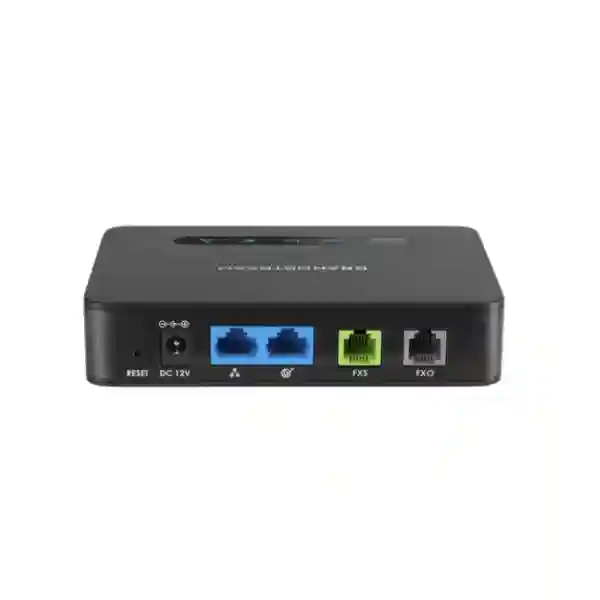
Grandstream HT813 Tanzania
The Grandstream HT813 is a compact analog telephone adapter built for organizations that need to connect an analog phone or fax device to a SIP service while retaining access to a traditional PSTN line. Its single FXS port, single FXO port and IP network interfaces make it useful for VoIP migration, branch-office voice integration, legacy device retention, remote PSTN access and continuity planning. For Tanzanian businesses moving from conventional telephony to IP communications, the HT813 provides a focused way to bridge old and new infrastructure without replacing every analog endpoint at once.
Grandstream positions the HT813 as a hybrid three-in-one gateway combining PSTN, an analog FXS interface and an IP network connection. Official specifications confirm support for two SIP profiles across its FXS and FXO functions, dual 10/100 Mbps Ethernet ports, three-way conferencing, T.38 fax, TLS and SRTP security, secure provisioning, SIP failover and lifeline operation. These capabilities make it particularly relevant where a business wants controlled migration to VoIP while preserving a physical telephone line for routing or backup.
1 RJ11 port
1 RJ11 port
2 profiles
2 × 10/100
What the Grandstream HT813 Does
The HT813 is not simply an adapter for an old telephone. Its design serves a more specific role: it gives an analog device an FXS connection to a SIP-based voice service while also providing an FXO interface that can connect to a traditional PSTN line. In practical terms, this means a business can keep an existing analog handset or fax machine, register the adapter to a compatible SIP platform, and preserve a physical telephone-line path for selected incoming or outgoing call scenarios. This is especially useful when a site is migrating gradually, operates legacy equipment that cannot be replaced immediately, or requires a fallback route that remains separate from its IP voice service.
The FXO port differentiates the HT813 from basic one- or two-port ATAs that only expose FXS connections. The FXO interface can terminate a PSTN line and bring that line into a VoIP environment, allowing the device to originate or terminate calls between IP and traditional telephony according to the configured dial plan and call-routing logic. The FXS port can meanwhile extend a SIP account to one analog telephone or compatible fax endpoint. This combination is useful in small offices, branch locations, remote sites, reception areas, equipment rooms and transitional deployments where businesses need an uncomplicated bridge between telephone technologies.
For organizations planning an IP telephony project, the HT813 can be considered alongside broader FourTeck Tanzania business technology solutions, particularly where voice requirements intersect with switching, firewalling, structured cabling, internet reliability and power protection. A successful ATA deployment depends on more than the adapter itself: SIP credentials, network addressing, quality-of-service settings, firewall policy, dial plans, PSTN behavior and power conditions all influence the final user experience.
Verified Grandstream HT813 Features
One RJ11 FXS port connects an analog phone or fax device, while one RJ11 FXO port connects a PSTN line and supports lifeline operation.
Grandstream specifies two SIP profiles through the FXS and FXO functions, supporting separate VoIP and PSTN integration workflows.
Two 10/100 Mbps RJ45 interfaces provide WAN and LAN connectivity, with integrated NAT-router functionality for supported deployment modes.
T.38 fax relay is supported, with G.711 fax pass-through available where appropriate. Fax operation should still be validated with the selected SIP service.
Support includes TLS for SIP signaling, SRTP for media protection, HTTPS management and strong AES-based provisioning security.
A failover SIP server can be configured so the device can switch to a secondary server when the primary becomes unavailable.
Grandstream documents TR-069 and XML configuration options together with HTTP, HTTPS, FTP, FTPS, TFTP and related management methods.
When power is lost, the FXS port can be hard-relayed to the FXO line, giving the connected analog phone direct access to the PSTN path.
Technical Specifications and Integration Guidance
| Area | Grandstream HT813 specification |
|---|---|
| Telephone interfaces | 1 × RJ11 FXS and 1 × RJ11 FXO PSTN line port with lifeline support |
| Network interfaces | 2 × 10/100 Mbps RJ45 ports with integrated NAT router |
| SIP | SIP RFC 3261, SIP over TCP/TLS and two SIP profiles |
| Voice codecs | G.711, G.723.1, G.729A/B, G.726, iLBC and OPUS, with jitter-buffer and echo-cancellation features |
| Fax | T.38 Group 3 fax relay up to 14.4 kbps and G.711 fax pass-through |
| Security | SRTP media, TLS/SIPS/HTTPS control protection, secure provisioning and device certificates |
| QoS | 802.1Q VLAN, 802.1p, ToS, DiffServ and MPLS support |
| Power and environment | 12V/0.5A output supply; documented operating range 0°C to 40°C and 10–90% non-condensing humidity |
These specifications describe the device capability; they do not guarantee compatibility with every carrier, PBX or analog endpoint. Before purchasing, confirm the SIP platform, PSTN signaling, caller-ID method, DTMF requirements, codec policy and fax requirements. In business deployments, it is also sensible to verify network segmentation, firewall traversal, DNS and NTP, firmware policy and whether provisioning will be manual or centralized.
When the HT813 Is the Right Choice
The HT813 is a good fit when a requirement specifically calls for both an analog endpoint and a PSTN line interface in one compact gateway. Typical examples include retaining a single analog reception phone while the business moves to SIP, connecting a legacy fax device to a modern voice platform, giving a remote site controlled access to a local PSTN line, or introducing VoIP while preserving a physical line as a fallback path. It can also be valuable in small branch environments where a larger analog gateway would add unnecessary ports and complexity.
It is not always the best option when many analog extensions or many PSTN lines must be connected. In that situation, a higher-density gateway or IP PBX architecture may be more appropriate. Similarly, if the requirement is simply to add a SIP desk phone, an IP phone may eliminate the need for an analog adapter altogether. The selection should start with the number of analog endpoints, number of PSTN lines, expected call paths, emergency-calling requirements, SIP provider compatibility and continuity objectives.
Deployment, Configuration and Voice-Network Planning
A typical deployment connects the analog telephone or fax machine to the FXS port, the PSTN line to the FXO port, and the HT813 WAN interface to the LAN, router or switch. Grandstream also documents a LAN-port mode in which the unit can provide DHCP functionality. For most managed business networks, the preferred topology should be chosen deliberately rather than simply accepting factory defaults. Confirm whether the ATA belongs on a dedicated voice VLAN, whether static addressing or DHCP reservation will be used, and what firewall rules are necessary for the chosen SIP platform.
Call routing deserves particular attention because the device can bridge IP and PSTN paths. Dial plans should be designed to avoid unintended toll exposure, accidental loops or ambiguous routing. Decide which calls should leave through the SIP service, which may use the PSTN line, what should happen when registration fails, and whether the FXO line should accept inbound calls into the VoIP side. Secure administration should include a strong management password, controlled web access and current firmware. Organizations operating multiple ATAs should consider Grandstream-supported automated provisioning methods rather than configuring each unit manually.
Network quality affects voice quality. Packet loss, jitter, saturated internet links and incorrect QoS can degrade calls even when the ATA is working correctly. Where a site carries voice alongside data, wireless traffic, backups, cloud applications or video, quality-of-service policy and adequate WAN capacity become important. The HT813 supports VLAN and Layer 2/Layer 3 QoS mechanisms, but those features only help when the surrounding network is configured consistently. Customers designing a wider voice environment may also review the FourTeck IP phone and voice endpoint portfolio for SIP desk-phone and business telephony options that complement ATA-based migration.
Grandstream HT813 Tanzania
For organizations in Tanzania, the Grandstream HT813 is most relevant where existing analog telephony still has operational value but the business wants the flexibility, manageability or cost structure of SIP-based communications. Many offices do not need to replace every legacy device immediately. A branch may have one trusted analog phone, a fax machine that remains part of a business process, or a PSTN line retained for continuity. In those cases, the HT813 offers a compact transition point with one FXS interface for the analog device and one FXO interface for the physical line.
Procurement should begin with the communication requirement rather than the model number alone. Confirm whether the organization needs a single analog extension, a single PSTN line, or both. Identify the SIP platform or carrier, the expected inbound and outbound routes, and any caller-ID or DTMF requirements. If fax is important, confirm that the provider and network path can support T.38 or an acceptable G.711 pass-through configuration. If the PSTN line is intended as backup, define exactly what should happen during a power loss, registration failure or internet outage. The HT813 includes lifeline behavior, but wider continuity still depends on the power and availability of the surrounding PBX, router, switch and provider infrastructure.
Tanzania deployments should also consider network conditions and power quality at the specific site. A UPS for the router, switch and voice infrastructure can reduce avoidable interruptions during short power events. Where the HT813 is connected to a managed LAN, voice VLANs and QoS can help maintain predictable performance when the same network carries cloud applications, large file transfers or video. Businesses that are building a complete voice environment can use FourTeck Tanzania as a starting point for wider telephony, switching and security planning, rather than treating the ATA as an isolated box. For regional projects, the FourTeck regional technology network can also be relevant when the same organization operates across multiple countries.
Grandstream HT813 Dar es Salaam
Dar es Salaam businesses often combine established telephone practices with newer IP-based systems, making the HT813 a practical option for selective migration. A trading company, logistics office, professional-services firm, clinic, school, hospitality operator or branch location may have one analog device that remains useful while the rest of the communication platform moves toward SIP. The HT813 lets that device participate in a VoIP environment while also providing a dedicated FXO interface for a PSTN line. This makes the adapter especially relevant for small sites that need flexibility without deploying a larger multi-port analog gateway.
Before ordering for a Dar es Salaam site, document the existing telephone line and the intended SIP platform. Verify whether the physical PSTN line uses signaling and caller-ID behavior supported by the deployment. Clarify whether inbound calls arriving on the FXO line should terminate at the local analog phone, pass into an IP PBX, or follow a specific routing rule. For outbound calls, decide whether SIP is the preferred route and under what conditions the PSTN line may be used. This planning reduces call-routing surprises and helps installers create a clear dial plan.
For offices with business broadband, voice should be protected from avoidable congestion. The HT813 supports VLAN and QoS mechanisms, but the router and switch should also be configured to respect them. Sites using cloud backups, CCTV uploads or large transfers can benefit from traffic management so voice packets are not delayed by bulk data. Security should include updated firmware, strong credentials and restricted administration access. If the Dar es Salaam deployment is part of a broader IP PBX rollout, evaluate extension numbering, reception routing, emergency-calling arrangements and how the PSTN fallback fits into the overall design. A well-planned HT813 installation becomes a deliberate bridge between legacy and IP telephony instead of a temporary workaround.
Grandstream HT813 Mwanza
In Mwanza, the Grandstream HT813 can suit branch offices, service businesses, schools, clinics and commercial sites that need a compact interface between analog telephone equipment and SIP communications. The single FXS port is ideal when only one analog endpoint must be retained, while the FXO port provides a way to connect a traditional telephone line. This combination can be attractive for organizations that do not want a large gateway but still need controlled PSTN access or a straightforward migration path toward VoIP.
A Mwanza buyer should first identify the business process tied to the analog device. If it is a fax machine, confirm that fax remains necessary and test compatibility with the intended SIP provider. T.38 support is built into the HT813, but end-to-end fax reliability depends on the provider and network. If the device is an analog phone, decide whether it will be used as a normal SIP extension, a backup handset, or a local point that must access the PSTN line during specific conditions. If the FXO port is being used for inbound PSTN calls, define where those calls should route and how unanswered or busy calls should be handled.
For network design, avoid placing voice equipment on an unmanaged or overloaded LAN if the site depends on consistent call quality. The adapter’s dual 10/100 Mbps ports are adequate for its role, but broadband quality, packet loss, jitter and router performance matter more than raw Ethernet speed. A documented IP address, secure admin credentials, firmware version and configuration backup simplify future troubleshooting. If the site is remote from the organization’s main IT team, automated provisioning can reduce maintenance effort. The HT813 supports several Grandstream provisioning options, so a business can move beyond one-off manual configuration when deploying multiple units across branches.
Grandstream HT813 Arusha
Arusha organizations in hospitality, tourism, education, professional services and administration may need to preserve selected analog services while modernizing their communication systems. The Grandstream HT813 addresses that requirement with a compact FXS/FXO design. One analog phone or fax endpoint can connect to the FXS port, while one conventional line can terminate on the FXO port. SIP registration allows the device to participate in an IP telephony platform, creating a controlled bridge between legacy copper services and modern VoIP.
For hospitality and guest-service environments, the value of an HT813 deployment is usually not the adapter itself but the continuity of a specific analog workflow. A legacy device may still be linked to reception, a back-office function or a specialized service. Before implementation, confirm whether that workflow should remain analog, whether it can be replaced by a native SIP endpoint, and whether PSTN access is necessary. If the analog device is mission-critical, document what happens during internet failure, PBX outage and power loss. The HT813’s lifeline function can directly relay the FXS port to the FXO line during power loss, but the business should still validate the desired behavior through testing.
Network readiness is equally important. The device supports SIP over TCP/TLS, SRTP, VLAN tagging and QoS, but those capabilities should be matched by the surrounding network. Voice traffic may need separation from guest Wi-Fi or high-volume data. Firewall rules should be specific to the SIP environment rather than overly broad. Remote administration should not be exposed unnecessarily. For multi-site operators using Arusha as one branch among several, naming standards, configuration templates and centralized provisioning can make support more predictable and reduce differences between locations.
Grandstream HT813 Dodoma
The Grandstream HT813 is relevant in Dodoma for offices and institutions that are moving toward SIP telephony while retaining a limited number of traditional analog connections. Government-facing businesses, education organizations, professional offices, NGOs, branch operations and service providers may all encounter situations where a single analog handset, fax or PSTN line still needs to coexist with IP communications. The HT813 provides one FXS port, one FXO port and IP connectivity in a compact form factor, making it easier to solve a specific migration requirement without deploying a large analog gateway.
Planning should begin with call flow. If the analog device is to operate as a SIP extension, record the extension number, authentication credentials, codec policy and voicemail behavior. If the FXO line is intended for fallback, define which users or dial patterns may access it. If inbound PSTN calls should enter an IP PBX, determine the destination and what should occur outside office hours. The two SIP-profile capability provides flexibility, but it also means configuration must be deliberate. Weak dial plans or open routing can create unwanted call behavior, so deployment should be documented and tested with representative scenarios.
For a Dodoma site, power and connectivity resilience may be as important as the ATA. A UPS protecting the router, switch and PBX can keep VoIP available during short interruptions, while the HT813 lifeline function provides a separate behavior when the adapter itself loses power. Administrators should test each failure mode rather than assuming continuity. Firmware should be maintained from Grandstream’s supported releases, passwords changed from defaults, and management access limited to trusted networks. If the organization is expanding beyond one site, use consistent templates for SIP credentials, VLAN settings, time services, syslog and configuration backup so the deployment remains supportable.
Grandstream HT813 UAE
For businesses in the UAE, the Grandstream HT813 is useful when a SIP deployment must interface with one analog endpoint and one traditional line. The device can support migration projects, remote branch requirements, fax connectivity and carefully designed PSTN fallback scenarios. Because the UAE market includes organizations with sophisticated IP PBX platforms as well as smaller offices that still depend on analog workflows, the HT813 can fill a narrow but valuable role between legacy equipment and modern unified communications.
Procurement should not assume that every PSTN, SIP or hosted-voice service behaves identically. Confirm the approved telecom environment, SIP credentials, caller-ID requirements, DTMF method, fax support and any provider-specific restrictions before deployment. If the FXO interface is intended for a local line, test disconnect supervision and incoming call detection. If the FXS port is used for fax, perform real end-to-end tests rather than relying only on configuration screens. For enterprise sites, align the device with security policy by enabling supported secure protocols, restricting administrative access and maintaining firmware.
Companies operating in the UAE can also evaluate dedicated regional options through FourTeck Grandstream UAE resources when they need broader Grandstream phones, gateways or IP PBX solutions. A regional deployment may include the HT813 at small branches while larger offices use native SIP phones and higher-capacity gateways. Keeping configuration standards consistent across countries reduces support effort. Use repeatable dial plans, naming conventions, password policy, firmware maintenance and centralized provisioning where possible. The objective is not to maximize the number of adapters but to use the HT813 where an analog-to-IP or PSTN-to-SIP bridge genuinely solves a business requirement.
Grandstream HT813 Uganda
In Uganda, the HT813 can support organizations modernizing from conventional telephone lines to SIP without abandoning every analog device immediately. The FXS port enables one analog telephone or fax endpoint to participate in a VoIP service, while the FXO port can connect one traditional line for routing or continuity. This focused capacity is appropriate for branches and small sites that need only one analog endpoint and one PSTN interface rather than a larger multi-port gateway.
A successful Uganda deployment starts with the carrier and PBX environment. Confirm whether the SIP account will register directly to the HT813 or whether the adapter will register as an extension on an IP PBX. If using an IP PBX, define the extension context, permitted outbound routes and how inbound FXO calls should enter the system. If using the PSTN line as fallback, decide whether failover is automatic, dial-plan based or reserved for specific scenarios. Lifeline support can provide direct FXS-to-FXO access during power loss, but operational policies and user instructions should reflect how the site is expected to behave.
For organizations with several Uganda locations, the FourTeck Uganda technology site can support wider regional planning around voice, networking and related infrastructure. Multi-site consistency matters: use matching firmware versions, standard provisioning files and controlled management access. Voice quality also depends on WAN stability, so monitor packet loss and jitter and avoid allowing high-bandwidth applications to consume all available uplink capacity. Where branch connectivity is variable, the value of an FXO fallback path should be tested under real outage conditions, not just documented theoretically.
Grandstream HT813 Kampala
Kampala offices often operate mixed technology estates where cloud applications, SIP telephony and legacy analog services coexist. The Grandstream HT813 is designed for precisely this kind of transition at a small scale. It can connect one analog endpoint to VoIP and one PSTN line to the IP environment, allowing businesses to preserve a specific legacy function while upgrading the rest of the voice platform. This makes it appropriate for reception areas, small departments, satellite offices and temporary migration stages.
Because Kampala sites may use different ISPs, routers and hosted voice providers, compatibility should be checked before mass deployment. Confirm SIP transport, NAT behavior, firewall rules, DNS and time synchronization. If secure signaling and media are required, the HT813 supports TLS and SRTP, but the chosen PBX or provider must also support and correctly configure those protocols. For fax, validate T.38 end to end. For PSTN integration, confirm line behavior and test caller-ID presentation, disconnect detection and inbound routing.
Operationally, it is useful to treat the adapter as managed network equipment. Record its serial number, MAC address, IP address, firmware, SIP assignment and physical location. Back up the configuration before major changes and use a change log for dial-plan or routing updates. If the office has a managed switch, place voice traffic in an appropriate VLAN and apply QoS consistently across the path. If the HT813 is being deployed because of a recurring internet issue, do not rely on the ATA alone; review WAN resilience, router health and backup connectivity as part of the same project.
Grandstream HT813 Arua
For an Arua branch or remote site, the HT813 can provide a practical connection between an analog phone, a local PSTN line and a central SIP platform. The compact one-FXS/one-FXO design is useful when the location has modest voice needs and does not justify a large gateway. A business can retain a familiar analog device, register the ATA to an IP PBX, and keep a physical telephone line available for selected call paths or power-loss lifeline use.
Remote sites benefit from simple, repeatable deployment. Before shipping or installing the unit, prepare the SIP profile, dial plan, VLAN settings, management credentials and firmware policy. If the site will be supported from another city or country, consider secure remote management and centralized provisioning rather than exposing the web interface directly to the public internet. The HT813 supports several automated provisioning mechanisms that can reduce the need for local manual configuration. Documentation should also include a recovery procedure so staff know what to do if the internet, PBX or power supply fails.
Connectivity quality should be measured, not assumed. VoIP can remain usable on modest bandwidth, but it is sensitive to delay, jitter and packet loss. The local router should prioritize real-time voice traffic where appropriate and avoid unnecessary SIP ALG behavior if it conflicts with the chosen platform. If the analog phone is expected to use the PSTN line during outages, test the lifeline path by simulating a power-loss condition in a controlled maintenance window. This confirms cabling and line behavior before an actual incident. For organizations operating many small sites, a standard branch design can make HT813 deployments easier to audit and maintain.
Grandstream HT813 Mbarara
In Mbarara, the Grandstream HT813 can serve businesses that want the advantages of SIP telephony without discarding a useful analog phone, fax machine or PSTN line. Its FXS port converts one analog endpoint into a SIP-capable device, while the FXO port provides a gateway to a traditional line. This design can be valuable for retail offices, service centers, education sites, clinics, small hotels and branch operations with limited analog requirements.
The key buying question is whether one FXS and one FXO port are enough. If the organization has several analog extensions or multiple PSTN trunks, a higher-capacity gateway may be more efficient. If only one legacy endpoint remains, the HT813 avoids purchasing unused ports. Buyers should also check whether a dedicated native SIP phone could replace the analog endpoint. The ATA is most valuable when there is a clear reason to preserve the existing device or line, such as process continuity, faxing, local-line access or staged migration.
Implementation should include a test plan covering inbound SIP, outbound SIP, inbound FXO, outbound FXO, caller ID, DTMF, transfer, hold, conferencing where required and fallback behavior. If fax is used, include several real documents and destination types in the test. Secure the administrator account, keep firmware current and restrict management access. Where possible, collect syslog data or document basic troubleshooting steps so failures can be diagnosed quickly. A small device can still become business-critical if it carries a unique telephone line, so configuration backup, labeling and power protection are worthwhile even for a single-unit installation.
Grandstream HT813 Gulu
The HT813 can be an effective voice-migration tool for Gulu organizations that need a small hybrid gateway instead of a high-density analog platform. One analog handset or fax machine connects to the FXS port, one PSTN line connects to the FXO port, and SIP service is delivered through the network interface. This simple architecture suits offices and branches where the requirement is very specific: keep one analog service available while integrating with an IP voice platform.
For Gulu deployments, determine how the device will be managed after installation. If the IT team is not located on site, configuration consistency is important. Prepare standard templates for account settings, dial plan, time zone, NTP, security and firmware. Grandstream’s automated provisioning options can support this approach. Avoid sharing generic passwords across sites, and do not expose the management interface to the public internet without a strong security reason and protective controls. If remote access is needed, use a secure management path through the organization’s network.
Voice continuity should be tested against realistic failures. Pull the WAN connection and verify the intended SIP failover behavior. If a secondary SIP server is configured, confirm registration and call handling. Remove power in a planned test and verify the FXS-to-FXO lifeline operation. Test the actual PSTN line for dial tone and expected call restrictions. These checks turn vendor features into verified site behavior. Where power or internet is unstable, use UPS protection for the router and switch and consider broader WAN resiliency. The HT813 can contribute to continuity, but a full resilient design also depends on upstream devices, the SIP service and the quality of the local network.
Grandstream HT813 Kenya
Kenyan businesses can use the Grandstream HT813 when they need to preserve a single analog endpoint and integrate a single PSTN line into a SIP environment. This is a common need during gradual migrations, where most users move to IP phones but one fax, legacy handset or local line remains operationally important. The adapter offers a compact way to connect that requirement without introducing a large gateway or unnecessary port capacity.
For procurement in Kenya, confirm the exact role of the FXO port. If it terminates an analog carrier line, verify compatibility with local line signaling and caller ID. If the device is linked to an analog port from an existing PBX instead of a carrier line, test the interaction carefully. For SIP service, identify whether registration is direct to a hosted provider or to an on-premises or cloud PBX. Configure dial plans so users have predictable routes and cannot accidentally bypass policy. If multiple branches are being standardized, define one baseline configuration and then adjust only site-specific values.
Organizations that operate across East Africa may coordinate this equipment with the FourTeck Kenya technology portfolio to plan voice, networking and related infrastructure in the Kenyan market. Secure operation should include strong passwords, current firmware and restricted management. If a provider supports encrypted SIP and media, the HT813 has TLS and SRTP capabilities that can be incorporated into the design. For fax or modem-like analog applications, do not assume VoIP behavior will match a pure copper line. Test the specific endpoint and provider because network impairments and codec negotiation can affect reliability.
Grandstream HT813 Kuwait
In Kuwait, the HT813 can support offices and branch environments where a modern SIP platform must coexist with an analog handset, fax machine or traditional line. Its one-port FXS and one-port FXO architecture is intentionally compact, making it suitable where the requirement is small but operationally important. Companies with distributed branches can deploy the same adapter model at selected locations while using native IP phones elsewhere, maintaining a consistent Grandstream ecosystem without overbuilding analog capacity.
Before deployment, identify provider and regulatory requirements for the voice service. Check SIP registration details, transport options, codec support, number presentation and any restrictions on PSTN interconnection. If the FXO line provides emergency or continuity value, document that purpose and test it. Lifeline behavior is triggered at the device level, but the organization should also consider whether the physical line itself remains active and whether users know how to access it during an outage. A label near the analog phone can provide simple operational guidance.
Enterprise security teams should integrate the HT813 into standard network policy. Use approved VLANs, firewall controls, secure management and firmware maintenance. Disable unnecessary services if organizational policy requires it, and limit administration to authorized hosts. Central provisioning can be particularly useful when the adapter is deployed across many offices. The small hardware footprint does not remove the need for governance: each unit contains SIP credentials and can provide a route to PSTN resources. Maintain an inventory, configuration backup and ownership record so changes are controlled over the product lifecycle.
Grandstream HT813 Ghana
The Grandstream HT813 can meet the needs of Ghanaian businesses that are transitioning from analog telephony to VoIP one function at a time. A single analog phone or fax can be connected through the FXS port while the FXO interface connects to a traditional line. This lets a business preserve selected legacy workflows while gaining SIP connectivity, centralized call routing and the potential for integration with a modern IP PBX.
The most effective projects define the business reason for retaining analog equipment. If the requirement is fax, investigate whether an electronic fax workflow could replace the device; if not, test T.38 with the provider. If the requirement is a backup telephone line, define when users should access it and how the dial plan behaves when SIP is unavailable. If the requirement is to bring PSTN calls into a VoIP system, validate caller ID, disconnect supervision and destination routing. This avoids buying the device on specification alone and discovering later that the call-flow requirement was different.
Network administrators should monitor voice performance on the WAN and apply QoS where congestion is possible. The HT813 supports common QoS mechanisms, but end-to-end results depend on every router and switch involved. Secure configuration is also important: change default credentials, use HTTPS, consider TLS/SRTP where supported by the SIP platform, and update firmware under a controlled process. For multi-branch businesses, assign consistent naming and configuration standards so each adapter can be identified quickly. Document the attached PSTN line and analog endpoint because troubleshooting is much easier when the physical and logical connections are clearly recorded.
Grandstream HT813 Nigeria
Nigeria has a wide range of business telephony environments, from fully cloud-based SIP systems to offices that continue to use analog lines for selected functions. The Grandstream HT813 is designed for a small hybrid requirement within that mix. One analog endpoint can be converted to a SIP-connected extension through the FXS port, while the FXO interface provides a path to a conventional PSTN line. This makes the model relevant for branch offices, small contact points, professional services, education, retail and organizations with a staged VoIP migration plan.
Because connectivity conditions can vary by location, deployment should include both voice-quality and failover planning. Measure latency, jitter and packet loss to the SIP platform, especially if the site uses shared internet for cloud applications, video or large uploads. Configure QoS where the network is under administrative control. If the branch has more than one WAN path, decide how SIP registration behaves during failover and verify that NAT and firewall rules remain correct. The HT813 can switch to a secondary SIP server when configured, but this is separate from internet-link failover and should be tested independently.
For PSTN integration, secure the dial plan and restrict unauthorized routes. The FXO port can provide valuable continuity, but it also creates a call path that should be governed. Test inbound line detection, outbound access, caller ID and disconnection. For fax, confirm provider support and perform repeated real-world transmission tests. If the adapter is installed in a remote branch, use configuration backups and centralized provisioning so recovery does not depend on a technician remembering site-specific settings. A disciplined rollout can make the HT813 a reliable transitional component rather than an unmanaged legacy bridge.
Grandstream HT813 Seychelles
For Seychelles businesses, the HT813 can be particularly useful in small offices, hospitality locations and branch environments where one analog service still needs to coexist with a SIP platform. The device does not try to be a large gateway; instead, it focuses on one FXS port for an analog phone or fax and one FXO port for a PSTN line. That makes it easier to justify where the requirement is narrow, such as preserving a reception handset, enabling a fax machine, or maintaining a direct analog fallback route.
Island and hospitality operations often place high value on continuity, so deployment planning should include the entire communications chain. The HT813’s lifeline capability can relay the FXS port to the FXO line if power is lost, but a robust site should also consider UPS protection for network equipment, backup internet and documented outage procedures. If the VoIP platform is cloud hosted, test calls over the actual site connection during busy periods. If the FXO line is meant for emergency or business-continuity use, verify it under controlled outage conditions and explain the procedure to staff.
Security remains important even for a small adapter. Use strong credentials, current firmware, limited management access and encrypted signaling or media where the provider supports it. If the site is part of a hotel or multi-building network, isolate voice from guest traffic and ensure the ATA’s IP addressing and switch port are documented. Fax should be validated across the chosen service because analog-to-IP conversion can expose timing sensitivities. A carefully tested HT813 can give Seychelles organizations a useful bridge between established telephone workflows and modern SIP-based communications without requiring an all-at-once infrastructure replacement.
Buying and Quotation Checklist
A useful HT813 quotation should describe the required use case clearly enough that compatibility and implementation can be assessed before deployment. Provide the number of units, destination country and city, intended SIP provider or PBX, whether the FXS port will serve a phone or fax machine, whether the FXO port will connect to a carrier PSTN line or another analog source, and the expected inbound and outbound call flow. State whether TLS/SRTP is required, whether centralized provisioning is planned, and whether the site uses VLANs or a dedicated voice network.
Frequently Asked Questions
What is the Grandstream HT813?
The HT813 is a hybrid analog telephone adapter with one FXS port, one FXO PSTN port and IP networking. It can connect an analog phone or fax device to SIP while also integrating a traditional telephone line.
What is the difference between FXS and FXO on the HT813?
The FXS port supplies an analog telephone interface for a phone or fax machine. The FXO port accepts an analog PSTN line. Their combination allows the HT813 to bridge between an analog endpoint, a telephone line and a SIP network.
Can the HT813 work with a fax machine?
Yes. Grandstream specifies T.38 Group 3 fax relay and G.711 fax pass-through. Real-world compatibility depends on the SIP provider, network conditions and destination, so fax should be tested before a business relies on it.
Does the HT813 support secure SIP?
The device supports SIP over TLS and SRTP for encrypted signaling and media, along with HTTPS management and secure provisioning features. The connected SIP service must also support compatible security settings.
What happens if power fails?
Grandstream documents lifeline support in which the FXS port can be hard-relayed to the FXO line when power is lost. The physical PSTN line must itself be operational for this path to be useful.
Can the HT813 use two SIP profiles?
Yes. Grandstream specifies support for two SIP profiles through the FXS and FXO functions, giving administrators flexibility for different VoIP and PSTN call-routing requirements.
Is the HT813 suitable for many analog phones?
No. It has one FXS port, so it directly serves one analog endpoint. Businesses with multiple analog extensions should evaluate a higher-density analog gateway or a different migration architecture.
Can the HT813 be centrally provisioned?
Yes. Grandstream documents TR-069 and XML configuration options as well as HTTP, HTTPS, FTP, FTPS and TFTP-based provisioning methods. Central provisioning is useful when multiple units are deployed.
Decision Recap
Choose the Grandstream HT813 when the requirement is specifically to connect one analog phone or fax endpoint to SIP while also integrating one analog PSTN line. Its strengths are the combined FXS/FXO architecture, compact footprint, two SIP profiles, T.38 fax capability, secure VoIP protocols, automated provisioning and lifeline behavior. Do not choose it simply because an ATA is needed; if there is no requirement for an FXO line, a simpler FXS-only adapter may be more appropriate. If several analog endpoints or PSTN lines are required, a higher-density gateway may provide a cleaner design.
For Tanzania and multi-country deployments, the best procurement decision comes from confirming endpoint type, PSTN behavior, SIP compatibility, dial plans, security, network conditions and support expectations before ordering. That approach reduces integration surprises and ensures the adapter is used where it adds real operational value.
Consult FourTeck About the HT813
FourTeck can help evaluate whether the HT813 is the right gateway for your existing analog device, PSTN line and SIP environment. Share your PBX or provider, the purpose of the FXS and FXO ports, required call routing and deployment location. A clearer requirement makes it easier to confirm the correct product, accessories and implementation approach.



Reviews
There are no reviews yet.