
DINSTAR BUSINESS SIP PHONE • TANZANIA
Dinstar G500 Business IP Phone
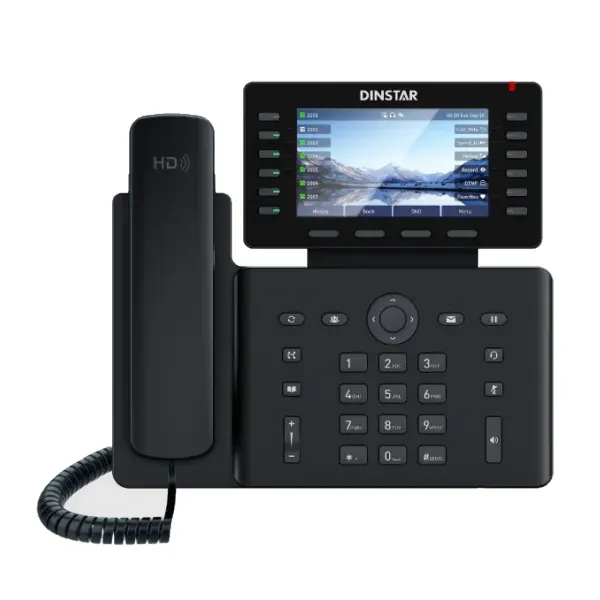
The Dinstar G500 is a high-end business SIP phone designed for demanding desk users who need many line appearances, fast one-touch functions, high-definition audio and a large colour interface. Official Dinstar information lists a 5-inch 1280×720 backlit colour display, support for up to 20 SIP accounts, 10-way conferencing, dual Gigabit Ethernet, USB 2.0 expansion, full-duplex speakerphone audio and programmable multi-colour line keys. It is positioned for managers, reception teams, supervisors, sales desks, contact-centre users and other roles where call handling is a core part of daily work.
The base G500 and the G500P share the core feature platform, but power differs: the G500 is supplied for adapter-powered use, while the G500P is the PoE-capable variant. Buyers should therefore specify the exact model required instead of assuming that every G500-labelled unit supports Power over Ethernet.
What the Dinstar G500 solves
A standard two-line office phone can be sufficient for a light calling role, but it becomes inefficient when a user must monitor many extensions, transfer calls repeatedly, manage several SIP identities, check colleague status or reach frequently used destinations without hunting through menus. The G500 is designed for that heavier workload. Its 12 physical line keys can work across five pages for up to 60 programmable line-key positions, while four soft keys and a customizable key layout give administrators room to map functions such as speed dial, busy-lamp-field monitoring, transfer targets and other PBX-supported actions. One line key can also be assigned as a customizable AI key according to Dinstar’s documentation.
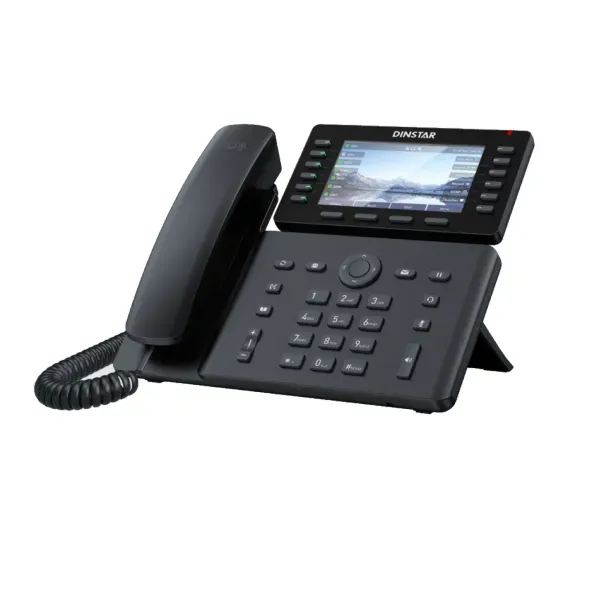
The larger 5-inch display is particularly useful for users who need more visible information than entry-level phones provide. The 1280×720 resolution gives menus, contact lists and line information a clearer workspace. Dinstar also specifies an adjustable display hinge and a dual-angle stand, which can help users position the phone for different desk heights and viewing angles.
Audio is another part of the business-use case. The platform supports HD voice with wideband codecs including G.722 and OPUS-WB, along with full-duplex speakerphone operation, echo cancellation, dynamic jitter handling, voice-activity detection and comfort-noise generation. These capabilities matter most when the surrounding network, SIP platform and far-end endpoints are also configured to support suitable codecs and call quality.
High call density
Up to 20 SIP accounts and extensive programmable key capacity make the G500 suitable for users who manage several lines, departments, queues or identities.
Clear collaboration
A 10-way local audio conference gives teams a practical way to bring multiple participants into a call without immediately moving to a separate conferencing service.
Headset-ready workflow
Dinstar lists EHS wireless-headset support for Plantronics, Jabra and Sennheiser families, subject to selecting a compatible headset and connection method.
Centralized administration
FTP, TFTP, HTTP, HTTPS and PnP provisioning, web administration, SNMP, TR-069, syslog and Dinstar NMS support can simplify multi-phone deployment.
Verified Dinstar G500 features
| Display | 5-inch 1280×720 colour SPI display with backlight |
| SIP accounts | Up to 20 SIP accounts |
| Conferencing | 10-way audio conferencing |
| Network | Two RJ45 10/100/1000 Mbps Ethernet ports |
| Audio | HD voice, full-duplex speakerphone, G.722 and OPUS-WB plus supported narrowband codecs |
| Programmable keys | 12 line keys across five pages, providing up to 60 programmable line-key positions |
| USB | USB 2.0 for supported accessories such as Wi-Fi/Bluetooth dongles and USB use cases documented by Dinstar |
| Security | SIP over TLS, SRTP, 802.1X and OpenVPN among supported protocols |
| Provisioning | FTP/TFTP/HTTP/HTTPS/PnP auto provisioning, web management, SNMP, TR-069, syslog and NMS |
| Phonebook | Up to 1,000 local phonebook groups, remote phonebooks and LDAP support |
| Power distinction | G500: adapter-powered model. G500P: PoE-capable model with optional adapter. |
G500 or G500P: confirm power before ordering
The G500 and G500P are closely related, but they are not identical in power design. Official Dinstar documentation distinguishes the base G500 as the version supplied for operation with a DC adapter, while the G500P supports IEEE 802.3af Power over Ethernet and can use an optional adapter. For a large deployment this distinction is important. If the project standard is to power handsets from a UPS-backed PoE access switch, specify the G500P. If adapter power is acceptable at the desk, the G500 may fit. Always confirm the exact suffix, included power accessories and switch PoE capacity on the quotation.
PBX compatibility and integration planning
Dinstar states that the G500/G500P platform is compatible with Dinstar UC/IP PBX products and has been positioned for use with common third-party platforms including 3CX, Asterisk, Yeastar, Xorcom, VoIP.ms, BroadSoft and FreeSWITCH. Compatibility still needs to be checked at the feature level. Basic SIP registration may work while advanced functions such as BLF behavior, remote directories, EHS control, provisioning templates, transfer keys, call recording or vendor-specific XML services may require platform-specific configuration.
Before deployment, document the SIP server or PBX, authentication method, extension numbering, outbound proxy if used, DTMF method, codec policy, time server, VLAN settings, provisioning server, firmware policy and security requirements. For larger phone counts, create a repeatable configuration template rather than configuring every handset manually. This reduces inconsistency and makes troubleshooting more predictable.
For related architecture guidance, review FourTeck Tanzania’s integrated IT and telecom solutions, the Tanzania business technology shop, and deployment and support services. These pages explain why IP phones should be planned together with PBX call flow, switching, VLANs, PoE, cabling and security rather than treated as isolated desk accessories.
Dinstar G500 Business IP Phone Tanzania
For businesses in Tanzania, the Dinstar G500 is most relevant where a desk user handles more communication than a standard office handset is designed for. Reception staff, service supervisors, sales managers, executive assistants, operations coordinators and contact-centre team leaders frequently need to watch extension status, answer several line identities, perform attended transfers, reach colleagues quickly and manage calls without navigating multiple menu levels. The G500’s high SIP-account capacity and programmable-key layout directly address that type of workflow. Its 5-inch display also provides a larger interface for contacts, call history, status information and menu navigation.
A Tanzania deployment should start with the voice architecture. Confirm whether the company uses an on-premises IP PBX, a hosted SIP platform or a hybrid arrangement. Identify the number of extensions, the users who genuinely need twenty-account capacity, the queues or ring groups that must be visible, and the headset requirements. This prevents overspecifying every desk while underspecifying the small number of power users who actually need richer controls. The G500 is best used where its programmable keys, conferencing and visible call handling create measurable operational value.
Network readiness is equally important. Voice traffic should have stable latency, low packet loss and appropriate quality-of-service treatment. Where phones and computers share desk cabling, the dual Gigabit Ethernet ports allow the handset to sit inline between the wall outlet and workstation. If the organization uses voice VLANs, validate switch configuration, DHCP behavior and PBX reachability before rollout. For the base G500, plan reliable adapter power. If centralized PoE is a requirement, evaluate the G500P instead and calculate switch PoE budgets carefully.
Tanzanian procurement teams should request the exact model, quantity, PBX platform, power preference, headset requirement, delivery destination and configuration scope. The quotation should state whether adapters are included, whether the model is G500 or G500P, and whether deployment includes provisioning or only hardware. Businesses migrating from analog telephony can also review verified related Dinstar products such as the Dinstar DAG1000-1S analog telephone adapter, which is relevant where a legacy analog endpoint must coexist with SIP calling. A well-scoped project treats the G500 as one component in a complete IP telephony environment rather than as a standalone purchase.
Dinstar G500 Business IP Phone Dar es Salaam
Dar es Salaam offices often have the highest concentration of customer-facing, administrative and multi-line call roles within Tanzanian organizations. Headquarters, logistics companies, professional services firms, clinics, hospitality businesses, retailers and regional operations may have reception desks that answer several numbers, managers who maintain more than one SIP identity, or supervisors who need to monitor teams and transfer calls quickly. The Dinstar G500 suits these heavier-use positions because it provides up to 20 SIP accounts, 10-way conferencing and a dense programmable-key interface without requiring an external console for many common workflows.
For a Dar es Salaam headquarters, the correct design is usually role-based. General users may only need an entry-level SIP handset, while reception, sales leadership and support supervisors benefit from the G500’s larger screen and configurable line keys. Mapping BLF, speed dial, transfer targets, call pickup, voicemail and queue-related functions to the keys can reduce repetitive navigation. Administrators should agree on a consistent template so that phones used in similar roles behave the same way. A user moving between branches then encounters a predictable layout rather than a different configuration at every desk.
Power and switching decisions should be made before procurement. If the project wants phones powered through access switches, choose the PoE-capable G500P and verify that the switch has enough PoE budget for the full endpoint count. If the base G500 is selected, plan adapter outlets and UPS strategy for critical desks such as reception. The dual Gigabit ports can support a workstation connected through the phone, but VLAN and QoS configuration should be tested with the exact switch model. Voice should not compete blindly with backups, CCTV uplinks or large file transfers on a congested network.
Businesses consolidating older analog lines during a Dar es Salaam migration may also need gateway hardware. The Dinstar DAG1000-1S1O hybrid VoIP gateway is a related FourTeck Tanzania product for projects where one FXS and one FXO style requirement exists, while the G500 remains the IP desk endpoint. Keeping endpoint, PBX, gateway and LAN planning in the same scope helps avoid late discoveries about port types, power, call routing or compatibility.
Dinstar G500 Business IP Phone Mwanza
In Mwanza, the G500 can be a strong fit for regional headquarters, branch offices, service companies, healthcare operations, education organizations, logistics desks and businesses that coordinate calls between local staff and teams elsewhere in Tanzania. A branch may not need a high-end phone at every seat, but certain roles can benefit significantly from more programmable keys and more visible line information. Receptionists, branch managers and dispatch-style staff often need direct access to internal extensions, frequently called destinations and transfer targets.
The first Mwanza design question should be how the phone reaches the PBX. If registration traverses a VPN or wide-area link to a centralized platform, call quality depends on the entire path. Packet loss, variable latency and congestion will affect voice even when the handset supports wideband codecs and dynamic jitter management. Network teams should test real conditions during business hours, identify the preferred codec policy, confirm firewall behavior and ensure that QoS is implemented consistently across the LAN and WAN where practical.
The G500 supports administrative tools that are useful for distributed operations: web configuration, auto provisioning over FTP/TFTP/HTTP/HTTPS/PnP, SNMP, TR-069, syslog, firmware updates and Dinstar NMS. These features allow an organization to create a standard branch profile rather than maintaining phones as one-off devices. Secure management is essential; remote administration should be restricted to trusted networks, credentials should be controlled, firmware versions documented and configuration backups protected.
When quoting a Mwanza deployment, provide the number of G500 users, extension scheme, PBX platform, power model and headset requirements. If analog devices remain at the branch, compare the required interface carefully. The Dinstar DAG1000-2S two-FXS adapter may be relevant when two analog endpoints must connect to SIP, while the G500 serves staff who need a full IP handset. This division keeps legacy-device migration separate from high-feature user endpoints and makes the bill of materials easier to understand.
Dinstar G500 Business IP Phone Arusha
Arusha has a diverse business environment that includes tourism, hospitality, professional services, education, healthcare and regional operations. These organizations can have demanding front-desk and coordination roles where telephone usability matters. A hotel or tour operator, for example, may need quick transfer access to reservations, transport, management and accounting. A professional office may have an executive assistant handling several lines. The Dinstar G500 provides the programmable capacity to map those recurring actions to visible keys, while the large colour screen improves navigation compared with compact entry-level endpoints.
For hospitality or customer-service use, headset selection can be as important as the phone itself. Dinstar documents support for third-party EHS wireless headsets from major headset families, but buyers should confirm the exact headset model and connection requirements before ordering. A good headset configuration allows staff to move around a reception or service area while maintaining call control, provided the accessory, EHS method and local environment are compatible.
Arusha projects should also consider internet and power resilience. If the PBX is cloud-based or located in another city, a stable WAN path is essential. If reception calling is business-critical, plan UPS protection for switches, routers, firewalls and the phone’s power source. The base G500 uses adapter power, so a local UPS-backed outlet may be required; the G500P can instead receive IEEE 802.3af PoE from a supported switch. Neither approach is automatically better: the correct choice depends on the existing LAN design and how the site protects network power.
Where an Arusha property is modernizing a mixed telephone environment, identify any analog trunks or devices separately. The Dinstar DAG1000-2O FXO VoIP gateway is a different class of product intended for analog trunk integration, not a substitute for the G500 desk phone. Keeping these functions distinct prevents interface confusion and enables a clearer quotation covering endpoints, PBX, gateway requirements, switching, cabling and deployment.
Dinstar G500 Business IP Phone Dodoma
Dodoma organizations may evaluate the Dinstar G500 for government-related offices, institutions, professional services, education, healthcare, NGOs and companies operating administrative headquarters or branches. These environments often place value on clear extension plans, predictable call routing and standardized equipment. The G500 can serve higher-demand users who need to manage numerous extensions and line appearances while keeping the interface visible and consistent.
A well-planned Dodoma rollout begins with call-flow mapping. Define the main numbers, receptionist behavior, after-hours routes, departmental ring groups, pickup groups and voicemail policy before assigning keys. The G500’s programmable capacity is valuable only when the key map reflects real work. Avoid filling every position with functions simply because the phone supports them. Instead, prioritize frequently used destinations and actions, group similar functions logically, and document the template so another administrator can maintain it later.
Security should also be addressed as part of the deployment. Dinstar lists SIP over TLS and SRTP, 802.1X and OpenVPN among supported protocols. Whether those features should be enabled depends on PBX compatibility and the network architecture. Encryption must be supported end to end, certificates and credentials need lifecycle management, and troubleshooting procedures should account for secured signaling. Even when voice encryption is not used, management interfaces should be protected with strong credentials and restricted access.
For procurement, specify the exact G500 variant, quantity, role profile, PBX, headset requirement and power method. If the site includes analog extensions or gateways, list them separately. FourTeck Tanzania’s contact and quotation page can be used to provide the deployment information. A complete request allows the hardware recommendation to consider existing switches, VLANs, cabling and PBX configuration instead of treating the handset as a disconnected purchase.
Dinstar G500 Business IP Phone UAE
For UAE businesses, the Dinstar G500 is positioned as a high-capacity desk endpoint for executives, reception teams, customer-service supervisors, sales desks and other users who work across many extensions or SIP identities. Multi-site companies with operations in Dubai, Abu Dhabi, Sharjah or other emirates may particularly value standardized phone profiles that can be reproduced at branches. The 20-account capacity, 10-way conference function and programmable key pages allow one endpoint design to cover many advanced call-handling roles without forcing every user into the same feature tier.
A UAE deployment should validate PBX interoperability at the exact feature level. Dinstar lists compatibility with common platforms such as 3CX, Asterisk, Yeastar, Xorcom, VoIP.ms, BroadSoft and FreeSWITCH, but configuration details can vary. Test registration, transfer, BLF, voicemail indication, remote phonebooks, LDAP, DTMF, call pickup, conference behavior and provisioning before mass rollout. For large quantities, a pilot group can reveal template issues before hundreds of phones receive the same settings.
Regional organizations may also want a consistent approach across Tanzania and the UAE. In that case, use the same extension naming, key layouts, provisioning standards and documentation wherever the PBX design permits. Hardware power can still differ by site. The G500P may be preferred where managed PoE switching is standard, while the base G500 can be used where adapter power is intentional. The endpoint should be matched to the network, not selected independently from it.
For wider UAE telecom and infrastructure planning, see FourTeck UAE integrated IT and telecom services and the specialist FourTeck IP phone resource. These verified FourTeck network sites provide context for PBX, telephony, switching and endpoint projects. Procurement teams should still request the exact G500 or G500P model, quantity, accessories and configuration scope so the quotation reflects the actual site design.
Dinstar G500 Business IP Phone Uganda
Ugandan organizations with branch networks, NGOs, financial and professional service operations, hospitality businesses, education sites and customer-facing teams can use the G500 for the subset of users who need richer call control. A national rollout does not require the same handset on every desk. Standard users can use simpler SIP endpoints while reception, supervisors and managers receive the G500 where its 20 SIP accounts, large colour display and programmable keys deliver a genuine workflow advantage.
For distributed sites, centralized provisioning is one of the most useful capabilities. Dinstar supports several provisioning protocols together with web administration, SNMP, TR-069, syslog and NMS. An IT team can define a standard template covering SIP server details, extension behavior, key assignments, VLAN values, time settings and firmware. The template should separate global settings from user-specific credentials so phones can be deployed consistently without exposing unnecessary information.
WAN conditions should be tested for branches that register to a central PBX. The phone’s jitter handling and codec support cannot compensate for severe packet loss or unstable connectivity. Consider QoS, VPN routing, firewall behavior and backup internet only where the broader network design supports them. If a branch loses WAN connectivity, understand in advance what local calling functions remain available and how users should communicate during the outage.
For regional project context, the FourTeck Uganda site provides a verified destination for PBX, networking and business technology requirements. Organizations operating in both Uganda and Tanzania can standardize handset profiles while still adapting power, cabling and WAN choices to each branch. A procurement request should include cities, quantities, PBX platform, user roles, headset requirements and whether the project needs supply only or supply plus configuration.
Dinstar G500 Business IP Phone Kampala
Kampala headquarters and larger branch sites are natural environments for high-feature IP phones because call traffic often concentrates around reception, sales, support and operations teams. The Dinstar G500 gives those users a large interface and significant programmable-key capacity. A receptionist can map colleagues and departments to BLF or speed-dial keys, a sales manager can maintain several SIP identities, and a supervisor can keep transfer destinations accessible without memorizing extensions.
The best results come from careful key-map design. Use the first page for the actions and people accessed most frequently, keep related functions together, and avoid overwhelming users with rarely used features. Because the G500 supports multiple key pages, advanced functions can be placed on secondary pages without crowding the main workflow. Training should explain how to handle calls, switch accounts, transfer, conference and use DND so users are not left to discover the phone only through trial and error.
Kampala sites also need to decide whether endpoints share network ports with workstations. The G500 provides dual Gigabit Ethernet, which can reduce cabling requirements at desks that have a single network outlet. The switch and phone configuration should still enforce the organization’s VLAN design. If the phone carries a voice VLAN and passes data traffic to a PC, verify tagging behavior and QoS before full deployment. For PoE, select the G500P rather than assuming the base G500 can draw power from the switch.
Multi-site companies can combine a Kampala phone deployment with standardized PBX policies for other Ugandan cities. The goal is consistent support, not identical hardware everywhere. The G500 should be reserved for roles that benefit from advanced call handling. Quotation requests should state the number of high-use desks, headset preference, PBX, network switch model, power option and any provisioning service required.
Dinstar G500 Business IP Phone Arua
Arua branch operations may use the G500 for managers, reception points, NGO coordination desks, healthcare administration, logistics teams or other staff who connect regularly with colleagues and external contacts. In a smaller branch, a single high-feature phone can provide more value than deploying advanced models at every desk. The branch manager or receptionist becomes the communications hub, making the G500’s programmable keys and multi-account support relevant to real workflow.
Connectivity should be part of the design from the beginning. If the phone registers over the internet to a hosted PBX, test the actual site connection for latency, packet loss and stability. If traffic crosses a VPN to a central PBX, confirm routing and firewall policy. Keep voice traffic separate from unnecessarily heavy local traffic where the switching design allows it. QoS can help manage congestion, but it does not replace adequate bandwidth or a stable WAN connection.
Remote administration is especially useful where local technical staff are limited. Dinstar’s provisioning and management features allow a central team to prepare settings and diagnose issues without manually rebuilding each handset. The organization should maintain a record of device location, MAC address, assigned extension, firmware, administrator, PBX profile and power method. This simple inventory can significantly reduce support time when a phone is replaced or moved.
For Arua procurement, determine whether the site needs the base G500 with adapter or the G500P with PoE. If a UPS-backed PoE switch already powers access points and other endpoints, the G500P may simplify power. If the site uses ordinary non-PoE switching, adapter power may be more practical. The model decision should follow the infrastructure rather than marketing preference. Include the network and power assumptions in the quotation request so accessories and switch requirements are not discovered after delivery.
Dinstar G500 Business IP Phone Mbarara
Mbarara businesses and institutions can deploy the Dinstar G500 where daily communication involves many contacts, departments or call identities. A hotel front desk, private healthcare administration, education office, distributor, professional services branch or regional sales team may need fast transfer and clear line visibility. The G500 is more appropriate for these power-user roles than for a basic extension that only makes occasional internal calls.
The 10-way conference capability can be useful for operational discussions where multiple internal and external participants need to join one voice call. Organizations should still determine whether the PBX or a hosted collaboration platform is preferable for larger or scheduled conferences. Local handset conferencing is practical for ad hoc calls, while cloud meeting services may offer recording, invitations or richer participant controls. The endpoint should support the communication process rather than replace other collaboration tools blindly.
For branch consistency, administrators can use provisioning templates to keep ringtone policy, time settings, SIP servers, codecs and key layouts aligned. When user-specific extensions are assigned, change only the required fields. This reduces configuration drift between phones and gives help-desk teams a known baseline. Secure the web interface, change credentials and restrict remote management according to the organization’s security policy.
Mbarara buyers should confirm whether existing Ethernet cabling and switches support Gigabit links and the intended VLAN design. If the phone will pass PC traffic through its second Ethernet port, test workstation connectivity and voice quality simultaneously. If PoE is required, specify G500P; if G500 is selected, confirm adapter inclusion and outlet availability. For organizations with analog devices at the same branch, evaluate the relevant gateway separately rather than attempting to solve analog integration with an IP phone.
Dinstar G500 Business IP Phone Gulu
In Gulu, the Dinstar G500 can serve as an advanced desk endpoint for branch managers, receptionists, NGOs, healthcare organizations, education institutions, hotels, customer-service desks and companies coordinating with teams in Kampala or other regions. The strongest use case is a user who frequently transfers calls, monitors colleagues, accesses several extensions or needs more direct keys than a standard handset provides.
A practical rollout should start with one or two pilot phones configured exactly as production units will be used. Test calls between internal extensions, outbound and inbound routes, blind and attended transfer, hold, DND, voicemail indication, conference calls, caller ID, BLF behavior and headset operation. If LDAP or remote phonebooks are planned, test directory response under normal WAN conditions. Pilot results should be documented before the same template is pushed to additional phones.
Gulu branches connected over wide-area networks should also test behavior after network interruption. Confirm how quickly the phone re-registers, whether DNS and NTP recover, and whether the PBX presents duplicate or stale registration records. Where a secondary SIP server is used, document the failover behavior. These checks are operationally more important than simply confirming that the phone powers on.
For purchasing, specify the exact handset model and the business role. A request that says only “G500 phones” can leave ambiguity around G500 versus G500P and around accessories. Include quantity, site, PBX, power design, headset needs and whether configuration is required. If the project spans several Ugandan cities, keep a common template but record site-specific settings such as VLAN IDs, provisioning URLs and WAN routes. This makes later support and replacement easier.
Dinstar G500 Business IP Phone Kenya
Kenyan organizations comparing business IP phones can consider the Dinstar G500 for managers, reception teams, contact-centre supervisors and other users who need high line density. The phone’s 20 SIP accounts and programmable line-key pages are designed for users who handle several communication contexts from one desk. Its larger display and HD voice platform make it a more advanced endpoint than entry-level models intended mainly for basic extension calling.
For a multi-branch Kenyan deployment, standardization can simplify administration. Define a small number of user profiles such as standard employee, manager, reception and supervisor. Use the G500 for the latter profiles where features justify the cost and configuration complexity. A common provisioning template can set global parameters, while extension credentials and local key assignments vary by user. This approach also makes spare-unit management easier because a replacement phone can be re-provisioned to the appropriate role.
Infrastructure remains central. Voice VLANs, QoS, stable WAN links and secure PBX access matter more to call quality than the handset specification alone. The G500’s dual Gigabit ports are useful when a PC shares the desk outlet, but network teams should ensure the access switch handles voice and data tags correctly. PoE requirements must be matched to the G500P model; the G500 base version should be planned with adapter power.
For Kenya-specific technology planning, visit FourTeck Kenya, which covers regional VoIP, PBX and networking requirements. Organizations with both Kenyan and Tanzanian offices can align extension plans and user profiles while adapting procurement and WAN details to each location. A cross-border standard is most useful when it defines configuration and support principles rather than forcing every site into an identical hardware count.
Dinstar G500 Business IP Phone Kuwait
Businesses in Kuwait can evaluate the Dinstar G500 when they need a high-feature SIP desk phone for reception, management, sales, customer service or operational coordination. The platform supports up to 20 SIP accounts, 10-way conferencing and extensive programmable keys, allowing one user to handle multiple lines or PBX functions from a single endpoint. The 5-inch 1280×720 screen offers a more comfortable interface for contacts and call information than smaller entry-level displays.
Compatibility testing should be part of procurement, especially where the organization already operates a specific IP PBX. Dinstar lists a range of widely used platforms, but feature behavior can vary by PBX release and provisioning template. Test transfer, BLF, directories, voicemail indication, time synchronization, DTMF and headset functions before a large rollout. If SIP over TLS or SRTP is required, confirm certificate handling and compatibility end to end.
Kuwait offices with structured PoE access networks may prefer the G500P version so the handset receives power from the switch and remains protected by central UPS infrastructure. The base G500 is more appropriate when adapter power is intentionally used. Procurement documents should not treat G500 and G500P as interchangeable. State the model suffix, included accessories and whether the quote covers a power adapter.
For regional operations spanning Kuwait and East Africa, consistent configuration is valuable. Use common numbering conventions, key profiles and support documentation where the PBX design allows it. Keep local differences such as VLAN IDs, SIP trunks and WAN failover documented separately. This structure helps support teams diagnose issues without assuming every branch has identical connectivity.
Dinstar G500 Business IP Phone Ghana
Ghanaian businesses can use the Dinstar G500 for roles that require frequent call handling and visibility across many extensions. Reception, sales coordination, customer support supervision, hospitality front desks and executive administration are typical examples. The combination of 20 SIP accounts, 60 programmable line-key positions across multiple pages and a large colour display makes the G500 a purpose-built power-user endpoint rather than a generic telephone for every desk.
A successful Ghana deployment should define how key assignments support work. For example, reception may need BLF for departments and managers, sales may need speed dials and multiple outbound identities, while supervisors may use call pickup and queue-related keys. Build separate profiles and keep the user interface consistent within each role. This is more maintainable than allowing every handset to evolve into a unique configuration.
If the PBX is hosted or centralized, WAN performance should be monitored. The G500’s HD codecs can provide clear audio when network conditions support them, but poor links may require conservative codec choices. Administrators should avoid changing codec settings without considering SIP trunks, PBX transcoding and remote endpoints. The correct policy should be tested with normal business traffic.
For multi-country organizations, the broader FourTeck Africa technology site provides regional infrastructure context. A Ghana site can use the same Dinstar provisioning principles as Tanzania while adapting the local PBX, SIP provider and network settings. Quotations should separate handset supply, accessories, configuration, PBX work and network remediation so procurement teams can compare scope accurately.
Dinstar G500 Business IP Phone Nigeria
Nigeria has many business environments where high-volume call handling is central: financial services, logistics, professional services, hospitality, healthcare, customer service, retail networks and multi-site corporate operations. The Dinstar G500 can be used for advanced users within these teams when a basic SIP phone would create too much menu navigation or too little line visibility. Twenty SIP accounts and extensive programmable keys allow the endpoint to represent different departments, identities and call functions.
Because larger Nigerian organizations often operate several branches, centralized management should be considered early. Dinstar’s provisioning and management options can support standardized deployment, but organizations need a secure provisioning architecture. Use HTTPS where appropriate, protect credentials, restrict administrative access and maintain firmware policy. Record device assignments and extension information in an inventory so branch moves and replacements do not create unknown configurations.
Network resilience is equally important. If SIP registration depends on public internet, understand what happens during ISP failure. Some organizations may use dual-WAN firewalls or redundant circuits, but voice failover must be tested rather than assumed. DNS, NAT, firewall state and SIP timers can affect recovery after a link changes. The phone should be included in business-continuity tests together with the PBX and network edge.
The G500 versus G500P distinction should be stated explicitly in Nigerian quotations. If the office has centralized PoE switching, G500P is the relevant version. If adapters are acceptable, the base G500 can be considered. UPS protection should cover not only the phone but also the switches, router, firewall and PBX path needed for calls. A powered handset is not useful if the upstream network is down.
Dinstar G500 Business IP Phone Seychelles
Organizations in Seychelles, particularly hospitality, tourism, professional services, government-related offices and multi-site operations, may use the Dinstar G500 at reception and coordination desks where call handling is more complex than ordinary extension use. A hotel front desk or administrative team can benefit from programmable keys for departments, managers and frequent destinations, while the large display makes directory and call information easier to read.
Island and multi-property deployments should pay close attention to connectivity architecture. If a property’s PBX is hosted remotely or centralized at another site, the WAN connection becomes part of the telephone system. Test latency, packet loss, failover and firewall behavior. If sites use VPN links, document the voice route and whether QoS markings are preserved. A well-configured G500 cannot overcome an unstable path by itself.
The handset’s USB and headset options can support reception and service staff, but accessories should be validated before ordering. Wireless headset compatibility depends on the exact headset and EHS arrangement. Wi-Fi or Bluetooth functions may require supported USB dongles rather than being built into every base model. Procurement should therefore list the required accessory function instead of assuming it is included.
For a Seychelles quotation, include the property or office type, number of high-use endpoints, existing PBX, desired power method, network switch details and whether configuration is required. Where multiple properties use the same PBX platform, a shared provisioning template can reduce support complexity. Each site can then have local extension assignments while retaining the same key layout and firmware baseline. This is especially useful for hospitality groups that want staff to move between locations without relearning the phone interface.
Related Dinstar and Tanzania FourTeck resources
The G500 is an IP endpoint, but a complete voice project may also need analog migration, switching, cabling, PBX configuration or gateway hardware. FourTeck Tanzania has verified related Dinstar product pages that can help buyers understand adjacent interface requirements. The Dinstar DAG1000-2S2O hybrid gateway combines analog station and trunk interfaces for mixed migration scenarios. The Dinstar DAG1000-4O FXO gateway is relevant where multiple analog lines need integration, while the Dinstar DAG1000-4S FXS gateway is relevant to projects retaining several analog stations.
These gateway products do not replace the G500. They solve different parts of the telephony architecture. The G500 is the user-facing SIP handset. Gateways connect analog endpoints or trunks to IP systems. Treating them separately clarifies the bill of materials and prevents FXS/FXO interface errors. For broader planning, the FourTeck Tanzania services page covers integrated voice, networking and infrastructure work, and the business technology shop provides additional product categories.
Dinstar G500 buying and quotation checklist
Confirm G500 or G500P. Do not assume PoE on the base G500.
List how many users need reception, manager, supervisor or high-line-density features.
Provide the IP PBX or hosted SIP platform and any required advanced features.
State adapter or PoE preference and whether UPS-backed network power is required.
Specify EHS, USB, Wi-Fi or Bluetooth accessory requirements and validate exact compatibility.
Decide whether phones will be individually configured or deployed through a standard provisioning template.
Confirm VLAN, QoS, cabling, switch capacity, firewall policy and WAN conditions.
Separate hardware, accessories, PBX work, installation, user training and support in the quote.
Frequently asked questions
Does the Dinstar G500 support PoE?
The base G500 is the adapter-powered model. The closely related G500P is the version Dinstar specifies with IEEE 802.3af Power over Ethernet. Confirm the exact model on the quotation.
How many SIP accounts does the G500 support?
Dinstar specifies support for up to 20 SIP accounts on the G500/G500P platform.
Can the G500 handle conference calls?
Yes. Official Dinstar information lists 10-way audio conferencing, allowing the organizer to bring multiple parties into an ad hoc voice conference.
Is the Dinstar G500 compatible with 3CX or Asterisk?
Dinstar lists compatibility with 3CX, Asterisk and several other SIP/IP PBX platforms. Advanced feature behavior should still be validated with the exact PBX version and configuration.
Does it support wireless headsets?
Dinstar documents EHS wireless-headset support for major headset families including Plantronics, Jabra and Sennheiser. Exact headset and EHS compatibility should be confirmed before purchase.
Can it use Wi-Fi or Bluetooth?
The G500 includes USB 2.0 and Dinstar describes Wi-Fi and Bluetooth dongle support. Confirm the supported accessory and firmware combination because these capabilities are not the same as assuming built-in Wi-Fi/Bluetooth on every unit.
Is the G500 suitable for reception?
Yes, particularly where reception staff need many programmable keys, BLF visibility, transfer targets and multiple SIP identities. The final key layout should be designed around the actual call flow.
What information should I provide for a quotation?
Provide the exact model preference, quantity, city, PBX platform, user roles, PoE or adapter requirement, headset needs, network switch model if known, and whether you need supply only or configuration and deployment support.
Decision recap
Choose the Dinstar G500 when the user needs a large 5-inch display, up to 20 SIP accounts, extensive programmable line keys, HD voice, 10-way conferencing and enterprise-oriented provisioning. Choose the G500P instead when PoE is a required part of the deployment. Use a simpler handset for general staff who do not need these capabilities, and reserve the G500 platform for reception, managers, supervisors and other call-intensive roles. The best deployment pairs the right handset with a voice-ready LAN, tested PBX interoperability, secure provisioning and documented call flows.
Plan the G500 as part of the complete voice system
A successful IP phone rollout depends on more than the handset. FourTeck can help scope the PBX, SIP accounts, VLANs, switching, power, provisioning, analog migration and user roles around the actual business requirement. Share your phone quantity, location, PBX platform and call-handling needs so the quotation can distinguish hardware, accessories and deployment scope clearly.
For projects that span markets, related verified FourTeck resources include FourTeck UAE, FourTeck Kenya, FourTeck Uganda, FourTeck Africa and FourTeck’s IP phone specialist site.



Reviews
There are no reviews yet.